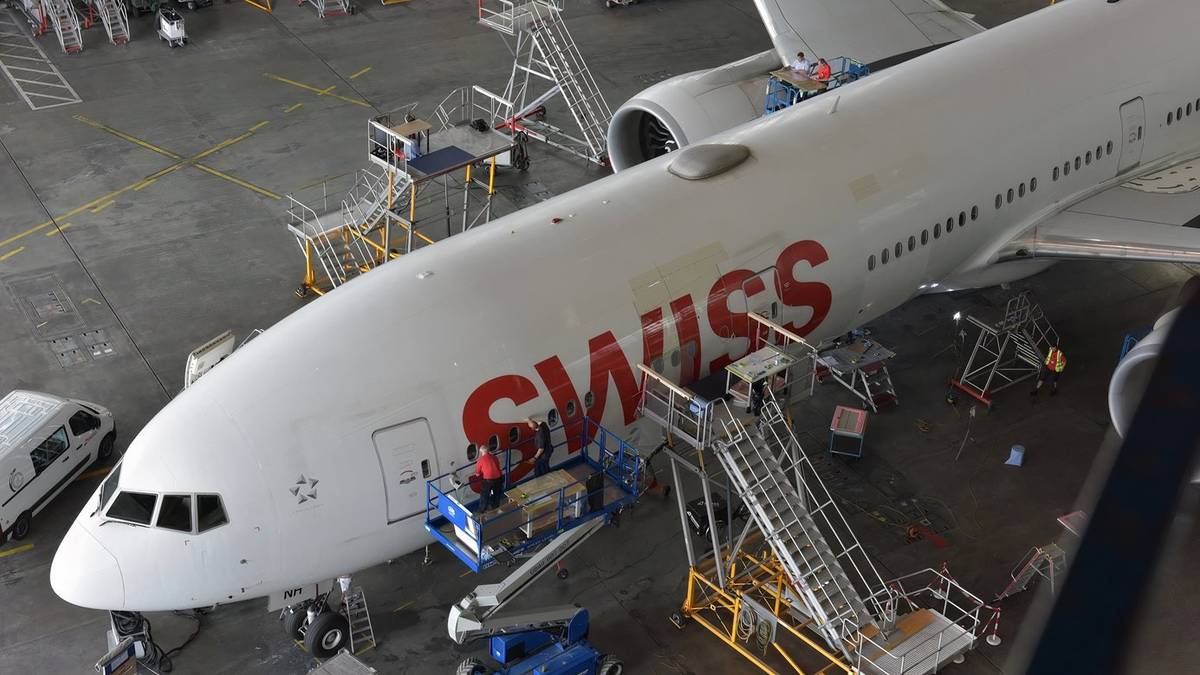
SWISS' Entire Boeing 777 Fleet Now Has Shark Skin Technology
SWISS saved more than 2000 tonnes of kerosene with the new technology in the last year alone.
Simple Flying
139 points · by belter · 2y ago · 85 comments
Anyone knows how long a airplane has to fly to be written of?
It's far less comparatively strong under compression, which seems to have been the principle failure mode of the now-permanently-submerged Titan.
The failure modes of explosive vs. implosive failure are also relevant. High-pressure implosions tend to collapse the entire hull, whilst so far as I understand, explosive failure, particularly at the relatively low pressure differentials of air and space flight, tend to be localised, and the fibre-reinforced nature of composite materials should reduce damage to the neighbourhood of the initial failure point in many cases. Implosive failure needn't actually penetrate the hull so much as crease it, a mode which CF handles poorly respective to the application.
Hence sci-fi horrors is like getting sucked out into space through a pinhole.
yes
> so metal oxidation isn’t an issue
no. It's not rust, but that higher pressure air can hold more water at the same relative humidity. The higher pressure air is achievable because carbon fiber has higher tensile strength per weight.
Airliners are required to do different checks at different stages, and the big one costs millions of dollars and requires them to basically disassemble and rebuild the plane. They even may have to remove the paint to check the hull for issues. Industrialized nations generally will only do this a couple times before the cost is more than the jet is worth (I think this is generally around 20,000 cycles, depending on the plane) then they sell them to a third world airline who doesn't have as strict a regulatory scheme. Even then, they generally live on for quite awhile, our regulatory scheme is designed to get as close to zero risk as possible, not to be economical, and it's hard to argue with the results. This is one of many reasons why there are an order of magnitude more crashes in the developing world, though even still safety is high relative to almost anything other than first world commercial airlines.
... mechanics could count on tell-tale build-up of nicotine around cracks as air escaped from the passenger cabin when the plane pressurized after lift-off."
https://www.upi.com/Archives/1988/05/27/The-recently-imposed...
I wonder if it could be made significantly worse. Leg room has been reduced overtime as far as I can tell. I’m 198cm, and it’s actually hell. I probably need to just pay more and go nearer the front, however this would only solve the legroom problem. The seats are too low and aren’t even close to supporting someone tall. I’m in NZ so everything is far away, and 18+ hour flights are actually awful.
I’m flying on an A380 in a few days, that will be interesting experience after only flying long haul on 777s in the past few years
Sure, we'd expect certain engineering things to get cheaper over time, but you can also see why some luxury touches got phased--or rather priced--out. :p
I suspect that pressure hull and wing spars experience the greatest loading and fatigue, and may be differentially influenced by overall flight time and takeoff/landing cycles.
The criteria might have changed since that incident.
Maintenance schedules are based on hours. Pilot experience is also logged as hours.
Supposed these panels were $100k/plane.
Jet fuel costs $0.36/lbs and a 777 burns about 30 lbs/nm in cruise. Suppose a 777 averages 14,000 nm/day. That's 420,000 lbs/day or $151,200/day. 1% savings would be $1,512/day, so the break even point would be roughly 2 months and would be profitable from then on. Suppose a 2 year lifecycle. That a savings $500k per year per plane.
Put a little more thought and data into your comments if you would be so kind.
Worth doing for the environment even if it's cost neutral probably.
The ROI appears to be 2 years. Considering the application is relatively easy, this looks like a good deal for airlines.
I've spent a few minutes looking for imagery of the film itself, sufficient to show details. There's surprisingly little, and I suspect the manufacturer doesn't want visual details of the skin itself available.
There's a schematic in the link below, which also shows the contrast of the AEROShark film to actual shark skin. The film is more grooves than scales, for those curious.
<https://swiss.newsmarket.com/english/press-releases/swiss-ad...>
While it's at this point obviously tested and proven to work, I wonder about the size of that texture in relation to the texture on actual shark-skin, and whether they are working at similar Reynolds numbers.
That makes it a tiny airline in comparison to others. For example Lufthansa group (which Swiss is a part of) has 98 wide-body aircraft. Competing Air France group has 165. The US is similar, Delta has 164. The Middle East is on another scale, Emirates has 249...
Still a nice innovation, but as a headline "Lufthansa group tests shark skin on 12 Boeing 777s" would be more realistic.
Each 777 can carry about 150 ton of fuel.
So they got about 15 fill ups free
No, It says a week in the article.
“Each aircraft takes about a week to have its AeroSHARK film applied, which requires high-precision workmanship from our personnel.”
I guess Swiss is Lufthansa's test before rolling it out to the rest of the group's brands.
I'm not going