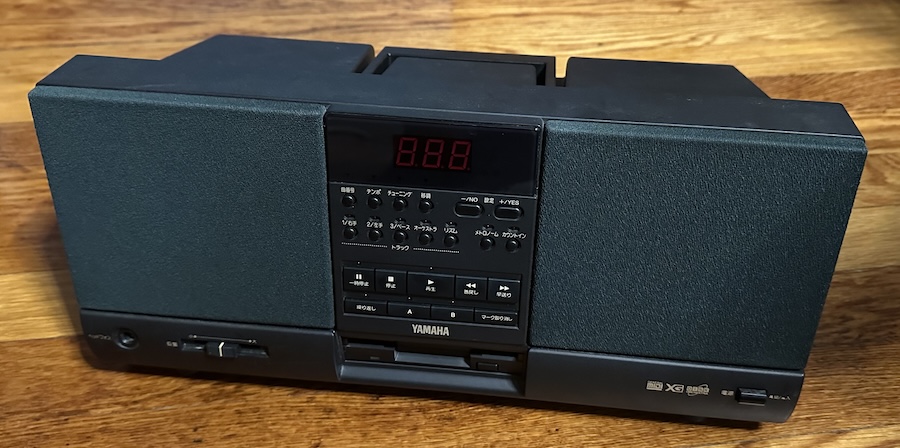
A Floppy Disk MIDI Boombox: The Yamaha MDP-10
Longtime readers of Nicole Express might know that I dabble in playing the organ. But sometimes I want to play with sounds that don’t have the organ’s defini...
nicole.express
132 points · by zdw · 2y ago · 32 comments
For less than a higher end Sound Canvas, you can get a real professional synth with a much bigger and better sound ROM, better DACs, better effects, etc.
I don't think this is a huge problem though, waveforms on sound ROMs are normalized so their peak loudness is as loud as she goes, no matter what the synthesizer. Even Sound Canvas models have different sound ROMs over time, and Gravis (and later, Creative et al) shipped enhanced GM sound fonts as well. I just like instruments to sound more authentic. I understand though if people want that Roland Sound Canvas sound too, or MT32 even. MT32 still can't be properly emulated. I own the real deal and it sounds much better than MUNT. Hats off to the MUNT team but like most (all?) software emulations of hardware synthesizers, something is missing.
[1] https://usa.yamaha.com/files/download/other_assets/7/2172427...
General Midi specified a set of instruments and standard program values to select them. For example 0 (or one depending on where you start counting) is will be a piano. Just as pianos vary in timbre, so can the instruments among various GM devices.
So I value the MT32 as an historic technology culture enabler, rather than as a sonic treasure.
That being said, I should run mine through my guitar pedalboard and see if it can be made to sound cool. :-)
I bought a Roland SCC-1 [1], and fell in love with MIDI. It was basically a CM-300 in a PCI card. I could program music that sounded like it was coming from a Roland keyboard. Such good memories.
But like you, I also was not a fan of FM produced MIDI, and that was only exacerbated by the SCC-1.
Soundfonts made it possible for games like FF7 to sound identical to the PS1, which was miles ahead of FM MIDI.
The MT-32, from what I understand, was based on the D-50 series, which means in theory it should have had access to unique patches like DigitalNativeDance. The problem with General MIDI is that it limited patches to the lowest common denominator, so even if a ROMpler had the potential to make interesting sounds, composers would stick to the generic ones for compatibility. I think it's no surprise the Sound Blaster (with CD-ROM interface) won over General MIDI in the end, because that way composers could record on professional equipment and everyone would hear it the same. It's too bad that it also ushered in the era of "game music" just being orchestral scores, pop music etc.
And on top of that, DigitalNativeDance is an outlier. It was (for its day) such a profligate use of ROM that it's not even representative of what a D-50 could do, in general.
Not that this contradicts your main point about GM constraining the choice of sounds.
If a game really needs to have a 'true' synthesizer it's easy enough to make use of a good software emulation now.
However, FM synth on PC sound cards, IMO, sounded pretty awful. I would prefer 8-bit NES synth over that of PC synth. E.g. while I do have some nostalgia from the Canon.mid file, I still thought it sounded relatively bad, compared to NES or SNES voices.
I felt the same about the Genesis, which I think used similar synth to older PC FM synth. I always felt that the SNES voices (or even NES 8-bit) sounded far better compared to the Genesis.
But ack this is subjective.
You clearly haven't tried Kerrygold's Dubliner cheese, then ;)
Compared to how many people, in many countries, use cheese, this sounds like an audiophile complaint.
Sure, yes, for tens or hundreds of millions of people, cheese is just cheese and a medium cheddar type cheese is interchangeable with any other in any recipe.
Similarly massive world-famous tracks, and entire music genres, have been built upon the built-in preprogrammed rhythm tracks of a few cheap 1970s Japanese home keyboards. Whole types of music where nobody involved can read notation, or play a chord, or possibly play an instrument at all.
In the light of this, I found this comment elitist and snooty and patronising in the extreme, TBH.
Of course you can make good music around super limited basic sound samples. To deny this is to deny arguably a double-digit percentage of all popular music since the 1960s or '70s.
Given that, why would it sound worse than any other means of triggering the same instruments?
Was glad to see this already here. Never before - or since - has the Tulley Toggle found a more appropriate use.
Or as he is in 2025, he saw everything keep on changing due to the ripple of his disruption of timeline.
Or as back2future postulate it is a different future and hence back to the speed of light issue.
Hard.