421 points · by janandonly · 2y ago · 216 comments
The bill could not be passed on Spain’s presidency. The presidency is now on Belgium and Stasi-fans are trying to get this bill passed again, hoping not to cause too much noise this time.
The text of the bill was modified a bit, and this time they added an exception, though
- Politicians and police are not subject to monitoring, only ordinal citizens messages’ should be wiretapped
https://european-pirateparty.eu/chatcontrol-eu-ministers-wan...
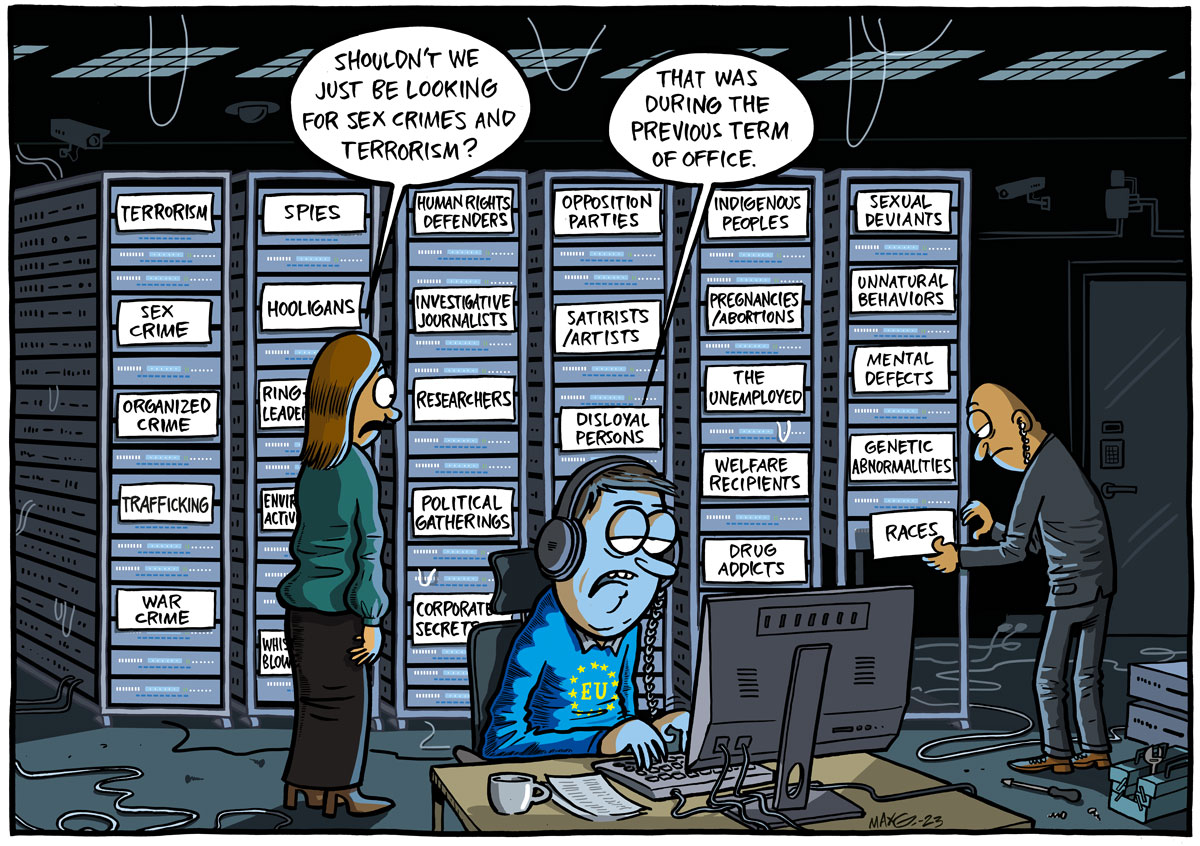
The inversion of values is frightening, politicians and police should be among the very few under scrutiny.
Of course, in 1984, their instruction manual, the top members of the party can turn their telescreens off.
Kind of funny to hear people refer to 1984 these days. We're so far past it now, and we did it to ourselves; giving up location data for maps (and mobile phone function for that matter), a Ring doorbell on every front door, participation in social media, etc.
But somehow it's all OK, because it's corporations instead of the government (a blurry line itself) on the other end.
No we are not, you are not forced to have a smartphone, your are still allowed to have sex and most democracy's don't torture you for speak against it.
Don't just fixate on the surveillance aspect in 1984, there's much much more in the book.
Most people don't know that we did it. They still happily click on "accept all" and blame it on EU to need to do that. They don't know what the heck is that, and why they should understand what's written there.
When they are asked cleanly, and simply whether they want to share their data to thousands of shady companies, about only a quarter choose yes. That's why Facebook had to force everybody in the EU to choose between paying and accepting it.
For me it was more like 2014. Though it was going on long before this … I think it was the pandemonium and ultimately the widespread acceptance … that sealed the deal!
Isn't that -again- a direct violation of the charter of fundamental rights (article 20)? (all are equal before the law)
Imagine living in a Bizarro world where the law said that private citizens could not be tapped without a warrant and probable cause but politicians and police must be surveilled to mitigate corruption.
Wonder how low would be the bar to become a politician. Signing up for a local council elections definitely makes one a politician, right!
Animal order, at its best.
It is he same abusive pattern of lying used to manipulate people against the right to self-defense agains a tyrannical government through the supreme law that prohibits the government from infringing on the people's inalienable, God given right to the means of self-defense, as enshrined in the Second Amendment to the US Constitution. "Think of the children" the tyrants wail as they demand you give up your ability to defend yourself against the bombs they threaten to use against their own population that refuses to submit to the desires of the ruling class and they are also busy slaughtering children by the tens of thousands.
Is this language necessary?
They're stasi-fans? Why bother listening to them?
I'm sure the motives were good - sometimes it's like finding a needle in a haystack, and it saved lives back then.
But you have mass surveillance, you can go through every hay in the haystack. Yet likely they won't. They'll settle on a middle ground with these outdated methodologies, and combine it with AI/data, to create some form of data-driven astrology. Someone will be inspired by CSI to ask AI to blow up a blurry photo, and AI might just hallucinate it. There will be experts out there who would oppose this, and these could be shut down by their bosses, the politicians who don't understand how it all works.
The Macdonald triad detects the worst criminals, sure, but it mainly detects victims of abuse. Privacy isn't important to the privileged groups; but it's a level of protection for the innocents who could be profiled wrongly.
That’s such an apt description of the junk science that’s going to get justified by AI.
There could be one-click-implication on a target person.
Polygraphs are still heavily used in US even though everyone know it's anti-scientific bullshit.
Really it’s internal threat security vs external threat security.
Measures to reduce personal security also reduce the security of the traditional armed forces.
1) The armed forces use most of the same networking software and hardware as civilians. They also rely on the same protocols.
2) In a total war scenario, like Ukraine, civilian communication infrastructure becomes military communication infrastructure. See soldiers relying on phones for communication and apps to aim artillery.
3) The vulnerabilities that get built into civilian communications are obvious cyber warfare targets.
The framing of privacy vs security tricks the traditional armed forces into thinking that they have the same interests as the NSA.
...
"... Franklin was thus complaining of the choice facing the legislature between being able to make funds available for frontier defense and maintaining its right of self-governance--and he was criticizing the governor for suggesting it should be willing to give up the latter to ensure the former. ..." [0]
[0] https://www.lawfaremedia.org/article/what-ben-franklin-reall...
So especially "1)" won't be true. Yes, right now they may be using same or similar things, but then after the new regulation they would be using superior stuff, problem solved.
"3)" is considerable because that's true, whatever difference there is in comms security, adversaries will have the same power over the civilian comms as their own government. Right now of course this is the case already, but especially after regulating it, will it become prevalent. I think governments are fine with this in general, though, which I deduct from the lack of countermeasures to it.
In reality, encryption is power, and the more power individuals have, the less power those have who want to control individuals. Everything else is smoke and mirrors, like the classic "think of the children" argument.
Will there be cost implications when adding a secure layer?
Will the secure layer add risks to the project? Governments are already bad at delivering defence projects on time, will the extra complexity make it worse?
How do we know which layers are insecure? Will there be a published list of vulnerabilities that need to be mitigated by the military?
1. End-to-end encryption does exist today (and it is deployed at scale). There is no going back.
2. There is no middle ground: either it is end-to-end encrypted, or it is not. "Sniffing" encrypted messages is not a thing, period.
3. Make all the laws you want, criminals will always be able to use end-to-end encryption. Those laws will only prevent honest people from protecting their communications.
I would guess that the largest deployments of end-to-end-encryption today is Whatsapp and iMessage by a quite large margin. E2EE for "real people" is provided by the grace of two massive publicly traded companies who have to follow local regulation. If Apple complies [1] with dubious requirements in China, I wouldn't bet against them doing it elsewhere either.
Sure, we have Signal, but how many normal users would start delving into side loading if the application simply was banned and not allowed on the marketplaces? We can always use PGP-over-whatever, but that's an argument for 3) - not 1).
I think politicians / police (and honestly many normal people) believe that the government have the right to do lawful interception of private communication and see E2EE as a step to far. The US has been wiretapping phones for a century already.
We as privacy arguers have a pedagogical challenge of explaining why regulation like this is bad and not equivalent to 1930's style phone wiretapping.
[1]: Chinese iOS users have their iCloud data (that for the vast majority includes the decryption keys) on Chinese servers, subject to the Chinese legal system. For the rest of the world the situation is the same, but s/China/U.S, which is arguably problematic as well.
The point is that policy makers need to accept this as a reality: they cannot wish E2EE did not exist, that ship has sailed long ago.
At lot. Police concocted a fake chat app and somehow convinced their targets to side load it. By all reports it was a wild success: https://www.theguardian.com/australia-news/2021/jun/08/anom-...
WhatsApp has 2 billion users, Signal 40 million and An0m had 12k. Legislation like this will make E2EE communications unavailable to everyone but the most motivated techies and criminals.
Yes, but ... it's also never truly end to end encrypted as humans can't do encryption in their heads. Thus there is an analogue hole at both ends. All you need to is install a spy app at the end points to access the unencrypted version.
And lo, I present to you the Australia "Assistance and Access Bill (2019)". It demands that companies that develop the endpoint software shall "assist" them in writing spy apps that are undetectable. It also demands those same companies shall use their "auto security patch" feature to silently install those spy programs on the targets devices.
I have no idea what the EU is proposing, and yes I agree if they are proposing we all use "breakable encryption" then it won't succeed for a whole host of practical reasons. But, I suspect they are smarter than that. And if they adopt the Australian solution, then while:
> 3. Make all the laws you want, criminals will always be able to use end-to-end encryption. Those laws will only prevent honest people from protecting their communications.
is true, it's also moot.
There is a way around the Australian version because it insists the government shall not introduce a "systemic weakness", which translates to "you shall not break the security our society depends on". Because of that they are prohibited from installing their spy software on everyone's devices; all installations must be pre-authorised by a court. That in turn means the software company must be able to target the targeted individuals devices, and only those devices. That's simple for the likes of Google, Microsoft and Amazon of course because they insist you create an account.
So the ways around it are:
1. Use open open source software, because the anonymous security updates make impossible to target someone. This is very difficult to do for most people.
2. Use a Chinese phone. They have been banned from using the closed versions of software, so they base their products on something like AOSP. You will probably get spied on by the Chinese government instead, of course - but if you live in the west why would you care? This is the easy one to do, so that's what will probably happen.
I find the ironies of the directions these proposals take us in absolutely delicious.
Well the article is about efforts aiming at weakening encryption, and my comment is about that.
> is true, it's also moot.
Anything is moot if you completely ignore the context. The article talks about policy makers who want to alter encryption in such a way that they get more control over it. My point is that they need to understand that they cannot get this kind of control the way they advertise it (with "privacy-preserving sniffers").
Of course you can say that anyway the NSA can hack you, but that's off-topic here. My point is that politicians need to understand the basics of how encryption works, such that they can think properly about propositions like that.
Even for politicians, there is a big difference between "privacy-preserving sniffing" and "adding a spyware in every device". The former is impossible, the latter is possible. But many politicians wouldn't vote for the latter.
So I agree it would be great to reduce the number of third parties for many sites. But I don't think this is something that can be fixed just by slapping a bit of regulation on it.
As a large percentage of all internet traffic is going through Cloudflare, they could spy on us or let $GOV_AGENCY spy on us.
There is no evidence and Cloudflare is (or at least used to be) somewhat of a HN darling, so it's perhaps not so popular to say, but I wouldn't be hugely surprised if turned out PRISM 2.0 involved them.
It is useless if the spyware can scrape screen, log your keyboard / etc
This judgement requires assuming an external position that "knows better", which is inherently incompatible with democracy. Voters can't be a danger to democracy by definition, even if they vote to end democracy and elect a strongman, well, that was their democratic wish.
I think democracies usually die because of the incompetence of party leaders, policy advisors, and primarily elites. Often the public tries to pivot away from that incompetence by voting, but always get politicians backtracking on their promises (and have no resource, given most not-exactly-direct-democratic election systems, to punish them until the next elections, and not for the things they backtracked or failed on - they had to do it for everything).
And there isn't much choice in representatives. Wish we had more choice than Trump or Biden but here we are again after 4 years.
There is little churn in Senate as well.
Supreme court justice positions are for life.
We're not that far from the ways of Monarchs. The powerful will guard their power.
The scientists know better than you.
No scientists were harmed (or involved) in this farce.
Intentionally compromised encryption is going to be enormously appreciated by North Korea, Iran, China, and all the others one would normally want to keep from looking at secret data related to finances, personal communication, military secrets, industrial R&D, etc.
Countries need to get their priorities straight on national security. The enemy is outside of their country, not inside. And they don't play by the rules, generally.
The purpose of a system is what it does, not what it consistently and persistently fails to do.
Far too long and far too much, people have assumed a good will of our governments because we have intenionlaly been conditioned to accept with blind faith that "democracy" is a universal "good", never asking oneself why the tiny psychopathic ruling class would be such vehement proponents and rabid advocates of "Our Democracy"™, a supposed rule by majority. It appears that not everyone gets as suspicious of things that contain inherent fundamental contradictions.
The type of politics that drives this is older, technically challenged politicians (aka. idiots) responding to pressure from minority groups whining about pornography and other things they don't like. The priorities seem to be appeasing groups like that in order to secure the next election cycle. By essentially sacrificing security, which they clearly have a limited understanding off.
Never attribute to malice that which can be adequately explained by stupidity. Some countries don't get their priorities straight because they are being led by idiots. It's indeed a system failure. The solution is wielding a giant clue bat and causing relevant stakeholders (military, financial sector, etc.) to wake up and push back and doing something about it.
The reason cryptography is still legal in most civilized places is that we've had a few rounds of that over the past decades.
Knowledge is a deadly friend
If no one sets the rules
The fate of all mankind, I see
Is in the hands of fools
_King Crimson - Epitaph_Knowledge and information need no rules, but humans do.
> Stefan Hector, a representative of the Swedish Police Authority, said that “a society cannot accept that criminals today have a space to communicate safely in order to commit serious crimes.”[0] A week later, it was revealed that the Swedish police had been infiltrated and were leaking information to criminals.[1]
[0] https://polisen.se/aktuellt/nyheter/nationell/2024/april/eur...
[1] https://www.svd.se/a/8qwGbx/granskning-poliser-lacker-till-g...
For leaks the hackers are always to blame, never the poor security of the companies.
We don’t yet have a firm grasp on how to handle the issue of extending privacy into these shared spaces. There just seems to be two unreconcilable polar extremes at the current moment without a clear path forward.
At least in the United States it could mean needing an amendment to the constitution as the 4th doesn’t properly cover these protections.
This quote from the article brings that into stark relief: "we do not accept that there need be a binary choice between cyber security or privacy on the one hand and public safety on the other. Absolutism on either side is not helpful"
Clearly, Europol misunderstands the fundamental, mathematically binary, nature of encryption as man-made "absolutism" that could be dispelled with just enough laws and warrants and wiretaps.
You can’t ban the chemistry of creating alcohol from homegrown grapes but you can ban and enforce against the practice well enough to limit bootlegging. The average person buys from the state regulated dispenser regardless of the possibility of doing otherwise.
The same COULD (uh oh, about to be misread and downvoted into oblivion) be said for cryptography, where bans of consumer friendly and easily available messaging applications would be similar to curbing bootlegging.
Of course the practice would continue for those who are capable but with consequences.
These are issues that must be reconciled. Hiding behind numbers will not work, as we are seeing play out in front of us, so we need constitutional protections.
This cannot be true, as we've seen time and again with cryptography. Wherever the laws of people collide with the laws of mathematics, the laws of mathematics win.
Unfortunately, in the US there is no bottom line constitutional protection for the (actually or credibly) innocent.
Procedure pre-empts innocence.
This impacts everything from permanent property confiscation based on subjective declarations of “suspicion” without any criminal indictment [0], general crime [1], to execution of the likely innocent [2].
Without a fundamental right for the innocent to have convictions vacated, after they are revealed to be highly suspect, procedure pre-empts information, even when the case for innocence is widely considered credible.
Executing the (credibly) innocent can even become a strategic politically advantageous performance. [3].
Constitutional protection of the incident would compel the courts to address catch 22 problems for the credibly innocent directly, providing a mechanism for relief when the gears of formal justice otherwise create no balanced recourse.
[0] https://www.npr.org/sections/thetwo-way/2014/11/10/363102433...
[1] https://en.m.wikipedia.org/wiki/List_of_wrongful_convictions...
[2] https://en.m.wikipedia.org/wiki/Execution_of_Nathaniel_Woods
[3] https://www.endfmrnow.org/arkansas-governor-denies-clemency-....
—-
Telling: what government is also pushing for all internal deliberations, materials and search queries, databases and algorithms leading up to prosecutions to be archived for the defense? Or to open up comprehensive surveillance systems search to the defense team?
Centralizing power and information in a way that supports convictions, but not defense, is a recipe for increased motivated, convenient, and incidental injustice.
There is no recourse against "procedure". The closest option was to raise it with the Police's internal affairs, but were told that's specifically for officer misconduct. And, with the exception of one inflammatory bitch, the officers were all polite and friendly (as they rifled through and took my equipment).
There's no ... anything ... that caters to the misconduct of the system.
(It's not surprising to a disinterested observer, but the feeling of powerlessness against such an injustice made it surprising to me).
HTTPS will only prevent spies observing or altering your communications; it does not prevent the service that you are communicating with (or whoever owns them now) from adding malware, etc.
I'm still flabbergasted that anyone supported danny masterson. That the head of an anti-csam org did it is just astonishing to me.
Is there currently a way for us, EU citizens, to vote those Brussels ghouls out of power? No, or at least none that I know of. Is this how a democracy is supposed to work? Certainly not.
Which is to say that events like this one should make most of the people see that the EU and the European Commission are certainly not democratic and they certainly do not represent the European electorate, because, as a matter of fact, the European electorate has no power over those people. But the propaganda still coming from those circles is too powerful, so, here we are.
They don't know how to read, and these politicians want to give them more books.
I've mentioned the below a few times on HN because, for me, it was a traumatic incident with an outcome that was essentially an unknown for 8 months of my life: My house was raided by police for suspicion of distribution of CSAM.
Skip-to-the-end: They took about $10k worth of my homelab gear, had it for 8 months, and then I was told I could come and pick it up. No charges, no nothing.
There are pages and pages of things I've written to document this incident, these are a couple of notables:
They didn't know to expect there to be children in the house. At ~7am on a school day. That's the amount of additional investigation they do into the 'subject' prior to raiding their property. ie. Fucking None. I have two teenaged children that have impeccable school attendance and academic results that I'd assume would be easily accessible to law enforcement, had they cared to do any background research.
This was a traumatic event for MY CHILDREN caused by quote-unquote Law Enforcement.
They said the raid was based on information provided from an overseas (I'm assuming US-based, I'm in Australia) source (private company, law enforcement, intelligence, I have no idea) that identified my household's street address via an IP address, and this "evidence" was gathered over a number of years.
They asked my eldest "does your dad use your computer", he replied "no" (truthfully), and they didn't take it, didn't even look at it. I pointed out a laptop on the breakfast table that I said was was my wife's (truthfully) and they didn't take, didn't even look at it (as far as I recall). I specifically asked if this was about "me, personally" (since they showed no interest in my wife's laptop), and they repeated their (what became somewhat of a mantra) of "this specific address, not your neighbour's address, this address". And yet they had no interest in computers identified as not belonging to me.
One of the first things they asked me was "do you use a VPN?" I answered "no". Which was true then, and is sure-the-fuck not true now (split routing, the fucking works) - as a learning outcome, to protect myself from further blind police incompetence.
As part of the phone call when I received the "good news" that I could come and pick my shit up (I guess they came out of their way to pick it up from my place, I had to return the favour), the detective in charge of the investigation gave me the impression that she thought that she / the system couldn't be wrong about me. She made a point to say the following three things:
- Use of virtual machines is suspicious
- MEGA is almost exclusively used for CSAM and they found evidence that I'd downloaded things from MEGA (I think I may have used MEGA to download android ROMs)
- They found "TOR" installed on one of my computers
The last one. Where do I start? It's so incorrect an understanding that it was a 'cherry on top' data point that I didn't really need to confirm how hopelessly out of their depth law enforcement is with technology.
To repeat: They don't know how to read, and these politicians want to give them more books.
One of the ironies is (because I've got this sort of sense of humour) if I was living in an actual panopticon, I'd have easily been exonerated as I'm far too boring a person without enough spare time to engage in any of that behaviour.
In addition to the above, my better half is a teacher. Teachers in Australia have a "Mandatory Reporting" responsibility to report possible cases of child abuse based on their observations as a teacher.
The suicidally depressing thing about it is, the organisations responsible for visiting the homes and families that have been reported are so under-staffed and under-funded that they only have the time to investigate cases where the child is in immediate life-threatening danger.
Combine the two above anecdotes together and you've got a society that's gone wrong and is still applying increasing pressure to the accelerator.
Politicians calling for laws against encryption who are not also calling for massively increased budgets to child protection organisations are pushing an agenda that has nothing to do with real, actual protection of children, and they should be called out.
I have also dabbled a bit with Tribler which, as it turns out, has built-in functionality similar to that of a tor node. I have a vaguely niggling suspicion that Tribler is a honeypot, but it's providence appears so wholesome, and it's been around a long time.
> Talked to the police
I think this is a lesson in what not to do in the future. And that equipment they took? Consider it all 100% compromised.
In Australia, they can force you to reveal the password.
>Failure to comply with an assistance order is a criminal offence. When the law was first enacted, the maximum penalty was 6 months imprisonment. However, authorities have since raised the maximum penalty to 2 years behind bars.
https://www.sydneycriminallawyers.com.au/blog/can-police-dem...
and apparently it may not apply to phones: https://www.theguardian.com/australia-news/2019/aug/19/feder...
either way, remind me to never travel to australia
Definitely appreciate the depth of this - thorough research was definitely done. Secondly, I’m definitely quick to blame the US policies for a lot of things.
However, this article is mostly about casting shade on the US about the EU’s mass surveillance. I don’t think anyone is to blame for what the EU does other than the EU, and for sure attacking the US isn’t going to prevent the EU from doing this.
I wonder if there is a better way to go about bringing awareness and taking action?
Well, some charade aside, the US usually says jump and EU politicians say "how high?" - the EU population be damned
However, if the EU is collaborating or even aligning with the US on intel gathering, it’s pretty far outside their openly stated mandate, afaik. Especially since the UK left, who were the most hawkish on mass surveillance, it’s creepy to think there are clandestine efforts to push for aggressive monitoring and even worse aligning with the US without oversight. If Mullvad is right, it’s also an absolute failure of MSM to not properly cover such geopolitically crucial issues.
> the EU population be damned
For sure it’s a concern, but overall many/most Europeans think the EU is a net positive today. Things have changed a lot since the crises of Greece etc. And with increasing geo-political tensions (Russia in the short term and China in the medium term), there’s an argument to establish stronger security and military efforts independent of US-led NATO, which have quite different goals.
I think this understanding of the EU's behaviour may be insufficiently cynical. There's one pattern in politics that is very hard to not see everywhere once you have been primed to, which is "high + low against middle": the faction that is in power allies with one(s) that is so far away from power as to never become a credible threat to it, in order to put the squeeze on a third faction that is actually a serious contender for the position of the first.
A canonical example that's sufficiently historical that it hopefully won't be too incendiary was the practice of early communist states to elevate individuals of peasant/worker background into positions they were unqualified for, as in the famous case of Lysenko - here, high (party brass) supported low (peasants/workers) at the expense of the middle (bourgeois intellectuals, represented in that particular instance by academia, who could have been organised and experienced enough to orchestrate a palace coup).
Within the US, the federal government/military/foreign policy complex and tech-based New Money are widely recognised as two distinct power centres, with it at times being unclear if the former can actually fully dictate terms to the latter. Under normal circumstances one would expect the former to champion the interests of its industries on the international stage, and indeed the US is known to have very sharp elbows in this regard (from the famous oil wars in the Middle East via the slightly less famous fruit ones in Central America to the backdoor arm-twisting in copyright matters). The picture for the tech industry looks quite different - far from starting a war or even merely successfully lobbying the EU to drop its regulation, the USG is looking away and whistling. As it happens, out of the four industries mentioned (oil, fruit, media, tech), the tech industry happens to be the one that is by far the most autonomous and misaligned with federal government interests (Apple randomly grandstanding on privacy, everyone wanting to keep their Chinese supply contracts and market access, general abundance of politically engaged progressives and libertarians...). Wouldn't it make sense if what happened was that the USG (high) actually gave the EU (low) a tacit go-ahead for their anti-US-tech measures, and perhaps even indicated to everyone involved that they may let them crack down even harder if the tech industry (contender for high) keeps falling out of line?
There's nearly nonexistent political accountability in the EU. If the EU decides something, there's really no effective way for its citizens to do anything about it even if it's a fairly unpopular change. There are too many layers of indirection between the elections and the decision making to hold the responsible politicians accountable to the voters.
This in turn makes the EU extremely susceptible to lobbying from special interests inside and outside of Europe.
More so than these campaigns, big reason why these laws have been hard to push through is probably Germany and their strong influence in the EU. Since the Germans still have a living memory of the DDR and the Stasi fallout made a significant impression in the public conscience, being seen as moving back in that direction is a really tough sell. 1984 is fiction, the east germans lived that shit.
It's not about protecting the children. They actually love it when children and teenagers are sexually assaulted: that gives more fuel to put in place a totalitarian state, using the pretext of protecting the kids.
It's the same everywhere. In France many crimes are committed by people Macron promised to deport: illegal migrants already caught for a crime. He said, before being elected, that he'd deport 100% of the illegal migrants committing crimes. Instead of that socialist judges are constantly releasing these dangerous criminals in the street.
But the actual victims? And victims' families? Zero concern. None.
And if a victim dares to fight back and should hurt the illegal migrants: then the whole power of the state falls upon him and he'll get an incredibly harsh sentence.
The world is upside down: politicians do not get to have their communication monitored, victims are sent to jail if they dare to defend themselves.
And why do they want to wage their war on encryption? To fight me. Because I hate the EU I live in and they want to silence me. And all those like me.
The tyranny of the government is a very real thing and anyone longing for more government and more government spending should look deep down in his heart and conscience and wonder if it ever did any good for a country to have ever more government.
Meanwhile people shall hate on the libertarians, calling them names ("ladder pullers"), but I'll tell you this...
Libertarians would never ever vote complete and total surveillance of citizens, while protecting the politicians.
But do not worry: the world you deserve for hating on libertarians is coming to you soon enough.
I'm with you on the "think of the children" argument. That is 100% what's happening, and I think that it boils down to how the human mind works, particularly on how putting out a fire feels much better than preventing the same fire.
"Libertarian" means a lot of things, so it's hard to criticize, I especially struggle with the closing thought. Who are these libertarians that we should support, in order to have a better world?