The curious case of the missing period
When Simple Mail Transfer Protocol is not simple
tjaart.substack.com
531 points · by the_real_tjaart · 2y ago · 193 comments
If I wanted to root cause this, the real problem is right there. Implementing protocols correctly is hard and bugs like in the post are common. A properly implemented SMTP client library, like one you would pull off the shelf, would accept text and encode it properly per the SMTP protocol, regardless of where the periods were in the input. The templating layer shouldn't be worrying about SMTP.
There is a multitude of classes of errors and security vulnerabilities, including "SQL injection", XSS, and similar, that are all caused by the same mistake that this case of missing period was[0]: gluing strings together. For example, with SQL queries, the operation of binding values to a query template should happen in "SQL space", not in untyped string space. "SELECT * FROM foo WHERE foo.bar = " + $userData; is doing the dumb thing and writing directly to SQL's serialized format. In correct code (and correct thinking), "SELECT * FROM..." bit is not a string, it just looks like one. Same with HTML templating[1] - work with the document tree instead of its string representation, and you'll avoid dumb vulnerabilities.
So, if you want to avoid missing dots in your e-mails, don't inject unstructured text into the middle of SMTP pipeline. Respect the abstraction level at which you work.
See also: langsec.
--
[0] - And therefore should be considered as a single class of errors, IMO.
[1] - Templating systems themselves are thus a mistake belonging to this class, too - they're all about gluing string representations together, where the correct way is to work at the level of language/data structures represented by the text.
[1] https://genshi.edgewall.org/wiki/Documentation/xml-templates...
[2] https://zope.readthedocs.io/en/latest/zopebook/AppendixC.htm...
This is not universally true.
JavaScript has an amazing feature called tagged template literals which let you tag a string with interpolations with a function that handles the literal and interpolation parts separately. This lets the tag function handle the literals as trusted developer written HTML or SQL, and the interpolations as untrusted user-provided values.
Lit's HTML template system[1] uses this to basically eliminate XSS (there are some HTML features like "javascript: " attributes that require special handling).
ex:
html`<h1>Hello, ${name}</h1>`
There are similar tags for SQL, GraphQL, etc. Java added a similar String Templates feature in 21.
Be careful with that "never". A curious and persistent person might discover a bug in the implementation, leading to something like the Log4Shell issue.
The bulletproof way of doing this is working at the level of abstraction of your target language. With HTML, that would be a tree structure. For example, if your HTML generation looks more like:
["H1", "Hello, " + name]
--
[0] - I skimmed the docs of Lit, it seems there are restrictions on where interpolation can be placed, but I don't think they're actually building up the tree expressed by the static parts.
SMTP is an example of an unnecessarily complex design, and the implementation bugs reflect it. SMTP shouldn't be hard for someone to correctly implement by themselves (even though I agree that people shouldn't be re-inventing the wheel).
If it wasn’t a period, it would be something else & you’d have to handle that instead.
That's an incredibly reductionistic view of the world that's utterly useless for anything (including actually engineering systems) except pedantry. It's obvious that the level at which you include control information is meaningful and significantly affects the design of the protocol, as we see in the submission. Directly embedding the control information into the message body does not lead to a design that is easy to implement.
> If it wasn’t a period, it would be something else & you’d have to handle that instead.
Yes, and there are many other design choices that'd be significantly easier to handle.
"The first two bytes represent the string length, in big-endian, followed by that many bytes presenting the string text."
and an in-band signalling protocol:
"The string is ended by a period and a newline."
In the second one, you're indicating the end of the string from within the string. It looks simpler, but that's where accidents happen. Now you have to guarantee that the text never contains that control sequence, and you need an escaping method to represent the control sequence as part of the text.
You always know what the next byte means because either you did a prefixed length, your protocol has stringent escaping rules, or you chose an obvious and consistent terminator like null.
I understand that constraint, and it seems reasonable - but in that case, why not use a length prefix? That should be even more efficient than having to scan for a line containing a single period and nothing else.
But for SMTP libraries, that's often part of stdlib (Ruby, Python, PHP, ...).
That's why it's a best practice to specify protocols at a very high level (e.g. using cap'n'proto) instead of expecting every random sleep-deprived SDE2 to correctly implement a network exchange in terms of read() and write().
In Germany, where I work, it is usual at the end of employement to ask for a letter of recommendation ("Zeugnis") that lists the tasks performed, and how good the employee was. It is an important document, as it will typcally be required when applying for jobs. Obviously, no employee would accept a document explicitly stating "this guy is a lazy bastard, do not hire him", so there is a "Zeugnissprache", a "secret code" to disguise this information as praise. One part of this code is that a missing period in the last sentence means "please ignore everything said here, this guy is horrible".
How do I know? I let a lawyer check my Zeugnis after my last employment, and (I assume out of lack of care, as all my performance reviews were positive) the last sentence was missing the period.
This legend comes from the fact that HR people cannot be too explicit about the fact that you've been a pain in the ass (you could probably sue if it's too transparent), so if they have nothing positive to say they will commend your punctuality or something equally as mundane. It's not secret codes, it's like... "bless their heart", but in HR talk. Plausible deniability if you want to sue, I guess. "But it's a good thing, your honor! They were always on time!"
But in the specific german case, the code is not even that secret. This is a formal document with a very specific structure, and very standardized phrases. There is even specific software to generate the text out of performance ratings. Basically something like this:
- John was overal engaged: he is a lazy bastard
- John was engaged: he is OK
- john was very engaged: he is good
- john was always very and thoroughly engaged: he is very good
...sigh:
Secret codes as in "watermark-level omission of characters" are a myth. Lingo and jargon do however exist, and convey meaning in a particularly subtle way. They are shared and taught by culture, not by a secret handbook passed down from generation to generation. See also dogwhistling.
The goal is to protect the issuer, not to selflessly inform the recipient.
Gee, what could possibly go wrong?
You just use the mail program from mailutils or whatever.
Just from a point of view of deliverability, developing bare bones SMTP interaction over a socket is a nonstarter. You can't just connect to random mail exchange hosts directly and send mail these days. A solution has to be capable of connecting to a specific SMTP forwarding host (e.g. provided by your ISP). For that, you need to implement connections over TLS, with authentication and all.
Also, a slightly ironic thing is that cron already knows how to send mail. The output of a cron job is mailed to the owner. Some crons let that mail address be overriden with a MAILTO variable in the crontab or some such thing.
It's not a good reason, no--definitely not--but it's a real reason.
You can require it and it gets provisioned.
But the other thing is: Don’t vendor your dependencies. Those libraries you use need to be updated regularly and timely, and absolutely not “only as necessary”. If updates lag behind or are avoided entirely, bugs like this can be huge problems even when the upstream code has been fixed, for people who thought that they should update only when they, themselves, see a problem or need.
The alternative seems worse: your own application's stability is now at risk against upstream changes that could break your code. Sure, you might not get a fix immediately, but I'd rather know I'm making a change because I need a fix than introducing instability and additional risk that I don't want to subject myself to. "If it ain't broke, don't fix it."
(For apps, a lock file will do it too.)
https://chromium.googlesource.com/chromium/src/+/HEAD/third_...
(And surely you should have tests to verify all your own functionality after upgrading a dependency?)
I agree 100%.
Relatedly, escaping somehow seems to be a foreign concept for a lot of programmers, who wouldn't ever see the above situation and ask themselves "but what if I want to send an email with a line containing a single dot?" yet another large group of them finds it perfectly logical and easy to understand.
I'd be surprised if any significant portion of software developers learned anything like that in the last 30 years, at least.
SMTP https://www.rfc-editor.org/rfc/rfc5321#section-4.5.2
Also in POP3 https://www.rfc-editor.org/rfc/rfc1939#page-8
As soon as I printed them, the error was clear. My version ran to two pages and the good implementation one page. I had not been careful to clear the buffer before sending the data (mbufs don't you know).
This still cracks me up.
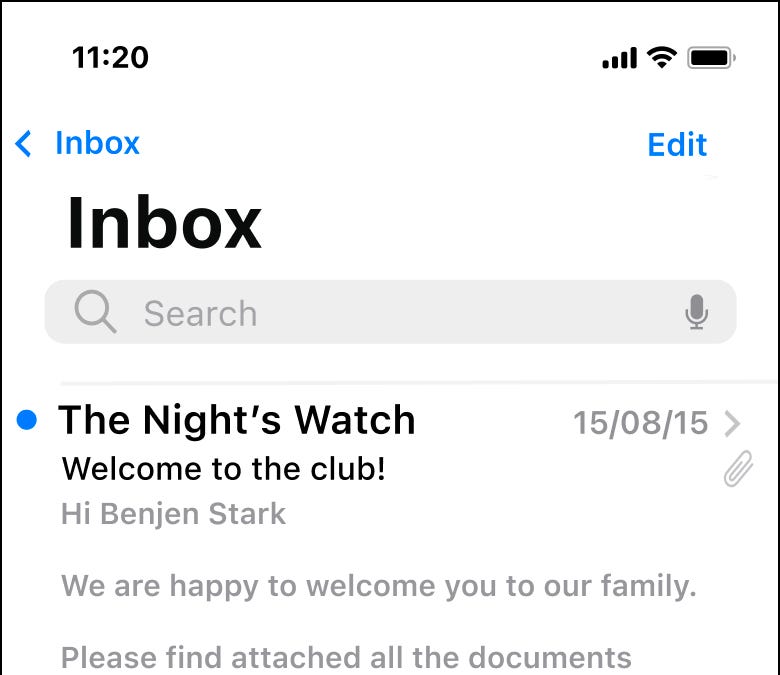
... lots of text ... <br>We are happy to welcome you to our family.<br>
the company is just blindly unaware to their minor problem.
While quoted-printable is supposed to have a max line limit of 78 characters including CRLF rather than 1000, email clients tend to be permissive.
The square brackets allow us to stick a port number on it: [ffff::0123:4567]:6301
As soon as I read the above, I knew the below would be the result.
> It seems one of our other teams haven't gotten around to patching this bug in their code.
I share your sentiment, thank you for reading.
[1] https://en.wikipedia.org/wiki/Wireless_Application_Protocol
[2] https://en.wikipedia.org/wiki/ColdFusion_Markup_Language
What the...
;-)
(-;
Maybe you're thinking of base64 encoding?
Other than the obvious moral that protocols should be implemented properly, the moral of the story is that all abstractions are leaky, and it will always be useful to understand the lower levels.
Of course if it was modern, different question.
Why is it implemented that way?
If a single period means end of mail then more than a period means it's mail data.
Why deleting the period in the first place? Couldn't they store one byte to check the next?
  .     Ends body
  ..    One period <--
  ...   Two periods
  .A    A
  ..A   .A
  A     A
there's a secondary issue here, why in the world would you auto split a monetary value across a numeric decimal indicator? why would you split lines at all for this use case?
So a message intended to be sent by an SMTP client:
DATA
Hello customer,<br>[978 characters] 27.00
Was erroneously formated into:
DATA
Hello customer,<br>[978 characters] 27
.00
.
The period after 27 will be removed. And this is how the html will be rendered.
Hello customer,
[Lots of text] 2700
so splitting 27.00 on the . becomes 27 00, because the CRLF is significant to the client.
you would want to split at whitespace, not at any other character -- unless you had a 999+ string of non-whitespace of course.
perhaps the author didn't know or didn't realize or thought it insignificant to his point that in addition there was a quoted-printable encoding, in which case i believe the trailing/mandatory CRLF can be made non significant for client rendering. personally i still would have split on actual whitespace. (well, i wouldn't have written an smtp client in the first place.)
And, they also state that the period disappeared because it was placed at the start of the next line when the split occurred.
From which one can deduce that they were doing the most basic "split" possible, splitting at the exact 1000 octet point, i.e. something like:
   if (length(line)>1000) then:
     line1=string_range(line,0,999)
     line2=string_range(line,1000,end)
   fi
> The maximum total length of a text line including the <CRLF> is 1000
ironically titled..
Good luck having it handle any of the SMTP craziness that isn't on the short introduction to the protocol.
Or the usage example.
Not to mention all the weird bandaids on top of bandaids to try to get sender verification and tamper proof emails working. That alongside the complete lack of end to end encryption.
It's just an incredibly unpleasant tech stack from top to bottom, through and through. The amount of moving parts/pieces of running software needing to cooperate just right to even function as a simple outgoing-only mail server is too damn high.
In the future, I hope that email will be like fax, or at least treated like http in comparison to instant messaging (https).
- The SMTP client spec says that an additional period would be added here.
- The SMTP server spec says that it would remove this additional period, bringing us back to one period.
I don’t get how this led to there being no period at all. Am I missing something?