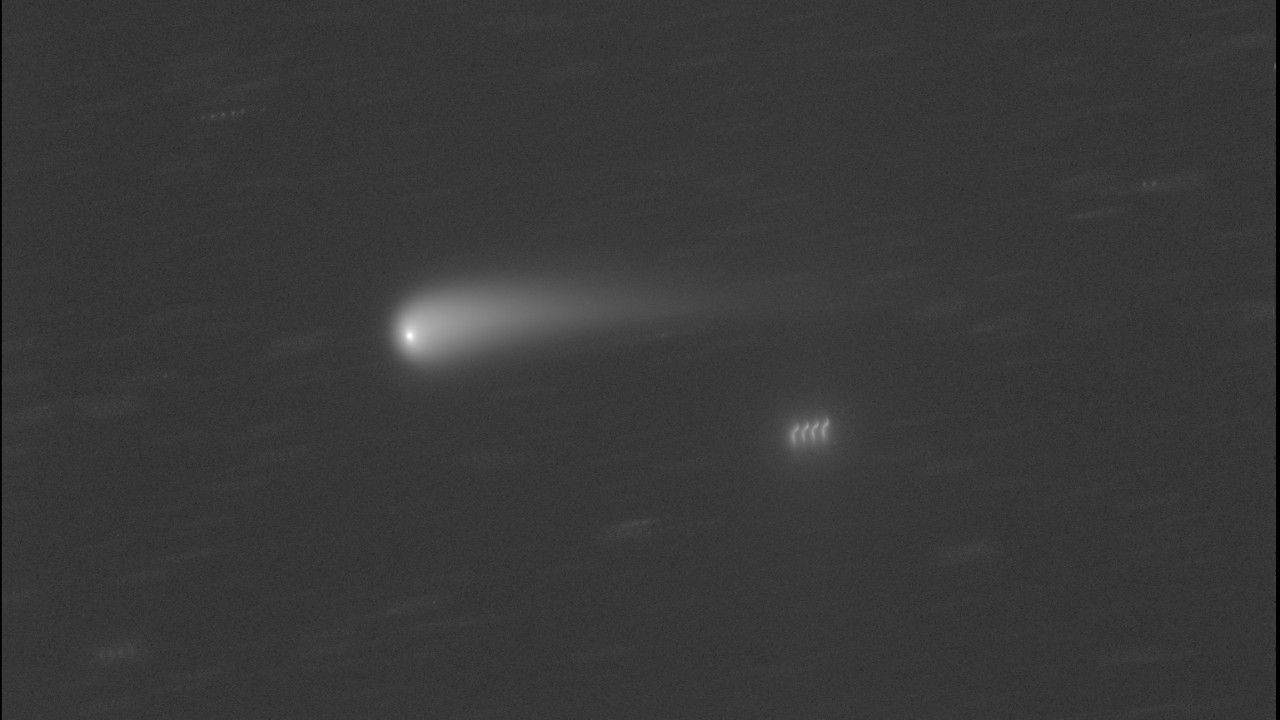
A comet approaching Earth could become brighter than the stars this fall
Tsuchinshan–ATLAS might become as brilliant as Venus.
Space
58 points · by belter · 2y ago · 75 comments
https://m.youtube.com/watch?v=NHozn0YXAeE (Released 14 days after perihelion in 1997)
> Most — though admittedly not all — comets originating from the Oort cloud usually end up being duds. Typically, as these comets cross the orbit of Mars, their steady brightening trend starts to falter, similar to a marathon runner at the 20-mile mark; "hitting the wall" so to speak. In the case of a comet having emerged from the Oort cloud, a sudden decline in brightening may be signaling that it ultimately will end up underperforming.
" You mean to tell me that we can see light from the edge of the universe, but we can't tell if an object will be bright (or not) when it arrives at earth ? "
Reading the article, it seems that there's materiel that will react with the faint but steady hit of sunrays. Still , with our tech and advancement, you'd think we would be able to give a reasonably accurate prediction of whether a a very large stone will continue to shine bright when it passes by earth at supersonic speeds.
That sounds like a difficult problem.
We literally don't know what gases, and how much of them, will evaporate off of it until they do evaporate. And that doesn't happen until it warms up more.
Let me just code that up real fast.
and we can't even precisely predict cloud formation more than week or two in advance right in our face - on Earth
so no wonder comets are unpredictable
In my experience, this is all comets
I doubt we'll need to.
Why do we even have names for months, when people do this? The Southern hemisphere exists too, guys...
> Unfortunately, we here in the Northern Hemisphere will not be able to check on the status of Comet Tsuchinshan–ATLAS during this summer because it will be situated much too far south to be accessible with telescopes. Those living in far-southerly locations, such as Australia, New Zealand and South America, however, will be able to track it in the morning sky before sunrise.
Cloud provider: “All our servers are UTC because that’s the international standard! Adapt your code!”
Also the same cloud provider: “We print all UTC dates using US format because that’s the local standard for less than 4% of the population. Nothing outside of North America exist or even if it does.. it doesn’t matter enough for us to care to learn about ISO 8601.”
America is, until now at least, the closest thing to Rome we had since its fall, but far bigger and with much farther reach.
I bet that if space.com looks at their analytics, they will find out that they are widely read across the globe, and the same applies to every other big media in the US.
Being a global empire comes with certain privileges, it is only natural that it would also imply some costs. One of them being aware that you have a global audience.
Like it or not, America is the new Rome, and Americans would benefit a lot from remembering this if they want America to keep its global influence.
Wow, pedants going to pedant, even so early in the morning. From the perspective of an observer on terra firma, the sun absolutely rises in position relative to the horizon. The actual causes of that doesn't mean that the sun is physically moving but is only the result of the earth's rotation has diddly squat to refute that to that observer, the sun is in a higher location as time passes until it eventually, wait for it...sets. Oh no, the horror to a pedant that we've now said it not only rises but sets too! Run away! Run away!!!
Meanwhile, "autumn" is a loan word from French. "Autumn" and "fall" were both used in Britain, but "autumn" eventually won out (after the colonization of North America).
Why did so many English speakers stop using "fall", a proper English word with a very long history in Britain, and switch to using a French word for it instead?
For that matter, why didn't they do the same for "spring" when it is so closely linked to "fall"? It seems very silly.
https://en.m.wikipedia.org/wiki/Acad%C3%A9mie_Fran%C3%A7aise