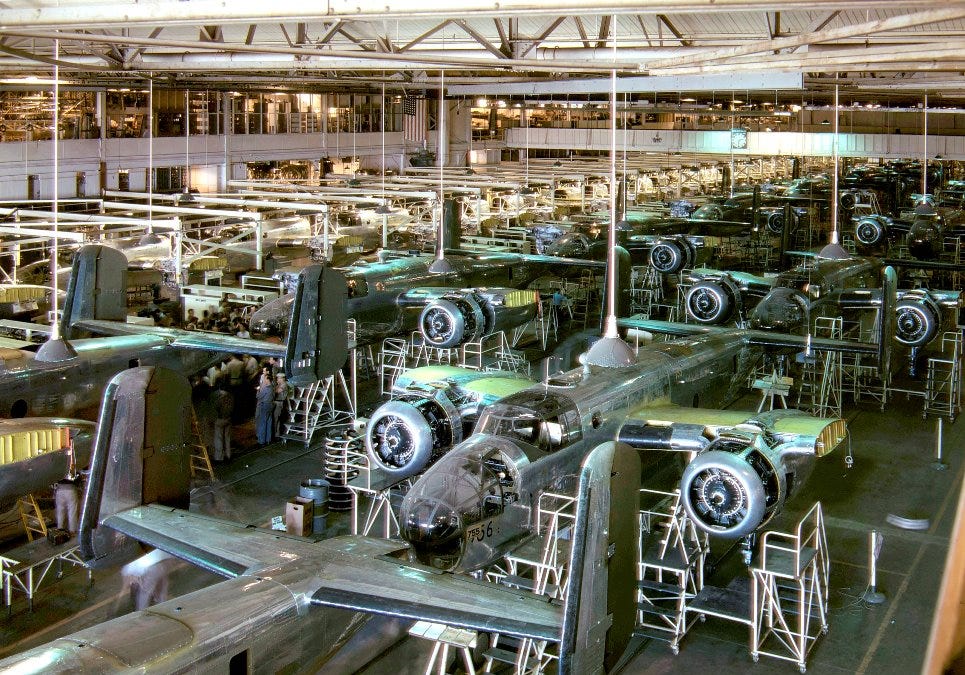
How to Build 300,000 Airplanes in Five Years
It’s no secret that the Allies won World War II on the back of the U.S.’s enormous industrial output.
construction-physics.com
373 points · by juliangamble · 2y ago · 556 comments
People now take for granted that "the sleeping giant" was going to awake after being attacked. But in WW1 the US was also the largest economy in the world, and it did not transform overnight in a weapons manufacturing behemoth, like it did in WW2.
If a conflict with China ever comes to pass, it is not at all predestined that the US will repeat its WW2 feat rather than its WW1 experience.
China is heavily investing in munitions and acquiring high-end weapons systems and equipment five to six times faster than the United States. China is also the world’s largest shipbuilder and has a shipbuilding capacity that is roughly 230 times larger than the United States. One of China’s large shipyards, such as Jiangnan Shipyard, has more capacity than all U.S. shipyards combined.
"U.S. Defense Industrial Base Is Not Prepared for a Possible Conflict with China"
https://features.csis.org/preparing-the-US-industrial-base-t...
This is especially egregious, because the few folks that have enough ethics to not do that, get driven into bankruptcy, by the ones that do.
The general consumer market basically wants cheap. If they can get stuff that does what they want, for less, then they go that way. They aren't particular, as to the source.
The market for High Quality is actually pretty small. People that make good stuff, don't get rich. People that make lots of cheap crap, get very rich.
The only way to reverse this, would be to invoke protectionism (or have a war, which will do that, anyway). That isn't very popular, with this crowd.
One mistake the US did was switching from defined benefit pensions to individual retirement savings. When the stock market is something you hear about in the news, most people don't really care about it. But when you see it in your retirement account balance, it becomes relevant. If outsourcing to China is good for the stock market, you vote politicians who make it easier.
I.e. greed will be the downfall.
Or are you saying people wouldn’t do something short sighted if it made them super rich in the meantime?
So corporations and consumers outsourced because quantity at price beat quality and strategic concerns.
We didn't. The US manufactures more than ever. It seems like we gave up the advantage because we let China take over the cheap junk market (before them Japan and Taiwan had that - both have moved up quality though); and we use far less people. A typically factory in 1950 with 2000 workers would now have around 200 to produce the same amount.
There are other aspects.
* Industry/mining/some types of manufacturing are often dirty business and cause pollution, not something you love to be around. Energy consumption is also high.
* They usually come with many hard jobs that people don't exactly love to do if they have alternatives.
This can be countered with automation, but that comes with high cost and limitations that we are only now approaching solutions for (eg flexible humanoid robots with AI-driven controls).
* The big industrialization craze of the 90ies/early 2000s came about as western markets started to saturate and approach low growth rates. The hope was that lifting new countries out of poverty would create economic opportunities.
People like to complain that it's the labour market, that nobody wanted the jobs.. but that's a lie told to stop the masses from organizing and putting some heads on pikes.
I don’t even think it’s very clear that recent US efforts to onshore manufacturing, both broadly and within green energy specifically, are even helping it. The US is paying close to a million in extra costs for every job it’s on-shoring, although there is the benefit of improving the US negotiating position and military readiness beyond bolstering employment.
I do not think they can do this forever.
Lenin
> Is it just because it would be impossible to have an industrial base in a world where Asia exists and can produce everything that could be built in the US for 1/5 the cost?
It's not impossible, had the US kept capital control and tariffs there would have been no way for Asia to catch-up at all. But the free trade ideology and greed led the US where it is now.
Because there's a basic heirarchy in capitalism where resource extraction is at the bottom, manufacturing in the middle, and finance at the top, and the higher on that heirarchy your comparative advantage is, the more value you capture out of the global economy.
The US won (or, more accurately, is winning, its not a static state) global capitalism is what happened.
undercutting and destroying the financial viability of unions and labor
The rich don't actually care about how much money they have, they care about how much money they have relative to other people. Hollowing out the middle class meant while milking profits from cheap overseas near-slave labor? My god, so many billionaire boners.
Why do you think nothing tangible has been done about illegal immigration in, what, 40, 50 years now? Something that massively increases the number of desperate workers to undermine labor supply and union-based manual labor and trades?
As it stands now, this problem will self-correct because manufacturing WILL onshore. It has to. China is dropping the hammer on economic reforms and ratcheting up totalitarian control, to say nothing of demographic bombs, the real estate / regional debt crisis, and the inevitable sanctions from a Taiwan invasion.
Don't worry about the shipbuilding. China doesn't have carriers. They don't have a navy that can leave shore more than a hundred miles or so.
The fact is the US Navy can blockade China's food imports and petroleum (as in, fertilizer so ... most domestic food) shipments in Malaysia at will and ... China starves a couple months later.
The policy that needs to be pursued isn't one of China as a dangerous peer state. That has already passed. The policy is to deal with China as a dangerous collapsing state. It's kind of the same effect (manufactured goods being shut off, reestablishing more domestic production and manufacturing), just with or without overt warfare.
IMO this is an opportunity for greenfield modern manufacturing construction: lots of automation, lots of modern EV-based low cost low carbon transportation and infrastructure, building up the domestic energy industry around alternative energy on a fundamentally cheap basis never seen before.
One way to do this is to intelligently allow the best and brightest in China to immigrate. They'll certainly want to get out...
As for the article, it was a lot easier to crank out airplanes when they were basically automobiles with different body shapes. These weren't turbojets, they were ICE engine-powered prop planes. Yes that handwaves a massive amount of engineering and retooling, but it wasn't like ICE engine designers suddenly needed to learn how chip manufacturing worked.
This should be interpreted as emphasizing the strength of the US Navy though, since it would take years and years for China to possibly match the tonnage of the US Navy even if the US didn’t build anything.
America loves fighting so much it's had a civil war and fought a few of it's closest allies at various times.
China is a novice at fighting. Whilst they may have lots of ships, having really good people to fight in a complex battlespace is different.
I don't think you can extrapolate fighting in Kosovo, Afghanistan, or Iraq to fighting China. If a war were to break out, both sides would be learning a lot of lessons very quickly.
The last war China was involved in was the relatively small Sino-Vietnamese war in 1979. And the last one before that was WW2.
It would be hard to count all the wars the US involved themselves in during that time.
However, with regards to China Americans seem to be mostly worried about Taiwan. Taiwan is a lot closer to the coast of the PRC than it is to the coast of the US. (On the other hand, the people living in Taiwan are even closer to Taiwan than the PRC is. And they would certainly enter the fray, too.)
I am not that sure anymore. US armaments industry got a bad case of Wall Street in the 1990s and there aren't many factories left. Even though the US is indirectly involved in a big land war with Russia, plus has a lot of purchase orders from other countries, the industry is spinning up at snail's pace. Smaller countries in Europe will wait 10 or more years for their F-35s.
One of the serious diseases of the developed world is bureaucracy. The US has way less of it than, say, Germany (which is almost a fatal case), and maybe it could get rid of it in times of need.
Maybe. But Starship development is still being delayed by licensing, even though said licensing didn't stop the only really serious problem until today (the destruction of the concrete launch pad in Boca Chica).
They had their own civil war that went from the early 1900s right up until 1965 which was sporadically interrupted by the Japanese.
The Chinese did nothing but fight for two thirds of the twentieth century
But not at wining. Last war US won was WW2.
Newertheless, US discovered that wars are good for making money.
More seriously, why are we not prepared? Didn't we spend enough to keep our defense industry competitive?
If a conflict with China comes to pass, it won't be on US or China soil. It'll be a proxy conflict somewhere else.
All the major conflicts since ww2 have been in proxy locations. Korea (US/China), Vietnam (US/Soviet Union), and so on.
"Occupying" a country is fruitless (see pretty much everyone in Afghanistan) and unpopular.
So I don't see Chinese bombers over Seattle or US bombers over Shanghai. In that sort if conflict both sides lose.
Taiwan is the obvious proxy in play. The South China Sea is the other. Both would give China significant geographical advantage. Taiwan is just important enough (making PCs) that the US may intervene. But will the US land troops in Taiwan to fight street battles? Probably not (imo).
Will Chinese troops parachute into LA or US troops parachute into Tibet? Not a chance.
With all this in mind, statistics and behaviors from ww1 and ww2 are somewhat irrelevant.
If there is a US China conflict though, it's more likely to be economic. Supply chains disrupted. Chips in short supply. In that sense domestic production of non-military items becomes paramount (to keep the population appeased.)
For strategic detterence capability building lots of ICBMs and missiles is good enough and cheap enough.
That would be more than enough to allow Chinese full control over that region of the world and give America a shamefully large black eye.
And lack of preparedness in the previous years before WWI was deliberate, because public was too much against the idea of interfering into European affairs and politicians made every efforts to make it as physically difficult as possible. Zimmermann Telegram changed that.
Exactly, I see it pretty hard to pull the same feat again unless there is a very big alignment with the companies that have installed capacity in the country.
[1] https://en.wikipedia.org/wiki/American_Expeditionary_Forces#...
This went on well into the late 1930s. It was recognized as a potential problem by some but the profits were large enough that these were ignored.
I encourage everyone to read the book "Human Smoke." It is a collection of headlines and newspaper excerpts from the period surrounding WW2. It's a fascinating read and wonderfully exposes all the propaganda driven half truths and complete fabrications we've sold ourselves about the conflict ever since it ended.
In Herman Wouk's novel The Winds of War, an admiral, aboard an aircraft carrier near Pearl Harbor in 1940 or -41, groused to his officers that (paraphrasing from memory) "sooner or later the [Japanese] are going to come steaming over the horizon, burning Texaco oil and shooting pieces of old Buicks at us."
Sources:
[1] https://www.defenseone.com/business/2023/11/race-make-artill...
[2] https://edition.cnn.com/2024/03/10/politics/russia-artillery...
The Soviet plan - which both Russia and Ukraine are well trained in - was to use lots of artillery. In backing Ukraine NATO suddenly sees a need for some shells that they wouldn't use if it was them. But the Ukrainian generals know them and so that is what they want. (Note too the nobody has provided Ukraine anywhere near the number of airplanes needed to fight a NATO style war - even if all promised F16s arrive today with full training it isn't enough for a NATO war)
The Soviet/Russian land doctrine is totally based on artillery. It makes sense that that is their priority.
Now, that doesn't mean that American doctrine would work well in a hypothetical war with China. I personally don't think the current doctrine would work well. But those that watch the military sphere know that brass have taken note of that and are implementing changes. That all you can really ask for.
While asking we should also question how fast we can scale up F35 production along with all the various arms the F35 carries.
Artillery has proved decisive in every conflict with static lines in the last 100 years. Sure, hopefully air supremacy would overwhelm your opponent and prevent a static conflict, but no air force has ever established supremacy in a conflict with saturated strategic air defenses. Perhaps the US air forces could, but this capability is untested. Sadam and Yugoslavia were limited to tactical air defenses in relatively small numbers compared with modern day Russia or China.
In short, artillery remains important, which is why US artillery shell production is up an order of magnitude over the last 3 years, and will continue to rise.
It's not disingenuous at all. It's pretty apparent if you even take a cursory look at modern American military doctrine/spending. The plan is always to park a carrier close by (maybe two), conduct an air campaign, then send in the troops. Artillery wars just chew up people which the the American public has not had an appetite for since Vietnam.
>The fact that thr US hasn’t had such a conflict since at least Vietnam (and arguably Korea) not withstanding.
It think that is a caveat as big as the Pacific. Vietnam was literally 60 years ago. You don't think top brass have rethought how wars are fought since then? For context, that's 10 Presidencies since LBJ (36th).
> Artillery has proved decisive in every conflict with static lines in the last 100 years.
Again, modern American doctrine has focused on the layering of power projection and troop mobility specifically to NOT fight in static positions.
> Artillery has proved decisive in every conflict with static lines in the last 100 years. Sure, hopefully air supremacy would overwhelm your opponent and prevent a static conflict, but no air force has ever established supremacy in a conflict with saturated strategic air defenses. Perhaps the US air forces could, but this capability is untested. Sadam and Yugoslavia were limited to tactical air defenses in relatively small numbers compared with modern day Russia or China.
Again caveats. Also a war with China will be fought exactly opposite to Ukraine (with missiles not artillery, and with dynamic naval fronts, not trench warfare).
God bless. Let's outperform all the adversaries combined in shell, ammunition, carrier, and fighter production. American military dominance must never be called into question even by the possibility of multi-theater war.
But maybe I'm not a military genius like those in charge of for profit defense contractors.
You didn't "go to war". A portion of your sovereign territory was invaded, and you did/are attempting to defend it. The fact that the US/NATO are willing to contribute to your defense is just a plus. Ukraine is not a NATO member and has no defense treaties with anyone in Europe.
I'm not a war analyst also, but nato doctrine is kinda different from Russia'S. During both Bosnia and Serbia bombing campaigns nato inflicted most damage through bombs, not shells. In Ukraine both Ukrainians and Russians had to resort to artillery shells because none of them could fly uncontested
The OP article is about creating the manufacturing capability, which is different from having the capability and not needing it.
Russian has been in a war for the past 2-years.
The US & EU have not.
If NATO could supply the materiel for Ukraine to "singlehandedly" defeat Russia, they would do it in a heartbeat. But they don't have it!
It seems more like politics than anything else.
Countries want to help.
But they don’t want to help too much, where they then get pulled into the war (or have Russia target them).
The economics and politics actually matter! The public do not want a war, and they do not like forseeing one, they want their own pricing issues dealt with, and they have power at elections. Whereas Russian and Chinese leaders can simply impose whatever level of hardship they need that doesn't provoke full scale open revolt and mass slaughter in their own streets.
The author ignores the USSR completely in their article, except for a brief mention in the graphs (where it's #2). 157k planes is impressive, too, considering that many of the factories had to evacuate to Siberia. 22k planes were also additionally leased by the US and the UK.
Y'all, it's true historically that the US has oversold its personnel contributions to the European theater, but overcorrecting with this weird nonsense about the USSR single-handedly winning WWII is just beyond bizarre.
The USSR did the most in that war but they were not in fact capable of winning by themselves.
Tousands of planes and tanks were sent as well as raw materials to keep their factories pumping.
This after they were initially on Hitler’s side.
Germany had already lost the war before Lend-Lease had a significant impact. The offensives of 1941 and 1942 failed before Western aid started arriving in significant quantities. The aid had much more impact on the Soviet offensive, particularly on the logistics side. It can be argued that Lend-Lease won Eastern Europe for the USSR.
As far as I understand, there are two schools of thought on what would have happened without Lend-Lease. In one, the USSR would have won anyway, but the war would have lasted until 1946 or 1947 and it would have been even bloodier and more destructive. In another, the USSR would also have lost, and there would have been an uneasy peace between them and Germany. In both cases, I'd assume the US would not see the Continental Europe worth fighting for.
But, it is good that all of the allies decided to band together and get it down a little bit faster. Every moment that Europe spent occupied was just another mountain of human suffering. Plus, getting that theater done before nukes really became available probably saved some historical German cities.
Is this still true in light of the recent Ukraine events? Russia certainly isn't losing if no one's going to stand up to it.
I feel like I’m playing Civilization again.
It was Russia that won the war. https://youtu.be/DwKPFT-RioU?t=205
And regarding the Ukraine war. Russia's industrial might is underestimated. And while it can not match that of the West, as a word of caution: China has more industrial capacity than the EU and US combined.
Wars have the nasty habit of taking unexpected turns...
Indeed, after the slaughter of WW2 you would expect Russians to be wary of starting wars by invading their neighbours.
Which is more than just Russia
Ukraine, Belarus, etc are significant contributors and bore some of the heavy causalities
Another part of the reason why invading Ukraine was dumb, Russia forgot what Ukraine was capable of. Attributing all of its success to itself but discounting its partners.
American production is spread throughout the country. China's is pretty much located in the east. Peace time production capabilities <> war time production. There is a reason the United States is developing Rapid Dragon (https://en.wikipedia.org/wiki/Rapid_Dragon_(missile_system) ). In a large scale war, the USA's ENTIRE logistics fleet can be turned into stand off attack aircraft which will overwhelm any local defenses and remove 'peace time' production from the board. I wonder why the USA chose to name the system after an old Chinese siege weapon?
"From October 1, 1941, to May 31, 1945, the United States delivered to the Soviet Union 427,284 trucks, 13,303 combat vehicles, 35,170 motorcycles, 2,328 ordnance service vehicles, 2,670,371 tons of petroleum products (gasoline and oil) or 57.8 percent of the aviation fuel including nearly 90 percent of high-octane fuel used,[36] 4,478,116 tons of foodstuffs (canned meats, sugar, flour, salt, etc.), 1,911 steam locomotives, 66 diesel locomotives, 9,920 flat cars, 1,000 dump cars, 120 tank cars, and 35 heavy machinery cars."
https://en.wikipedia.org/wiki/Lend-Lease
Good luck flying those planes without fuel.
There are the obvious parallels where the US has great advanced technology, China can sure make things in mass quantities; also they have plenty of brilliant engineers and scientists and can figure out anything. Some obvous differences are the US has been where people from the world flee to, to get freedom and liberty; now we are in a serious period of retrenchment though, with certain (ahem) groups wanting to restrict the books in the library if they are idealogically unacceptable and also anti-science and anti-education etc going along with that. China is not the place you want to go to if you are going to introduce heterodoxical ideas.
There are also all the echos of the '20s and '30s in our current times in the US and the world, groups of countries pushing different ideas and coming together in blocks. We have instant communication, nukes make everything even more serious than that time. The new ascendant anti-democratic countries want their shot at power and riches too.
This has always been much more important than dead capital.
Does anyone know if anyone has stared the infrastructure to produce these things en masse in the US? If so, how can someone with heavy construction experience, CAD skills, and embedded experience become a part of that?
I'm guessing the system is named after an old Chinese siege weapon system to give China a message.
US fighting standoff war also throws allies / partners in region with security guarantee to the dogs. PRC going to start hitting US military infra in JP/SKR/PH to drag US into fighting in 1IC.
What are you smoking? Germany is the one that attacked the USSR. I can hardly see how they'll remain anything but allies after that. Actually Germany didn't just attack, they prepared and executed the largest invasion in human history.
> I think China will do a switcheroo on Russia
China is not going to do a switcheroo on Russia. If it wanted to, it'd wait until Russia is exhausted/broken and invade/recover the lands it used to historically belong to them (+resources that come along). Instead, they want Russia to remain as an annoyance to the West.
China is never aligning with the West. They won after WWII and the West tried to break into them in two wars (Korean and Vietnamese) to no avail. They'll fight till the end.
They were also only 20% as capable as Chinese drones.
Read this and get terrified
https://www.ft.com/content/dd2e936e-5934-49f1-8aa6-29dea9a41...
We also don't know what form drones will take as the technology matures. Quadcopters are common right now because they require exactly zero aerodynamic knowledge to build or fly. Any tween with an AliExpress+YouTube account could design, build, and fly all of the systems we've seen to date. As the systems become more automated in the face of EWAR, lasers, shotguns, whatever, expect a reversion to high speed fixed wing systems that trade a little bit of CDF knowledge for order-of-magnitude performance improvement in basically all realms (payload, range, endurance, speed, survivability etc).
It's a lot like the switch from battleships to aircraft carriers in the early 20th century. When a single squadron of cloth and wooden biplanes became capable of sinking a 50,000 ton armored warship that took 5 years to build, the writing was on the wall, and the countries who didn't adapt lost.
US Military contractors have a very different conception of "cost effectiveness" than most of us.
Anyone outside of Ukraine designing drones right now should simply stop what they are doing and watch and listen and learn from the innovators on the ground there. All of those pie in the sky ideas will probably be completely useless in the face of reality.
Something about evaluating production quantity by weight always puts a smile on my face
Imagine measuring computer hardware output by weight.
The key and important factor of computer hardware has little to do with weight.
Whereas, weight is an important factor for aircrafts. A plane produced today will have similar capabilities as a plane produced 30 years ago of the same weight.
That is absolutely not the case for computer hardware.
... As long as you don't do something stupid with it, like using it to evaluate people.
When it comes to material goods that dramatically vary in size (ships, planes, bombs), tonnage is usually a good first metric.
Everyone points to NASA in the 60s as a perfect example of gov production but like all newly formed bureaucracies they are largely the sum of the people they recently absorbed into it. NASA mined all the universities and nerds from private industry who brought their work patterns, leadership, and attitudes to the organization.
But as these orgs age it’s the classic Iron Rule story of managers taking over and accountants ruining things etc etc.
Maybe we need to move away from monolithic mega gov orgs and create new ones to solve new problems each generation instead of being catch alls that do nothing well and never face any risk of being replaced. There needs to be ways to breed new life and kill off the natural development of bad management and crippling rulemaking.
corpos are functionally immortal and it's the cancerous mass, not the germ line that survives.
> the phrase "war is the health of the state" that laments the success of governments in arrogating authority and resources during conflicts.
The problem the US might have in full war mobilization today would be due to cronyism. Remember all of the exceptions to Covid lockdowns for "essential" employees? Some of that is of course necessary but I suspect it would be very widespread if it happened today. This would stoke resentment from people/companies not so privileged.
Any of that could be a misunderstanding or an urban legend though.
Wow. Unbelievable
* https://www.findagrave.com/virtual-cemetery/622200
* https://en.wikipedia.org/wiki/Oakwood_Cemetery_(Montgomery,_...
If you are not losing a few people in training, you are not pushing things hard enough.
A few days of classroom instruction, 40-100 flight hours of practical training (Less in the Axis, due to oil shortages, less in the USSR at the start of the war, due to the all-hands-on-deck state of emergency), and then it's off to war with you.
Axis pilots would fly until they were killed, seriously injured, or captured. Anglosphere bomber pilots would fly ~30 combat missions, and if they survived, would be rotated out to work as instructors.
The average combat survival rate for bomber pilots was ~10 missions, but due to the infrequency of flights, most Anglo bomber crews survived the war, without ever hitting their rotation limit. Meanwhile, in the Pacific theater, the more missions bomber crews flew, the bigger the rotation limits grew (Because survival rates improved, the generals in charge figured that it would be reasonable to ask crews to fly more missions.) The air crews were, understandably, not very pleased about this.
Fighter pilots had much higher quotas, before they could rotate out.
Sounds like a Catch-22.
The T-38 jet trainer, first flight in 1959, still in use: 1,189 built, 210 crashes and ejections.
[0] https://www.historians.org/about-aha-and-membership/aha-hist...
We enjoy one of the highest cancer rates in the world. All those factories used to dump their waste into our aquifers.
One major influence is that American industrialists were busy expanding global markets and happily supplied their technology and manufacturing processes to the two major buyers, Nazi Germany and Communist Russia, in the 1930s, with Ford being one of the major actors, perhaps more active in Germany:
In Germany:
> "Ford and the Führer: A History of Ford Motor Company's Involvement in Nazi Germany" by Paul Ingrassia and Joseph B. White: This work delves into Ford's business activities in Germany, documenting the introduction of assembly-line manufacturing and the company's interactions with the Nazi regime."
> "The American Axis: Henry Ford, Charles Lindbergh, and the Rise of the Third Reich" by Max Wallace: This book explores the relationship between American industrialists like Henry Ford and the Nazi regime, including detailed accounts of Ford's manufacturing contributions."
In Soviet Union:
> "Gorky Automobile Plant (GAZ): Built with the technical assistance of Ford, the Gorky Automobile Plant began producing vehicles using American-style assembly lines. Ford provided machinery, blueprints, and training to Soviet engineers and workers. Soviet engineers and technicians received training in Ford’s American factories, learning about assembly line production and modern manufacturing techniques."
I don't know if there's a particular moral to this story, other than that in search of short-term profit major American industrialists were happy to get in bed with any and all buyers.
The US was pursuing a largely isolationist foreign policy, and was not investing in armaments.
The USSR had, between 1917, and 1939:
* Spent six years fighting an incredibly brutal and bloody civil war.
* Was attacked by Poland in ~1920.
* Spent another decade putting down various secession movements, mostly in central Asia.
* Had multiple minor conflicts with China and Japan.
* Was heavily involved in the Spanish Civil War.
* Also needed a strong, standing army to put down any further internal resistance.
* Could smell which way the wind was blowing, and was ready to capitalize on German's ambitions in Europe, by taking its chunk of Poland (And later invading Finland).
Given all that, it was functioning on a war economy pretty much from ~1917 to 1941. (At which point it transitioned to a total war economy.)
This was all in the context of a strong central push for mass industrialization. Steel production alone increased ~5x between 1930 and 1940. Up until the Nazis took power, the USSR worked very closely on both industrialization, and military armament with Weimar Germany. Krupp was building factories in the Don, and future Luftwaffe pilots were being trained in Lipetsk.
That's a fun way of saying that the USSR started a war of conquest against Poland.
Both of those states fought with the goal of expanding their borders to a pre-partition status - the USSR aimed to reclaim territories lost in Brest-Litovsk, Poland to something resembling the pre-partition commonwealth. Poland won the war, and made significant territorial gains, in exchange for recognition of Soviet Ukraine... And then 1939 happened.
Some people in the US were. FDR was not.
And that has changed since then..?
Now China is the country with the largest industrial output.
It's not like those old machines were primitive, and there have been major breakthroughs in mass-manufacturing.
(the logical end point of that thought process is some kind of Space Battleship Yamato scenario where the designers produce an "invincible" design, but only one of it. Hopefully real planners can be dissuaded from that nonsense, although the Axis were prone to this way of thinking)
the capabilities of planes from ww2 and today are almost not worth comparing
The F-35 is on back-order to the mid 2030s. Even superpowers can't make more than tens of planes every year.
It's just that the modern world is relatively peaceful, that's why they don't need more.
The armistice was a pause for the peace treaty to be negotiated and signed.
Now, if you think the Treaty of Versailles was intended as just a pause for new soldiers to grow up...I don't think that's particularly accurate for most signatories. Had it been, appeasement wouldn't have been tried.
What the actual _hell_ happened to this idea?
In China the entities connected to the CCP are excepted from a lot of laws that slow down processes or make them more expensive.
In the US is that way less the case.
Day-to-day, sure.
In a national mobilization (even without additional action of Congress) when the President’s emergency powers in law are deployed to enable production? Things change radically.
In 1943 the expected average life expectancy of a B-17 (crew and aircraft) was only to survive 11 missions! My Aunt's father was in one that was shotdown, he survived being a POW and came home after the war.
https://www.nationalww2museum.org/war/articles/black-week-da....
China's manufacturing is mainly in the east, while the USAs is spread throughout the country. China's manufacturing is centered around coastal, river, and railway access. The USA has a distributed highway system for wartime variability/survivability.
China is dependant on oil imports. The USA in a net oil exporter.
For reference 3 week Iraqi air campaign had favourable land basing, 5 carriers, doing uncontested runs. Napkin math extrapolate to PRC size and you're looking at 5 years if US can sustain unsustainable tempo and PRC barely shoots back. Double that if US has to operate at standoff range where most of sorties goes to tanking/defensive air. The scale of PRC is massive.
PRC MIC industry is in the EAST far inland, specifically to account for US standoff range, i.e. rapid dragon with even JASSER would have to launch over mainland soil to hit. Can do even more extended AGM156Bs with 1900km range, but still has to be launched within PRC A2D2 1IC bubble, and they weight 5x more, i.e. can only fit lol10 in C17... all of a sudden you have a vunerable platform + missiles worth 400-500m trying to drop ordinances in area PL17 is designed to defeat. This is without mentioning PRC likely has / at least demonstrated to have capability to move MIC underground, see third front.
PRC has enough domestic oil production 4+ million barrels to run military AND industry with transport rationing.
But really what you're missing is if US starts hitting mainland targets, PRC will hit CONUS targets - they're pursuing conventional global strike. Their rocketforce platforms are increasingly dual use for reason. Reality is US is a net oil exporter in the same way Saudi is - i.e. it doesn't matter having resource autarky because extractive infra can be hit by Houthi drones. Era Fortress America is ending/over. PRC hitting 300 refineries and LNG plants cripples US homefront as much as much US trying to blockade PRC energy. And if we get to that point, then it's a matter of who has more distributed energy infra (i.e. renewables), and capital stock, excess construction capacity to survive the attrition game.
China is massive, but their 'strength' of mass production (what is being discussed here, converting a countries capabilities to war time production, and being claimed as uncounterable by the USA) is concentrated in the coastal areas and associated river shipping lanes. USA industry is spread throughout the country.
Again you completely ignore what I said. It wouldn't be 5 carriers of F-18s over five years, it would be our current fleet plus an additional 1500 stand off attack bombers, allowing those F-18s to focus solely on softening air defense sites, etc. China's installed robots have zero to do with any of this. They don't have automated factories 'spawning' units.
China's oil production just hit a record lows even with them putting their 'limitless resources' into it. China's western oil fields and offshore oil fields (like their billion dollar oil platform) would be scrap.
China's current MIC industry doesn't matter, it's converting domestic production to a war footing that is being discussed here. The claim is conversion of their current civilian capacity would overwhelm the USA. Again, China's civil capacity is concentrated in the coastal areas and associated waterways which make it not valuable as a war production capacity, while the USA is spread throughout the country. You don't need to take out every factory, just enough associated infra. But keep moving goal posts, change the subject to try and get a gotcha.
Edit: I have to add I hope none of this happens. I love China. My dad was a communist hippie and our house was filled all kinds of books on China from historical to modern Chinese thinking. My ex was an acupuncturist so we often talked about ancient Chinese thoughts as well. While I understand it's completely different now, 2010's Shanghai was one of my favorite cities. I'm also old enough to have been friends with a lot of students stranded in the USA after the Tiananmen Square massacre so my heart breaks for the Chinese people and I understand that their government is not them and does not care about their interests.
https://en.wikipedia.org/wiki/List_of_countries_by_aluminium...
The biggest exception seems to be Vietnam, with a very large reserve of bauxite (and obviously quite geographically close to China).
230x ship building advantage, more dry tonnage per year than entire 5 year US ship building program in WW2... US advangage over JP in WW2 aws charitably 20:1. That's just in one "mature" industry, PRC isn't just better in US, it's magnitude better than US ever was relative to peers. Another example is their revelation of _one_ gigafactory for 1k cruise missile components a day. JP is buying 400 tomahawks over next few years for 1.5B. PRC indicating they can do that in one shift. US has 4000 stockpiled, replacing at ~100 per year. Some of the production figures are very lopsidded. Meanwhile they're addding about as industrial robots/automation than RoW, and industry is going to get increasingly cheap renewable inputs. The advantages are snowballing.
US still ahead in aviation due to committing to mature tech, but PRC knocking out their 5th J20 already 100+ per year. SpaceX is next as PRC pursues their mega constellation. I think people are prematurely jerking to SpaceX payload lead, they have a short term competitive advantage in doing high capacity launches on "small/medium scale", read: American scale with ~40 resusable rocket fleet. It the economics justified it, no reason PRC wouldn't have 400 falcon 9s. The TLDR is once indigenize tech matures, PRC can pursue incredible economies of scale, and build up enough production capacity to exceed aggregate production of others in 5-10 years.
I'm sure it can be done eventually by China though, they are just as smart as anyone else. Can they organize their scientific and engineering forces as well? Knowing it can be done is a huge help.
In 1943, the US built more than half as many Fleet carriers as Japan fielded over the entire war (15 vs 28), while also producing an absurd number of escort carriers. In the last year of the war, the US built about as many F6F (Hellcat) fighters as Japan built A6M (Zeros) in the previous 5 years (the F6F is generally considered far superior to the A6M; the F4F is the older contemporary of the A6M).
The economics clearly justify mass production of widebody aircraft, yet China is unable to produce their own.
And you expect China to mass produce Falcon 9 rockets? How about they start with a simple airplane first.
But economics also don't CLEARLY justify domestic wide body when they can focus on electrified HSR without fossil inputs, AND PRC pop density / geographic concentration limits future of civilian air due to air corridor congestion.
I expect PRC to mass produce domestic F9 if the economics clearly justify it. LM5 already estimated at F9 $3000 per kg, so hard to say how much mass producing PRC F9 tier reusable can drive down cost + add capability. If it's there's clear significant demand for more than sustaining mega contestallations past 2035s, I'd expect them to spam F9 for domestic use, before civil wide body that's going to take longer due politics of international aviation.
I don't think it's clear that a war would necessarily escalate to attacking industrial targets because there is a kind of MAD at play.
From America's point of view, the problem with escalating the war to industrial targets (which I am sure US military planners realize) is that the US has an Achilles' heel in it's reliance on petrol. Almost all US petrol comes from only 130 domestic plants. If those are disabled, most US supply chains will crumble, including food. No need to disable all the factories when there's no way to transport stuff and workers aren't fed. That weakness might be enough to deter the US from striking Chinese industry.
EVs might be one of the bigger bulwarks the US could pursue toward greater national security.
- Lack of infrastructure investment
- Civic infighting
- Political divisions, distractions, and corruption
- Social regression
- Gender disparity in undergraduate education
- Declining standards of living
The post has one interesting resource that can become a bottleneck: people, what if there is a mod where you need to find and employ aliens to run your production line? Maybe some of the aliens will choose to work in factories instead of attacking you..
The point I'm trying to make here is that the will to do this still exists in the US today and I have no doubt that if we as a country decided to enter a world war like WWII we would very quickly ramp. We certainly still have the culture and the resources to do it were we to discover the will.
Great Britain historically had a fraction of the population of France and other European powers, but consistently out-produced the rest in ships and projecting naval power.
And then there's just the cluster fuck that is the US defense industry. Who could make aircraft for the US in mass numbers anymore? Boeing can't even figure out if they installed a few bolts, NG can't do basic maintenance without wrecking a plane, LM will get you your aircraft for 5x the initial estimate and a decade late.