79 points · by doener · 2y ago · 82 comments
Braking is important but steering to avoid something is probably the better option in most cases. It takes some distance to stop a fast traveling, heavy vehicle.
Imagine seeing an accident happen directly in front of you on the highway. You better be able to steer in time cause you sure aren't stopping before hitting anything.
This is also the reason to try and have both hands on the steering wheel all of the time, versus a relaxed one hand at 12 o'clock lounge while doing 70+ mph.
Radar would, but radar is also a bit crap - in particular angular resolution is very very poor.
The usual diameter of fog droplets is in the micrometer range, but is highly variable.
So microwave/milimeterwave lidar could theoretically work.
The signal is clear enough at a safe speed, but there wasn't much time to react zooming around inside a cloud.
Really? I wouldn't have missed. There was plenty of time for the car to stop based on the video I saw. It looks like 4 seconds of visibility before the driver had to turn the car. It didn't seem like the car was going that fast. There's no way a normal human being paying attention wouldn't be able to get the car to a full stop in that 4 seconds.
From what I understand, Tesla's FSD only uses vision to drive. But we, as humans, use all of our senses to drive. We use vision, smell, sound, as well reasoning and historical knowledge.
If I saw flashing lights in a fog, I would slow down no matter what. I might have heard some sounds, however faint, from the train moving. I would have reasoned that I should always drive slow in the fog, particularly near an area where there are train tracks. I might have sensed that we are driving in train track territory because I saw some tracks around here in the past or I have come across knowledge about this area before that I remembered. Tesla's FSD uses non of these senses.
If I see a crashed oil truck and there is a strong gasoline smell, I might drive as fast as possible out of the way in case it explodes or catches fire. If I smell something weird coming from the car's components, I might stop and not drive. If I smell a cow poop (such as near UC Davis), I might ready by brain for the tiny chance that a cow might escape the fence into the road.
We don't just use pure vision like FSD. If FSD is only vision, then it should make up for the other senses such as sound, smell, and human reasoning with things that humans don't have such as rador/lidar.
> He said that the Tesla did not slow down but that he was able to stop, still hitting the crossbar and damaging his windshield.
So this guy has been in a similar position before and still let the car barrel towards the train hoping it would stop this time? I don’t buy his story.
The fog is an interesting situation too, as non-vision technologies would struggle here too.
At the point where it crossed the road the train was moving sideways relative to the car. In the range direction it was close to stationary relative to the ground (and the crossing arm was entirely stationary, of course). So I think radar would be unlikely to save this case. If the radar was looking to the side, so it could see the train cars approaching at high speed and predict that they would enter the road, then maybe. But this seems like it would also potentially have a lot of false positives e.g. at overpasses. Perhaps for that reason, I believe automotive radars like the ones Teslas used to have generally only point toward the front. And if the train had been stopped in the crossing, as they sometimes are, the radar would be unhelpful no matter where it was pointed.
It’s still early days for autonomous driving and it clearly isn’t there yet. But perhaps one day it will be. We won’t know unless we keep trying.
But what we do know – with an extremely high degree of confidence – is that “just drive the car yourself” has a very large death toll. That’s not the solution to road safety you seem to think it is. The status quo is very dangerous.
Having driven in both places, the driving standards in the US are much much worse. Perhaps we should concentrate on that first? And because not everyone will be able to afford a self-driving car utopia, perhaps it will have a greater effect.
As always the technology industry perhaps is using this justification to solve the wrong end of the problem.
1.2m road traffic deaths occur annually. There is no definition of “safe” that kills over a million people a year.
> Having driven in both places, the driving standards in the US are much much worse. Perhaps we should concentrate on that first?
Both can be worked on simultaneously. “Why don’t we do X first?” is really just saying “Stop working on Y!” in disguise.
Here we are, 8 years later and despite flashing crossing lights and the train, it failed to detect "train crossing ahead - stop" situation.
I get their probabilistic approach, but I don't see it passing the regulators.
When Starship explodes: "this was a success, we learnt a lot along the way".
This is the same here, yes there is an accident, but at the end this was a success because:
1) The accident didn't happen, so the safety measures worked (the "human driver").
2) Once the fix is deployed, if you look in the long run, over 100 years, it won't happen again, so potentially hundreds of saved lives.
And Tesla can claim: "Hey this is the driver's fault anyway".
Main difference between SpaceX and Tesla is that it is the user paying at the end of the day.
The abuse of language is inexcusable and Tesla should be penalized for the lies.
That is the reason why other OEMs test such things with trained professionals before it is released to the general public.
Maybe we whould apply such an approach to the question: `Should Elon Musk be in jail` ?
And, as with FSD, since a single bug can cause death, I think we should roll a thousand time, and throw him in jail should a single 'yes' appear.
Remember in the last earnings call Elon said that the latest version of FSD is almost ready for actual autonomous operation. I don't think this is the case.
they roll out new versions regularly, that's a valid excuse to try it again on a new version at "something it failed at previously". Funny how everyone assumes OTA updates will always fix problems, and never create more.
He's been saying the same thing for a decade now.
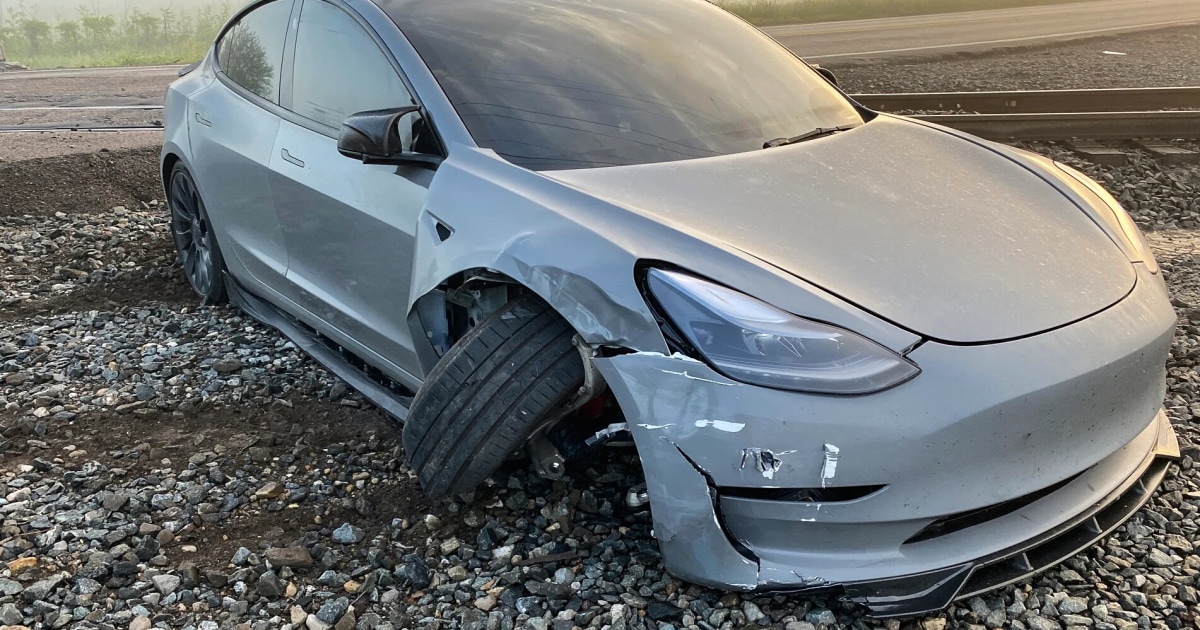
Not surprised. That wheel definitely looks mangled enough to warrant a hefty repair bill.
Yeah, also drunk driving, typing on your phone, etc. It’s almost like we can’t just trust our fellow humans, especially not on whether some automated black-box technology that not even its creators can reason about, is safe. That would be the job of governments and regulators.
https://www.cts.umn.edu/news/2023/april/lidar
https://www.lslidar.com/lidar-penetrates-fog-and-empowers-sa...
But to your point any quasi autonomous driving assistance should have sanity chacking to fall back | downgrade spped and control and warn operators when sensors no longer work as expected.
Just as a good human driver should know when to slow down | pull over in poor conditions.