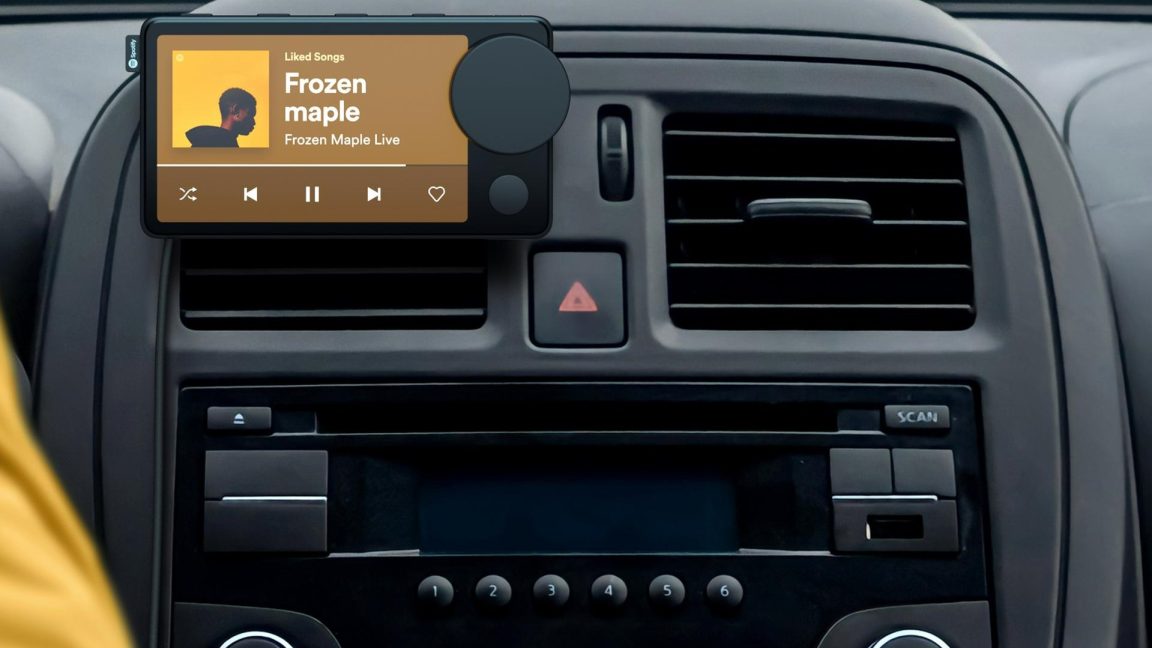
Spotify won’t open-source Car Thing, but starts refund process
Spotify to brick hardware it released to general public in 2022 this December.
Ars Technica
271 points · by nickthegreek · 2y ago · 236 comments
As a counter-point, back around 2008, I purchased two Squeezebox music players from Logitech (digital music players that Logitech had acquired from Slim Devices: high quality DACs that supported every audio format, gap-less playback, synchronised playing on multiple devices, and were very configurable).
They discontinued these products four years later (2012) but kept their mysqueezebox.com online service running up until the start of this year (2024). They kept the user forums running and archived the knowledge-base wiki. Most importantly, they open-sourced the stand-alone server software for running a local Squeezebox server and continued to pay the main developer to maintain the project for more than a decade after they discontinued the products. He’s still the lead developer and project maintainer of the server software, now called Lyrion Music Server: https://lyrion.org/
Correction: the stand-alone server software was always open source, specifically GPLv2. In addition to the audio quality and features, that was one of the selling points for me. It being written in Perl, meant that it was both cross-platform and easy to run on a GNU/Linux system.
Great support but I was left with mixed feelings since I still had almost completely working keyboard and I think the experience would be better if they would send me just the keycap.
Maybe that could be subcontracted out but I can see why it's just simpler to replace the whole thing.
I’ve been hesitant to buy things like smart remotes, or other things in similar categories, because so many companies have poor track records around support. Good support does more than advertising ever could for me.
For a while I hoped someone would buy their Harmony division and keep making them but alas, it was not meant to be.
They do deserve some praise, but I also don't want the bar on the floor. Things would be better if more were like Logitech.
We need laws that step in to make this impossible. Hardware should be designed so that it can be reused. Make it so that people can just reflash the memory at a minimum. There's no reason for something like this to become e-waste. And the excuse being Spotify wanting to protect their brand should not stand.
What about cars, air conditioners, dishwashers, fridges, furniture, clothing? What about when we throw all of those out?
The amount of e-waste I've gotten rid of over my life is miniscule both in terms of weight and volume in comparison to the things I've listed.
I think we confuse environmental impact with cost. Just because a phone and a fridge both cost $1,000 doesn't mean they're equivalently bad to throw out. A device like a Car Thing is nothing compared to, say, an air conditioner. Even if it was half the price.
It's like when people want to make sure Apple will take their AirPods back for recycling, but have no problem with tossing single-use AA batteries in the trash. They seem to be mistakenly measuring by purchase price rather than actual environmental impact.
I mean, I definitely think it's important to recycle e-waste. But I just don't understand when people don't seem to care when their old air conditioner gets taken away but care about old phones, when one AC probably contains more materials than all the cell phones they will ever buy in their lifetime.
Fast fashion is shame too - clothes ought to last a bit as well.
And cardboard/particle board furniture that services .5-1.5 moves is also basically bad.
Cars have been steadily increasing in durability and reliability for decades
you see it constantly in anything surrounding apple, for example. wireless charging is bad, because using 2.5w more for the 1 hour a day your phone is actively charging is literally killing the planet. meanwhile if you sit on the cord wrong once a year and have to have amazon send a truck out with an extra cable, you have undoubtedly exceeded the pollution by orders of magnitude.
same for batteries etc, if your crappy amazon battery needs one extra replacement over the life of the phone, you have undoubtedly vastly exceeded the e-waste and pollution savings of right to repair. Let alone the impact of the extremely short software lifecycles - those android phones are basically disposable and unsupported the day they launch, and apple devices actually have supremely good lifecycles given their long support, the thriving secondhand market (long life) vs disposable phones that get rapidly cycled through, the parts lifecycle/support, and the refurb/recycling lifecycle etc. But right-to-repair is a fashion statement and people will die on the hill that sending out five amazon trucks of parts for a phone that's unsupported in 6 months and in the trash after 3 years is saving the planet.
AI is bad because e-waste and energy, regardless of whatever value it delivers. Over the next century we will probably save GW of energy due to increased efficiency in basically everything (doubtlessly introducing another jevon's paradox of course, but that's not the fault of the tech, that's a generic complaint against any efficiency improvement). Introducing AI into end-user devices is bad because users might feel compelled to upgrade, which is bad. Training smaller models that don't use so much energy in the long-run is bad, because it uses energy now. Upgrading your graphics card is bad because e-waste - even though you sell it to someone else who continues to use it, and even though the guy with a mattress on the floor and a killer gaming rig that he upgrades yearly has way lower emissions than a family who takes one vacation a year to florida (even driving etc). On and on.
people just want a foolproof "your product is bad" that can't be argued against, and e-waste/pollution is a great card to play, especially when it's selectively applied and you refuse to admit any of the foibles of the products you prefer.
also, people still don't want to admit that rossman's right to repair isn't quite the same thing as the platonic right-to-repair. rossman's interests fundamentally lie with keeping rossman group turning a profit, which isn't quite the same thing as users being able to repair their own devices by themselves etc. people don't like apple selling parts straight to end-users because "repair shops can't turn a profit at those prices" and yeah, having a multinational conglomerate renowed for its supply chain deploying low-cost labor to perform factory-line repairs on a limited selection of devices is going to be cheaper than artisianal craftsman repair, that's just the economics of it etc. Nobody has accused them of having different prices internally/externally, repair shops just can't afford to compete at the same prices that apple charges itself.
Right to repair doesn't guarantee the right of repair shops to turn a profit in the face of a well-oiled OEM repair shop operation/pipeline, but actually it's a good thing to have that brick-and-mortar repair pipeline etc, that's what you want, if you want to keep devices running longer etc. Market competitiveness is not the same thing as e-waste lifecycle, and OEMs subsidizing the repairs/running them at-cost is actually a good thing for pollution/e-waste even if indies can't compete at fair market rates. You just can't actively charge yourself less than the fair market price for the item, but even if you did, keeping devices running is the goal, right? These are contradictory goals, market competitiveness is not the same thing as keeping e-waste out of landfills, and if you really care about the latter it probably will require subsidies on repairs, or taxes on new devices, to overcome the economics of mass-production vs individual-repair.
Same for component-level repair. Obviously that is a thing rossman would like to offer as a business service, but is it a necessary aspect of phone repair given the ready availability of assemblies? If you want to drive down costs, bringing boards (via B2B/wholesale trucking) to a central place and reworking them en-masse is going to be a very efficient way to do it, you’ll even recapture some of those economies of scale vs 1-off artisanal repair. And cost of repair is obviously a major factor in whether people decide to repair vs landfill a broken device. But that’s bad because rossman doesn’t get paid as much if you just swap a PCB - it probably should be an option but it realistically isn’t ever going to be the default, to have an artisan unsolder a bga and put on a new cpu or memory or whatever, and there are strong social arguments (cost) for doing it the other way. It certainly isn’t some showstopper to overall repairability (nobody is resoldering a BGA at home anyway), just not favorable to rossman’s bottom line.
also, right to use third-party parts is not really a right-to repair issue. that is personal preference, but there's also safety (muggings/theft) and resale considerations etc. Certainly there are good reasons to explore flexibility/solutions but again, this isn't a right-to-repair issue when there are reasonably at-cost repairs available and a ready supply of first-party parts etc... if phones aren't going into landfills that solves the problem, right? it's a personal preference about the market economics/principles of a device you own (one I generally agree with, with the caveat there's countervailing concerns too). but that gets wedged into an e-waste issue too!
hell even apple making the tools available is a conspiracy to some people - "apple renting you the OEM replacement tools (which are completely optional and in no way required or forced, you can use an amazon spudger if you want too, and which they will outright sell you if you want to keep them because you're an indie repair shop or whatever) for the cost of shipping is bad because the pelican cases are too big and heavy" is a serious topic of discussion for some people. and before you think that's a strawman... someone defended the idea a couple weeks ago on here lol. like there's just no winning with a bunch of these people lol.
the whole e-waste/right-to-repair has just turned into a massive greenwashing/circlejerk and again, it's these same people who are so concerned about airpods and apple self-service who are so adamantly opposed to "greenwashing" in principle, yet they're basically engaging in a contemporary greenwashing movement themselves backing leaders with fixation on greenwashing their own business requirements as being movement goals etc.
In practice minimizing e-waste/pollution lifecycle basically boils down to keeping devices in service longer and ensuring less unnecessary road-trips over the lifespan of the device. The easiest ways to get there are good parts lifetime, good software support lifetime, accessibility of brick-and-mortar/retail repair service, a thriving secondhand market/value retention to encourage resale, etc. Everything else is optional, and you actually don't need much beyond the apple store/self-service model to accomplish those actual needs.
like, taking my old trade-in iphone and refurbing it and selling it to someone in africa or india is what you want, right? how did that become a bad thing/complaint for the greenwashing movement? shouldn't that actually be required, if the phone has a reasonable degree of serviceability why shouldn't it be mandated that trade-ins be refurbed and get another lifecycle?
Also, the actual nuclear-hot take: even lightning was not really a big deal given how long it'd been in service. Having one specific, long-running cable that is deliberately aimed at being significantly cheaper than USB-C (which it was, until very recently) is really not a big deal and probably the phase-out of lightning pushed a large number of extra trucks on the road, extra cable sales to replace the old ones, new usb-c PD chargers sold, etc. I definitely feel the user-convenience argument, I am very happy to unify everything I can onto USB-C these days, but there was a very real additional pollution cost incurred from the changeover itself, that need not have been incurred. Cables wear and break, especially phone cables that get heavily used etc, and having 3 types of cables instead of 2 (usb-c and micro-b) was not the end of the world. Now micro-B really does need to die though, I am entirely tired of that shit to a degree that I didn't care about with lightning. Reversibility has been here for 15 years now, get with the program, and the durability of the sockets is still awful (although better than mini-B, which also refuses to die).
Like a lot of green movements it just sort of is a mishmash of contradictory and often self-defeating goals, pushed by lifestyle advocates and profiteers who stand to gain by selling associated services etc. I do support the overall goal it just doesn’t feel like the current discourse has anything to do with that, it’s just people attaching their lifestyle choices/political choices to a convenient/favorable wagon. And you can easily tell this by how hostile people get over it all. It was never about the e-waste, it was about “apple bad”. And that always is the first and most powerful beat in every single one of these “right to repair” discussions. Name a single rossman video that isn't at least 30% anti-apple screed by weight lol. Like are there really no other vendors with glued batteries or unrepairable mainboards or no service manuals given to third parties? I think there obviously are... but the Samsung stuff just goes in the trash instead of sending it to a Rossman type place, so you're seeing survival bias at best, outright personal bias at worst. It's an easy, popular, large target that drives massive amounts of clicks given the wild amount of apple-hate that still exists to this day etc. They aren't your friend more than any other corp... but they actually do have a pretty green lifecycle compared to a parade of disposable android phones or $300 craptops. And people just cannot possibly bring themselves to admit that apple stepped in the right direction for a change (see also: privacy). Doesn't make them perfect, but neither are any of the alternatives, and apple generally does better in these areas (e-waste/sustainability/lifecycle and privacy).
At the end of the day people are just so credulous about a pitch that inevitably concludes with the pitcher attempting to sell you something - not just rossman but framework, fairphone, etc. And people are just so sanctimonious about it all, like they just want to dump all over everyone because they bought into a youtube personality who needs to keep doing component-level repairs to stay in business or w/e. And again, I guess what else is new with the greenwashing movement, but these are people that think of themselves as ostensibly being virulently opposed to greenwashing etc. Again, I guess what else is new.
Write, but do the not-vote-thing if they don't listen. The desire to not be hoodwinked has already been expressed. Just not this specific way.
Or, expressed more positively I guess, vote for those who don't need goaded to do the obviously good thing.
Otherwise, how can they possibly set priorities once during election season for the whole term for any possible future issue?
Democracy is closed-loop control. You need a feedback signal. It's a feature - not a bug.
The result is calculated on the basis of the votes cast.
So if you have 10 votes of 20 possible you get 50%, if 5 don't vote it's 10 out of 15 = 66.6%
[0] https://www.amazon.com/Dont-Vote-Just-Encourages-Bastards/dp...
Such is the point argued by Dr. Mike Huemer in his essay In Praise of Passivity [1], and to this date I've never found a clearer piece of writing on the matter.
[1]: https://bazhum.muzhp.pl/media/files/Studia_Humana/Studia_Hum...
Full refunds no questions asked will still only get some small percentage, most people don't take the time and just toss it.
Letting the 0.1% of geeks who know how to and are interested in spending time on it reflash their hardware doesn't actually solve the problem in any meaningful way.
This seems to be the official policy for many retailers, insurance companies, etc. Hide the process, make it difficult, so you don't have to pay out as much.
____________________________________________________________
Is your product dangerous, addictive and stuck in a lawsuits-quagmire, even social engineering cant redirect away from you? We can help you- and create a healthy-alternative, that sits on the shelves like stones calming the public spirits feng-shui with a choice. Nothing sedates like responsibility distributed and societal agency diluted. The consumers are returning, the free market is healing. AliBuy products. We make it in red, so you don't have to.
That said, yes, they will probably also make the process as hard as they can get away with it. Anyway, have some popcorn, this one got quite interesting.
Courts follow laws as written, and make decisions and establish precedent whenever laws are vague, in edge cases, or when laws conflict.
But for stuff like this new laws are absolutely required. Why would you prefer unelected judges to be making stuff up, instead of democratically elected lawmakers whose literal job it is to decide these kinds of policies with input from constituents?
“Open” “unsupported” hardware would be hard because frankly I don’t know what that means. People who have the Spotify thing are pretty much free to do what they want with it. There are some DRM and anti-circumvention laws… but those are bad laws regardless of whether the device is supported or not. Again, just repeal those statutes as well.
A million arbitrations means a million arbitrary results, where one claimant doesn’t know what evidence was uncovered in the other cases.
Most importantly punitive damages. Arbitrators almost never impose real punishments, which means more companies commit fraud / act maliciously towards customers.
I also need to some detail about how companies are trying to enforce MDL-like bellwether and mass-arbitration rules in order to further reduce costs and chance of success.
>Thank you for waiting! As I can only suggest you for free Premium in your account. The actual Car Thing refund is done by the specialty advisors, so I'll create a case related to your issue and transfer it and the right team will get back to you through email. Sounds good?
So I am now waiting for an email.
I wonder if their CISO or security team is aware of this, I reached out to address found in https://www.spotify.com/.well-known/security.txt
Here is response I received:
Hello there,
Thanks for reaching out to us via messaging. Your case has been escalated to the highest tier of Customer Support here in Spotify. All communication within this email thread will be from the Escalation team from now on.
We can see that you've already sent a proof of purchase via chat. About refunding, please share the following details with us:
- Bank name - Bank Location - Account Holder Name - Routing & Account no - SWIFT - A screenshot of the required bank details on your online banking or bank letter (if it's possible).
Make sure to hide any sensitive payment information like your full card number for your security.
We'll keep an eye out for your response so we could sort this out.
Kind regards,
XXXX Escalations Team - Spotify Customer Support
Is that an actual issue with US accounts? Over in EU it's common to publish your account number (IBAN) and routing code (BIC) on your website, letterhead, and obviously on bills you send to customers so they can pay you.
They should only be able to send you money, not use it to request money, right?
It's a terribly outdated system.
For that reason, I have two checking accounts, and don't keep large sums of money in the account I use for payments.
It is completely understandable that someone like you who doesn't live or work in the USA wouldn't know how sensitive a Bank Account/Routing number is here. If you exist in a modern banking system with proper security, it is easy to assume that the rest of the world works the same way.
However, there is absolutely no excuse for the decision makers at Spotify here in the USA not to understand this.
I guess only a very small fraction of people will do this, making it a very cheap way for Spotify to stop any negative press regarding this issue.
What we need is a law that obliges them to issue automated refunds in cases where 100% of customers are entitled to a refund.
I've had Spotify premium for 12 years now. Back in 2020 I got a rather large prepaid debit card. I put a couple low dollar subscriptions on there. Spotify being one of them. Card ran out of money.
So Spotify instantly shifts me down to the free plan, after 1 failed payment, and deletes all the songs I synced to my phone until I update my card on file. Which was supremely obnoxious on mobile (but that's because I signed up for Spotify with Facebook, and 8 years after breaking FB SSO OTP code generation on mobile they still haven't fixed it)
No grace period, no warning that my payment failed and I was being downgraded. Just a big old full screen pop-up warning me that if I continue into the free version, it would immediately delete all my playlists.
Paying customer for 12+ years, with 12+ years of playlists. Had I not read the small print and just clicked "continue" it would've deleted ALL of that. Even after updating my payment method, and not having pressed "continue" (to the free plan) I had to re-sync all the songs I'd already downloaded.
They're a very user hostile company, and I've never had the slightest bit of sympathy in their fight with Apple, and this is a pretty good reinforcement.
What would be ideal is to open up devices to be flashed with custom FW or OS installs and some rudimentary docs on doing so. That would be enough for the community to run with it if there is sufficient demand and value.
Spotify has taken something that could be used generically too, and just decided to brick it.
Insert something about product and consumers and how its all just some big money game or something somewhere :D
Strongly disagree. While the arbitrary deadline on the bluetooth flasher tool that Google created is dumb, I ended up with 4 bluetooth controllers for free. Seems like a pretty great deal to me.
Kind of a shame when companies do this.
I also wonder how long till the hacker community starts hacking these things any way? Seems like a worthy device to hack, though I can't imagine there's millions of these out there. I'd love to buy a 2nd hand one and install custom software on it if someone builds said firmware.
Hell, if Spotify had open sourced this and still sold them, I might have bought a first hand one. I would just be streaming my Apple music to it instead. ;)
Thankfully folks have started organizing to reverse engineer the device:
- https://github.com/err4o4/spotify-car-thing-reverse-engineer...
- https://hackaday.com/2024/05/30/old-spotify-car-thing-hacks-...
And given the price of tech labor, most businesses are going to want to put their engineers on active projects.
I haven't opened mine up yet but there's not a lot there that an ESP32, a screen, and an encoder couldn't replace. I'll probably disassemble mine for the encoder knob and see if I can't repurpose the screen. The actual hardware isn't particularly compelling otherwise.
I think a simple rule could easily suffice here:
All firmware and schematics must be made available to regulatory agencies to put a device containing a digital computer on the market at all. That info can be sealed until a device is no longer sold, except for devices that need to meet higher safety standards (cars, medical devices, some kinds of home automation, definitely anything operating heavy machinery or infrastructure), in which case this is made publicly available as soon as the device goes to market
Also, repeal DMCA 1201 in its entirety. The government has no obligation to protect business models with the force of the state
We already enforce safety and environmental standards on manufactured products. This is a no-brainer
If so, then why making people contact them?
And also bumping people away from normal customer support, to "specialty advisors"?
This isn't looking like good faith.
Is Spotify's market position now strong enough that they don't have to care what people think of them?
What is the purpose of this device in the first place? In 2021/2022, smart phones with bluetooth or usb/audio cables were in full effect which is how I'm assuming >99.999% of users use Spotify. Were there Spotify users that had cars during the recent 3 years that had cars with radios that were incompatible with bluetooth or aux inputs that made this device desirable?
I'm also surprised they're bricking Car Thing. Given how it works, I didn't realize it would even need server data in the first place.
- customer-facing reason: Spotify Connect https://support.spotify.com/us/article/spotify-connect/ We have to be able to know which device you're playing on, show it in device pickers and even let you play stuff on devices not in the same network
- second major reason: most of the decisions of what to play cannot be made on the client. This has to do with licensing and related analytics. Even different types of devices will have different licensing applied to them. So to even simply say "play next song" you have to tell the server you're going to listen to a track. And that track might not be available for the specific combination of account/device/country/phase of moon which client has no way of knowing about.
Source: I work at Spotify, but I can't answer any questions about CarThing (didn't work on it, and it would be NDA anyway)
https://www.aliexpress.com/item/1005004704739971.html
https://www.aliexpress.com/item/1005006422066598.htmlI suspect this was mainly for people who only have the ability to send audio to their head unit without actual controls in some older cars.
I haven't checked for this - does anybody know whether the car thing has the "safety pause" that the spotify app has on Android Auto? If not, that would be enough reason to use it by itself.
Shame on Spotify.
Clearly Spotify sees Car Thing as a mistake. That’s ok, mistakes happen. But they should really be working to make sure customers aren’t paying the price for their mistake (as much as is feasible, anyway). It sure doesn’t sound like they are doing that.
BTW, there could be code in there they don’t have the right to open source, so I don’t know whether to judge them on that aspect of it or not.
-- Following is my original comment written before I knew much --
It seems to me like the bare minimum would be enough to take the heat off: Publish a quick and dirty flashing tool, and leave the binary of the firmware available. If people want to disassemble the firmware they have plausible deniability to the patent holders involved, and if nerds want to devote time to reverse engineer it and make a custom firmware image, they can figure it out themselves. After all, part of the fun of such a project is the challenge.
> A Spotify spokesperson declined to confirm to Ars if Spotify would offer full refunds to everyone who showed proof of purchase or if there were further requirements. The representative said that owners should contact Spotify via the above link about refunds.
> The email doesn't explicitly guarantee refunds, though...
I hate that companies are allowed to use just ever so slightly different designs of their products every generation.
We are over regulating SW companies, because it feels free, it's just a software.
Why can not we force the biggest HW developers to make sure that devices can share spare parts across generations AND preventing them from bricking perfectly good devices?
Also, there are privacy issues:
Companies, like Spotify only do these types of things to soften their dominant business tactics, just like Google, just like Amazon, etc. They appeal to emotion just like politicians appeal to emotion with religion or social justice causes in their speeches to soften their image so they get away with the decisions based on who they actually are and how they really feel later or when rubber meets actual road.
Spotify is just a business interested in doing things that make them the most money possible and they have a history, like others, to appeal to people with social peacocking to soften their image while being so dominant in the market.
The Car Thing has already been rooted. It runs Linux. There's a clear path towards a custom firmware: https://oddsolutions.github.io/Spotify-Car-Thing-Root/
Could there be more to this? Maybe the Car Thing's DRM has been completely broken? Record companies want to license cars/things differently?
Spotify Car Thing will be discontinued - https://news.ycombinator.com/item?id=40456644 - May 2024 (229 comments)
They're bricking rather than simply discontinuing support. Does that perhaps mean there's a problem with the device? Unpatchable security flaw perhaps?
Facebook Portal, I’m looking at you.
I feel Spotify is really losing sight of its core competencies and its actual value proposition at this point. Will be interesting to see how this shakes out.
Spotify was amazing in recent years for 3 reasons: 1. Early pioneers in good ML based music taste making aided by teams of people who knew the various genres.
2. Spotify’s ability to do this well came from its strong investment in metadata which gave them a corpus of insight into what people listen to and why. Somewhat analogous to the rich tagging TikTok does to its videos on support of FYP.
3. The ubiquitous and continuous client support made it so easy to bring Spotify everywhere, that any alternative was going to mean more friction. In a way Spotify Connect is their iMessage blue bubbles moat. The ubiquitous and branded clients available on tons of hardware and every OS was their social contract. It was cool to use Spotify and not cool to be an Apple Music or Tidal user. The slow but continued atrophy of client support only builds distrust in this narrative. And that gap is closing when compared to other services.
https://techcrunch.com/2024/05/30/spotify-begins-offering-ca...
Context:
https://fortune.com/europe/2023/12/04/daniel-ek-to-slash-blo...
https://thehill.com/homenews/media/4444678-joe-rogan-deal-sp...
https://fortune.com/europe/2024/04/29/daniel-ek-salary-spoti...
https://musictech.com/news/industry/spotify-ceo-daniel-ek-co...
Spotify is under constant fire due to its low royalty payout rates. Ditto reports that an artist receives $0.003 – $0.005 per stream on average, with 30 per cent of those royalties going to Spotify.
Spotify paid out $48 billion to the music industry, paid out $250 million to Joe Rogan and Spotify CEO Daniel Ek cashed out $118.9 million in shares - which combined with the rest of the Spotify executives totaled $250 million in stock sales.
Whereas:
https://www.wired.com/story/what-soundcloud-created-can-neve...
If Spotify is happy to brick hardware that customers paid good money for, then is it valid to ask if Spotify should be bricked?
Is Spotify doing good by its streamers?
Is Spotify a positive force for new music discovery and promoting promising talent, or is it embracing long tail effects to maximize its own profits and those of its cronies in the music industry?
How does the situation change if everyone cancels their Spotify membership in protest, or sells short the SPOT stock?
How does the situation change if the majority of shareholders and paying customers demand that the entire Spotify board is thrown out so that Spotify can be restructured in favor of streamers, employees and listeners?
Could a few hackers and makers, perhaps with the help of some benefactors who won the internet lottery, throw together a p2p app that negates the need for Spotify's existence?
Are any of these questions unreasonable, given the recent behavior of Spotify?
The predictable nature of all of this makes me wonder why the disruption model stops at a handful of people getting morbidly rich at everyone else's expense.