40 points · by andromaton · 2y ago · 75 comments
https://www.amazon.com/Crime-America-Cambridge-Studies-Crimi...
as it points out the limitations of the social sciences and generally why people don’t find science satisfying, particularly looking at it scientifically as opposed to “here is a paper I can use as a weapon to justify my dogma”.
In that book, researchers analyze just about every theory of the crime drop and got inconclusive results. The one exception was a chapter which was not quantitative at all but rather spun the story the black people in NYC switched from cocaine and heroin to passing around a blunt, sipping from 40s, and having a chill time.
Hey, whatever it takes to get the sage herb descheduled.
> The median HR was 0.94 (IQR, 0.83-1.05) for the effect of red meat on all-cause mortality — ie, not significant.
However, the article (and the study) are absolutely worth a read. Another main take-away is:
> I hope you read this paper and think about it every time you read an observational study that finds a positive or negative association between two things. Ask: What if the researchers were as careful as Zeraatkar and colleagues and did multiple different analyses? Would the finding hold up to a series of plausible analytic choices?
What researchers chasing popular beliefs fail to realize is that once you chase popular opinion, your science and therefore you are suspect, not to mention the 'content' was never going to be as popular as the latest bowel movement of modern Ben-Hur.
Aesop's fable on the Bat, the Birds and the Beasts comes to mind regarding the fall out of this approach.
"Of the 48 analyses deemed statistically significant, 40 indicated that red meat consumption reduced early death and eight indicated that eating red meat led to higher mortality."
> You know? You are also right.
I've thought it might be due to in part to high metabolism. My entire family is quite slender and generally have trouble gaining weight.
Boars and pigs are closely related, but meat from the latter has twice the calories of the former - largely due to its extreme fat content.
I had to lay off red meat due to typical sedentary lifestyle induced health issues, but I found that the problem isn't exactly in the species consumed, but in the ridiculous amount of fat that's present in factory farmed animals.
On the flipside game meat is perfectly fine, even if expensive.
My steak pipeline:
* Buy uncut slabs of USDA Prime grade ribeye from your local butcher or wholesaler like Costco. If possible, avoid blade tenderized meat.
* Individually hand-cut steaks of about a pound each. You quickly learn to eyeball this.
* Individually vacuum seal them while sucking out as much moisture as possible. A FoodSaver or similar can do this cheap and easy. Buy bulk bag rolls from Costco, first-party bags are more expensive for no benefit, while pre-cut bags cost a lot to only save a few seconds.
* Freeze them until needed. With the moisture and air gap removed, they basically become a slab of solid marble with a shiny finish. There will be 0 crystallization or freezer burn if you sealed them properly. You are now set for months of superb steak with minimal further fuss.
* When needed, put one or more of these steak modules into a 137F sous vide for at least 2 hours. Season / fry / grill / etc from there as preferred.
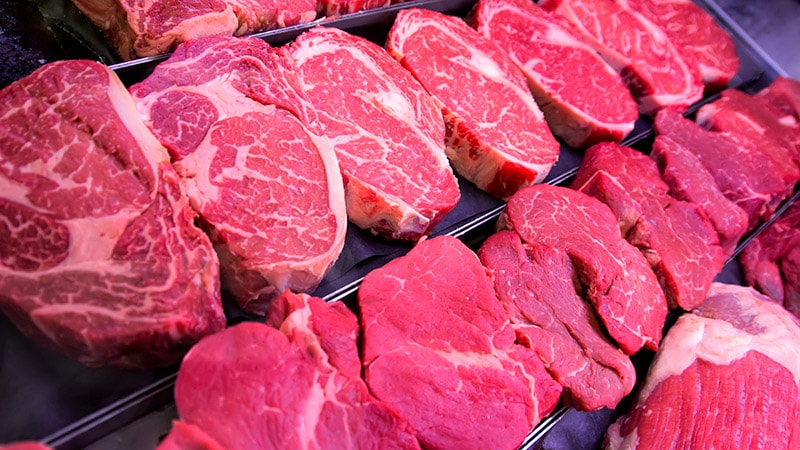
Having been on a carnivore diet for a while, and seeing many medical problems resolve that had not resolved with many medical interventions by doctors, it would be great to see more studies take a look at this.
It's an analogously similar situation with me. Haven't missed the fiber one bit.
The transition takes a bit of planning as there are initial side effects since your body is used to digesting and getting energy from sugar instead of fat. This video is a good start.
Then if someone is personally addicted to meat and/or cannot enjoy other non-animal products providing the same nutrients then it's another topic. But let's not make incorrect statements, red meat is not key to anything.
Meat provides many vitamins and nutrients in a highly bioavailable form. No one is addicted to meat. It’s a great nutrient delivery vehicle and looking at how many ways we have invented to cook it and increase its digestability it must have been useful. Grains and plants seem to be fillers to a main meal, throw in a bunch of vegetable matter in a pot with stringy meat to make it go further is how many poor people eat and the reason for the beans and rice. Any family that can afford to throw in some chicken legs or entrails or even muscle meat is going to do so into those beans and rice.
In one of the third world countries I lived in they would often tease people who could only afford beans rice and plantains because it was noted they were not as intelligent. Anecdotal sure but a common sense wisdom found in different and less affluent areas.
Furthermore, I can take your argument and use it the same. Eg Many people don’t eat vegetables, they only eat meat, and they are doing fine and many say they are doing better than ever. Let’s not make incorrect statements, vegetables are not key to anything.
You've lost me here. If you want a short active life then mainly meat might be fine, if you want to live in a different situation than our evolutionary past then you are killing yourself early by skipping vegetables, statistically speaking.
You've completely changed the bar in your argument from what is good for preventing early death by today's standards for expected life time to other things.
The key, as far as our scientific understanding goes, is to have the right micro/macro nutrient in our diet. Where you get them is not as important.
Also, using chickens and cultural norms of other countries (very often shaped by European colonists and their ideals) is not a strong argument as you might think.
In many countries being overweight is a sign of wealth and hence desired but we know that it's not the best in terms of long-term health.
P.S. You say nobody is addicted to meat? Take any random 3 people and ask them not to eat meat for 1 week. Let's see how that goes.
Vegan diets are another story though
The real question if you want to stay healthy is what meat and in what quantities.
300gr of fresh ground beef every other day from the local bio farmer isn't the same as ultra processed bear shaped ham* at every meal.
* https://encrypted-tbn0.gstatic.com/images?q=tbn:ANd9GcRkM8VO...
> Intake of processed meat (adjusted HR, 1.03 [95% CI, 1.02-1.05]; adjusted ARD, 0.90% [95% CI, 0.43%-1.38%]) or unprocessed red meat (adjusted HR, 1.03 [95% CI, 1.01-1.05]; adjusted ARD, 0.76% [95% CI, 0.19%-1.33%]) was significantly associated with all-cause mortality.
I haven't looked further at either of these papers; just saying that telling me there's another paper which agrees with 4/5 of the other papers is not actually much information, in itself.
How'd this bias manifest in their choice of which studies to review? The 4/5 opposite that I mentioned points the other way. (Added: I wrote this before you added an example paper.)
Of course their main point is supposed to be about finding ways to counter this effect of engineering desired results within academic standards. I agree that's a real thing and part of a huge problem.
"Zeraatkar and colleagues have shown that there are thousands of plausible ways to analyze the data, and this can lead to very different findings. In the specific question of red meat and mortality, their many analyses yielded a null result. "