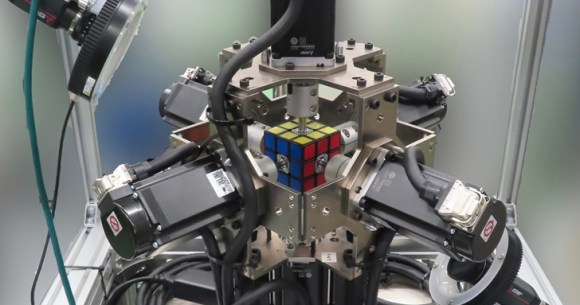
Mitsubishi develops robot that solves Rubik’s Cube-style puzzle in 0.305 seconds【Video】
It's literally faster than a speeding bullet.
SoraNews24 —Japan News—
308 points · by nanna · 2y ago · 203 comments
Like, seriously, I don't think most people can comprehend the speed of robots, much less the speed of the processing controlling them. I think it's one of those things you should just intuitively understand if you're living in the modern world.
If the robots ever do rise up, and I'm not saying they will, you won't see it coming!
Hard to quote the video but from wikipedia[1]:"Micromice are among the highest-performing autonomous robots."
Things like fans and ground effect being used to make these devices do 6g turns while mapping and solving a maze.
Alternately, the world of quadcopters, face recognition (body warmth recognition required?), lidar will make for a terrifying battlefield.
Detecting heat via infrared will still be useful, any kind of engine gives off heat. Whether biological or mechanical.
You can construct engine that have disguise their heat signature a bit, or that have a smaller heat signature. But that severely limits their capabilities, which might be a good enough outcome for the sides that use the heat detection.
It’d be nice if all wars were basically a simulated conflict with robots fighting each other far from any humans but the defector that turns their robots on human populations will always have an advantage in actually winning wars.
Edit: and not everyone will have robots.
It could mean no revolution happens ever again and the currently established dictatorships stay as they are forever.
99% of computing power is used for "make work"¹ (graphics, teetering stacks of abstraction and now AI) so things don't really feel different to humans on a desktop level other than "shinier, drop shadows and in 4k I guess?", but the actual capabilities of computers are virtually unlimited in the context of some tasks.
If the robots turn against us and they don't need to use all their cycles on the abstractions and other human frippery, then we're really in trouble. A true AGI will know how to wring everything out of a scrap of silicon and human engineers will be wondering how a program that looks like random noise and fits in a STM8 can possibly be the controller of a captured drone, right before they get headshotted with a ball bearing fired by a passing drone at 1000 feet that picked their heartbeats out of the ambient soundscape or something.
Humans' best defense then would be somehow hide behind something computationally intractable where the AI couldn't use it's raw computing power. I'm not really sure what that would be, though (if I were, I'd probably write a novel!).
¹: well technically all human endeavour is make work, so this isn't meant as a slight, though I have some opinions on the state of modern software, just that the vast majority of the cycles aren't doing the core thing you're trying to use the computer to do. For example a graphical calculator program may be running the thick end of a hundred million instructions to run a handful of actual ALU ops.
You may enjoy Use of Weapons by Iain M Banks, which features a plot point along these lines
Robots that would win the Ukraine war would look like a barrage of drones or missiles (either stealthy or in overwhelming numbers) flying into the air defence radars. There are 100m-wide radio dishes in orbit, the exact location and type of every radar on earth is known. Followed by standoff hammering with precision artillery (both the guns and the shells are fundamentally robotic) and lots more drones and missiles.
The this hasn't happened seems more a question of not revealing capabilities the US feels it might one day need as a trump card. Combined with not wishing to aggravate things to much (they say) or, cynically, not wishing to let the war end until the Russians are bled dry. Don't want them to capitulate while still in possession of anything more advanced than a Mosin-Nagant.
The energy efficiency of the human body is what is actually mind boggling vs robotics.
Tuning that sucker must have taken so much time in going for the absolute fastest speed.
The guy's face of accomplishment tells me pressing GO is nerve wracking and that risk of it exploding is non-zero.
I get nervous at a demo in front of Important Stakeholders even though the thing seems to work perfectly up to that point. Because demos summon gremlins.
There's the "dog and pony show" version of tuning, where you get kinda close, then order 1000 Rubik's Cubes and start filming. Eventually you get lucky.
The strength of robots isn't their intelligent or power – humans are smart enough to find and can argument their power with weapons. What we cannot compete with is their speed. Fighting a robot would be like trying to fight Neo at bullet speed. We wouldn't have a chance.
Just toss them a couple with the stickers swapped about.
Is the ego (Borg queen) manifesting (appearing only after TNG) to quell the neurotic, all-consuming pursuit of answers to technically impossible but theoretically valid questions? Did bare, mechanic cognition come first, then some way to reflect on and steer it as a defense mechanism to getting stuck in catatonic or compulsive loops?
wat
Hopefully we can just create one scramble-bot for each solver-bot and have them pass the same couple of cubes back and forth between each other.
And these systems will absolutely emerge there if the war lasts long enough.
In the book us humans who are generalists meet an alien race that's subdivided between functions, for example having leaders with massively improved thinking capabilities, soldiers with instant reaction times and so on.
It does really well to show that generalists can be great at a lot of things, but extremely inferior when measured against a single category.
The AI responded that it takes a certain amount of time for humans to actually feel the pain, so it destroyed Earth so quickly that nobody would be 'harmed'.
Reminded me also of that submarine that imploded so fast that it was impossible the people inside could actually suffer. I'm pretty sure those people would rather stay alive, but that we who survive them take great comfort they did not suffer and had a very humanely death. Whatever a humanely death may actually be...
I think robots are a rather clunky end state for anything that would likely have some autonomy over it's evolutionary path.
In 2018, this was solved by some guys (I believe one worked for Boston Dynamics) in 0.38s.
Video: https://www.youtube.com/watch?v=nt00QzKuNVY
Hardware Info: https://build-its-inprogress.blogspot.com/2018/03/the-rubiks...
Software Info: https://cactus-zone.blogspot.com/2018/03/rubiks-solver-softw...
In the slowed version it seemed like the operations were fully sequential, I think they might be able to achieve a shorter time by overlapping some operations and potentially with edge-cutting too
In the slow-montion footage of the shared faster Mitsubishi robot you can see it's doing some operations in parallel (but not edge-cutting)
* They move really fast
* They necessarily look like science fiction reactors
* if they jam the cube explodes
It looks like this robot can do about 67 turns per second (tps)
The fastest humans can do 20 to 30 tps, but only for especially ergonomic algorithms. This robot was able to achieve its tps with arbitrary moves that would be terrible ergonomically for a human. Quite impressive
[0] https://build-its-inprogress.blogspot.com/2018/03/the-rubiks... (see first video)
This is the visualisation of the scramble and the solution they used:
https://alg.cubing.net/?setup=x2_U_F2_R_L__F2_D_R2_U2_R-__F2...
Few comments on the solution:
They took advantage of the ability to move two parallel faces at once making solution in 14 steps (if you consider Up and Down move at the same time to be only one step).
If they have a double-turn move they ALWAYS turned clockwise.
I bet centripetal forces are also quite significant in this case, nearly tearing the cube apart. Good speedcubes are very easy to disassemble accidentally.
This result isn’t that significant in context: the official record went from just under 0.4 seconds to just above 0.3 seconds
Don’t know if they’re controlling for that or not but I suppose if that would matter depends on how far ahead of the previous record this is
Looking at the article it looks like it’s .08 seconds ahead, which taken as a % of total time strikes me as substantial enough as to not much matter. I’m counting 16 moves in the slower video (which was not the WR) but I’m also barely aware of this stuff so I could be wrong.
It’s not like woodworking where the errors are part of the “soul” of the piece, or like creating art, where creativity is the core of the endeavor. It’s just trying to spin stupid planes on a stupid block as quickly as possible. Before you’ve even started, you’ve failed.
I also put running into this category. What are you going to do? Run a 0:00.00 mile? What’s the point of training to run faster? At some point we’ll decide someone is the fastest “natural” human and then we’ll move onto cybernetic humans because what are we going to do? Continue to watch people not be amazing?
I’m not sure what my overall point here is except to say I feel like when it comes to mechanical capability, shooting for the “best” is just stupid and pointless. When it comes to artistic capability, sky is the limit.
Solving Rubic's is enjoyable because the next time you break your own record is unpredictable. It's similar to gambling in one aspect and to playing 2048 in another: as you play more, the time between your "win"s increases, but so does your ability to focus, and push forward without success.
I can do Rubik's Cube. I can never beat a machine or many of the other people who can do it. It does not stop me enjoying the combination of memory and muscle memory and the satisfaction of the completed cube.
There are many things for which I will never reach a global maximum, but the maximums I do reach please me.
Kind of like chess. Humans have no chance against computers. But it doesn't mean people stopped playing chess, quite the opposite actually, and computers are put to good use for training and analysis and human chess is improving probably like never before.
You can call human cubing and chess an "art" if you will, the way you spin the cube and move the chess pieces have some "soul". From a purely utilitarian perspective, both traditional arts and activities like solving cubes are useless, so they are also similar in that regard.
- The act itself is fun - Competing with others can be fun - Improving oneself in a measurable way is satisfying
Many people like doing what they are good at, and not everyone is good at art.
For example, you could solve the final layer by repeating 3 algorithms. Or you could learn about 100 algorithms for 100 permutations. At higher level, you would know that using A algorithm would be faster than B because the one next to it is easier to perform.
You could look in blind cube where you look at the cube, memorize it then solve it while blindfolded.
Asking for a friend ...
Justifying anything by bending logic and doing mental gynmastics.
I think it's important to note that humans still arguably do better in this case. The robot seems fast, but it cheats compared to a human. It sees all four sides at once, and the timing does not include picking up the cube or setting it down.
I will be impressed when we have a robot that can pick up a cube, look at it with two cameras from the same direction, solve it, and put it back down in under ~3 seconds (which is the record for a human). I doubt very much we are there yet.
In human cubing competitions, humans have a few seconds to look at the cube before the timer starts.
I'm sorry for the snark, but your comment is extremely sad to me. It's shocking how much digital ink is spilled on HN explaining really simple human feelings to people who pretend that they don't understand them. Comments like yours are among the worst things about this place.
If someone started looking at me do my hobby with my friends and decide I was a failure, that’s their perspective. But I think the response the kids give to that these days is “touch grass.”
Before my knee decided it wanted no part of my existence, my goal was to have all my "distance"[1] times within 200% of the world record. Seemed doable with some work (had some within, some just outside, others a way off.)
[1] 800m to 100k
Some people do stuff just because it's fun, not to be the best of the best. If you only do something to be the best, why do anything at all?
However, you cannot beat a robot in Rubik’s cube solving and you cannot run so fast that time itself stops. So what are you doing.
To be the best, I'd presume.
You said they enjoy doing it. But I have a hard time imagining someone laboriously perfecting something (but never actually doing so) as an enjoyable activity. In fact, it sounds like hell to me.
The reconstruction of the solution can be watched here: https://alg.cubing.net/?setup=x2_U_F2_R_L__F2_D_R2_U2_R-__F2...
It is a 16 moves solution, which is rather lucky (1 in 35 or so) [1]
The human record of solving a cube in Fewest Moves is also 16 [2]
[1] https://cube20.org [2] https://www.worldcubeassociation.org/results/rankings/333fm/...
I am not saying this robot isn't impressive. What I'm saying is: lets see the time if the clock is running while the robot operator loads and unloads the cube from the robot. I doubt it competes with the current human world record:
Max Park 3.134 seconds [1]
As for loading I think it'd be fun to see how fast the robot could perform the same start conditions. Mostly because of how many cubes would fly apart in testing :p.
But what about from the perspective of the Robot. All of a sudden we'd have to start adding multiple axis of control to the robot to be able to pick up the cube from the table. From that point of view the impact is far from trivial.
Edit: Ignore me, I was confused with the .38/s video from 6 years ago.
I couldn't use Google to find it... Google's advance search only goes up to a year ago. Kinda scary how we can lose knowledge like this...
Also kind of amazing how we’ve come to expect maintaining knowledge like this…
Genuinely curious, as I’ve always been skeptical of claims of world record cube solving times, if there is a heavy reliance on the starting position, and that isn’t consistent.
If you look closely when the robot performs the fast rotational movements on the cube, it has near zero overshoot. It nails the position right every single time while also being insanely fast.
That's definitely impressive for marketing their servo controls especially considering that the cube is not a "speed cube" with chamfered edges on the blocks that can tolerate rotations with imprecisely aligned pieces, but a regular one that's less tolerant to that.
https://en.wikipedia.org/wiki/Optimal_solutions_for_the_Rubi...
https://www.mathworks.com/matlabcentral/cody/problems/1123-r...
In a first phase you Reduce the cube state to a one that can be solved in only 180-degree turns, and in the second phase you complete the job using only 180-degree turns.
It has a nice property of splitting the work roughly in half (so both of those phases have roughly half bits of complexity of the full puzzle). And both of them are small enough that can be solved pretty instantly.
The optimal Reduction is not often leading to optimal solution, so you try out many different Reductions and see which one can be completed fastest. Interestingly - this is also the approach top human solvers use in Fewest Moves event.
https://github.com/cs0x7f/min2phase (in java) and https://github.com/cs0x7f/min2phase.js (in js)
This very nice library is a minimalistic implementation of 2phase algorithm and can generate hundreds of scrambles per second in the browser (so generating random state and then solving and then printing) and it hardly ever produces scramble longer than 20 moves. It's used by cubing trainers / timers etc.
So a good algorithm in a fast language on a good cpu should solve a cube in roughly 20 moves in probabaly 0.001s.
However to squeeze few miliseconds here and there it would make sense to read the cube state, use some very fast heuristic to make a first move, and utilize the 0.1s it takes to rotate the first face to find the best possible solution afterwards. Probably by the move 3 we will reach optimal solution.
Any "recording breaking attempt" is going to be a little dependent on a good starting position.
This robot is able to do optimal solutions that a human wouldn't be able to find
I'd be more interested to see where Mitsubushi are using this same high-speed robotics tech in production use.
What's that cube made of to widthstand being solved in 0.3 seconds?
(builder of a LEGO Mindstorms cube solver speaking)
CubeStormer was a hobby project though, so not the same as this robot which looks like it entirely uses company resources.
  - How can we market our world-class precision manufacturing skills more effectively
  - What if we make a robot that solves Rubik's cube at insane speeds
- Sounds cool, see you in 3 monthsThese days, the better (speed)cubes are non-Rubik ones.