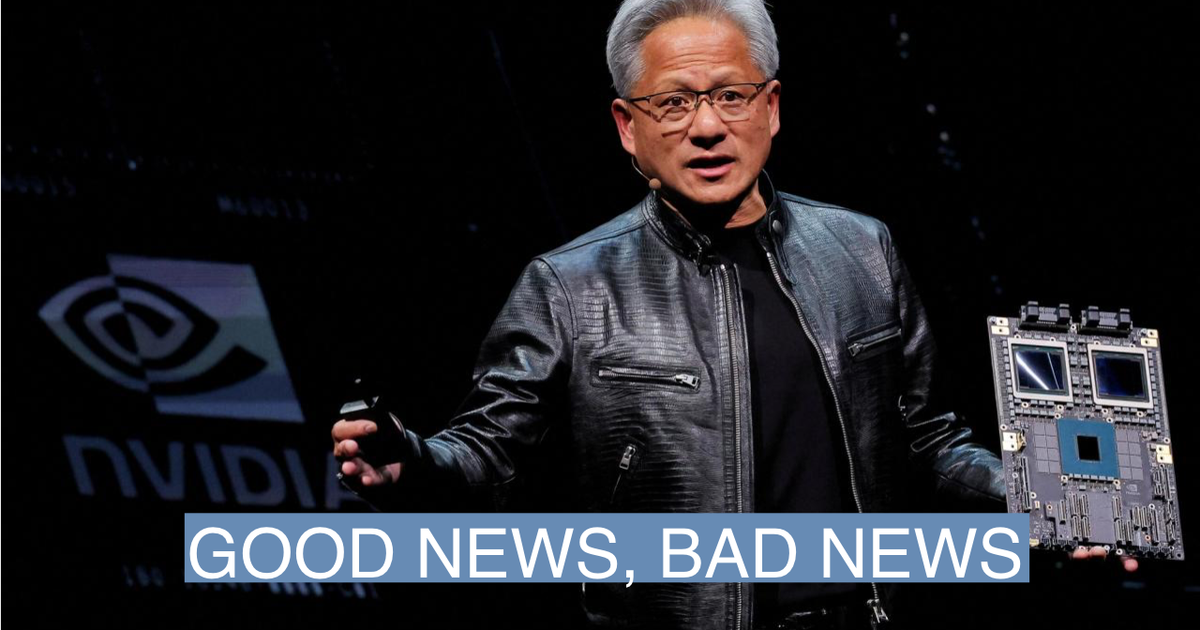
US eyes antitrust investigation against Nvidia as market value surpasses $3 trillion
The AI chip manufacturer’s value surged past tech giant Apple this week to claim a spot as the second-most valuable company in the world.
semafor.com
59 points · by ilamont · 2y ago · 80 comments
It doesn't immediately ruin Nvidia and its moat, but it paves the way for competition that isn't thwarted simply because the leader in the space has proprietary software that everyone uses as the de-facto standard.
This would make it possible for AMD and other competitors to compete on hardware and how well they can integrate the software. It would also diversify providers and in all likelihood accelerate AI development as having the same software work across different hardware means there is more total compute available (one of the current bottlenecks as I understand it)
[0]: Kind of like how anti-trust with Microsoft ended up accelerating the market space for alternatives to their products as they started maintaining official documentation for their file formats used across Office products, as part of their strategy to stave off further issues of anti-trust. Same reason they open sourced C# by all accounts.
i wish there were an obvious way to filter articles down to just those based in established vetted facts.
And it's as much as you're going to get until "US formally announces antitrust investigation".
that's the problem : it's hearsay presented as fact in the title.
https://news.ycombinator.com/item?id=40593275 U.S. clears way for antitrust inquiries of Nvidia, Microsoft and OpenAI (nytimes.com)
2024-06-06 148 comments
The problem is if development of those GPUs has such a high fixed cost that in a more competitive environment revenue does not pay for it. But that seems unlikely to me at a first glance. AMD, Apple, Google, and Facebook all have their own chips. They just don’t have CUDA to go with it, or don’t sell their chips to customers.
Rather, a case like this would lower prices by increasing competition. Other commenters have mentioned that if CUDA opened up, that would help companies like AMD become more competitive. Right now, if you want CUDA, you are forced to buy a GPU from Nvidia. So broader CUDA interoperability would benefit "also-rans" and consumers too.
[1] https://www.ftc.gov/advice-guidance/competition-guidance/gui...
You fix the anti-trust issues and super charge AI development just by open sourcing CUDA.
It'd reduce the US advantage over Europe-- since an AI startup could actually do useful stuff without breaking the bank on training and running the models, but it'd basically be a rebalancing where hardware companies get less and actual AI companies get more.
Then again, it never "required" consumer harm as far as I've read.
This has zero consumer harm since an insignificant fraction of consumers use Linux.
The harm is in their control of both chip making and e.g. CUDA. The analogy would be Intel refusing to license 8086 and x86 to AMD [1].
[1] https://itigic.com/x86-on-intel-and-amd-why-cant-anyone-else...
How would a significant fraction of consumers use Linux if it's not supported by a monopolist?
edit: also, is the premise even true? Are these compute farms really running windows?
Consumer harm comes when there is intention to control consumer choice. Since Linux isn’t the biggest platform, but a major choice: It is therefor harmful for Nvidia to not support it properly.
Check your bias.
Second, what? The drivers for AI work loads on Linux are powering massive models right now.
I think what you actually meant is “I don’t understand antitrust laws or really underlying tech and am mad I can’t game on Linux”
As far as what I read about the driver stack, they only recently (within a year) release source for kernel modules. They did not open source the whole stack. And these are only new modules in an alpha state.
Its basically the bare minimum.
Most people aren't running ML on their workstations and these mostly use entirely different types of cards.
If anything, I would take Nvidia, AMD, and maybe Intel to court for price fixing their GPUs.
Lack of consumer harm requirement is starting a comeback because it's during monopolization effort, consumers actually benefit from low prices. Once monopoly cements itself, prices tend to skyrocket and quality go down because factors make it very difficult for competitors to emerge.
I don't like what Nvidia has done to gamers but they're not really a monopoly just because AMD and Intel were too busy tripping over their shoelaces and Jensen Huang built a well oiled machine that outcompeted everyone else.
Nvidia is a monopoly in the sense there is no competition, but unlike monopolies that are illegal this one came about as a result of the rest of the market simply not bothering to play while they kept pressing on.
Succeeding so hard by legitimately outcompeting every other fucking bastard in sight shouldn't mean getting slapped with antitrust.
More discussion: https://news.ycombinator.com/item?id=40593275
* they're taking action to prevent others from making other GPUs compatible with CUDA
* they're buying up foundry and packaging capacity
It's probably likely that there's execs at Nvidia who know these things are good for them and bad for their competitions and have explained it in some internal emails...
For those that don't remember, here's examples of what MSFT did:
1. Kickbacks to computer OEMs to prevent the installation of alternative OSes. Basically buying market share & preventing competition.
2. Embrace, extend, extinguish to take over standards protocols in favor of Microsoft-developed ones.
3. Unnecessarily integrating IE into the OS, making it the default browser, and giving it access to OS APIs to work and perform well that other browsers couldn't do.
4. Leverage their OS to maintain a monopoly in the office suite space and use the office suite to maintain a monopoly in the OS space.
Milking your customers to the max is the opposite of what you'd do to illegally maintain a monopoly.
But from what I’ve seen they haven’t really done anything anti-competitive. They seem like the same company as they were years ago: selling devices, software for the devices and support for the software.
Compare to the tech megacorps who have evolved via acquisition, data brokerage and enshittification and always seem to find new ways to pop up and make you roll your eyes.