The Weird Nerd comes with trade-offs
A metascience post of sorts that argues we should take human capital more seriously
writingruxandrabio.com
445 points · by jseliger · 2y ago · 477 comments
The exact stereotype differed by domain... the performer who is a diva, the self destructive author, the manic artist... each with a hint of nobility but also quite off-putting.
The author wanting to combine Weird Nerd with autistic is very incorrect IMHO... I've known a lot of weird nerds, am one myself, and there's lots of different flavors, most of them not autistic.
So much of talent is just really caring about something specific. Caring about it above other things. Specifically above external motivation and incentives. Do that and the weirdness grows naturally, neurodivergence isn't even necessary (though it might help)
I almost wonder if nerfing autism to the point where it's a fun thing to talk about having on tiktok is a way to demonize effective interventions so insurance companies won't have to pay for them.
It's a mix of romanticization and a change in acceptance and understanding of the two, and they do often go hand in hand as we've seen.
But things like the tiktoks mentioning "My Ausistic brain" or "My ADHD brain" are a bit over the top and are making it feel like it's being treated as a 'cool thing' to have.
For me personally I knew I had some sort of autism or ADHD decades ago. It was only when I started having massive issues focusing on work a couple of years back, combined with stimming and an increase in sensory issues that I decided it was time to investigate and sure enough, diagnosed with both. Out of the ~20 developers at my workplace a good 2/3 of them are either diagnosed with one or the other, or exhibit strong signals that would indicate they've likely got at very least ADHD.
The "my ADHD brain" stuff isn't my thing, though I am pretty sure I have an ADHD thing that's so mild it doesn't quite qualify for the second D, but I have a heavily ADHD spouse, and she likes them. I think it makes her feel less crazy/dumb for doing the admittedly sometimes amusingly boneheaded things she does, like bashing her arms and legs into things or making tea and forgetting it a moment later. But also she has grappled with how that content flattens ADHD into, her words, "quirky ditz syndrome" and much rarely goes into the darker aspects she struggles with, like being completely unable to accomplish a basic task for hours on end and getting increasingly frustrated with herself, or her "zombie hours" when she gets absolutely stuck in her phone (I eventually helped her setup parental controls on iOS to boot her off after awhile, but even that being couched in things called "parental controls" is humiliating for her).
Didn't investigate and get treatment until it imploded my career...
The people that think it's trendy are young, they often live at home with parents so I think it's a case of their ADHD / austism not yet having serious repercussion's.
I've spent a lot of time trying to avoid things that challenge my attention span, mediating and journally, and trying really hard to use organizational tools/apps. With some pretty decent success.
I really struggle with knowing when disorder is just code for anti-human (or anti-your personality) work.
https://www.theguardian.com/australia-news/2017/feb/23/outcr...
(after the outcry, the decision was reversed)
But yes, it is a serious condition and feeling awkward is not in the same basket.
The only reason to appropriate the term "autism" and associate with that condition is to medicalize one's psychology and obtain funding and services that previously were reserved to "low functioning" autistics (before that term was even necessary).
(edited to clarify)
At 7 years old, she has mental capacity of 2 year old.
With the right help, she can be somehow functioning, but surely won't get into STEM. Being "weird nerd" is pretty orthogonal to being actually autistic.
Even assuming that someone is a high-functioning autistic person - now what? As far as I know, there is no course of treatment that can cure it.
Is it just about wanting a label for one of many reasons (to find a tribe, evade responsibility, get accommodations of one form or another, etc)
Don't know anything about the topic and am kind of curious.
Look at every thread about the subject on these boards: it's filled with people claiming to be "on the spectrum" (aren't we all?).
>nerfing autism...is a way to demonize effective interventions so insurance companies won't have to pay for them
What a bizarre conspiracy. Are treatments even expensive?
It’s much easier to pretend it’s all a scam and not do anything, or penalize/force people to ‘act normal’. At least for insurance companies, teachers, employers, and often parents.
Which is why a lot of folks with ‘actual’ ADHD/Autism have a lot of PTSD from their childhoods. (And no, not a joke.) Severe, triggering, legit PTSD. Objective, causes the same physiological symptoms as those in war zones type PTSD. Except for it being around ‘weird’ things like school, childcare, interactions with their parents, teachers, peers, instead of when their buddy got blown up by an IED.
To make things even more complicated, persistent and repeated traumatic events that a person is powerless to prevent (usually in childhood, but not required) tends to cause Complex PTSD - which has a lot of overlap with ADHD and Autistic symptoms. Like 80-90% depending on which set of definitions one uses.
A really good way (in my experience) to get Complex PTSD is to be around someone like a parent/caregiver/partner with Antisocial Personality Disorder/NPD/BPD and suffer repeated adverse events because of it that they can’t escape. Something that if it’s a Mother doing it, Society will actively prevent someone from escaping.
Fun times, eh?
As to how to stop or get out of this? Who knows. A big underlying problem (and why society defers to the Mother in most cases here) is that there is no chance there will ever be enough resources to actually figure out the underlying truth for most of these situations.
That is because the real problem cases fundamentally work via manipulation and hiding abuses, so good luck. It would require an objective, unbiased expert (if such a thing is even possible) to follow the kid around 24/7 to see what is actually occurring. For months, or even years. And frankly, in my experience a large portion of scientists, engineers, medical doctors, nurses, police, special forces, and firefighters have backgrounds like this. So maybe this kind of thing is actually essential for society to function.
And regardless, solving this may be like solving the obesity crisis by getting everyone to run on treadmills and get fit or the like. That just ain’t happening.
This is a really nice statement. Definitely agree with it. I've often seen so many fast-starters in many fields who just taper away, because the subject just isn't interesting to them, and it was the peeps who stayed in the field that ended up becoming really good at it. Definitely holds up the old "Average intelligence and persistence has accomplished much more than genius" quote
"Average intelligence and persistence has accomplished much more than genius"
For hard problems, high IQ is necessary but still insufficient. You are not going to solve a hard math problem with average IQ no matter how much persistence you throw at it.
I'm inclined to disagree, but there's an important piece here that I've found when solving problems that were at least hard for me: sometimes I can get hung up on making a particular approach work when it's not going to and what I need to do is back up and find a different angle of attack.
For example if you're solving a hard math problem with little math knowledge and average IQ, if you're really passionate and persistent about it, then you'd realize you first need to learn more math to build your understanding of the domain. IQ/persistence in this case is not really about the problem itself, but more about the problem-solving process itself.
I'm sure your diagnosis is legitimate, but also I'm inferring from your comment that you are married and gainfully employed; so it sounds like you're able to build and maintain relationships, as well hold conversations with strangers or non-close acquaintances when necessary.
In years past would any professional have bothered to test someone like you for a disorder?
Just because things seemingly turned out OK doesn’t mean the treatment was appropriate. In the same way, just because someone manages to “get by” doesn’t mean they don’t need to be diagnosed. It’s just making their life needlessly more difficult whereas they could yave more resources that reduce the burden they have to live with every day.
Just knowing you have a diagnosis, regardless of whether or not you are treated, can be incredibly empowering and helpful. It isn’t a mystery why other people could sit down and study for three hours when I was in college and I couldn’t. I was diagnosed with ADHD, I knew where my blockers were and what they looked like (and continue to!) It gives me a lot more control and ability to manage myself day to day vs. assuming something is wrong with me. The latter feeling can be incredibly demoralizing and even lead to self-destructive tendencies such as a self-medicating with alcohol and drugs. After all: Why bother trying if you’re convinced you’re truly broken? It’s not something that has a name but that other people share this problem with you and manage is, again, incredibly empowering.
The traits you are describing here and autism don’t exclude each other. Many autists live well. Some Fortune 500 founders and/or CEOs are autistic. I’m tempted to conclude you are projecting a stereotype, but I might be reading too much into your post.
I've thought of being tested by a doctor but always think "What's the point? How is it going to help knowing?" so I'm curious as someone also well into adulthood if you've had any impact from knowing.
I'm also married and am able to keep a job and function relatively well even though I'm not the most sociable person.
Can I ask candidly, what did you gain from knowing this? Presumably this didn't have much effect on you, since you seem to be fairly successful - finding a partner and getting married and presumably also having a decent job.
Seems kind of like a vanity validation for your wife rather than a benefit to you.
For instance, I spend a lot of time scripting conversations and I've found if I don't do this it will have a meaningful negative impact on my ability to communicate with people. Almost like if I don't practice setting up the path between a concept and the words, then when I need to talk to other people that connection doesn't exist and I just can't put things to words.
Yeah, the benefits are a mixed bag and subjective but that's why we should normalize self-dx rather than insisting people have to get a medical opinion to be "validated".
> I recently argued that many Weird Nerds (I called them autistics, but people really hated that)
These are the same thing. The author recognizes that. Everyone recognizes that.
But I draw my ingroup/outgroup boundary broadly enough to include all non-sociopathic humans and several other species; I have zero motivation towards spectator sport; music only holds my interest for a few plays and then bores me; I can "visualise" my sense of balance strongly enough to completely override my actual sense of which way is down; my body self-image is almost entirely under conscious control (as in: I can't be body-dysmorphic because I don't have a consistent morph to dis).
It would not surprise me if ASD is overrepresented in scientists and engineers.
However, people also imitate their tribe, and seeing "weird nerds" with mental illness may get other nerds to emulate that behavior without actually being mentally ill.
Would neurodivergence have to be native (so, not grown "naturally") and at which point does weirdness fit on the spectrum ?
Recently I think people are more receptive to lower degrees of neurodivergence. I see it the same way people understand that you have a gradation between having difficulties climbing stairs and not being able to walk. We could probably have it more in the open that many are not full blown clinically diagnosed ASD patients, and I wouldn't see it as an issue to have "false positives" of diversity lumped into neurodivergence if it was destigmatized.
What I'm not clear on is whether this translates to better real-world interactions. Certainly, it raises awareness of the conditions, but just watching a video does not necessarily lead to smooth conversation. Generally meetings with famous actors are pretty awkward and it is even less clear to me that someone who watches ADHD videos would necessarily enjoy meeting an ADHD person irl, particularly one that doesn't make engaging videos with millions of views.
We have small and graduated buckets for absolutely anything that impacts how we socially interact with someone. Which town they come from, nationality, ethnicity, educational background, religion down to specific cult group, football team, wealth level, parent's profession, family composition etc.
Any of these has potential for negative discrimination, but we also use them for improving the interaction and mitigate confronting issues. The small and graduated buckets do IMHO help avoiding the negative impacts in the first place.
In that context, everyone is neurodivergence because, afterall it's a spectrum we're all on and nobody is going to be deadest average. At some point we have to define at what point these spectrums become clinical. The kind of language you see in the DSM for stuff like this is "does it affect daily living/relationships/health in a negative way".
Being neurodivergent isn't a disorder, not showering because you're obsessed with programming probably is.
Thing is, I'm not a psychiatrist, the author probably isn't, most of us aren't. The question of whether it becomes clinical is IMHO irrelevant to most of us.
We won't be standing in front of someone pondering whether they can apply for disability, the better question will be how comfortable they are at keeping eye contact for instance.
People that are between the two, the vast majority of people, are not said to be either autistic or schizophrenic (you can't be both at the same time but can go from autistic to schizophrenic with a degenerative disease). Everyone is not "on the spectrum" for autism, again by definition no one that is schizophrenic is "on the spectrum" for autism at all so your comment is nonsensical.
But I just don’t see the point of diagnosing people with things unless it causes some kind of actual disability and dysfunction.
Just one spectrum, 2 dimensions? Is that all we get? It's a linguistic short-cut, I get that, but I wonder how useful it is, how much nuance it conceals.
Here's an image that shows what I mean: https://ih1.redbubble.net/image.4683716510.9542/raf,360x360,...
The spectrum can essentially be thought of has the degree of neural "over-connectedness".
It also feels a bit tech-centric... probably tech is someplace autistic attributes are particularly helpful, but other subjects are probably most compatible with other kinds of neurodivergence.
Some people these days who are anything but call themselves autistic, ADHD, etc because they don't have a defensible banner anymore under which they can be passionate or ambitious without some reason behind the reason for it.
The only way out is empathy - true empathy, a willingness to accept sometimes (often) people do things for the sheer joy of doing them.
Hard disagree, which I think is your point. I see this as an offshoot of anti-intellectualism: distaste for / absence of passion and ambition is cultural, not biological, and culture becomes self-sustaining.
> The only way out is empathy - true empathy, a willingness to accept sometimes (often) people do things for the sheer joy of doing them.
Strong agree, and it's wild to me that this has indeed become a radical idea.
I suspect most of us here are... At least in some degree.
That makes one of us - no consensus required.
Monotrope? AuDHD? Brenner's Lacanian "Way of Being"?
Forensic accounting of which spectrum owns which symptoms is the new ultra-sport - winner take all. The thought that we wind up with yet another control vs. uncontrollable dichotomy of Stoicism worries me, at least in the West.
Walk around an Amazon warehouse unannounced for an afternoon observing its transformation of surveillance capitalism into a set of funhouse mirrors where the observer cannot discern between observer and observed - an infinitely extensible Heisenbug. It's as if you took a page from the 1980's PC design playbook and decided that delightful beige was the architecture of the future - a kind of inorganic revenge of the techno-typicals.
If so, I have to disagree vehemently. That is not my experience at all and feels extremely homo economicus and - to be honest - depressing. I want to care about things I like and that bring me joy, even if no-one pays me for that or validates my choice.
Most extroverts aren't ruthless machivellian self interested people like you are worrying I am claiming, but they are focused primarily on fitting in and being accepted by others- and do choose their activities and behaviors mostly based on that. Their interests are genuine, but the biggest factor in them is usually who it connects them with, and how it makes them appear to others. What do your hobbies, car, clothing, etc. say about you and how will that affect how others see and treat you?
Introverts are, as the name implies, more inwardly focused- and although they enjoy social connection and acceptance also, it can be exhausting and therefore less motivating, and generally takes a back seat to more inwardly generated concerns. It is often wrongly confused with being socially awkward or shy, which isn't the same at all.
Caring about something beyond a typical amount for intrinsic reasons is a neurodivergent marker?
Is this really the HN I grew up with?
I'm not sure why people are so upset about this suggestion... I'm not sure if they just disagree, or if they don't like being labeled neurodivergent.
Different types of neurodivergence are highly correlated- a quick google search suggests introversion, left handedness, autism, dyslexia, and ADHD are all highly correlated. Left handedness is also a type of neurodivergence that goes a lot deeper than which hand you write with.
First it's absolutely true that orgs that purport to support weird nerds will revert back to rewarding politicians. I've seen it happen, and typically has to do with who is doling out money.
However, in my experience the vast majority of brilliant nerds way overextend themselves, and are much too confident outside their domain. They're also much more likely to be jerks and will tumble from conflict to conflict until they get their way by attrition or status. Conflicts are strangely more personal because so much ego is tied up into it. They're more likely to assume they're right in every (non-tech/science related) situation.
My advice to weird nerds (assuming emotional intelligence isn't an innate skill) is: Find a way to turn your brainpower onto this challenge as equally important as your core interest. Treat interacting with your institution like a long term engineering project or investigation. Think long term and be strategic, create and track longer term plans, try to learn what people respond to, what works and what doesn't. Always try to be kind and maintain some humility, but assuming you aren't sure what that really means, then ask for lots of feedback. Or you can just find someone you trust and delegate all of this to them, like a technical founder hiring a CEO.
(Edit: relatedly, if you work for or with weird nerds in a support role, my advice is to take full advantage! They might have a useful point, so set your own ego aside, don't take it personally (they are weird), and try to listen charitably. Their work is what you're here to support, after all.)
Your next paragraph gives advice to the weird nerds, but this is practically a genre. What I haven’t seen much of is advice to an organization about how to deal with what you’re pointing out here.
You have an employee that’s brilliant in technical area X but also has very strong and very wrong opinions about how the company ought to structure its cap table, pay its cleaning staff, and market to potential customers. He gets into constant arguments about these things. What do you do?
Definitely worth it for a Nobel Prize level intellect but I’m not sure how far below that the line is.
I think it's an interesting question, how organizations should deal with this. I think my previous employer actually dealt with it quite well - for the issues I cared about I _was_ given the opportunity to express my opinions and also share them with the people who were in the positions for making decisions around these issues. I was generally listened to patiently and also got (sometimes unsatisfying) explanations for why the actual course of action was different. I was _not_ given the authority to make these decisions or push these issues (the ones outside my area of expertise) through. I ended up leaving the organization in quite a bit of frustration, which I think was probably unavoidable, but I learned a ton from this episode, and we're otherwise still on good terms (I help out with little things now and then).
That's what you do.
A lot of very smart people think because they're very smart they have some kind of exceptional insight into the inner workings of all things. They don't. And they need to be reminded of that. Intelligence allows someone to gain that insight faster than those in the middle of the bell curve of IQ, but it doesn't magically confer it. It still takes time, reading, research, and seeing it in practice.
Or put another way - what I call the "Iceberg Analogy" - every discipline in life is like an iceberg. The average person sees about 10% of what's actually happening, and is able to comprehend that without too much effort, but the other 90% that's below the surface takes a lot to fully make sense of.
Except most of the time ... they are not. Most non-junior WNs learn to have significant respect for those doing the work. The Weird Nerd judges based upon objectively observed behavior rather than social cues or group opinions.
Mostly, the Weird Nerd gets in trouble because they simply aren't fooled. And that pisses of corporatocrats like you worse than anything else.
The WN can see that you are rewarding the politician rather than the person who actually did the work. The WN will actually calculate the full cap table and see the distortion that flags the insider backscratching. The WN can envision exactly how the sales incentives will be exploited. etc.
Effectively, the WN is a canary that detects bad managers immediately unlike normal people. And that's something that bad managers simply cannot abide.
When you talk to people, you have no idea how much time they've spent before that conversation gaining insight. Maybe their simple phrase is a culmination of several years of research and insight, whereas for you, you just thought about this topic yesterday.
Seems like normies need to be reminded of that way more frequently than nerds.
The same thing you do with any highly anti-social employee, fire them. It doesn’t matter how sophisticated their technical skills are, if they are incapable of transforming that into value for the company, then their value to the organisation is at best nothing, and more likely negative.
Companies/institutions are social systems, and the phrase “politics” is mostly just used to refer to “social skills”. If too many of the participants are corrupt or incompetent then the social network of the organisation can become especially toxic. But that’s a different problem to the fact that if you want to contribute value in such a system, you need to have social skills.
Can you get value out of somebody who has terrible social skills? Maybe sometimes, but it takes a lot of babysitting. Even then, you’ll never be able to properly trust that you’ll be able to rely on them to do anything ever. So it’s almost never worth the cost.
Call him to your office and warn him his behaviour is unacceptable as it is interrupting the business. If he still persists, fire him for insubordination and/or disrupting the workplace.
The difference between a master and a nerd is whether the talent is socially desired, and the difference between being employed and unemployed is whether you can be productive to society regardless of your personal leanings.
Brilliant nerds that solve problems for the organization on their own usually don't get rewarded as much as politicians despite the skills perhaps being more rare at the organization than politics.
For example, you could deep dive into a bug that's been hanging around, finally find the really technical solution to it, but most of the money holders won't be able to appraise that value from the technical details alone.
In general, simply giving away things to companies will usually get you taken advantage of (usually not maliciously).
Doing a tour to explain why it's a problem first, then providing the solution, is the much better alternative.
It really is true that it's a thankless job if everything is working well and you're being proactive by fixing problems before they become a problem.
There are exceptions where the money holders can deal with the technical details and don't need to be sold on the problem first, but it's rare and usually those are prestigious jobs in close proximity to lots money.
it's a skill like any other, so if you put in dedication and practice, you can get better at it, just like practicing leetcode. whether or not an individual wants to do so is on them.
edit: I wish I had more skill at building coalitions and/or pushing an organization in a direction without saying "we need to do X".
If this behavior is rewarded, then you haven't eliminated politics - you've reinforced politics but eliminated social cohesion and decorum as elements thereof.
Status is immensely important. people who have status or convey it can get away with being wrong or espousing falsehoods and will not be called on on it. If anyone is guilty of speaking outside of his or her expertise and spreading bullshit, it is likely not going to be the nerd.
Take social media: it is more about who they've said you are rather than _what_ you say. The key message of the medium is less the content of the message itself (though it figures in!) and more the combination of your online persona's followers + likes along with the message itself. I'd argue social media is a real shift in the Internet itself where we began to take online reputation very, very seriously, to the point that we decided we'd believe that likes were more than just Internet Points.
And people _love_ this sort of structure because it means that something other than actual competence can be the deciding factor. They have a shot at being in the cabal and among the deciders. And it's a lot easier to evaluate people: simply see what other people say about them.
Not saying that non-technical factors don't matter. They matter a lot and are often very easy wins to pick up. But it's clear people like systems that aren't centered around competence as much as they may claim otherwise. And areas where that isn't the case seem to eventually be converted to more conventional hierarchies.
It's different competence. Not incompetence. It's being competent at identifying marks to exploit, attention-seeking, etc.
I don't particularly care for it myself and feel pretty strongly that it's narrowing the gap between humans and apes, rather than widening it, but it's still some kind of skill.
Now we have self-identifying "computer hackers" and "security researchers" and "red team operators" who probably have never heard the words "shellcode" or "ASLR" in their life, and whose technical chops cap out at wrapping payloads from hardcoded URLs in a 100-line golang script and call it an advanced exploit. We used to call them "script kiddies." "Compiler developers" who couldn't tell you the difference between a regular expression and a context-free grammar, and simply wrap babel in a javascript snippet, calling their glorified terminal alias a real compiler.
Go look at the posers on r/programminghumor, or, god forbid, fucking Instagram influencers releasing content and memes about programming instead of having any technical competence with computing itself. While being a computer nerd used to be looked down upon with derision, it's now trendy and hip to be a "software engineer," much in the same way geek culture was appropriated and colonized by outsiders to the field. People think that 16 weeks spent studying JavaScript at a bootcamp puts them on even footing with shut-ins who spent tens of thousands of hours in front of a bash terminal and customizing their vim setups. It's the absolute depths of Dunning-Krugerism. These aren't geeks; they don't act or talk the same as people who have been embedded in this culture for years and lifetimes, even if they parade around superficial status markers to try to pose as one. It's as if an Anglophone went to a country where the predominant language was one other than English and started appropriating a few dozen words from the native tongue to pose as a local - "you're not from here, are you?"
Perhaps this stance on computer geek culture is "elitist" or not "inclusive" enough, but be aware that maximum inclusivity tends to result in the same regression to the mean that you describe. It's much easier to spin a narrative about how 31337 at programming you are when you can write any bullshit you want on social media and pose and identify as something you are not, while those who are actually out there writing software instead of posting about it, pushing commits instead of simply updating their GitHub READMEs, have scant little to show to the blithering masses of people who confuse Internet Points, narratives, and hearsay for actual competence. It's a continuation of the postmodern trend to socially construct status, narrative, and indeed, even truth, by manufacturing simulacra and digital content to stand in for and completely replace any underlying reality.
In the real world, the "Weird Nerd" rarely checks all of these boxes, let alone most of them. I bet a lot of people will read this and identify as the Weird Nerd despite checking none of the boxes. That's the nature of articles that leave out the nuance and instead give us the most idealized view of a noble scientist who was a victim of the system. It leaves an opening for everyone to feel like they were a victim of the system.
That's why this problem is far more complicated than articles like this would lead you to believe. Many of the "Weird Nerd" people out there aren't perfect scientists or engineers unfairly shunned by the system. Many of them have real flaws of varying degrees that would require a lot of guidance and mentoring even within a perfect system. And it's not easy! In fact, it can be very taxing on teams to work around the quirks of your average (non Noble Prize winning, like this article) Weird Nerd even if they can produce good output, which is why so many companies select for Boring Nerds instead.
I can’t speak for academia, but in tech companies I’ve worked at I’ve seen a marked improvement in management when there’s a tech track for engineer advancement such that they never need to become managers, if they don’t want.
It's not surprising that lots of people opt out or wash out of this system because the expectations don't match the formal preparation for it.
Outside laboratory science, the expectation to bring in funding is not as strong. You don't need much money to do research, and grants are not as readily available. As far as the administration is concerned, if you do your teaching duty without too many issues, you can use the rest of your time as you see fit. Academic politics revolve more around personal relationships with the tenured people at your department.
Problem is that many places design their ladder such that non-managers are expected to do manager-like work past a certain level. This is to much dismay of those people who are not trained in management skills, and most of the skills they have acquired thus far are no longer being put to good use. These Weird Nerds may very well understand that being at the next level means making impact that exceeds what one person can do alone, nonetheless they will become increasingly unhappy at those roles. Maybe they will leave, maybe they will avoid getting promoted to higher levels in the first place.
I mean the entire VC culture is ate up with the 10x CEO, the fact that a few other people lower down the totem pole can 10x in their narrow field shouldn't be a surprise.
Let's forget the Weird Nerds for a minute and look at the following situation: a person W is technically savvy enough to have accomplished a big chunk of project X. Say, 90%. And then there is a 10% left which takes as much work. So management hires people from a consultancy to pick up the 10%. Except that these guys don't write much code. They are adept at finding their way into technical management at light speed and want to push what should be their work back to W, while doing the bare minimum otherwise. Now W has more work than before, because he has been pushed into politics. At the very least, he will need to communicate to his colleagues that they need to pick up the slack for real. With some luck, W will find a nice way to do that, but that's the kind of problem he is ill-equipped to handle.
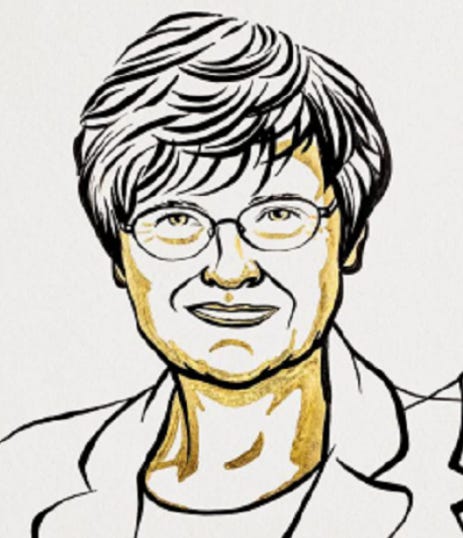
There is something in this article which is overlooked in these comments: people like Katalin Karikó are often under a lot of pressure to perform. They can have crippling debts, or be supporting an elderly parent or relative. Or fear something as life-wrecking as a deportation. They don't get the luxury of being "average", because there are more desirable "average" candidates than them: people who speaks with the right accent or in the right cultural code.
The industry has really changed though. It is much easier to hire social well adapted people who can code at all than to hire a bunch of people with social problems who can code really good. The former is scalable at least, the latter breaks down as no one can get along.
Individual efforts are completely different. A programmer like Notch can produce Minecraft on his own and then just get help to push it into a maintained product. This happens all the time, but you can’t produce that easily (and definitely not consistently) at the big corp level.
There's plenty of counterexamples in the software space, to the point where most great software was originally written by a single person - C, Unix, Linux, Git, TeX, Python, Ruby, Perl, SQLite, QEMU...
Most of these now have huge teams maintaining them of course, but the initial research and engineering that was needed to come up with the golden egg is usually a one man show. C designed by committee is COBOL.
I’d argue that it’s not due to communication costs. The more you attempt to parallelise a problem the harder communication gets.
If you have no financial constraints? In what world do you spend massive amounts of money to mitigate people being "weird"?
And frankly, nobody's irreplaceable. If you're #1 in the world, but casually drop racist and sexist slurs, odds are that the #2 expert in the world isn't that much worse than you, nor #3..#10.
No matter if one is "weird nerd" or not
I love weird nerds, I love the sort of people who obsess about things, who work on them as obsessively as I do, I love info dumps, I love people who are passionate even about bizarre, niche shit I don't care about (actually, I love them even more for it!) but seriously. You need to be able to hold a conversation. You need to be able to talk productively with your fellow people, including difficult conversations. You need to open to negative feedback, to be able to take criticism or contrary viewpoints without turning into a puddle of some combination of depression/rage/self-hatred, or people are just not going to get on with you.
And I fully accept that autism runs through this pack of people like a freight train, and that's fair, I am always down to provide accommodations, I will talk to people how they need to be talked to, I will bend the norms of social interaction so it's more palatable, all of that, zero issues whatsoever. But even with that in consideration, relationships of all kinds are a give and take, and if all you do is take, people will notice, and people will avoid you.
You implying that non-nerds have any of these traits lol no they don't it's just that they exhibit more of group-thinking and less individualism, so they provoke less situations that might potentially cause conflict.
My experience with nerds is "ok each has their own opinion this is going to be difficult but let's try cooperating" whereas non-nerds act exclusively "my way or the highway" because they have never previously encountered the idea that their view of the world might be wrong "because I'm the majority".
The thesis of the initial discussion is that it is unfair to hold "weird nerds" to certain standards.
The person you are responding to is claiming that actually some of these standards are important.
Your response to that of claiming that the standards are important is to say that actually normal people don't pass those standards either.
This doesn't refute the argument that the standards are important, but would actually agree with them that actually yes it is totally fine to hold people to important standards, weird nerd or not. (And in fact, you think the weird nerds are even better are following the standards! So what is the issue of holding them to those standards then?)
edit: to be fair, it is extremely necessary to have both voices at the table challenging one another
I wouldn't want to tar all people who might be perceived as Weird Nerd, based on one data point (which AFAIK might not even be due to them being a Weird Nerd).
Almost all of the too-many people I've seen burn others under their influence, I wouldn't have called any of them Weird Nerd. And none of them appeared to be geniuses. Rather they tended to be at least somewhat successful as political operators, unlike how the article characterizes Weird Nerd. (Arrogant seemed to be the most common attribute, then greedy, dishonest, and unprintable bad word.)
Someone might decide to call some of those FTX cryptocurrency scammers Weird Nerds, but you could also just call them overprivileged brats with consequently warped worldviews.
And in what way is Katalin Karikó responsible for your mistreatment? I doubt you would have said something similar about a black or gay former manager, attributing your mistreatment to their race or sexual orientation. But for some reason it’s perfectly acceptable to attribute it to a Weird Nerd personality.
>There was a time when academia was society’s refuge for the eccentric, brilliant, and impractical. No longer. It is now the domain of professional self-marketers. As for the eccentric, brilliant, and impractical: it would seem society now has no place for them at all.
https://www.goodreads.com/quotes/7004628-there-was-a-time-wh...
I would venture a guess that the vast majority of "Weird Nerds" are not Katalin Karikós, and instead are simply difficult jerks who are not nearly as smart as they think they are. Hubris mixed with obstinance is a recipe for misanthropy.
Also, the notion that the internet is a place where your outputs are judged solely on their merits, so that you don't have the "ability to sell yourself and your work", is absolutely hysterical.
Linus's approach is very good at setting this precedent, while staying really quite friendly, and it's what attracts a lot of people to the endeavor.
How about: IQ and EQ are mostly fixed in any given individual. You can use one to simulate the other - e.g. using EQ to get help or bullshit your way through a problem your IQ is insufficient for, or using IQ to intentionally behave in a way that would be totally natural if you had higher EQ. So it's not that they're negatively correlated per se, just that if you're being pressured past your limit in one, the other will effectively drop.
The "bundle of tradeoffs," which is a more humane and human way of thinking, is at odds with the "cog in the machine" approach which began with interchangeable machined parts and progressed on to the human element. Being replaceable then becomes a prized characteristic. Indeed, one of the administrative staff suggested that anyone who seemed like they were too valuable to replace ought to be let go on those grounds alone. It's a recipe for a kind of predictable mediocrity.
Business loves predictable mediocrity, and we see it in various forms of intellectual property. Why sell a copy of Office for unlimited use when you can charge monthly and predict out your next few quarters? Own a movie? No, rent. And as academic institutions continue their transformation into administratively bloated credential assembly lines, we will see more business-y strategies worm their way in.
There's a lot of that. And in academia in general.
Many/most are decent people. But even those often haven't been exposed to the ordinary life experience of the majority people from their country. And that often seems to affect how they think about themselves and the world.
Also, there's often implicit self-promotion and self-interest behavior. Which they might think is normal, since it's in their upbringing, and in the circles they now travel in. But it's not necessarily normal to the masses of their countries (which I'd expect to tend towards more cooperative and egalitarian in some ways).
Science ultimately is a collective effort. The collaboration doesn't need to happen in real time, in the same physical place. Ideas can be spread out across time and geographies and finally one person puts them together and given our bias for hero worship, we call that one person a genius and go on a wild goose chase of how can we create more geniuses instead of asking how can we foster a environment for ideas, an environment which sometimes needs to last for decades in order to bear fruit.
I'm sorry, what, even if they're preponderant you can't just call all of them that any more than you can collectively call all basketball players "Marfan Syndrome havers"
I don't like to call anybody autistic because it invites paternalism or even outright discrimination. I even object to using much milder labels such as "introvert."
The author is conflating people who are motivated internally by making great contributions to society with autism. Many of the best artists and scientists aren't autistic, and perhaps are quite the opposite: deeply emotional and socially aware. I'd argue you need a deep understanding of social value to even want to make a great contribution to society.
Also, it's not like people with autism are automatically geniuses. Anecdotally I've found autism to not really contribute to original and innovative thinking, more with excessive fixation on a subject. There is a difference.
Autistics only nessecarily misunderstand social value in a superficial way. They are frequently compensating for a sort of "social blindness" with unusual strengths like pattern recognition to get insights into social situations in a more detached way through a different lens.
People also can be on a team with somebody who has a deep understanding of social value who doesn't have it themselves. Jobs/Woz comes to mind.
I say this as a weird nerd who is definitely on the spectrum, like I suspect many HN readers are.
> but for some reason people really do not like to call marathon winners "Kenyans".
Why might other marathon runners not like being lumped in with that country, given its incredible winningness at long-distance racing?
And even then, its a _spectrum_ meaning every person has a their own unique mix of, lets just call them quirks.
Meaning they (and you) are more than a single word like "autism". In fact in Sweden we've moved away from the "autistic diagnosis" because it's too simplistic. It's dangerous to be too caught up in "being autistic" that we hinder ourselves and others when we can do more.
Signed, a dad with autistic tendencies and a 4-year old child with may quirks that already give us quite a lot of challenges.
But the thing is, it's a spectrum.. Personally I do find it a little ridiculous because the biggest parts of autism have absolutely nothing to do with my work/interests but with social life, sensory issues, etc. And it's definitely more a struggle than a superpower (at least to me).
The best thing for a Weird Nerd to do is to find a trustworthy 'patron' who can appreciate that it benefits them to handle the messy human stuff and let the Weird Nerd do the nerd work. The problem is that Weird Nerds are often terrible at figuring out who is trustworthy and a good fit for a symbiotic relationship like this.
I think the point here can be strengthened by removing the issue of "weird traits" entirely. The simple reality is, if you are hiring someone to be very, very smart in their field, at a world-class, there is literally no one who can just parachute in and replace them, level, you need to minimize the amount of other things they have to do in order to operate at that level.
Why hire a world-class irreplaceable expert to do anything if you're going to require them to spend 90% of their time doing things other than being a world-class irreplaceable expert? Even if the expert is the nicest person in the history of humanity, it's still a complete waste if you can't support them and they have to do all this other stuff just to be allowed to function as a world-class expert.
In local parlance, this is no different than hiring a senior engineer and then 100% filling their schedule with meetings. Or expecting to hire a unicorn that is an expert in seven distinct languages and is also a manager and a high-level sales person. If I put that job listing out HR would laugh and send it back to me. Essentially making "world class scientist AND good manager AND expert sales/politician" the baseline for functionality in the sciences is just a recipe for futility.
There doesn't even have to be a correlation with "weird traits"; even a population-average distribution of the ability to me a manager + politician + sales + something else is a very, very tall ask. Add back in that there are certainly good reasons that outlier personality traits are fairly likely to go with outlier skills and it just makes it worse, but it would be plenty bad enough without that.
On one hand, I understand that I can't get a job because of my own flaws. After all, who needs a solo-only C-only [2] programmer who can't build theory of mind and thus, can't read code written by others and who refuses to prioritize employer over user?
On the other hand, it is hard, and I secretly hope the industry can change so that people like me can have a place.
Edit: To clarify, I don't think I am a Genius, just a Weird Nerd in the sense that I do not like politicking. However, I am trying to learn from my empath wife how to do it because yes, it is a necessary evil right now.
[1]: https://gavinhoward.com/2024/06/my-programming-journey/
[2]: https://gavinhoward.com/2023/02/why-i-use-c-when-i-believe-i...
In some ways, things are better than ever for folks like you. Starting and running a one-person business making software is feasible now but would've been much harder in decades past.
> Second, I work alone on code that is entirely in my head. ... Rust is great for teams ...
Unfortunately, industry has problems that are big enough that they're not easily solved with one person. So tools that work to bring about a team's success will be valuable. As will individuals who work well in teams.
Yes, you are absolutely right.
Unfortunately, I have been trying that and failing. I don't blame anyone for that either.
> Unfortunately, industry has problems that are big enough that they're not easily solved with one person. So tools that work to bring about a team's success will be valuable. As will individuals who work well in teams.
You are absolutely correct. And yes, that is why people shouldn't hire me.
Nevertheless, I think there are some problems that one person can solve.
I want to make the next-gen version control system. I think that may be small enough for one person. Other infrastructure software can be like that too.
> I want to make the next-gen version control system
While you certainly could invent one yourself, you could consider contributing to popular ones like git/mercurial. It'd help teach you both the positive and the negative aspects of their design choices. Also you could consider learning from newer approaches like Jujutsu [1] or Pijul [2] on your way to designing the next-gen system. Good luck!
I have also tried to start my own business, but that is not going well.
> Weird Nerds (I called them autistics, but people really hated that)
And I totally get why they're trying to come up with a word that markets better, and yes many people react negatively to "autist" or calling someone "on the spectrum".
At the same time, man prominent people are making public their diagnostics and assert being on the autism spectrum, and I wonder if it becomes a disservice to them to not use the term when appropriate, precisely because of how it's perceived now.
I have good reasons to consider myself neurodivergent (and others do consider me such). There are definite divergences that have caused me problems. I have what people consider "superpowers" and what people consider "difficulties".
Not certain I am autistic. Might have been considered mild or (the then-termed) "high functioning" as a kid in the 80s.
But on the other hand, I don't think it's necessarily wrong to put me in the same broad category as autistic people, because I have the same issues in the context of the article -- with being conventionally "ambitionless", having relatively little grasp of (or instinct for) power games etc., and needing the kind of support that others often do.
That category needs a name. (In the UK we'd traditionally go for "boffin", which is broadly a term of affection, but it's a little harder to spot a boffin these days because of casual clothing at the office)
Also, "on the spectrum" is used today much like "depression" was used in the '90s. It's a catch all excuse used at the expense of people actually suffering the disorder. Much like sometimes you are just sad, I would wager many people who claim to be "on the spectrum" are just assholes.
> something they choose to do
Point taken, but then switching that for "weird" doesn't feel like helping, it's still a pejorative and not really focused description.
> people actually suffering the disorder
An issue I'd take with that is the effect to which it's penalizing depends a lot on the environment and what the person is trying to do. Would two people with the same condition, but one suffering and the other not, need to be identified in two different ways ?
Is it the autistic/not-autistic spectrum? Because if so, we're all on it.
I think it's a good thing to come up with some other term to refer to these extrinsically motivated nerds that don't really care for typical social constructs but bring immense value to a bunch of types of work. That way whether they identify or are diagnosed as autistic isn't necessarily the important piece, more the result of their person.
This is very similar to the idea of the tortured artist or that to be a great comedian you have to be depressed.
The happy and well adjusted comedian or socially adept mathematician doesn’t make for an interesting story — it just doesn’t fit the popular narrative and so it gets ignored.
In every discipline there are total weirdos and normal people at every step of the way, from terribly inept to amazingly world-class.
Not selecting against weird nerds doesn't mean selecting against "socially well-adjusted Nerds".
In fact, the article says that a person can in fact be exceptional at politic and science, despite their tenets being antithetical in many cases.
> There is a strong anti-correlation between these interests (that of course does not mean there is no one who is good at both.)
Unfortunately my only solution to this is to learn from my dad’s experience and lean into instead of away from the areas Katalin disdains. Success seems to require leaning into these areas of social reciprocity. Especially in startups. Yes you must make a product that people want, but to become big it requires distribution, which requires schlepping by performing these social reciprocity hacks.
A wn is disconnected from society. This gives him the power to think and act independently. The non-wn can't do that.
(And, being disconnected like that, the wn is oblivious to a million social hints and cues. He is blind that way)
It isn't voluntary, being a wn. It's an artifact of habitual, excessive concentration, or something.
The non-wn's state is involuntary too.
Both are products of nature/society/habit/etc. Both trapped in their respective shape.
I suppose some of us are not trapped like that. There might even be a way to escape it. To make that habit-shape into something conscious and voluntary.
This had the effect of embracing those people who hadn't necessarily figured out how to be independent adults. As long as they were lucky enough to be identified and brilliant enough to be hired, they could flourish at the Labs.
I'd love to know if other settings have made similar accommodations, and to what effect.
A major risk in academia is picking a dead-end niche. We hear about the people who picked an unlikely winner. This one picked mRNA vaccines. The inventor of MRI scanning had similar problems. He was almost fired. Those two succeeded, eventually. But the people who work on E-beam lithography or vaccines against addiction didn't do so well. Both of those would have been huge if they worked well. You can't tell in advance. If you could, the problem didn't need research.
A more useful way to look at this is that doing it and selling it are different skills. This is why companies have separate R&D, production, and marketing departments. If you face a hard problem in one of those areas, you can't devote enough time to the others. This is to some extent a time management and division of labor problem.
Academia is not team-oriented in that sense. At least below the principal investigator level. Once reaching that level, university PR departments are happy to hype any modest advance into a major breakthrough. Below that level, it's a cold world. Academia seems to have built itself a dysfunctional world - a huge bureaucracy, not much of a career path for real researchers, and a shrinking pool of full professorships. So anybody who is any good goes to a startup now.
Henry Kissinger, who was not lacking in people skills, once commented that "academic policy is so vicious because the stakes are so low".
I think it is naive to take such a stance. This is the thinking that leads to layers of management, institutional bloat, non experts with MBAs calling shots and ultimately loss of the opportunity to fund genius as it becomes all the blurier who really has the vision and capability and who is just good with filling out grant applications.
One aspect of it, that has always been a part of the package, is that folks Just. Don't. Like. Me.
Most, if questioned about their dislike, may come up with a couple of things, like "He's abrupt," or "He's arrogant," but these are also exactly the traits present in many folks that they do like. They are just trying to justify this "feeling" that they have about me.
As anyone in my shoes can tell you, we're "bully magnets." Most of us were recipients of multiple atomic wedgies, in school. My grade school days were a living hell. Again, there's no real "reason" for the hate. There's just something about us that pisses them off. I suspect that the "resting bitch face," prevalent amongst us may have something to do with it. It often looks as if we're being hostile, when we're not. I spent many years, training my "resting" face to be one that's basically "harmless dork," as opposed to "angry bastard." Doesn't win me a lot of respect, but, at least, I'm not being attacked out of the starting gate, anymore.
I've gotten used to it. It doesn't even really bother me too much, these days, and it happens a lot less. Feeling sorry for myself is a waste of time. I used to get all butthurt about it, but that was just stupid of me. Others have far worse crosses to bear. In the aggregate, it's been a good thing. I'm fairly decent at my software development.
The folks that matter, stick around. I do have a fairly large circle of close friends and associates that don't let my "oddness" get in the way, and enough folks have respected me, that I was able to make a decent living.
But many of us don't have those "soft" skills, that can be important, when working in a team, or trying to establish relationships with other people.
It sounds like those are totally fixable personality defects, yet here you are acting persecuted and making excuses. What if you didn't blame other people and instead took responsibility for your own off-putting behavior?
I've worked with too many men who think they're too special to follow social etiquette, when they are actually just garden-variety jerks who use their nerd identity as a get out of jail free card.
It's far too easy to conclude that you aren't heeding your own advice. Was this some next level attempt to show what being a bully magnet looks like?
I don't understand.
Not really sure what the solution is. Maybe a huge increase in the number of national labs, as a vent for those who hit the first roll but fail the second.
We also need a vent for people who are good at teaching but not super focused on research. Drastically increase the community college system, IMO, and start paying the instructors enough to have nice middle-class lifestyles. Stop making people-people and weird nerds compete for rare grants and let them both do the things they are better at.
It doesn't take very long to find corporate examples of this alternative, and why it's not great either.
One thing is to always be looking for one's own blindspots and examining how your or other people's behavior might be misinterpreted, and defusing any potential awkwardness with honesty and humor. For example, forgetfulness or anxiety rather than intentional snubbing. And err on the side of humor mixed with some self-deprecation and self-awareness because it demonstrates you're cool, reciprocate, are domesticated, and strive to not embarrass others intentionally.
A while back, the department dean was a mildly-weird nerd but developed politician-/salesman-like cheerfulness and political skills taking some of the burden off PIs and supporting them in whatever ways were needed to bring in the big grants, licensing deals, and industry collaboration. Having 2 expert, dedicated, highly-productive grant writers were also invaluable. The grad students were absolutely going places and startups were on the minds of about 80% of folks. It was a good spot to branch out from or build a research CV but there weren't profits to be had directly there.
In the React case, I'm not sure it would have become the framework it is today unless Dan Abramhov pushed it outside of the company. That took an insane amount of effort and skill to do that, especially at the time when Angular was quickly establishing itself.
Rust required an entire company to organize behind it and Mozilla spent a fortune getting it on its feet. Otherwise, I am not sure it would have been more than an experiment on someone's laptop, long forgotten.
I'm not sure what the solution for that is, or how else you push through all of the noise. Every great discovery and advancement in history is driven by the folks who can sell their hard work or at least have someone else willing to do it for them.
(I’m not being political. I just don’t follow the connection)
It's not a dig at the movement or their values, i do think its a minority who do this, but its a vocal minority who might be capturing the movement (i don't think this is the case, but this is a danger. look at what HAES as become).
Even the proposed rule
> Any system that is not explicitly pro-Weird Nerd will turn anti-Weird Nerd pretty quickly
just feels like a misunderstanding of the paradox of tolerance[0] ("in order to maintain a tolerant society, the society must retain the right to be intolerant of intolerance").
So we need to question what the author means with "Weird Nerd", because if a weird nerd just isn't expressing intolerance, I can't fathom how anyone could have an issue with it ...and become "anti-Weird Nerd".
> Everything comes at a cost: spend more time worrying about politics, there will be less time for science. What’s more, the kind of people who really care about science or truth to the extent that Karikó did, are not the same people that get motivated by playing politics or being incredibly pleasant.
Obvious answer: We should incentivize and structure our institutions to be more receptive to Weird Nerds in order to enable further progress of science.
My take: Scientific work is by its nature unnatural for human beings. Human beings played politics for millenia and are structured to do so, mentally, physically, biologically. Structuring our society to be more receptive to the people which we are wired to not be receptive is swimming against the current.
The same argument can be applied to a lot of modern phenomena.
https://x.com/esrtweet/status/1795088812944584781
He contends that autism is brain damage that limits your max IQ and that all the smartest people are neurotypical -- the genius brain is almost necessarily a normie brain, but better.
I think that what's closer to the truth is that extremely high intelligence is itself a form of neurodivergence, which is likely to be comorbid with other forms of neurodivergence. Eric himself I believe to be neurodivergent (in some non-autistic way) with 95% confidence: one of the tells is his choice of desktop environment: a minimalist tiling window manager (likely i3) with Emacs full screen on one of his displays -- anything else he deems too distracting and a drag on his brain. This sounds very ADHD and in any case is an almost archetypal Weird Nerd setup. Neurotypicals love their Windows and Mac style UIs, and every NT software engineer I've met has no problem managing -- and mousing through -- multiple windows: Visual Studio Code for coding, Postman for making HTTP calls, DBVisualizer for database interactions, etc.
NTs also love what people like Eric (and I as well sometimes) dismiss as "monkey socio-sexual games"; and if you are smart as well, you tend to get really, really good at these. Having been around extremely intelligent people who otherwise seem neurotypical (in particular, having married one and thus gained two more as in-laws), they tend to get less into hard science fields like math and physics, and more into fields where they can wield their impressive social skills for maximum benefit such as law, psychology, or entertainment. (Great actors, like Orson Welles or Sir Patrick Stewart, fit this profile to a T, though there are some great actors -- like Dan Aykroyd -- with autism!) My in-laws were legal professionals for the entertainment industry; after that long and successful career they retired, went to seminary, and joined the clergy of the Episcopal church!
Eric's observation that all the best scientists are neurotypical-ish may be a result of what's described in TFA: in today's world, being a prominent scientist selects very hard against Weird Nerd traits because at that level, beyond a baseline level raw skill in the discipline doesn't correlate well with success; schmoozing and marketing do. The same has been true of professional software engineering for at least a decade and a half or so.
I definitely think so. If Eric had gone to tea with faculty at the Institute of Advanced Study back when Einstein and Gödel were top dogs he may well have had the opposite impression.
And they hide this behind a smokescreen by focusing on all the superficial forms of diversity (gender, skin color, orientation etc).
There never was such a time, since at least the time of Newton and Euler Academics are a popularity and status contest. You got to be eccentric only after you climbed to the top of your field.
The part about "organized manager" is surprising. If we're going to stereotypes, I would've guessed that a manager who was autistic would likely have being organized as one of their strengths.
Regarding "socially adept [...] manager", I've worked with two software engineering project managers who were autistic. They were both very different (one amiable, and had much better than average understanding of human behavior and emotions; the other came off as making an effort to tolerate people). Both were not only well-respected, but liked, and were effective at difficult work&people-herding jobs.
Even with the manager who came off as not really liking anyone by default, and even on a very difficult project, almost everyone on large teams respected the project manager (excepting one person, who couldn't stand something about the project manager, or the nature of the project). And I didn't hear the grumbling like I'd normally hear about a manager who was unfair, incompetent, or dishonest.
I play D&D. This exposes me to a wide variety of people, but unsurprisingly, a lot of them are probably what the author would consider Weird Nerds.
Most of them are perfectly pleasant people, and I look forward to spending time in their company, both in the context of playing D&D, and just as a way to socialize. Heck, at my last session, a player proposed doing a regular board game night, and I am very excited to do this with those people.
But. Occasionally, you meet someone who is just fucking unpleasant to be around. Maybe they're on the spectrum (as the author really wants to lump all Weird Nerds on the far end of), maybe they're just poorly socialized, maybe they're just assholes. And unless they're just awful people [more on this later], you learn to put up with their idiosyncracies - because in the end, they're pretty good at playing D&D, and it's fun to slay a dragon or solve the mystery of the mermaid pond, or finally get revenge on your vampire stepfather from hell or whatever. But those people? They're not coming to board game night, and they're not fucking coming to any of my BBQs. They're ok in the context of playing D&D for three hours, but I'm not willing to spend more time with them.
I think that's another reason why some Weird Nerds who are unpleasant to be around have found a safe haven on the internet, as the author puts it: because while they're still unpleasant, you can read their unpleasant words and then walk away for awhile. They're not standing in front of you, demanding your time face to face. If someone is the world's expert on a thing you're collaborating on online, it doesn't matter if you groan every time you have to talk to them, because your time with them is largely limited, and you can walk away at literally any point during the interaction and regain the will to live and spend more time with them.
I'm not sure what my point is. Maybe that it's kind of ok to not want to be around people who are unpleasant to be around, and that despite that, it's also ok for them to still meaningfully participate in the things that matter to them.
[About the awful people in D&D: it's a game, and it's made to be fun. Not every table is made for every player, and vice versa. If you're in a game, and someone is truly ruining the game for the other players by being a generally unpleasant person, I am begging you to just fucking stop playing with them. Life is short, don't surround yourself with assholes. I promise you can find more players. And if you're the one being asked to leave a D&D table because other people find your unpleasant, reflect on your actions. Maybe you're just at a table that's a bad fit for you. Or maybe you're an asshole.]
(If I currently play D&D with you, rest assured that I am not talking about you; all the examples are from past games.)
However, whenever he'd have his "cool" friends over for parties I wouldn't get an invite, in fact never met any of his other acquaintances. He explained to me once that he likes to keep his different social lives separate, and I was apparently the only one in his "tech" social circle.
That made me feel like shit, and reinforced my self-view as failing to be a normal human.
This is a theme that's continued with multiple "friends" throughout my life, to the point where I eventually just gave up trying, gave up giving of myself to others to simply be siloed or discarded once they got what they wanted from me. I got tired of the lack of reciprocation in giving me a chance to be a part of their actual life even though they were apparently getting enough from me that they were willing to keep me around when it suited their needs.
I hope some day you gain some compassion and can see that people who are different than you are still people, and that treating them as lesser except when you can get something from them (like an interesting dnd game) is a huge part of the problem in these types of people retreating even more from the social and emotional norms.
At this point, why in the hell do you think I would even _want_ to be willful part of the society you inhabit, that treats other humans as you do?
But please don't equate me with someone who treated you badly, based on five paragraphs I banged out this afternoon.
Just because I don't want to invite a casual acquaintance who regularly says things I find vile to my house, doesn't make me an incompassionate villain.
Not to defend but how is someone to recognise a fault of their own if they're not called upon? Unless its truly terrible and they know they are doing it on purpose.
The issue we live in nowadays we are all scared how to tell each other how we feel towards and that we now safe harbour them by throwing them a label and approving that to a degree.
I'm direct and blunt, if someone is doing something in a group I call them out of it; I expect folk to do the same for me.
I may be offended but you should be offended, there's no harm in that.
Granted it's a double edged sword. You tell them; they preach to their safe haven and breathe the toxic fumes of their peers. Or they actually recognise it.
But I'm a DM, not their therapist or their dad - I'm not obligated to hand-hold someone through a radical restructuring of their personality.
And, it might not surprise you to find out, some people react very badly to being criticized. And I'm not particularly interested in having an argument over my subjective opinion of a person. I just don't want to be around them anymore.
Therein lies the crux of the issue. Everyone agrees that this person needs help, but also agrees that they shouldn't feel obligated to provide it.
And so they continue on, blissfully unaware of the chafing they cause. Life goes on, and their contribution remains minimal.
"No that's not alright, cut the crap otherwise your out of here"
Why play with them and not just cut them out completely? By keeping them in group your only enforcing their unpleasantness.
It might be true that allowing minute variances between normie nonverbal feedback gatherer people to be a factor to their successes has its own problems, but encouraging everyone to drop that BS and just be offensive and blunt to make things simple is at least not a widely supported solution.
So be nice... it sometimes gets complicated to be just a nice and happy person, but you actually don't have to be a fearless warrior at all times.
Maybe I'm just to compassionate.
Not your emotions, not your circus.
Academics are as much courtiers these days as they are researchers.
I think the real problem isn't so much the skillsets of the researcher involved as much as is what is implied about the environments and the vagaries thereof.
The argument this piece is referring to and the way it is responding to it seem to deflect attention from the real problems, or rather, recasts it in the wrong way. My focusing on whether or not Karikó is "too weird" or whether it's time to abandon "weirdness", it deflects attention from all the problems that people are dealing with in academics. For every person who is "weird", there are many others who are not and still get screwed, or still others who are not but also not particularly bright and still "milk" the system or are in the right place at the right time.
This whole debate strike me a bit like climate change debates, specifically the criticism that berating people for not recycling or using plastic straws or whatever is just blaming the victim, or is hiding the real offenders behind the curtain. In the same way it strikes me as kind of besides the point whether Karikó is weird or not, or how weird is too weird, or whatever. The bottom like is academics is no longer really about science in many fields, and not even really about how socially skilled you are, it's about politics and random dynamics of fate.
My impression of academics is that it blew way past "social skill" long ago and is now in a very different realm altogether. I've seen too much fraud and manipulation to blame anyone who has good ideas for "not being socially skilled enough."
I didn't read the original tweets but the idea that Karikó should be shamed for complaining because "that's just the way it is" seems like condoning the problems and then blaming her for calling them out. The next step is complaining about people calling out fraud because "that's just what everyone does".
What was your director’s response?
Do you think there’s any chance you’re biased and blind to other innovations because you really dislike self-promotion, marketing, and branding?
I am definitely biased, but whether I am blinded to real innovation or progress is something I think about all the time.
I think I would not be opposed to the self-promotion, marketing, and branding were it in support of some significant achievement or accomplishment. Unfortunately we have a culture that seems to think showering and getting dressed in the morning is a noteworthy event.
To use a more concrete example, I ran a project to upgrade a significant piece of software in our environment that had been neglected for some time. The project went well and I moved on to more interesting work. I had multiple people tell me that we should promote it, give talks about how it was done, pound our chest about how hard of a project it was, etc. I refused. In my mind it was a normal upgrade of a system we were responsible for and frankly was disgraceful that it was in such a bad state of deferred maintenance. There was no way I would be comfortable “taking credit” for doing what should have been done years ago.
Fast forward a few years and another team responsible for doing a similar project is giving multiple presentations all around the org and all the way up to the 2nd in command of the company. I’m like wow, maybe we should have taken the opportunity when we had it to pretend like we are superheroes for doing the bare minimum of our job and not having a vendor drop our support contract.
You think you’ll change from this experience or just keep doing stuff the way you like to do it?
I'm something of a weird nerd myself, and though I haven't tried it, I'm sure ChatGPT could spit out some of the most complicated code I've written and make it look easy.
This is ridiculous! The best researchers won't be much better at 45 than 25, so it's just wasting 20 years getting "experience" and moving up the ladder. But by nature of getting that experience, they're going to give up on actual innovation.
To get great research done you have to be great manager who can prioritise time and resources, balance a budget, forge connections with other researchers, get the most out of the people working for you and know where and how to get even more funding to keep the research going after the initial round of research dries up. Those 20 years might not make you a better 'scientist', but hopefully they will make you better at all the other 'soft' skills that are required for successful scientific research. At 25 you should be focusing on the science and doing research and not have to bother with all that 'crap'.
At 25, you are likely pursuing somebody else's ideas, because you have not proven yourself yet. At 35, you should be pursuing your own ideas, but it often gets delayed to 45, because taxpayers are stingy with their money.
I ask because I hear/read very similar things to what she wrote from people in all kinds of fields (not just STEM or academia).
Number of times the words "weird", "nerd" or "autistic" appear in Kariko's memoir: 0
Number of times the word "internet" appears in the book: 3
#1 referrring to her mother ("there was nothing she couldn't find on the internet") who would call Kariko daily to keep her informed of current events because Kariko was too busy working the lab (not publishing silly ideas to a substack blog about "Weird Nerds")
#2 referring to a book about stress by an endocrinologist that she read as a teenager ... she describes how the author in 1925 noticed that many diseases have the same symptoms and comments that "anyone looking up symptoms on the internet today" would also notice this
#3 referring to a period "in the 1990s, before the dawn of the internet bubble"
Thus, Kariko appears to have achieved success without being autistic and without heavy use of the internet. In fact, she achieved success despite an "internet bubble".
Let's hope the blogger finishes her PhD despite the distractions of the internet. It is likely that the only "Weird Nerds" she has identified are an internet audience who likely worship university dropouts and who are most certainly not doing real work on real biological problems in a wet lab. Instead, they are staring at screens and playing video games.
Trying to put computer addicts that idolise university dropouts whose idea of biotech is life extension in the same category as Nobel Prize-winning biochemists who have solved real problems is pure fantasy, like computer games. But coming from web bloggers, it's not surprising.
It's also not surprising that Kariko refers to an "internet bubble". That bubble arguably needlessly diverted investment away from biotech during Kariko's career. The example she cites is gene therapy which in the 1990s was "the next big thing", only to be later overshadowed when the internet bubble arrived.
Dante hated flattery so much, he immersed flatterers in excrement in the 8th circle of hell, below murderers. A fitting image given how full of crap such people are in this life.
In a riff on John Adams, no scientific enterprise will function in the absence of a moral people. You cannot have good scientists without first having virtuous men and women. You are wasting your time, and in fact, probably laying the groundwork for harm.
I thought academia was created by the nobility to be a place for weird nerds since the weird nerds were useful.
I think you hit the head of the nail there.
being agreeable when you disagree, even when you are 100% certain you are correct
It's essentially the bureaucrats taking over. Putting metrics on things that can't be measured well and treating those as if they're the answer. Saying "good enough" or "something is better than nothing" when they don't apply. Because it's easier to deal with that than the chaos and uncertainty of innovation.
I think this is also something silicon valley lost. We definitely stopped dreaming. Stopped building the future we wanted and instead just started doing work. There's been a lot of stagnation. It's not just about making things smaller
Societal niceties are difficult to navigate as I just can't predict the effects of what people do as a consequence of what I say and personal opinion may not be grounded in fact.
For example the job interview, technically I have no issues at all, but initially I did not know the "right" way to behave in them, and I would come across arrogant (statement of fact comparing oneself's achievements to others invariably tend to do this). I expected to be hired based on technical merit and that I am generally amenable.
I wasn't hired until I started manipulating the interview, faux humble, quiet, hiding smaller achievements, exactly the kind of thing you're taught in school is the opposite of what to do.
I'd also investigate the interviewers to find out their interests and hobbies for leverage e.g. they like paint balling, ok, I don't do that but I can use some of their common phrases in parlance "by accident" and without giving away my background research on the interviewer.
I shouldn't have to do this, and I despise it (mainly from resentment of the process) but the results speak for themselves. In 4 interviews since I started it I've landed all 4 jobs.
Side note: I'm wondering what will happen with this comment will people downvote because it's showing I'm manipulative in interviews, or up vote due to agreement / feeling the same way. Obviously I want the latter as I like points, but society (perhaps not community) tends to go the other way when you speak uncomfortable truths.
What this misses is the fact that a massive element of the “support for women in STEM” discourse was the blatant demonization of the Weird Nerd in favor of the Failed Corporatist.
In education they call this "twice exceptional".
"Nerd" has been the subject of a long and largely successful attempt at reclamation, to the point where people younger than a certain age don't generally consider it to be derogatory and comfortably identify with it. It's been so successful that the author feels the need to prepend the word "weird" to clarify that we're not talking about just anyone who likes video games.
> I'm a genius and I'd like you to change your behavior to accommodate my needs.
Wow. Sure as hell feels that way.
See, I actually feel like this is happening across the Internet, too, in a different way.
Firstly, I'd consider myself some sort of "Weird Nerd" but certainly not a genius or even especially intelligent; I would be willing to indulge in the idea that my contingent and I have some unusual qualities that, while not remarkable, are still somewhat unique and indeed basically a package deal with our "other" traits.
Secondly, while "weird nerds" are prominent on the Internet of today, they're definitely struggling to keep control over their own spaces. Anyone remember forums, and have routine thoughts about how different it is from social media? I think that forums were controlled by weird nerds, and social media is clearly not, it's controlled by people who play the political games better and more often. Weird nerds are forced to try to adhere to the rules of this system, they get increasingly tired of it, burn out and start behaving erratically. I think a lot of people are deeply in denial that this is happening, and some of them may have never even known a world where it wasn't happening, so they find other reasons why.
Being driven by truth and put off by bullshit is something that I think is very core to a lot of people who are currently struggling to find anywhere to fit in. No matter how much time passes, it will never feel "right". It feels like people can only ever be their true and honest selves in small quantities, in closed groups, being careful with who to trust.
Note that this person seems to be somewhat convinced that the Internet is the best place for weird nerds, but also note that the critique they are talking about happened on X, one of the largest and most influential social websites on the Internet. I think this should speak volumes to how much weird nerds are not in control of the "rules" and narratives of the Internet right now. I'm not sure what the authors thoughts are on this (and I'm sure it's detailed in other posts if I wanted to know) but I think this is a huge battleground. It's a bit hard to see it because it's obfuscated by the broader "culture war" of the Internet, which makes it appear as if the "fight" is between two hyper-partisan groups that have completely opposite views. I think that's neither the cause nor the reality of why the Internet is full of so much strife; I think those hyper-partisan spats formed around more interesting and nuanced conflicts and overshadowed them. I hope that some day there will be a moment of clarity where everything starts to make sense...
I lost my job in a layoff over 6 months ago and really struggled to find something in the state that tech has been in since zirp and section 174 went away.
If there's any positive I see from all of this is that there are a lot of weird nerds out there feeling unmoored, unmotivated, and are looking for somewhere to fit in and do the greatest work of their career. I think that someone(s) with resources who creates such a nerd commune will create something truly special, something that transcends the "normal", giving these misfits something that they fully own, drive, but still share with the same world that looks down on them as "divergent". I have never met a more passionate or selfless group of people.
I think Steve Jobs was an example of this type of nerd whisperer. He knew what drove the people that actually create things in this world, and he gave them a powerful outlet to show their value. I think he deeply felt and meant what they were selling at the time: "the people who are crazy enough to think they can change the world, are the ones who do".
"Normal person," 2002: "you use the Internet? How weird and anti-social!"
Same person, 2012: addicted to Internet in public, oblivious to people around them
Interesting how the social acceptability changed so drastically in ten years time. It's almost as if it is completely arbitrary and based on political (e.g. relative) observations. And not a hint of incongruity is felt between the former and latter opinions.
Weird nerds are suited for environments with high growth that need experts and will transfer resources to get the most out of them.
This is in general true - groups will spend resources on an advantage, when the need for it is painfully obvious.
> Paul Graham talks about an underrated quality one needs for extreme success, namely the willingness to be low status. And Karikó had plenty of that: she lived her convictions, in this case the conviction in the importance of mRNA through rejections, humiliations (her office was vacated without her having received prior notice) and hardship. I would go even further and say: she had intellectual courage
Spoken of as courage and low status, being on the pursuit. But societally what I think is most under-stated is the dissonance.
Bruce Sterling's Reboot 2011 put forward two modern archetypes. The first isn't super relevant here, but Favella Chic, being low resources but amazingly cool, bending & reusing whatever you can scrape together to be cool as hell & on top of your shit. The other is High Tech Gothic, where you are wired to the 9's, a master of your domain, amazingly capable & competent, but desperately alone & on your own; a It's Lonely At The Top / The Crown Wears Heavily sentiment.
This idea of apartness, the stark difference of values and beliefs and actions between the individual and the world they see about them: I am so glad to have had some referents for this notion, it's been so helpful. And personally, mulling it over, I keep thinking, it's not really the Weird Nerd's issue. It's not really their problem per se; another view is that the world is failing to hook people, failing to expose them to the raw awe and majesty of possibility and science, failing to inspire exploration & discovery & maker-ship that such an amazing universe of possibilities and circumstance has created around us.
As the Butthole Surfers song Weird Revolution says, The so-called weirdos in this country stand as completely freaked out by the normal man as the normal man is completely freaked out by the weird masses reaction to him. It's worth assessing not just the weirdos as the weird ones! And it's worth telling them, letting them know, this dissonance between your world and the so called normality isn't necessarily your fault, isn't necessarily something wrong with you. I don't think we duly sympathize or grok the alienation the weirdos suffer with.
The Butthole Surfers' observation was -- only recently -- given scientific support in autism research, where it's called the "double-empathy problem". Previously, the prevailing theory was that autistics suffer from "lack of empathy" or "mind-blindness"; the double-empathy theory posits that it's rather a case of mutual incomprehensibility between autistic and allistic minds. Dogs and cats get into conflict because they have difficulty reading each other's body language, but if you are a dog person (as most people are) you have a tendency to always blame the cat.
In retrospect, it is pretty hard for a weird nerd to gain traction with any ideas other than obviously profitable products. Strategic thinking needs to be done by the MBA's /s