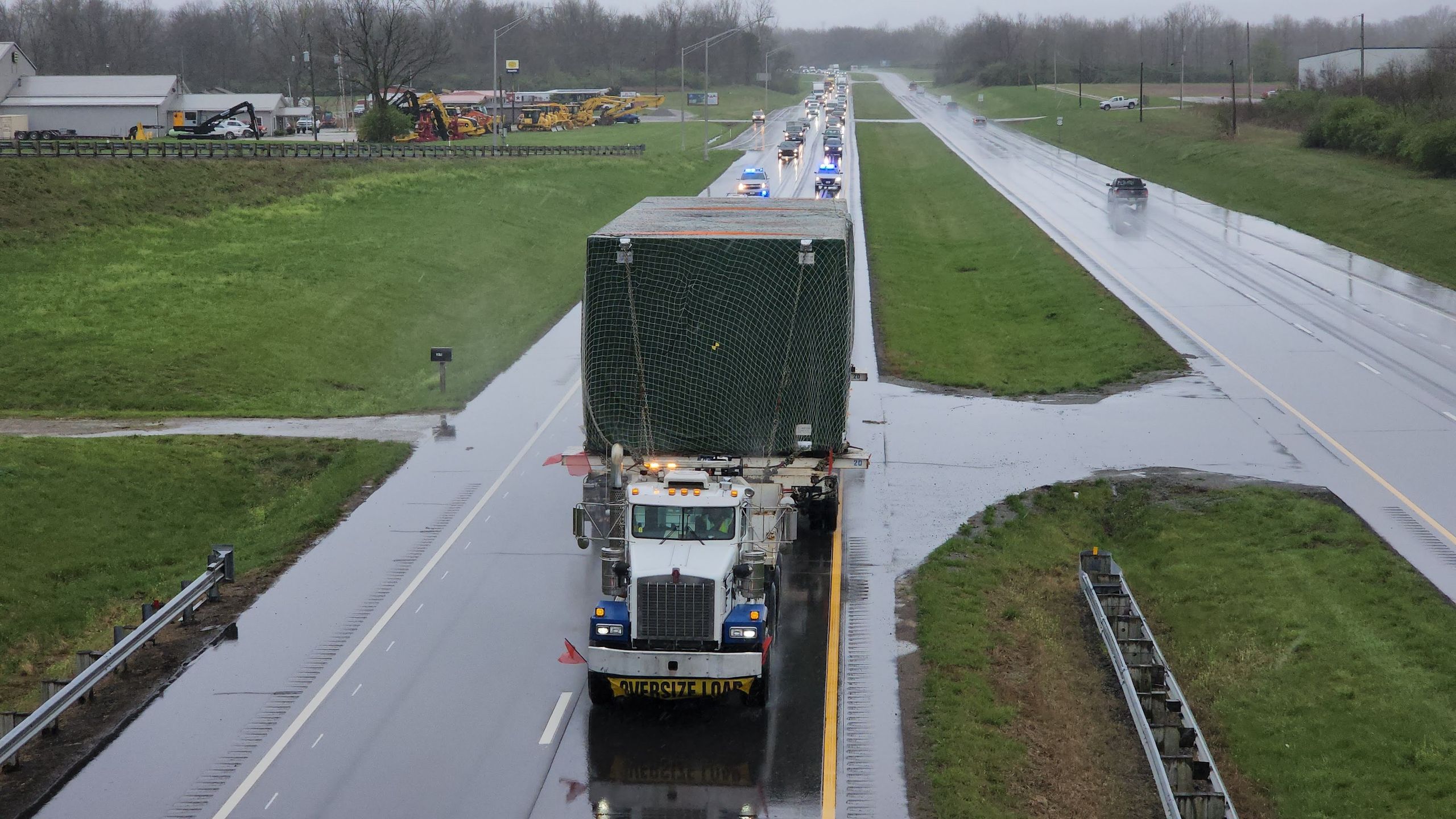
Intel is trucking a 916,000-pound
Imagine the nine day long traffic jam.
Tom
248 points · by prng2021 · 2y ago · 236 comments
I still have no idea what it was, but it added some excitement to a very mundane April that year. I have to imagine it was a very opportunistic move, since most traffic was stopped for covid already.
https://www.tdtnews.com/news/business/article_c49e80c8-124b-....
Several deliveries are usually staged one after the other, so you get to see a variety of loads if you are unlucky enough to have to wait for 30-40 minutes. Most of the time, it’s pre-fab buildings and nothing too exciting.
And if you're going to need 4 trucks to get it out of the port anyway, might as well just drive it there.
Sorry, no idea why I'm debating some random person on the internet about an issue which has absolutely no impact on me whatsoever. Sport, I guess.
Searching for when they moved Endeavor from LAX to the museum years ago is worthwhile. That was a tight fit on LA streets.
This was probably in the 2009-2013 timeframe, IIRC.
I used to do a number of those odd tasks (jackhammering down bank safes in preparation for the new tenants, ordinary pizza delivery, engineering a track for people to ramp/jump their mid-90s shit-mobiles, ...). I'm in tech as an ML engineer or something now, but one of these years I think it'd be a ton of fun to sit down and intentionally experience a hundred or so jobs and get a feel for what other people do for their livelihoods -- ideally in many distinct locales (e.g., where I grew up it was common for people to rent/(buy-with-intent-to-resell) a gas-powered bandsaw mill and produce most of the raw materials for their house, partly because land was cheap, partly because wages were piss-poor, and partly because there was a strong "make-do" attitude where people were willing to work hard to make a nice life with whatever hand they were given -- the sorts of jobs you'll have access to there are very different than those even a few hours away, much less a few states or countries).
That was a bit of a minor rant. I'm in strong agreement though; that sounds like a super interesting job.
  * there are oversized load spotters like those folks with a hobby of keeping track of aircraft or trains?
* there is economic intelligence value in extracting and surfacing data from oversize load permits?0. https://medium.com/planet-stories/a-beginners-guide-to-calcu...
Then again, the need for permitting should mean that state DOT's are already aware.
I do hope Radia gets their WindRunner plane off the ground. It's designed for onshore wind renewable energy, to be a plane with colossal internal volume. But it's also designed to work on landing strips that are much shorter & crucially primitive iirc or at least much more basic, to radically expand access to where we might setup wind power.
I have high confidence such a plane would most likely end up being used for other tasks too, if created. Maybe it's not as absurdly expensive as I imagine, planning & coordinating these intense logistics routes, but being able to airship things to interesting destinations seems super compelling to me, seems like it could enable a lot of infrastructure development that's simplify infeasible right now.
Marching into fancifulness here, but with something as big as a fab, I could definitely picture an initial construction phase where a sizable fraction of the land is dedicated as runway to start, isn't developed, while big items are flown in. Sounds wild, but could be possible! The model Radia has is off-site construction, and it's not too too hard to imagine perhaps more than wind turbines might benefit from this model: maybe not just coolers and fabs, but perhaps even prefab building walls could benefit from this.
https://www.wsj.com/business/energy-oil/how-the-worlds-bigge... https://news.ycombinator.com/item?id=39690182
Maybe it's infeasible, but I could imagine something as large as a fab being able to
The weight gives Tom a big number for his headline - but 99% of the problem with this load is the dimensions - which are too big for normal railroads. (Yes, the weight is also large enough to rule out using a heavy-lift helicopter.)
Vs. a single 1940's-era steam locomotive+tender could weigh over 1,200,000 lbs. Modern locomotives - where electronic control makes it very easy, flexible, and wage-saving to operate 'em in sets - generally weigh a bit over 400,000 lbs. per.
Is that an error?
Check the picture here: https://www.truckersnews.com/news/article/15677391/expect-de...
It appears to indeed be 280 feet long.
My initial understanding of needing more fabs in the US was mainly for embedded stuff like for military, automobiles, and that kind of thing. Is this push actually more so for higher end fabrication for modern non-embedded use?
Whatever the case is, having some more domestic production (especially for something as valuable as microprocessors) seems like a big win for any nation. I'm looking forward to seeing how the US does with chip fabrication. I don't expect them (us?) to become the dominant player, but I am bullish on US chip production.
[0] https://en.wikipedia.org/wiki/List_of_semiconductor_fabricat...
So to put it simply; the US wants to be sure it can still make H100's even if the rest of the world goes to shit.
I don't think that is quite right. It is a very important ability. I don't think it is the "most important" ability. If you have semiconductor fabs but not dry docks to build capital ships you will be in for a world of hurt. If you have semiconductor fabs but not agriculture to feed your people you will be in a world of hurt. If you have semiconductor fabs but not the ability to cast solid-fuelled rocket engines for your missiles you will be in a world of hurt.
It is one of the many important abilities. The reason we are talking about it is not because it is the "most important", but because it is at danger of being lost. We don't talk about the other equally very important abilities (like dry docks for giant ships, agriculture to feed the nation, or solid fuel casting, or a myriad of other things) because nobody worries about those going away.
The US certainly has that capability - should food supply ever become critical, slaughter cattle, pigs and sheep and redirect the grains used to feed them to the population. The amount of grains would feed 800 million people [1].
[1] https://news.cornell.edu/stories/1997/08/us-could-feed-800-m...
Very modern chips are more suited for intelligence work no weapons systems per se. The physics of flight, artillery and balistic missiles is pretty much well understood, we don't need machine learning for that. Some modern systems use computer vision as a terminal guidance system, but again, you don't need state of art semis for that.
Stuff like this wasn't realistic from systems made in the 90s or even 00's.
Also nuclear weapons simulation is what keeps the DoE continuously buying new world leading super computers.
There are a lot of interesting fabs in the US making some pretty bleeding edge products, but often not digital microprocessor chips. A lot of the more bleeding edge are analog/RF kind of stuff, especially GaN and GaAs stuff.
My impression is that automotive and military applications mostly use older, more mature, cheaper modes. Are the fabs for these older nodes mostly re-purposes formerly cutting edge fabs, or do they go around building brand new (higher volume?) fabs for these nodes?
I guess I’m wondering if the capacity to build automotive chips in 10 years will be limited by the ability to build cutting-edge chips nowadays. Or maybe if TI (or whoever) can, like, borrow a couple near-retirement TSMC guys in a couple years and spin up some brand new old-tech fabs.
Most weapon systems use old silicon that needs to be robust in all military operational environments. They don't benefit from having more modern silicon. Terminal guidance systems on hypersonic missiles that do kinetic intercept of other hypersonic missiles often use something like a MIPS R3000/4000 class CPU and a DSP of similar vintage.
ISR systems (intelligence, surveillance, reconnaissance) benefit from state-of-the-art silicon because that data is extremely large and analysis is time sensitive. Since pervasive ISR at scale is a cornerstone of modern military operations, having the best silicon and software for this type of computation is strategic. In these cases, it is often the latest commodity silicon.
E.g., how difficult would it be for a nation state to damage one in a way that requires a major replacement part from ASML, with long lead time?
And with or without it clearly being an intentional act of sabotage?
Im going between Cincinnati and Columbus several times over the next three weeks and am not looking forward to this even though it seems theyre taking a mostly out of the way route through the SE Ohio farming towns.
If you're going between Cincinnati and Columbus, you should be absolutely nowhere near this route, as it's going nowhere near I-71.
Generally, low overpasses or turns that would be problematically tight.
E: Checking street view, for example: that Mink Rd overpass over I-70 is likely either too narrow or not rated for the weight.
https://www.google.com/maps/@39.9506421,-82.7300744,3a,75y,1...
Seems like starting at 8pm would mean less snarl, less traffic to deal with, etc.
Southern states do their work from 8pm-midnight+.
Northern states do it from 9am-5pm.
Also, night time is dark. It makes things much more difficult than it needs to be at the convenience of some drivers in a car. Natural daylight is just so much better than having to have portable lights.
Was this written by an AI? A football field is 360 feet long.
You can pretty much bet it means "economic development" incentives of some sort, combined with a fair amount of personal glad-handing. Intel probably got all sorts of tax-breaks, credits, grants, and FSM-knows what-else as part of the deal to pick Ohio. And the Governor and others probably took Intel execs to plenty of nice steak-houses, strip-joints, exclusive parties, yadda, yadda, yadda.
> The Ohio nuclear bribery scandal (2020) is a political scandal in Ohio involving allegations that electric utility company FirstEnergy paid roughly $60 million to Generation Now, a 501(c)(4) organization purportedly controlled by Speaker of the Ohio House of Representatives Larry Householder in exchange for passing a $1.3 billion bailout for the nuclear power operator.
...
> In July 2019, the House passed House Bill 6, which increased electricity rates and provided that money as a $150 million per year subsidy for the Perry and Davis–Besse nuclear plants, subsidized coal-fired power plants, and reduced subsidies for renewable energy and energy efficiency. Governor Mike DeWine signed the bill the day it passed.[0]
0. https://en.m.wikipedia.org/wiki/Ohio_nuclear_bribery_scandal
Plus 15 congressmen, 2 senators are going to want their part of the Federal rain money.
https://www.dispatch.com/story/business/manufacturing/2024/0...
https://www.datacenterdynamics.com/en/news/microsoft-buys-20...
I wonder if Ohio is in a sweet spot—low property values but still not far from the Megalopolis in the grand scheme of things.
Seems unclear to phrase it that way when talking a about the dimensions of the load and then comparing the entire transport apparatus length.
Unsure how they jump from 280 being greater than 360.
The rectangular field of play used for American football games measures 100 yards (91.44 m) long between the goal lines . . . . The entire field is a rectangle 360 feet (110 m) long. . . [0]
The pitch is rectangular in shape. . . . the longer sides are called the touchlines. . . . The two touchlines are between 100 and 130 yards (91 and 119 metres) long . . . [1]
I would’ve thought the ability to do a super load or not determined a lot of your mfg/etc process. Seems surprising a company could switch over to a super load because it’s now available.
Lots of companies have huge pieces of equipment sitting at factory X that they would rather have at factory Y for example.
Nobody is going to spend months of planning and many millions of dollars on alterations to save a few grand on a one-off project. But hey, if someone else has already done the planning and alterations, why not piggyback off of that and save yourself some money?
Author doesn't understand football.
You haven't said what part of it you think is wrong - though I do believe that both American Football and Association Football (aka "soccer", or "real football" :P) do both play on pitches a bit longer than 280ft.
Sorry, you have been blocked You are unable to access parameter1.com
Why have I been blocked? This website is using a security service to protect itself from online attacks. The action you just performed triggered the security solution. There are several actions that could trigger this block including submitting a certain word or phrase, a SQL command or malformed data.
What can I do to resolve this? You can email the site owner to let them know you were blocked. Please include what you were doing when this page came up and the Cloudflare Ray ID found at the bottom of this page.
And I also get blocked on the cloudflare link for some reason.
One of our equipment barely fit through an entryway and required half-inch steel dowels to be put on the ground so it could roll for part of its journey.
I believe we are rapidly approaching the end of miniaturization. Even now, node sizes are mostly fabricated just to keep advertising smaller numbers.
However, those will (likely) be exploitable regardless of when the fab was built. The limiting factor isn't likely going to be the fab equipment so much as the techniques used.
That's where I don't know that bigger better fabs is going to be the arms race that it has traditionally been.
Maybe, but Apple will own all of that advanced capacity. Those of us who have not bought into the Apple ecosystem will have to slum it with lesser chip processes, which this fab will help with the demand for.
> gunfire in transit
Not just gunfire, they need to protect it from
- Climate Activists, blocking road and sabotaging the instrument, like they destroy old paintings at museums and art galleries to bring awareness via headlines [1]
- Foreign Adversary Intentionally Sabotaging Equipment to prevent America from leading in Semiconductor ( Had happened to India’s SCL silicon lab when they were catching up with market in 1980s ) [2]
- And ofcourse Gun Slingers too
[1](https://www.nationalgeographic.com/environment/article/famou...)
Saying they "destroyed" any paintings is plain wrong, you've either not read past the headline or you're deliberately trying to make climate protesters look bad.
While I'm aware of many art/museum related climate protests, I haven't heard of a single one that damaged any art - all of them, like the example you linked to, the protestors chose targets where they could avoid doing any real harm. In the story you linked they threw paint over a glass case that protects the painting, not over the painting itself.
So it definitely wouldn't surprise me if climate protestors decided to delay the trip by temporarily blocking a road, but it would be extremely surprising if they did anything worse than splashing paint on something that does no harm other than needing a cleaning crew to get it off.
I would guess that it isn't. My assumption (without any data backing this up) is that making a specific, super rugged transport container would cost more (along with the additional logistics of it) than the insurance on it.
Quite a few folks like shooting stuff and have very poor judgement.
It's not like something like that has never happened before: https://www.justice.gov/usao-cdca/pr/santa-barbara-county-ma...
As soon as they turn onto some smaller road they're going to run into power lines. If it's so expensive for Intel/Ohio DOT to move it, it's not gonna be any easier or cheaper for a thief.
This is like, what if someone stole the copper wiring from the white house
Fun to think about though. Fun weird question.
And using your white house example, while I'm sure people stealing copper cabling from it isn't considered a high risk, the possibility of people using guns to shoot at the white house certainly is something they take quite seriously!
There's no way the truck in the picture is hauling something 280 feet long!
The traffic behind it is closer than that!
Still-- there's no indication that anything in that image is 280 feet long!
Maybe the container in the foreground is, but the part that's shown can't be more than 75 ft.
It's like reading a story about a Wooly Mammoth being spotted in the wild, but people are only taking blurry pictures of its rear end. :/
In fact, I could almost imagine that sabotaging this thing would actually have an economic boon as it would allow the roads to operate again (rather than shutting them down for days to move a 10mph mega fridge).
Consider, for example, the economic damage of the camp fire wildfires. That was caused by a single downed power line.
So why are they called camp fire wildfires if a camp fire was not the start of it?
Maybe they can share offices with Boeing.
A lot of other big things, like wind turbines, are shipped in smaller pieces and assembled onsite. At least according to a family member of mine who works on them, you even get slightly different designs that are specifically tailored to the local highway transport regulations in different countries.
That said, I think in general you're right that the story is that it's just cheaper to do it this way. I just think that assuming you'd need to build actual factories is a bit drastic. But perhaps even getting the equipment needed for final assembly onsite is prohibitively expensive compared to just transporting the fully-assembled equipment.
Just guesses it's not something I'm into.
For context: typical max weight for a truck in the US of A is 80k lbs, or a bit over 36 metric tons.
over 10x heavier than the maximum allowed by law
TFA suggests it's not split up:
> Intel will put a 916,000-pound "super load" on the road in Ohio on Wednesday, for a trip that will cover approximately 150 miles in nine days and snarl traffic for over a week...
> Four of these loads, including the one hitting the road now, weigh around 900,000 pounds — that's 400 metric tons, or 76 elephants.
> Intel's 916,000-pound shipment is a "cold box,"...
EDIT: Further information in the ODOT advisory detailing the schedule of this one shipment confirms 916k pounds is not split among multiple loads:
https://www.transportation.ohio.gov/about-us/traffic-advisor...
> This is the twelfth of nearly two dozen "super loads"... This load... measures approximately 23’ tall, 20’ wide, 280’ long, and weighs 916,000 pounds.