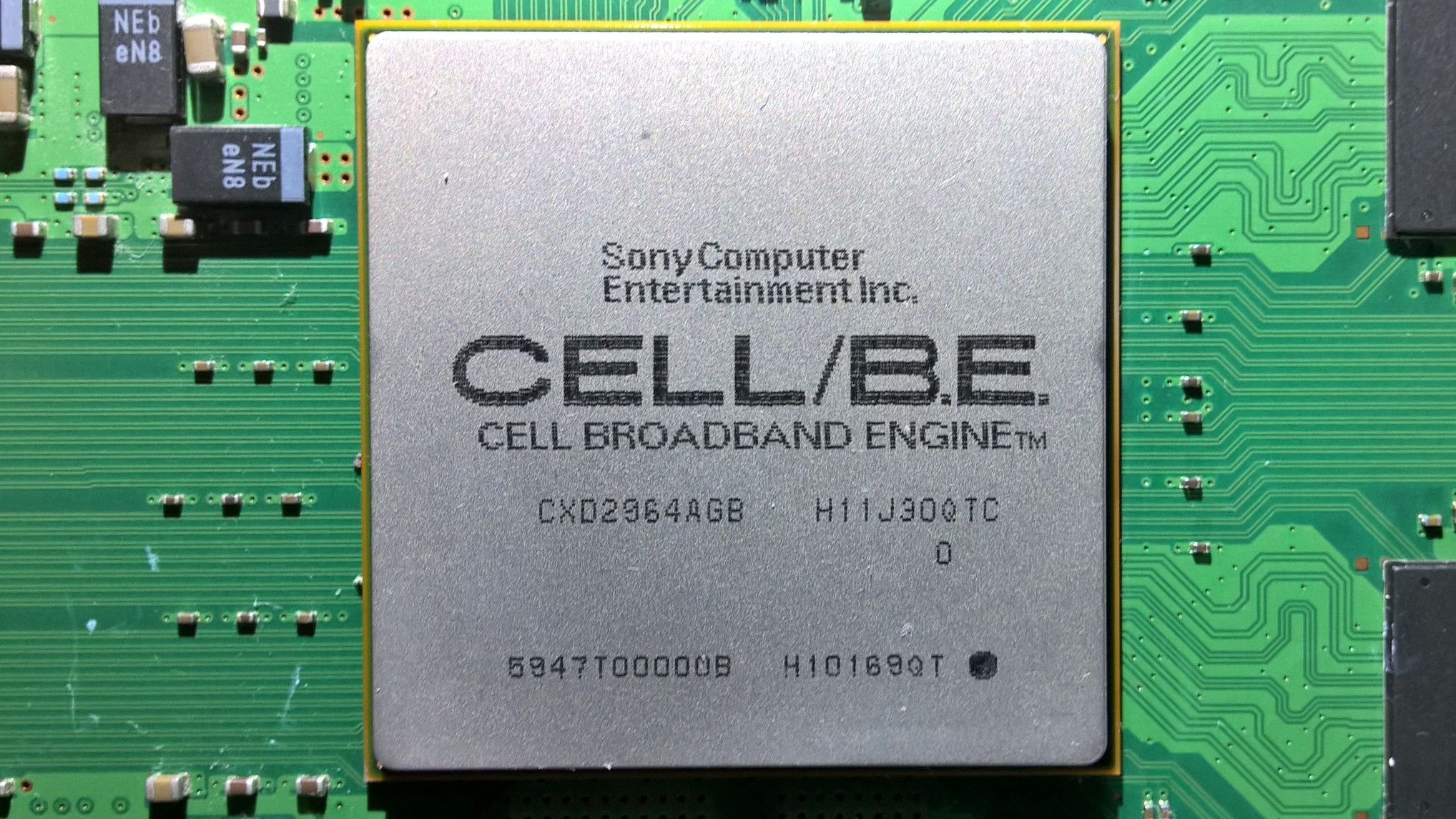
AMD CEO Lisa Su reminisces about designing the PS3
Even before she worked at AMD, Lisa Su was making big moves and proving to be one of PlayStation
Tom
358 points · by rbanffy · 2y ago · 246 comments
Was an interesting experience, though all I remember now is how it required careful exploitation of the vector units in the SPEs to get any decent performance out of it, and how annoying it was to synchronize between the SPEs and the PPE.
For each assignment the prof would include a benchmark, so we could compare the performance in class. Was a huge difference between the students that spent time optimizing and those which did a basic implementation.
Here is the OS course: https://www.uio.no/studier/emner/matnat/ifi/IN4000/index-eng...
When I talk to people outside my home country it feels most don't do these kind of things at the bachelor level. But, like you, people who go on a masters then might do one of these things and go much more in-depth than I did.
That's "full stack" development :)
Also wrote a BBC Micro emulator, which was great fun.
I heard about the OS one, sounded super cool and also a lot of work from what I gathered. Heard about it too late and required a buddy. Oh well, can't have it all.
[1]: faculty of math and natural sciences
I can't remember exactly how many, but once you included lectures, scheduled labs and tutorials, was not that far from 9-5 (minus the standard university-wide Wednesday afternoon sport slot).
The friends would go quiet and say "oh, we have 12".
And that didn't even incude the "non-contact" hours in the labs grinding the coursework until security shooed us out late at night so they could lock the building. Good times (in retrospect, especially).
I say used to, but still do. Even 10 years later me and my girlfriend (that studied at UiO) still tease each other about who is the smartest or had the hardest courses, or she mocks my ring, heh.
I did a little bit, but it ended up being a super PITA because I didn't want to put my PS3 on my desk and give up playing games on it on my TV.
Because I wanted to keep it with my TV I had tried to use it with Bluetooth KB/Mouse so I could use it from the couch.
And well typical Linux you always end up spending time on the most mundane thing. Bluetooth on the PS3 in Linux at that time didn't seem to work right.
That to me is like peak Linux right there. At some point I had said to myself "I wanted to play with the cell and instead I'm working on Bluetooth" and I lost interest cause of course I had real work too. Then eventually Sony disabled the whole thing.
I think a later gen locked it right down.
I got the impression that Sony encouraged this use of the console early on. They were probably aiming to establish themselves in the scientific computing niche. We also had nvidia-sponsored labs where they taught CUDA (or at least tried to - it was pretty difficult to do without support and most people took the class for access to computer labs equipped with amazing gaming machines). We all know nvidia won that war.
This is the kind of thing where library and OS support is essential. Developer ergonomics is not that hard to get right (because developers experience it) and yields immense benefits when it's done.
I see that today with GPUs where you need to concern yourself with moving data and setting pipelines up, and thinking about the peculiarities of that particular GPU.
Though from the published material for 2024 it seems not to have changed too much in principle, eg the codec63 I recall implementing parts for.
edit: oh and yes, one of the highlights of my degree.
[1]: https://www.uio.no/studier/emner/matnat/ifi/IN5050/index-eng...
Part of your grade depended on the performance of your code, with a bonus for the fastest submission. It led to a very nice semi-competitive semi-collaborative atmosphere.
Made designing/porting games a massive headache though because nothing else was like it.
I think neither Sony nor anyone else expected the consumer CPU and GPU industry to evolve so quickly in that time, otherwise they would not have spent hundreds of millions developing anew architecture from scratch. Intel also made the same mistake back then when they tried to reinvent the industry with the new Itanium CPU architecture. Hindsight 20/20.
Those years were indeed wild for tech progress. You bought a new CPU, suddenly two years later you have 64 bit CPUs as the new thing. You then bought a 64 bit CPU to be like the cool kids and suddenly dual core CPUs are all the rage.
Now it's impossible to beat commodity SoCs on that front.
In the design phase they were expecting almost 5ghz at launch, and to hit around 10ghz at the end of the product lifecycle. When the process guys came back later to let the architects know the reality we've sort of now all internalized (high end consumer electronics can expect ~3ghz with good cooling solutions) a lot of simple but fast pipeline designs stopped making sense. These are the exact same pressures that killed off the Netburst architecture too, making intel go back to a PIII design and make it smarter rather than clock markedly faster.
PS3 Cell could do about 154 GFLOPs across it's 7 cores (6 SPUs and 1 PPU, excluding the GPU), while Xeons were in the low double digits. What really was awkward about the Cell architecture was the DSP-style nature of it, which works great for something like shaders or audio processing with a clear pipeline, but not for general purpose computation. It was really a successor to the PS2 in this regard, where data flowed between specialized and memory constrained processors using a DMA.
> Sony nor anyone else expected the consumer CPU and GPU industry to evolve so quickly in that time
PS3 used an NVidia GPU. Though there was some clunkiness around sharing memory between the Cell and GPU compared to the UMA on PS4, but not especially so compared to a graphics card on a desktop machine.
Actually, there is such a scattered supply chain for semiconductor chips, that any war that disrupts international trade in a material way, would bring that entire industry to its knees. So many critical suppliers in the semiconductor supply chain are single companies, or single country oligopolies.
The 21st century will not be a remake of the 20th. Empires rise and fall, and that's in their nature to do so. So far, China has managed theirs very well, and I don't see a fall in the cards for this century.
see for context: https://news.ycombinator.com/item?id=5561505
That was the trickiest part - getting the data in and out of the thing. You had 6 SPE's available to you, 2 were reserved by the OS, and keeping them all filled was a challenge because it required nearly optimal usage of the DMA engine. Memory access was slow, something over 1000 cycles from issuing the DMA until data started coming in.
Back then, C++ was all the rage and people did their various C++ patterns, but due to the instruction size being so limited, we just hand-wrote some code to run on the SPU's which didn't match the rest of the engine, so it ended up gluing together two dissimilar codebases.
I both miss the cleverness required back then, but also don't miss the complexity. Things are so much simpler now that game consoles are basically PC's with PC-style dev tools. Also, as much as I complain about the PS3, at least it wasn't the PS2.
In Europe, PS3 was widely popular especially in conjunction with Call of Duty because Xbox never really gained ground in EU, at least that was my impression growing up as an EU gamer. Wii was also popular af at the time but PS3 and Wii buyers were different audience, Wii was more casual type of gaming and it was suitable for family gaming while PS3 was for more serious gamers who played more hardcorish titles like COD, FIFA and PES and ofc there was and is PC master race for real hardcore gamers.
Considering the absolute dominance of PSX and PS2, it was definitely not what they were hoping for. Not quite as dramatic as Nintendo with the market loss from SNES to the N64, but I’m sure Sony had a lot of similar conversations. You also have to consider that Xbox was the distant third place console in the previous generation, so barely losing to Sony at the last minute was definitely considered a huge success. Especially after the disaster that was the RROD. If that hadn’t happened Microsoft likely would have beaten Sony’s sales.
When you buy a gaming pc you can play all prior generations of pc games.
* Yeah, Yeah, I know this is not really all that true/over simplified. But you have to understand I am the type who enjoyed the fight, almost more than the game. the fight? you know first you fight the pc a bit and if you win you get to play the game. Really, if you just want to sit down and game get a console.
It seems an incorrectly strong wording by the interviewer.
And people seem to sleep on how powerful the xbox360 was - the CPU was a fair bit smaller than the cell, true, (~150m transistors vs 250m in the cell) not not really the multiples some articles seem to imply.
And the GPU in the xbox was arguably a fair bit more advanced - being a little larger (~300m vs ~335m transistors), and being a unified shader architecture that came to dominate GPUs from then on. And the more flexible architecture enabled more GPGPU-like tasks that the cell SPUs might have handled on the PS3. And these early GPGPU models were also a bitch to program for - like the cell SPUs were.
So it's not like one was simple and easy, the other crazy complex and advanced, but more one had the fancy experimental stuff on the CPU/Cell die, the other on the GPU die. Just the techniques used on the GPU continued to be developed and supplanted much of the Cell-style tech.
Interestingly, the Xbox 360 (Xenon) CPU cores were based on the Power Processing Element (not the Synergistic Processing Elements) from the Cell processor.
From [0]:
"When the companies entered into their partnership in 2001, Sony, Toshiba and IBM committed themselves to spending $400 million over five years to design the Cell, not counting the millions of dollars it would take to build two production facilities for making the chip itself. IBM provided the bulk of the manpower, with the design team headquartered at its Austin, Texas, offices. Sony and Toshiba sent teams of engineers to Austin to live and work with their partners in an effort to have the Cell ready for the Playstation 3's target launch, Christmas 2005.
But a funny thing happened along the way: A new "partner" entered the picture. In late 2002, Microsoft approached IBM about making the chip for Microsoft's rival game console, the (as yet unnamed) Xbox 360. In 2003, IBM's Adam Bennett showed Microsoft specs for the still-in-development Cell core. Microsoft was interested and contracted with IBM for their own chip, to be built around the core that IBM was still building with Sony.
All three of the original partners had agreed that IBM would eventually sell the Cell to other clients. But it does not seem to have occurred to Sony that IBM would sell key parts of the Cell before it was complete and to Sony's primary video-game console competitor. The result was that Sony's R&D money was spent creating a component for Microsoft to use against it."
( From the WSJ )
[0] https://web.archive.org/web/20150129121858/http://www.wsj.co...
If they just asked for a 3-core SMP version of a PowerPC and the Cell project never existed, I suggest it's likely it would still look very similar to what was released in the xbox. VMX already existed, POWER5 already had SMT.
I don't see there being a huge amount of new technology made for the Cell's PPE for the Xbox project to import in the first place.
As far as I understood, Halo was the killer app for Xbox but I suppose it was the killer app only in US, because like I said, from my EU gamer's point of view, Call of Duty was all the rage first on PC and then afterwards on PS plus FIFA and PES were huge on PS as well.
https://en.m.wikipedia.org/wiki/List_of_backward-compatible_...
I was amazed that I am actually able to play PS3 games on my (older, not at all top of the line) laptop thanks to the brilliant RPCS3 emulator.
A PS5 is way more powerful than my laptop, so in theory SONY could just make all those PS3 games available through emulation.
The Wii GPU is very much the GameCube one with some tweaks and faster clock speeds.
The 360 one is absolutely an ATI custom Radeon part.
Lets start from the end, game consoles these days are basically optimized PCs. They are effectively nothing like the first, second, or even third generation consoles that had fairly unique hardware, desirable exclusives and so on.
Cell may have been difficult to program well for, but it speaks volumes about the current state of consoles that devs worry about being able to be lazy with ports. The idiot consumer will buy whatever anyway. The side effect of the first generations' relatively unique hardware profile is that games actually had to be optimized and tailored to the hardware. No lazy ports ( I still get pissy sometimes over ps3 dragon age port ). Exclusives had to be good or at least showcase what the console could do.
So is that what makes Cell infamous? The thing made news when could be run in a cluster[1].
I have a different take. Cell is the remnant of the consoles, when they were still worth one's time.
It’s not about being lazy with ports. It’s that the asset budgets are so large that making games is way too expensive. For any normal company you basically _have_ to launch on multiple systems if you want a financial payback.
And every time graphics get better the problem gets worse. More models, more textures, more detail, more everything. $$$
Unless you have a monster hit (Zelda, Last of Us) you may be unable to make your money back on one machine. Even if you could, why not just make more money by adding in the other machines?
There’s a reason pretty much only 1st party studios do exclusives.
Totally. Thomas Was Alone is one of the best games I’ve ever played and it’s just a bunch of boxes. It’s basically high resolution Atari.
Great graphics are nice and can certainly help, but the be all end all race to always look the best is not working well.
Some kind of reckoning has got to be coming. We’re getting to the point where it’s like 5+ years between sequels to big titles just cause that’s how long it takes. Much like mega budget Hollywood movies no one‘s willing to take a risk when it costs that much.
The bigger issue with current consoles imo, specifically the PS5 and XB, is their input homogenization and stagnation. Consoles have historically been forward-looking via their controllers to enable new ways to play games:
[NOT including optional accessories, only out of the box abilities]
- N64: Analog controls, 4 controller ports, controller expansion ports
- PS1: Dual analog controls
- PS2: Pressure-sensitive buttons, built-in rumble
- Dreamcast: ...
- Xbox: ...
- Gamecube: ...
- Wii: Motion controls
- PS3: ...
- Wii U: Gamepad screen
- 360: ...
- PS4: [Correction!] Touchpad
- Switch: Detachable and sharable controllers
- XB1: Kinnect
- PS5: ...
- XB1X: ...
I'm definitely not implying that every new input type was successful (See Wii U, kinnect), but consoles up until about PS3/360 had something new to offer regarding ways to experience games. This has all but stopped, with Nintendo being the only one to consistently introduce new ways to play that cannot easily be replicated on a PC. Plugging a PS5/Xbox controller into a PC yields the same or better experience as buying a dedicated console these days, so why buy the console at all?
Putting console exclusives aside, I can build a PC that does everything I need it to do but play some new games + a console for less than it costs to build & maintain a "gaming rig". Also, my PS4 is still working after ~10yrs. I would have to upgrade my PC more frequently than that to keep up with new games.
You're also forgetting the two-point capacitive touch pad on the PS4 controller. It's OK, almost all the video game developers did too.
Haha, good catch, corrected!
It’s easier. I don’t have to fiddle with drivers. Or settings. Or choosing which card to upgrade to when. Or debugging mismatches. I don’t have to have the OS + Steam/Epic/whatever + games.
The games are written to what I have and I don’t need to worry about it. The OS is completely built around playing games and making it easy for me to acquire them and I don’t have to think about any of it.
I had the years of building gaming PCs and messing with all of that and doing all the research. And I had fun. And at this point in my life I just don’t wanna deal with it I just wanna play a nice game.
Fancy haptics were introduced by the Switch.
I am not sure how you are counting them, but the second generation were the Atari 2600 and its peers, and the third generation were the NES and the Master System. Consoles had unique hardware until the 7th generation (PS3 and X360).
Here's the original interview which has more details that I found interesting.
https://stratechery.com/2024/an-interview-with-amd-ceo-lisa-...
I recall various news stories about governments buying up PS3s because they could be used for cheap and effective computation at scale.
https://knowyourmeme.com/memes/playstation-has-no-games/phot...
At the time, UT was building TRIPS[0], a processor capable of > 1 teraflop / sec.
In the middle of his talk (with several TRIPS members present), he made an off-hand remark "I think I could build a petaflop processer...without too much trouble,"* which caused a small stir in the audience!
[0] https://www.cs.utexas.edu/users/cart/trips/
* I might be misremembering the exact quote, but this was the gist of it.
Roadrunner is a 1.38 Pflop/s-peak (double precision) hybrid-architecture supercomputer developed by LANL and IBM. It contains 12,240 IBM PowerXCell 8i processors and 12,240 AMD Opteron cores in 3,060 compute nodes. Roadrunner is the first supercomputer to run Linpack at a sustained speed in excess of 1 Pflop/s.
The 6502 was descended from the 6800 - one of a few ur-microprocessors - and somewhat clumsily evolved into the 65816 before its brilliant but highly specialized design (hard to target for HLLs and which fundamentally assumed memory could be accessed roughly as fast as the CPU was running) couldn't keep up with the times. As far as I know that's pretty much it for its branch of the CPU family tree.
Meanwhile - and I admittedly know less about this - as I understand it the PowerPC is ultimately descended from the IBM 801, which was a high-end workstation and server chip. There might've been some influence from Motorola, and Motorola made the 6800 - the 6502's father - so in that sense the 6502 and the PowerPC might be very distant cousins. Still, that's pretty tenuous.
My understanding is that the original ARM team was directly inspired by the 6502 - so if its legacy lives on anywhere, maybe it's there.
There is still so much value in this ancient machine.
What is she thinking? She's sitting on what could be the 2nd most valuable company in the world. And she's doing nothing.
AMD's GPUs are as good as NVidia's. But their drivers suck. They did all the hard work. Now they need to invest a relative pittance in fixing up their drivers and open sourcing the rest. But they won't.
Absolutely nothing about this situation makes any sense. It's a company that's sitting on gold (actually, by weight, the value of GPUs is far higher than that of solid gold bars). But... they're throwing it all away for nothing? Is she getting paid off by NVidia to do this?
AMD is the single most confusing entity out there.
This is totally wrong. MI300x was released Dec 2023, just a few months ago. It is a fantastic product, but not into the hands of enough people, yet.
Give it time.
It has nothing to do with availability or pricing. You can't rent single MI300x today cause ROCm doesn't support virtualization. PCIe passthrough doesn't work yet. AMD knows about the issue and is working on it.
We will have 8xMI300x for rent soon. Once AMD fixes their stuff, we will be able to rent out one at a time.
Problem is: no one wanted it. So none of that panned out. If it had gone on to be something like Intel’s Core 2 Duo that showed up everywhere in hindsight it would look smart.
Apple wasn’t a great example but it was the best I could think of. It took Apple 10 years to go from the A4 in the first iPhone with an Apple chip to the M1 in the first Mac. They also were just using Arm, the same instructions that they had been using before and something well understood.
They didn’t suddenly release something people weren’t really prepared for like a Transputer and just declare “this will be everywhere within three years“. They let the switch take its time as necessary.
Sony had the arrogance to do both of those.
Previous PlayStation hardware was just as odd. Ps2 reused old surplus Ps1 processors just for audio, and had coprocessors just like cell.
Then out of nowhere Xbox 360 comes out, Halo that was a macOS title suddenly a main and a well selling IP on Xbox. Not just that, it also picked HD-DVD as its format posing a threat to Blu-ray.
Sony had to put something out.
The Xbox 360 released its HD-DVD drive a few days before the PS3 hit store shelves in North America. Sony had established the PS3 would use Blu-Rays a year before the Xbox 360 was even publicly announced.
I think there were a number of things Sony wasn't expecting about the Xbox 360, but HD-DVD or Halo wouldn't have been any of those things.
How is it related? We all knew Sony would use Blu-rays, but if HD-DVD won the battle, then PS3 suddenly loses a big chunk of its value - it's a good, "cheap" Blu-ray player.
> Xbox 360, but HD-DVD or Halo wouldn't have been any of those things.
HD-DVD sure, but it's unrelated to what I'm saying.
Halo - not so sure because it only really took off after the second installment IIRC. There were a few titles that were supposed to compete with Halo at launch of PS3, but Halo won.
https://en.wikipedia.org/wiki/Xbox_360_launch#Titles
There wouldn't be a Halo game released for the Xbox 360 until September 2007, nearly two years after the release of the console.
No it didn't. The PlayStation 3 outsold the Xbox 360. Have a look at the 7th generation charts on VGChartz:
It's true the Wii sold the most.
The 8th generation didn't go well for Nintendo. The Wii U was a flop. But they're back on top with the Switch.
It's true the devs have become more comfortable develeoping games as the console matured but that's about it.
Xbox was always flop comparing to PS
For PS3 vs 360, the PS3 sold 87.40M units to the 360's 85.73M.
The PS3 started outselling the Xbox 360 for the year in 2007 and kept steadily gaining on the Xbox in total sales for the generation until it overtook it.
Xbox's one year head start kept it level with the PlayStation 3 for quite a while but it lost out in the end.
Look at the global yearly sales figures on VGChartz. From 2007 the PS3 outsold the Xbox 360 every year except for 2008:
The charts you link to show game sales that lag way behind the xbox. For example Skyrim sold 2.6 million in 2011 on the xbox and only a million on the ps3.
I only say this because I got my ps3 for free with the purchase of a Sony television at a Sony store (remember those?) in late 2009 and never purchased more than a bare handful of games which I almost never played.
After the cost-reduced redesign in 2009 Sony gave away a free ps3 with every television purchase in Sony stores for almost an entire year.
Skyrim was one the games I bought and it was so buggy, even for Bethesda, on the ps3 due to ram limitations (I've read) that I purchased it again for pc.
Used my ps3 to watch a ton of blurays and Netflix, though. My ps3 was, and based on those yearly charts a lot of other peoples' ps3s were also, extremely powerful streaming boxes and I only retired mine when I upgraded to a 4k tv and got an appletv 4k.
Snark: Nintendo’s market is kids, people with kids, and people who were previously kids. Xbox and PlayStation are fighting over the market of people who’d be better served by a PC but don’t want to deal with all that. /Snark
That is to say, I still think there's significant competition for sales.
And if Nintendo didn't exist, it would be easier for Sony and Microsoft to take in the market for cute, whimsical, child-friendly, instead of having to distinguish themselves by being the more serious or more powerful option.
And handhelds; Nintendo has more or less stolen that entire segment, Steam Deck still being relatively niche and PS Portal being a different kind of thing. Sony's handheld ambitions are moribund and not for lack of trying.
The target market for the Switch are people who play Animal Crossing, Super Mario Galaxy, and Zelda games.
There's some amount of crossover there, but there's also a large amount of separation in those markets. I know lots of people who play a ton of Animal Crossing and Zelda but would never want to play something like Borderlands or CoD or Darksouls.
As, what, an ornament? People buy games consoles to play games on (or occasionally for movies or some such), and I think very few of the games that people are buying a Switch to play are even available on Xbox/PS, nor vice versa (or at least, the Switch ports of the games that people buy Xbox/PS to play are not on a level where those people would buy a Switch to play them).
That's a pretty damn large market (= all adults). I think you meant to say "people who were previously kids playing Nintendo"
Who is not included in that? Toddlers?
But yeah, I 100% agree that the overwhelming draw of Nintendo consoles is their exclusives, so it's mostly orthogonal to Xbox/PS/PC. If you want to play Mario or Zelda or Pokemon or Fire Emblem, you've got one choice. The common idea that the Steam Deck is competing with the Switch is almost entirely wrong.
I think they're counting P4 hyperthreading, but I remember dual-CPU Pentium II boards.
The concept of multiprocessors was already well understood around 1963, i.e. the multiplication of the performance of a computer by the multiplication of the CPU hardware.
On the other hand, the purpose of SMT is to enhance the throughput of a computer by ensuring that the existing execution units do not stay idle, by executing instructions from multiple program threads in order to keep them busy.
The modern use of SMT has been started by a research paper published in 1992, as a proposed improvement to the superscalar out-of-order CPUs already popularized by IBM POWER, but the name SMT (simultaneous multi-threading) has been coined only later, in 1997 (in the IEEE Micro from September/October 1997).
IBM had already used SMT in the experimental Advanced Computer System in 1968 (and they have filed for SMT patents in 1971: US 3,728,692 & US 3,771,138), but that project has been canceled and its superior architecture has been mostly forgotten for several decades.
CPUs that could execute instructions from multiple program threads, but not during the same clock cycle, like in SMT (hence the "simultaneous" of SMT), are older than the IBM ACS, for instance such a processor with fine-grained multi-threading was the peripheral processor of CDC 6600 (in 1963). SMT can exist only in superscalar CPUs, because only there multiple instructions are initiated in the same clock cycle.
Of course, as a woman engineer to make it this far she’s used to not getting the limelight in a male dominated industry - which may also explain some of AMDs recent success.