125 points · by poopcat · 2y ago · 104 comments
(the original page is now 404)
https://web.archive.org/web/20230522141639/https://www.rickg...
The message about stolen artwork is most unfortunate.
I wonder what happens if you press the EQ or PL buttons. :)
So yes, it's totally possible for someone doing tech today to have never interacted with complex analog interfaces since being a little kid. Still unlikely for the next couple years, but possible.
I was really expecting some mechanical tricks around the play/pause buttons liked I had on my old cassette player to make them xor-like .. so disappointed. And frustrated I just don't have the skills or time to make one but would love to see someone actually do it.
"Like buttons on a car radio" seems more plausible to me however.
Radio buttons?
yes, I meant radio buttons. of course!
I'm laughing so hard at myself now.
Pushbuttons are similar. The XOR system is literally "radio buttons" or "ganged switches", but I can no longer find that exact item on catalogues. It works by having a bar hooked around all the switches so that when one is halfway-pressed it triggers the unlock across all switches, so the unused one pops out.
Then you need to hook all that up to your microcontroller as inputs, do panel cutouts, etc. The switches tend to be through-hole, complicating manufacturing. Then you discover that you end up needing two boards, one full of inputs and display parts which are through-hole so there isn't space on the back for the actual MCU.
More expensive than a touchscreen? Especially if we also calculate the energy-costs for usage..
As someone who watches content from This Old Tony, Inheritance Machining, GreatScott!, Marius Hornberger and so on I would watch a series of someone building this. That's how I see you can subsidize a project like this these days.
Do you guys not have money?
I was hoping for physical buttons and sliders.
Since then I've changed to a Pi Pico, and using PIO (programmable pins) makes the touch-delay problems I had magically go away. PIO really is awesome.
I've also replaced the DC motor with a tiny stepper motor, and now everything works peachy. Just waiting for some screens and stuff from AliExpress.
Anyhoo, shooting myself in the foot: https://youtu.be/GjmFbgqFeMQ
Those physical concepts at 0:38 look very good.
To this day, sound and light control in the entertainment industry and recording studios have 100s of motorized sliders.
Modern consumer devices are the worst.
Professional mixing desks have hundreds of them, and can memorize the positions of the set to save a lot of sound engineer time.
FYI there is prior art for this sort of control - google 'motorised fader'. Used for audio tech mixing desks.
That capacitive touch slider is really cool.
My one holdup is that its hard to find a TFT of exactly the right rize for the upper part. Also the volume/balance sliders get in the way a bit s the mechanical design is harder than anticipated. Also I feel that FDM printing doesn't do it justice.
Update: forgot to include the trick - cheap servos are crap because of the cheap potiometers. The electronics have to work and are the cheapest way to compensate for sub-standard parts elsewhere so they are somewhat ok. So if you combine the board from a 1EUR servo with an ALPS linear motorized slider that has a super high quality potiometer since its far larger and you would hear it being crap - the gears and motor are also good. This combined with the board from the servo gets you super smooth control.
The screens are by far the most tricky part to get right, size and positioning. At first I thought about using one of the super thin Sony mobile screens for the entire thing, then using an overlay to separate them, annnd then to make it tactile with knobs, the knobs would touch the screen, and the phone would send the co-ords to the playback device (RPi in my case).
But that's because I wanted a very "thin" end product. Making it deeper allows for some more creative layout.
I've settled on a linear potentiometer driven by a stepper motor, and it's working out for me so far!
Good luck with yours! Got any links to follow it on?
Here's mine FWIW: https://youtu.be/GjmFbgqFeMQ
From your video you came to almost exact the same solution I have. :) I really can suggest trying to run it from a servo board - it has all the stuff for smooth movement already in it.
I was thinking about using a "SoftPot Membrane Potentiometer" to bring the chonkiness down a little, where the knob on the front would have a little nub at the back which would press against the strip and give you the same kind of effect (but then you need a way to drive that nub, of course).
I also thought about using the stepper motor and spiral combo out of a CD-ROM drive, maybe putting an encoder on it, but the spiral isn't long enough, so meh.
I'm still waiting for screens from AliExpress before I make an updated video, otherwise it'd just be, "look, it's smoother now, yay".
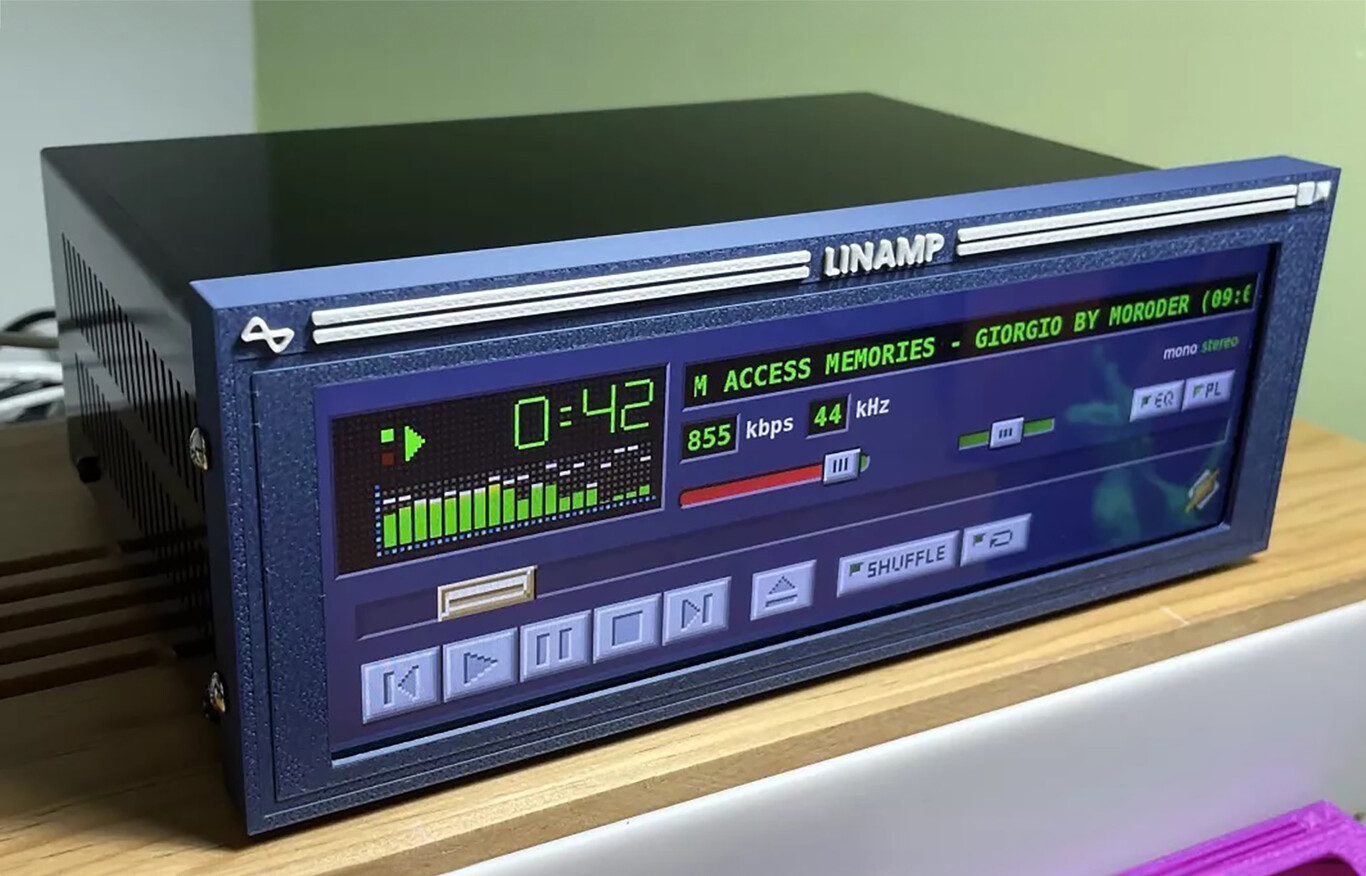
Here is the actual good thing, gone but not forgotten: https://www.youtube.com/watch?v=PkPSDOjhxwM
He mentions the main issue for a physical interface is that screens aren't necessarily available in the required dimensions.
Linamp, the IRL Winamp
"My name is Giovanni Giorgio, but everyone just calls me Giorgio."
Very disappointing - running winamp in fullscreen is now 'physical'?
Seriously?