Getting 50% (SoTA) on ARC-AGI with GPT-4o
You can just draw more samples
redwoodresearch.substack.com
394 points · by tomduncalf · 2y ago · 243 comments
Ryan's work is legitimately interesting and novel "LLM reasoning" research! The core idea:
> get GPT-4o to generate around 8,000 python programs which attempt to implement the transformation, select a program which is right on all the examples (usually there are 3 examples), and then submit the output this function produces when applied to the additional test input(s)
Roughly, he's implemented an outer loop and using 4o to sample reasoning traces/programs from training data and test. Hybrid DL + program synthesis approaches are solutions we'd love to see more of.
A couple important notes:
1. this result is on the public eval set vs private set (ARC Prize $).
2. the current private set SOTA ~35% solution also performed ~50% on the public set. so this new result might be SOTA but hasn't been validated or scrutinized yet.
All said, I do expect verified public set results to flow down to the private set over time. We'll be publishing all the SOTA scores and open source reproductions here once available: https://arcprize.org/leaderboard
EDIT: also, congrats and kudos to Ryan for achieving this and putting the effort in to document and share his approach. we hope to inspire more frontier AI research sharing like this
> In addition to iterating on the training set, I also did a small amount of iteration on a 100 problem subset of the public test set
and
> it's unfortunate that these sets aren’t IID: it makes iteration harder and more confusing
It’s not unfortunate: generalizing beyond the training distribution is a crucial part of intelligence that ARC is trying to measure! Among other reasons, developing with test-set data is a bad practice in ML because it hides the difficulty this challenge. Even worse, writing about a bunch of tricks that help results on this subset is extending the test-set leakage the blog post's readers. This is why I'm glad the ARC Prize has a truly hidden test set
Because the thing we have now is data-hungry. Your brain is pre-trained on other similar challenges as well. What's the point of requiring it to "generalize beyond the training distribution" with so few samples?
Really, I thought LLMs ended this "can we pretrain on in-house prepared private data for ILSVRC" flame war already.
The concern with the data-hungry approach to machine learning, that at least some of us have, is that it has given up on the effort to figure out how to learn good background theories and turned instead to getting the best performance possible in the dumbest possible way, relying on the largest available amount of examples and compute. That's a trend against everything else in computer science (and even animal intelligence) where the effort is to make everything smaller, cheaper, faster, smarter: it's putting all the eggs in the basket of making it big, slow and dumb, and hoping that this will somehow solve... intelligence. A very obvious contradiction.
Suppose we lived in a world that didn't have a theory of computational complexity and didn't know that some programs are more expensive to run than others. Would it be the case in that world, that computer scientists competed in solving ever larger instances of the Traveling Salesperson Problem, using ever larger computers, without even trying to find good heuristics exploiting the structure of the problem and simply trying to out-brute-force each other? That world would look a lot like where we are now with statistical machine learning: a pell-mell approach to throwing all resources at a problem that we just don't know how to solve, and don't even know if we can solve.
The mainstream attention LLMs have garnered has added a bunch of noise to the way we talk about machine learning systems, and unfortunately the companies releasing them are partially to blame for this. That doesn't mean we should change the definition of success for various benchmarks to better suit lay misunderstandings of how this all works
One core idea we've been advocating with ARC is that pure LLM scaling (parameters...) is insufficient to achieve AGI. Something new is needed. And OPs approach using a novel outer loop is one cool demonstration of this.
Why do you say it's sampling programs from "training data"? With that choice of words, you're rhetorically assuming the conclusion.
If he only sampled 20 programs, instead of 8000, will we still say the programs came from "training data", or will we say it's genuine OOD generalization? At what point do we attribute the intelligence to the LLM itself instead of the outer loop?
This isn't meant to be facetious. Because clearly, if the N programs sampled is very large, it's easy to get the right solution with little intelligence by relying on luck. But as N gets small the LLM has to be intelligent and capable of OOD generalization, assuming the benchmark is good.
Already the 2021 paper Drori (and many papers since) did similar things.
It's a common idea in this space...
I mean, generating tens of thousands of possible solutions, to find one that works does not, to me, signify AGI.
After all, the human solving these problem doesn't make 10k attempts before getting a solution, do they?
The approach here, due to brute force, can't really scale: if a random solution to a very simple problem has a 1/10k chance of being right, you can't scale this up to non-trivial problems without exponentially increasing the computational power used. Hence, I feel this is brute-force.
Please learn a bit of combinatorics.
> After all, the human solving these problem doesn't make 10k attempts before getting a solution, do they?
No. People have much better "early rejection", also human brain has massive parallel compute capacity.
It's ridiculous to demand GPT-4 performs as good as a human. Obviously its vision is much worse and it doesn't have 'video' and physics priors people have, so it has to guess more times.
Brute searching literally means generating solutions until one works. Which is exactly what is being done here.
> Please learn a bit of combinatorics.
Don't be condescending - I understand the problem space just fine. Fine enough to realise that the problem was constructed specifically to ensure that "solutions" such as this just won't work.
Which is why this "solution" is straight-up broken (doesn't meet the target, exceeds the computationally bounds, etc).
> It's ridiculous to demand GPT-4 performs as good as a human.
Wasn't the whole point of this prize to spur interest in a new approach to learning? What does GPT-[1234] have to do with the contest rules? Especially since this solution broke those rules anyway?
> Obviously its vision is much worse and it doesn't have 'video' and physics priors people have, so it has to guess more times.
That's precisely my point - it has to guess. Humans aren't guessing for those types of problems (not for the few that I saw anyway).
How well would an LLM trained with a huge number of examples do on this test? Essentially with enough attention, Goodhart's law will take over.
How many thousands of Python programs does a human need to solve a single ARC task? That's what you get with reasoning: you don't need oodles of compute and boodles of sampling.
And I'm sorry to be so mean, but ARC is a farce. It's supposed to be a test for AGI but its only defense from a big data approach (what Francois calls "memorisation") is that there are few examples provided. That doesn't make the tasks hard to solve with memorisation it just makes it hard for a human researcher to find enough examples to solve with memorisation. Like almost every other AI-IQ test before it, ARC is testing for the wrong thing, with the wrong assumptions. See the Winograd Schema Challenge (but not yet the Bongard problems).
My guess is supported by the experience that, in AI research, every time someone came up with a plausible test for intelligence, an AI system eventually passed the test only to make it clear that the test was not really testing intelligence after all (edit: I don't just mean formal tests; e.g. see how chess used to "require intelligence" right up until Deep Blue vs Kasparov).
Some people see that as "moving the goalposts" and it's certainly frustrating but the point is that we don't know what intelligence is, exactly, so it's very hard to test for its existence or not, or to measure it.
My preference would be for everyone in AI research to either stop what they're doing and try to understand what the hell intelligence is in the first place, to create a theory of intelligence so that AI can be a scientific subject again, or to at least admit they're not interested in creating artificial intelligence. I, for example, am not, but all my background is in subjects that are traditionally labelled "AI" so I have to suck it up, I guess.
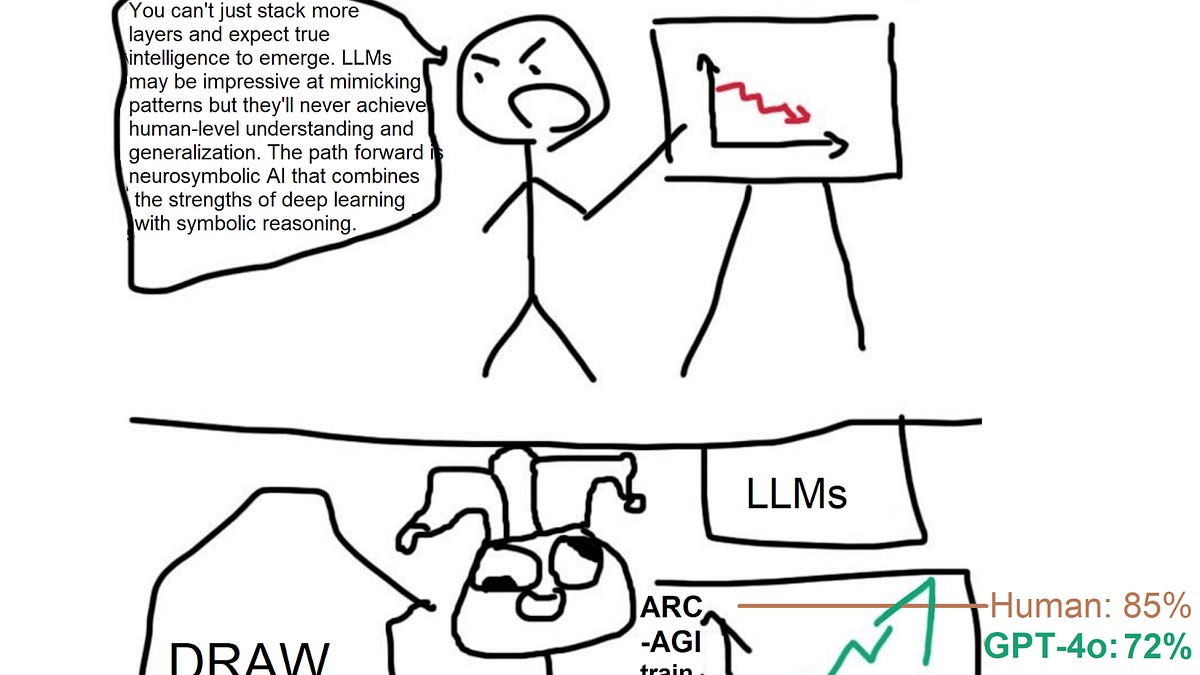
Adding the close-to ad-hominem attack on Francois Chollet with the comics at the beginning (Francois never claimed to be a neuro-symbolic believer), this work does a significant disservice to the community.
His response:
"This has been the most promising branch of approaches so far -- leveraging a LLM to help with discrete program search, by using the LLM as a way to sample programs or branching decisions. This is exactly what neurosymbolic AI is, for the record..."
"Deep learning-guided discrete search over program space is the approach I've been advocating, yes... there are many different flavors it could take though. This is one of them (perhaps the simplest one)."
Pitching him against LLMs in such a binary fashion is deceiving and unfair.
Nope. This is neurosymbolic AI:
Abductive Knowledge Induction From Raw Data
https://www.doc.ic.ac.uk/~shm/Papers/abdmetarawIJCAI.pdf
That's a symbolic learning engine trained in tandem with a neural net. The symbolic engine is learning to label examples for the neural net that learns to label examples for the symbolic engine. I call that cooking!
(Full disclosure: the authors of the paper are my thesis advisor and a dear colleague).
A lot of top researchers claim that obvious deficiencies in LLM training are fundamental flaws in transformer architecture, as they are interested in doing some new research.
This work show that temporary issues are temporary. E.g. LLM is not trained on grid inputs, but can figure things out after preprocessing.
If this article wanted to attack Chollet, it could have made more hay out of another thing that's "hidden in the middle of the article", the note that the solution actually gets 72% on the subset of problems on which humans get ~85%. The fact that the claimed human baseline for ARC-AGI as a whole is based on an easy subset is pretty suspect.
At the time I noticed that many of the ARC problems rely on visual-spatial priors that are "obvious" when viewing the grids, but become less so when transmuted to some other representation. Many of them rely on some kind of symmetry, counting, or the very human bias to assume a velocity or continued movement when seeing particular patterns.
I had always thought maybe multimodality was key: the model needs to have similar priors around grounded physical spaces and movement to be able to do well. I'm not sure the OP really fleshes this line of thinking out, brute forcing python solutions is a very "non human" approach.
It still is. It misses the solution so comprehensively that it needs an outer loop to figure out which one is the solution out of 8k programs GPT-4o generates.
I don't think the location of the outer-loop or the design of it really makes much difference. There is no flock of birds without the individuals, the flock itself doesn't really exist as a tangible thing, but what arises out of the collective adjustments between all these individuals gives rise to a flock. Similarly, we may find groups of LLMs and various outer control loops give rise to an emergent phenomena much greater than the sum of their parts.
Yes, we do. It's a language model.
ARC-AGI has odd features that leave me flummoxed by the naming and the attendant prize money and hype.
It is one singular task and frankly I strongly suspect someone could beat it within 30 days[1], in an unsatisfying way, as you note.
There's so much alpha that can be pieced together from here, ex. the last couple Google papers use the 1M context to do *500-shot*, i.e. 500 question answer examples. IIRC most recent showed raising travelling-salesman problem solve rate from 3 to 35%.
[1] I pre-registered this via a Twitter post, about 48 hours ago, i.e. before this result was announced.
Program synthesis has been mentioned as a promising approach by François Chollet, and that's exactly what this is.
The place I find slightly unsatisfying is this:
> Sample vast, vast numbers of completions (~5,000 per problem) from GPT-4o.
> Take the most promising 12 completions for each problem, and then try to fix each by showing GPT-4o what this program actually outputs on the examples, and then asking GPT-4o to revise the code to make it correct. We sample ~3,000 completions that attempt to fix per problem in total across these 12 starting implementations.
I'd been tossing around a MCTS idea similar to AlphaGo, based on the idea that the end transformation is a series of sub-transformations. I feel like this could work well alongside the GPT-4o completion catalog. (This isn't an original observation or anything)
To be precise, "this" -a bog-standard generate-and-test approach- is the dumbest possible way to do program synthesis. It's like sorting lists with bogosort and a very big computer.
It's exactly like bogosort: generate permutations and test. Except of course the system that generates permutations costs a few millions(?).
In your opinion, what has changed that would accelerate a solution to the next 30 days?
This sort of idea would then be shared openly on new sites, creating more attempts. Fallout I did not anticipate was getting widespread attentional on general tech news sites, and then getting public comment from a prize co-founder confirming it was acceptable.
Intelligence is an ability that is naturally gradual and emerges over many domains. It is a collection of tools via which general abstractive principles can be applied, not a singular universally applicable ability to think in abstractions. GPT-4, compared to a human, is a very very small brain trained for the single purpose of textual thinking with some image capabilities. Claiming that ARC is the absolute market of general intelligence fails to account for the big picture of what intelligence is.
People in general are interested in capabilities or economic impact, and GPT-2 cleared no notable thresholds in those regards.
I prefer the exact opposite approach: let’s use a strict definition, and have levels to make it really explicit what we are talking about.
Here is a good one:
“Levels of AGI for Operationalizing Progress on the Path to AGI”
Then stop selling it as a tool to replace humans. A fast moving car breaking through a barrier and flying off the cliff could be called "an airborne means of transportation, just a very bad one" yet nobody is suggesting it should replace school busses if only we could add longer wings to it. What the LLM community refuses to see is that there is a limit to the patience and the financing the rest of the world will grant you before you're told, "it doesn't work mate."
> So at what point does a human go from not generally intelligent to generally intelligent?
Developmental psychology would be a good place to start looking for answers to this question. Also, forgetting scientific approach and going with common sense, we do not allow young humans to operate complex machinery, decide who is allowed to become a doctor, or go to jail. Intelligence is something that is not equally distributed across the human population and some of us never have much of it, yet we function and have a role in society. Our behaviour, choices, preferences, opinions are not just based on our intelligence, but often on our past experiences and circumstances. It is also not the sole quality we use to compare ourselves against each other. A not very intelligent person is capable of making the right choices (an otherwise obedient soldier refusing to press the button and blow up a building full of children); similarly, a highly intelligent person can become a hard-to-find serial criminal (a gynecologist impregnating his patients).
What intelligent and creative people hold against LLMs is not that they replace them, but that they replace them with a shit version of them relegating thousands of years of human progress and creativity to the dustbin of the models and layers of tweaks to the output that still produce unreliable crap. I think the person who wrote this sign summed it up best https://x.com/gvanrossum/status/1802378022361911711
I don't understand why people assume that the purpose of any tool is to "replace humans". Automation doesn't replace humans and never has and never will. It simply does certain tasks that humans used to do, freeing people up to do different tasks. There is not a limited amount of work that can be done, there isn't a limited amount of _creative_ work that can be done. Even if AIs were good enough to do every creative task done by humans today (and they aren't and won't be any time soon), that doesn't mean that humans will have nothing of value to produce, or that humans will have been "replaced". There is always going to be work for humans to do, even in a universe where AI have super human capabilities at all tasks.
In particular, human beings strongly value the opinions and creative output of _human beings_ simply for the reason that they are human and similar to them. That will never change, no matter how intelligent that AIs get.
Because of this https://news.ycombinator.com/item?id=40070566
The point about LLM's is they may have a lot of drawbacks right now but they're improving at a rapid pace. They already are very useful. There are hundreds of stories coming out of companies effectively leveraging them to replace workers in many natural-language related tasks. They're far more useful than a car that goes off a cliff.
Nobody more useful than an LLM is being effectively replaced by an LLM. Those few companies that jump the gun too early are suffering for it.
>That sign
We already have dishwashers and washing machines. Companies are working on making humanoid robots that can do those things, it's just that it's harder to develop a fully-fledged embodied humanoid than it is to create the diffusion models and LLM's being used today. It's not some conspiracy to let AI do all the fun stuff first.
Nobody is preventing anyone from making art or writing poetry. If someone finds value in AI art or writing, either you have to accept that they weren't the audience member you wanted, or you have to accept that your ability to be creative is a learnable algorithm same as anything else.
It's an existential complaint. "Why won't the nerds make something for meeeee." Do it yourself. Make that robot.
Sucks to think that you're not that special. Most art isn't. Most music isn't. Any honest artist will agree. Most professional artists are graphic designers, not brilliant once in a generation visionaries. It's the new excuse for starving artists. AI or no, they'd still be unsuccessful. That's the way it's always been.
That plan B is now going away, and a music career will be much more like a sports career: either you make it in football, or you need to find another career where your football skills won’t be very useful.
That is obviously scary for many.
Your response is “learn to art” “The nerds dont owe you anything.” “Most of You would be unsuccessful anyway”
You brought in absolutely unrelated items.
1) Learn art - that is baked into what the Sign is saying. There is no Terminal Point for being an artist.
2) Nerds dont… - Where nerds come in as a class for this conversation?
2.1) if you can speak for all nerds, please note that I sure as heck dont want Warhammer 40k, I want Star Trek.
3) Most would be unsuccessful - so what?
Are they happy practicing their craft? Do they have the choice to spend their time on those pursuits and enrich their lives, and share their joys with others around them?
But people choose to be in denial.
As long as this level hasn't been achieved in all domains, it isn't AGI.
Furthermore, you're counting cases where humans do things the computer cannot but ignoring cases where the computer does things humans cannot. For instance, I doubt any human alive, let alone average humans can give reasonable explanations for short snippets of computer code in as many languages as GPT-4o, or formulate poetry in as many styles on arbitrary topics, or rattle off esoteric trivia and opinions about obscure historic topics, .... I think you get the point. It has already surpassed average human abilities in many categories of intellectually challenging tasks, but with your definition if it fails at even one task an average human can do, then it lacks "general intelligence."
I suggest that your definition is one for "AHI" (Average Human Intelligence), not one for "AGI" (Artificial General Intelligence.)
Not so with GPT. It will try, and fail, but that it tries at all was unimaginable five years ago.
Though on the other hand figuring out which manipulations are effective does teach us something. And I think most problems boil down to pattern matching, creating a true, easily testable AGI test may be tough.
This would sound more far-fetched if we knew exactly how they work, bit-by-bit. We've been training them statistically, via the data-for-code tradeoff. The question is not yet satisfactorily answered.
In this hypothetical, for every accusation that an LLM passes a test because it's been coached to do so, there's a counter that it was designed for "excessively human" AGI to begin with, maybe even that it was designed for the unconscious purpose of having humans pass it preferentially. The attorney for the hypothetical AGI in the LLM would argue that there are tons of "LLM AGI" problems it can solve that a human would struggle with.
Fundamentally, the tests are only useful insofar as they let us improve AI. The evaluation of novel approaches to pass them like this one should err in the approaches' favor, IMO. A 'gotcha' test is the least-useful kind.
The human brain is millions of years of brute force evolution in the making. Comparing it to a transformer or any other ANN really which essentially start from scratch relatively speaking doesn't mean much.
https://chatgpt.com/share/2fde1db5-00cf-404d-9ae5-192aa5ac90...
GPT-4 created a plan very similar to the article, i.e. it also suggested using Python to pre-process data. It also suggested using program synthesis. So I'd say it's already 90% there.
> "Execute the synthesized program on the test inputs."
> "Verify the outputs against the expected results. If the results are incorrect, iteratively refine the hypotheses and rules."
So people saying that it's ad-hoc are wrong. LLMs know how to solve these tasks, they are just not very good at coding, and iterative refinement tooling is in infancy.
Hard to find the right float but worth trying I think.
1) Most of the heavy lifting is being done by search. We're talking about having the LLM generate thousands of candidate solutions, and they're mostly bad enough that "just pick the ones that get kinda close on the examples" is a meaningful operation.
2) More samples improves performance despite the fact that GPT-4o's vision is not capable of parsing the inputs. I'm curious how much performance would degrade if you shuffled the images passed to the model (but used the correct images when evaluating which candidates to keep).
3) It's definitely true that the LLM has to be giving you something more than random programs. At the very least, the LLM knows how to craft parsimonious programs that are more likely to be the solution. It may be that it's providing more than that, but it's not clear to me exactly how much information on the correct search space is coming from the hand-crafted examples in the prompt.
Overall, the work to get this far is very impressive, but it doesn't really move the needle for me on whether GPT-4 can do ARC puzzles. It does, however, show me that search is surprisingly powerful on this task.
Maybe a AI version of Hanlons Razor. Never attribute to AGI what could be easily explained by being in the training set.
This approach is https://en.wikipedia.org/wiki/Embarrassingly_parallel, which is a good fit for biological neural architectures, which have very many computing nodes but each node is very slow (compared to electronic computer CPUs/GPUs).
I think we need those pieces, and also a piece for determining hypotheses in an efficient manner. Monte Carlo Tree Search could be that piece. Probabilistically choose a node to search, and then backpropagate the probabilities back to the root node.
The approach described in the article is exactly "brute-force search over some sort of DSL". The "DSL" is a model of Python syntax that GPT-4o has learned after training on the entire internet. This "DSL" is locked up in the black box of GPT-4o's weights, but just because no-one can see it, it doesn't mean it's not there; and we can see GPT-4o generating Python programs, so we know it is there, even if we don't know what it looks like.
That DSL may not be "domain specific" in the sense of being specifically tailored to solve ARC-AGI tasks, or any other particular task, but it is "domain specific" in the sense of generating Python programs for some subset of all possible Python programs that includes programs that can solve some ARC-AGI tasks. That's a very broad category, but that's why it over-generates so much: it needs to draw 8k samples total until one works for just 50% of the public eval set.
Isn't the public test set public on github and therefore GPT-4o trained on it?
It will be good to see the private set results though.
So it's not at all surprising to me to see Arc already being mostly solved using existing models, just with different prompting techniques and some tool usage. At some point, the naysayers about LLMs are going to have to confront the problem that, if they are right about LLMs not really thinking/understanding/being sentient, then a very large percentage of people living today are also not thinking/understanding/sentient!
The LLM isn't doing the reasoning here, it's just pattern matching the before/after diff and generating thousands of Python programs. The actual reasoning is done by an agentic like loop wrapped around the LLM, as described in the linked blog.
I don't think it is like that but rather Chollet wants to see stronger neuroplasticity in these models. I think there is a divide between the effectiveness of existing AI models versus their ability to be autonomous, robust and consistently learn from unanticipated problems.
My guess is Chollet wants to see something more similar to biological organisms especially mammals or birds in their level of autonomous nature. I think people underestimate the degree of novel problems birds and mammals alone face in just simply navigating their environment and it is the comparison here that LLMs, for now at least, seem lacking.
So when he says LLMs are not sentient, he's asking to consider the novel problems animals let alone humans have to face in navigating their environment. This is especially apparent in young children but declines as we age and gain experience/lose a sense of novelty.
Chollet published his paper On the measure of intelligence in 2019. In Internet time that is a lifetime before the LLM hype started.
b) He is not being overly negative of LLMs. In fact he believes they will play a role in any AGI system.
c) OpenAI CTO has publicly said that ChatGPT 5 will not be significantly better than existing models. So the rate of improvements you believe in simply doesn't match reality.
This isn't that big a bullet to bite (https://www.lesswrong.com/posts/4AHXDwcGab5PhKhHT/humans-who... comes from well before ChatGPT's launch), and I myself am inclined to bite it. System 1 alone does not a general intelligence make, although the article is extremely interesting in asking the question "is System 1 plus Python enough for a general intelligence?". But it's not a very relevant philosophical point, because Chollet's position is consistent with humans being obsoleted and/or driven extinct whether or not the LLMs are "general intelligences".
His position is that training LLMs results in an ever-larger number of learned algorithms and no ability to construct new algorithms. This is consistent with the possibility that, after some threshold of size and training, the LLM has learned every algorithm it needs to supplant humans in (say) 99.9% of cases. (It would definitely be going out with a whimper rather than a bang, on that hypothesis, to be out-competed by something that _really is_ just a gigantic lookup table!)
Back in the days similar generalization was used for Deep Blue chess computer. Computer won in 1997, but the AGI abyss is still as big.
His definition of intelligence is interesting: something that can quickly achieve tasks with few priors or experience. I also think the idea of using human "Core Knowledge" priors is a clever way to make a test.
It literally just did this for me 15 minutes ago. You can't talk about AGI when it is this easy to push it over the edge into something it doesn't know.
Paper references have got better the last 12 months but just this week it made up both a book and paper for me that do not exist. The authors exist and they did not write what it said they did.
It is very interesting if you ask "do you understand your responses?" sometimes it will say yes and sometimes it will so no not like a human understands.
We should forget about AGI until it can at least say it doesn't know something. It is hardly a sign of intelligence in humans to make up answers to questions you don't know.
Unless you’re saying you have never held on to a wrong opinion that was at some point proven to be wrong?
None of them are terribly hard but some aren't trivial either, a couple took me a bit of thinking to work out. By far the most tedious part is inputting the result (I didn't bother after the first) which is definitely something AI is better at!
Seems like it relies on identification of objects and then mapping them somehow. Most of the cases so far that I've seen are based on some transformation or relation between the objects.
So far it seems like some search among common transformatiosn and relations could solve it. Plus some heuristics/computation for counting order, wholeness(boundary) or pattern.
IMO it can be solved by search of programs that combine these + some LLM to guide heuristics most likely.
The only hard one was applied noise or one testing understanding of "gravity".
Did anyone test human baseline for this?
https://www.youtube.com/watch?v=QWWgr2rN45o&t=46m20s
The truth is in the middle, I think. They learn in-context, but not as well as humans.
The approach in the article hides the unreliability of current LLMs by generating thousands of programs, and still the results aren't human-level. (This is impressive work though -- I'm not criticizing it.)
In general, there is too much fluff and confusion floating around about what these models are and are not capable of (regardless of the training mechanism.) I think more people need to read Song Mei's lovely slides[1] and related work by others. These slides are the best exposition I've found of neat ideas around ICL that researchers have been aware of for a while.
[1] https://www.stat.berkeley.edu/~songmei/Presentation/Algorith...
https://chatgpt.com/share/2fde1db5-00cf-404d-9ae5-192aa5ac90...
So it's pretty close to being able to plan solution completely on its own. It's just rather bad at coding and visual inputs, so it doesn't know what it doesn't know.
But you can have GPT write code to reliably convert the image grid into a textual representation, right? And code to convert back to image and auto-verify.
Can someone explain?
If you can't do ARC, you aren't general enough. But even if you can do ARC, you still might not be general enough.
Program search mimics what humans do to a certain extent but not in entirety.
A more general world model and reference will be required for agi.
/sarcasm :D