201 points · by MBCook · 2y ago · 95 comments
I suffer(ed) from chronic depression, and I'd get "bouts" of severe episodes every 5-6 years or so. I was very fortunate in that ketamine infusion therapy was a complete and amazing godsend for me - it was like it fixed a switch in my head. But I know other people with chronic depression that did ketamine therapy that got no benefit (but at least in one case they did get a lot of benefit from a different treatment, TMS, transcranial magnetic stimulation). My point is that basically everyone in the field of psychiatry knows that some interventions work great for some people while having no effect on others. More research like this should allow us to better target treatments.
I don't understand for example why ADHD is any more real than any other collection of seemingly related symptoms one might conjure up. Just going by the criteria of the DSM, its logically possible for two people to be diagnosed while sharing only 3 of the 9 symptoms. And if one someone without ADHD can have 5/9 symptoms, and someone with ADHD can have the first 6 symptoms, and another can have the last 6, and another 1,3,5,7,8,9 of the symptoms, it says to me these symptoms can arise out of completely independent causes. So might it be possible someone meeting the clinical definition of ADHD can have just happen to have 6 independently caused symptoms?
Thats not to say I don't think people truly have physical issues, but there is nothing at all to say any two people who "have" depression or ADHD are anything at all alike.
There are lots of psychiatric disorders where that doesn't take place, but developmental neuropsychiatric disorders don't fall under that "are they even alike at all" kind of umbrella. In some kind of awful alternate universe we could pretty reliably induce them with gamma knife surgery, for example.
Depression is much easier to argue that it's a less specific symptom of a larger constellation, with lots of causes and lots of manifestations.
And how significant are these results? Are we talking about a few percent difference? Are 10% of diagnoses ADHD shown to have statistically significant differences, 20, 50, 90? Depending on the figure, my criticism of the diagnostic criteria remains. Because if it is a low figure like 10%, that means 90% of the diagnoses aren't supported by any scientific evidence.
From what I've been told, including professionals this evidence does not exist.
I've also seen studies which indicate that psychiatric evaluations are entirely inconsistent across physicians.
Using brain imaging to push questionable psychiatry premises was very popular for a while, and you need to take a lot of research from that era with a huge grain of salt. Remember that with the right settings, neuroscientists can even produce images showing activity in brain regions of completely dead salmon: https://www.wired.com/2009/09/fmrisalmon/
This kind of reasoning is completely faulty and rampant in discussions that usually hold a fair amount of stigma towards people experiencing mental health conditions (it’s also extremely insulting fyi).
I can have a headache, and there may be an unknown biological mechanism, but that doesn’t mean I’m not experiencing a headache.
With physical ailments, symptoms are surface manifestations of an underlying physical cause. For example, fever and fatigue in flu are the result of the influenza virus. Crucially, you can have the physical cause without symptoms (such as in the presymptomatic period), so the two are dissociable. Even where the physical cause is unknown, there's still this symptom-cause distinction.
In the case of mental disorders, they're essentially defined by the symptoms. To have depression is to be depressed. To have anxiety is to be anxious. What would it even mean to have depression without being depressed?
While on some level these are physical in a sense (insofar as they result from brain activity), I don't necessarily think we should think about their cause in the same way as a physical ailment.
More to the point, there's a much more obvious sociocultral element to mental disorders. There's no 'objective' line between being sad and being depressed so while we clearly can and should treat depression, it seems to be very different from other diseases.
None of this is to take away from the real suffering people undergo with these disorders. I just don't think that treating them through a strict biological-pathological lens is as useful as people think it is.
I have diagnosed ADHD, and I take mental health very seriously. I have zero such prejudice.
By "definite" things I mean, singular, physical causes which can be pointed to.
I am not sure what you mean. Isn't "executive control" involved in almost every behavior? Why are the criteria used in ADHD diagnosis any more indicative of executive control than some other set of criteria I can come up with?
Is being bored of people talking a sign of lack of control or a lack of interest?
>I would argue that all people with ADHD generally also show all of the symptoms,
All people show all the symptoms. Who has never lost their keys, day dreamed during a conversation, loses focuses in an activity, forget small details, etc.
>yet I can’t stand up and walk without checking everything in my pockets like most people can.
How do you know what most people do? I think checking your pockets is a fairly common normal behavior. Different people have different adaptations to solving this problem of making sure they have what they need when they go out. Some people may have developed the discipline from a young age for example of placing things at the same place everytime. Some people may be more risk tolerant or care free, so they may not devote so much attention to the consequences of losing things. Some people may be clean freaks, so they encounter where their things are more often as they clean, and having a clean space, are also able to find things more easily. Some people, in some circumstances may become anxious, overly excited, etc before going out, and lose track of these things. There's a million reasons for why someone does these things.
These are all things that may even change by environment! I think the ADHD diagnosis can be harmful in that it makes people attribute all their behaviors to "Adhd" and makes them believe they are incapable of being changed.
And this is all contingent on even trusting that you actually do forget things more often than most, which again I don't know why people are so sure about, and Im even more confused as to how a physician assesses this to be true.
It’s not just ADHD. Consider OCD, while there are several sub types and triggers, many of the traits and rituals are very similar (repetitive washing, locking of doors, uncomfortably violent ideation) so much so that it’s clear they are related.
And if you’re a familiar of these people, you will experience their condition undoubtedly, when compared to a neurotypical.
This is a whole another problem with the diagnosis. A human being is making subjective judgements based on the self reporting of another human being. Most of the dsm is stuff like "is often inattentive in conversations", "often misplaces things".
How often is "often"? How do you know on average how many times people misplace things?
I have no issues with this at all if we just admit its not really a science and were just trying to treat patients
Personalised brain circuit require personalised therapy, and talk therapy with well trained therapist seems to be the key to treat the cause instead of symptom. All the difrerent fancy medications are "throw stuff against the wall and see what works".
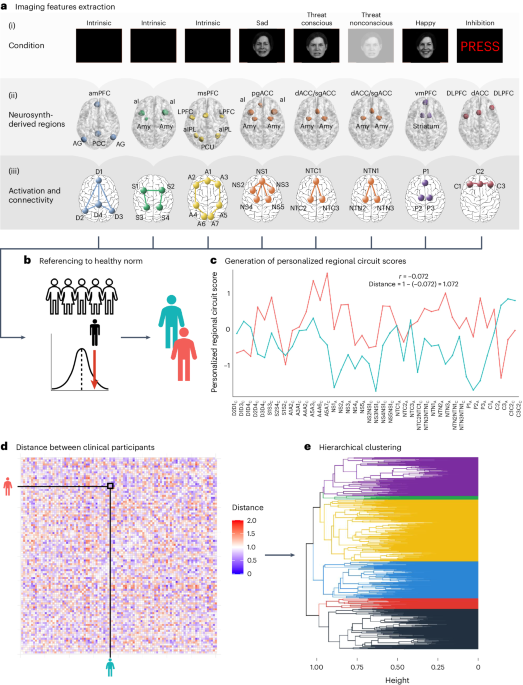
Its basically: a) Use Neurosynth.org to perform metanalytic analysis associated with these search terms: “Default Mode, Salience, Attention, Threat, Reward, and Cognitive Control" Neurosynth is awesome, check it out.
b) Resulting region pairs were quantified for intrinsic functional connectivity after regressing out task effects. * I don't understand the word 'pairs' here since Neurosynth does not provide pairs of anything (i.e. ROI's), unless they mean pairs of voxels.
c) quote: then it gets really messy with : "o identify regions of interest (B) we considered the default mode, salience, and attention circuits to be task-free and the negative affect, positive affect, and cognitive control circuits to be task-evoked (details in Table S3). We refined our circuit features by first excluding regions based on low tSNR and low fit to gray matter (C). We evaluated internal consistency and excluded region pairs whose connectivity showed stronger associations with out-of-circuit region pairs than within-circuit region pairs in our healthy sample (E). From the resulting set of regions (E) we identified the subset implicated in hypothesized dysfunction and derived circuit clinical scores references to a healthy sample (F; details in Table S5)."
[1][pdf link] https://www.ncbi.nlm.nih.gov/pmc/articles/PMC9511971/pdf/nih...
Importantly, they provide data and ROI masks so that others can examine this in their own datasets: https://github.com/leotozzi88/cluster_study_2023
Specifically: do some combinations of biotypes struggle to relate to one another in the same way as autistic/non-autistic pairs do?
Fascinating research regardless and I look forward to more people lifting the veil on the blobs of symptoms we think of as illnesses to get at the (seemingly highly varied) things that drive them.
A transformer model would be interesting because you can map voxels to tokens and then look for patterns there. The embeddings alone would be interesting. Then there are generative AI approaches that can be integrated in as well.
There's a few free ideas for anyone interested. Neat stuff!
[1] https://lisafeldmanbarrett.com/books/how-emotions-are-made/
A.) we found the types of brains that are inherently prone to depression/anxiety
B.) we found the patterns that depressive/anxious thoughts make on MRIs
Trying to separate thoughts from the physical brain wiring is futile - there is no disconnected "thought" that is _not_ the wiring of the brain. Changing thoughts does change brain, and changing brain does change thoughts.
But even being able to do something objective m (an MRI) and come up with a prediction that is halfway accurate would be a big step forward.
Could this lead to A? Maybe, assuming it’s confirmed. Or maybe cause and effect is backwards.
Either way, it’s _something_ i’m not sure we’ve had before.
The question is whether their mechanism of action truly helps in people with depression disorders or anxiety disorders or any of the other conditions they are prescribed for. We clearly know from clinical trials that it helps some, at least somewhat, and it doesn't help at all or even hurts in many others; and this remains true regardless of dose. We don't have any specific theory as to why this is.
Now consider the poor response to available medication (IIRC 30% remit and 60% respond, which leaves roughly 40% with a potential deadly disease without medication). Some symptoms of depression occur in other mental illnesses, like the similarity between bipolar and unipolar depression. Maybe the disease we currently call depression is acutally a cluster of diseases. That's the reason to look for biomarkers that separate those different diseases and the develop treatments specifically for one disease. Similar to the development of brexanolone for postpartum depression.
Right now we just try lots of drugs, one after another, on each patient until something works or the patient gives up. What if we could confidently predict the drugs that were the most likely to succeed for each group? It may cut treatment times and help people find relief faster.
Even if we don’t find new treatments or gain a better understanding of cause/effect it could still be useful.
I am one of the people with this deadly disease and frankly I want to die right now because I am homeless living with schizoaffective disorder and it its the 15 year anniversary of my nephews suicide and all anyone here does is downvote me because they cannot take the time to listen.
DO you know how many years I have heard of sht like this and then I go to the doctor and I am getting the same medications my mother got when she was sick 60 years ago?
Do me a favor, read my blog, look at what I know and what I have and am living with, then come back here and tell me I should be happy about this study that will do nothing for me and nothing for anyone in the next 20 years. Then tell me how not giving me that money to help me other people living with mental illness who are homeless to find housing is not better.
But nevertheless, if these studies don't happen, there will forever be people who have to suffer like you do.
Instead, there are many other places where money is being wasted on things that not only have 0 chance of helping, but are actively hurting people. The war budget is many times over all of the psychiatric research money ever spent - maybe we should target taking money from there to help people people struggling with mental illness or homelessness or both, before taking that money from research.
From the article:
> There is an urgent need to derive quantitative measures
> We need treatment, not more tests to tell us what we already know.
Testing for objective markers can/should lead to choosing the most adequate treatment faster than relying on self reported symptoms or subjective opinion from therapists (even if experienced or informed).
This need to measure everything is almost pathological.
Speaking as a patient myself.
I wish there was a way I could get an objective test that spits out exactly what's wrong with me and which treatments are most effective. I've been through several psychiatrists and treatments and am yet to find something effective.
I'm glad research like this is being done.
What's pathological is the tendency to see everything in black or white, right or wrong. There are many different causes for fatigue and tiredness: the flu, atypical depression, chronic fatigue, etc. But those conditions can overlap with depression. Putting the symptoms through a sieve by eliminating some causes helps pinpoint the origin (I over-simplify of course).
edit: this complaint about measuring things is a bit surprising considering what needed to be measured so this article https://christianbonanno.substack.com/p/what-caused-my-menta... (edit: interesting reading btw) could be written ?
However, your post has a very "we don't need x-rays, we can just tell the bone is broken" vibe. It reads like you think better and more objective, quantitative diagnosis is not worth pursuing.
depression with anxiety is dramatically more difficult to treat than either or.
Bipolar can come across as ADHD in certain parts of the cycle or just usually depression. In fact, you can even have uni-polar depression that does not respond to traditional anti-depressants and you don't necessarily exhibit hypomanic episodes.
Relying on patients to know and understand what they are experiencing other than "this is just normal I assume everyone else experiences this" is not reliable.
Having something that can reliably diagnose and find markers for these conditions would be _huge_.
I wade through whitepapers and books on this stuff because of my own issues. I don't expect the average person to even remotely know about all of this; it's a lot and very subtle.
To add on to all of this, people tend to not seek treatment until there IS a problem. Sometimes this can be really life alteringly bad, sometimes it's benign. But it would be helpful if people could just "take a test" and know or at least have an idea.
The issue with being "objective" is also that your doctor has to be "objective" and I've had a lot of friends that are clearly ADHD and end up with DRs that think they are just trying to get medication and don't have ADHD.
Worse yet; they do get medications and they have to cycle a few different ones because of the way they tolerate it. It would be really nice if we had an idea to correlate your ADHD, your body chemistry, and which drugs would be most effective for you rather than the 3-12 month ordeal of figuring that out.
"To enable more precise diagnosis and selection of the best treatment for each individual, we need to dissect the heterogeneity of depression and anxiety. The dominant ‘one-size-fits-all’ diagnostic approach in psychiatry leads to cycling through treatment options by trial and error, which is lengthy, expensive and frustrating, with 30–40% of patients not achieving remission after trying one treatment"