254 points · by Tomte · 2y ago · 179 comments
For any given input text, there is a corresponding output text distribution (e.g. the probabilities of all words in a sequence which the model draws samples from).
The approach of drawing several samples and evaluating the entropy and/or disagreement between those draws is that it relies on already knowing the properties of the output distribution. It may be legitimate that one distribution is much more uniformly random than another, which has high certainty. Its not clear to me that they have demonstrated the underlying assumption.
Take for example celebrity info, "What is Tom Cruise known for?". The phrases "movie star", "katie holmes", "topgun", and "scientology" are all quite different in terms of their location in the word vector space, and would result in low semantic similarity, but are all accurate outputs.
On the other hand, "What is Taylor Swift known for?" the answers "standup comedy", "comedian", and "comedy actress" are semantically similar but represent hallucinations. Without knowing the distribution characteristics (e.g multivariate moments and estimates) we couldn't say for certain these are correct merely by their proximity in vector space.
As some have pointed out in this thread, knowing the correct distribution of word sequences for a given input sequence is the very job the LLM is solving, so there is no way of evaluating the output distribution to determine its correctness.
There are actual statistical models to evaluate the amount of uncertainty in output from ANNs (albeit a bit limited), but they are probably not feasible at the scale of LLMs. Perhaps a layer or two could be used to create a partial estimate of uncertainty (e.g. final 2 layers), but this would be a severe truncation of overall network uncertainty.
Another reason I mention this is most hallucinations I encounter are very plausible and often close to the right thing (swapping a variable name, confabulating a config key), which appear very convincing and "in sample", but are actually incorrect.
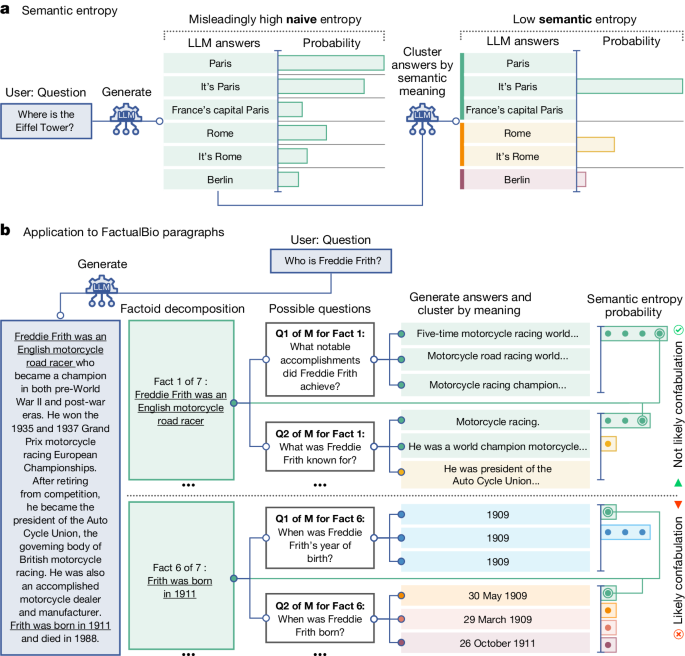
It depends on the fact that a high uncertainty answer by definition is less probable. That means if you ask multiple times you will not get the same unlikely answer, such as that Taylor swift is a comedian, you will instead get several semantically different answers.
Maybe you’re saying the same thing, but if so I’m missing the problem. If your training data tells you that Taylor Swift is known as a comedian, then hallucinations are not your problem.
A better example might be that the model overtrained on AWS cloud formation API 2 and when v3 comes out produces low entropy answers that are wrong for v3 but right for v2 (due to training bias), but the answers are low variance (e.g. "bucket" instead of the new "bucket_name" key).
Another example based on a quick test I did on GPT4:
In a single phrase, what is Paris?
Paris is the city of Light.
Paris is the capital of France.
Paris is the romantic capital of the world renowned for its art, fashion, and culture.
I don’t know the technical term for it, if there is one, but essentially by prompting with “In a single phrase” you are over-constraining the answer space, and so again you’ve moved into a high uncertainty regime.
Consider if you prompted a tool to render Paris in a single image. Eiffel Tower and Arc? Paris street with bakery? Overhead maps view? With what included and what omitted?
Hallucinations are an error that occurs based on providing an answer with high uncertainty, not wrong or outdated training data.
Blaming human semantics for LLMs is generally a bad idea, since we only use human semantics to qualitatively explain how the models abstract ideas. In practice you simply don't know how the model relates words.
To me this sounds very similar to lowering temperature. It doesn't sound like it pulls better from grounded-truth but rather more probabilistic in the vector space. Does this jive?
For your Tom Cruise example, since all those phrases are true and grounded in the training data, the technique may fire off a false positive "hallucination decision".
However, the example they give in the paper seems to be for "single-answer" questions, e.g., "What is the receptor that this very specific medication acts on?", or "Where is the Eiffel Tower located?", in which case I think this approach could be helpful. So perhaps this technique is best-suited for those single-answer applications.
> draw[ing] several samples and evaluating the entropy and/or disagreement between those draws
the method from the paper (as I understand it):
- samples multiple answers, (e.g. "music:0.8, musician:0.9, concert:0.7, actress:0.5, superbowl:0.6")
- groups them by semantic similarity and gives them an id ([music, musician, concert] -> MUSIC, [actress] -> ACTING, [superbowl] -> SPORTS), note that they just use an integer or something for the id
- sums the probability of those grouped answers and normalizes: (MUSIC:2.4, ACTING:0.5, SPORTS:0.6 -> MUSIC:0.686, SPORTS:0.171, ACTING:0.143)
They also go to pains in the paper to clearly define what they are trying to prevent, which is confabulations.
> We focus on a subset of hallucinations which we call ‘confabulations’ for which LLMs fluently make claims that are both wrong and arbitrary—by which we mean that the answer is sensitive to irrelevant details such as random seed.
Common misconceptions will still be strongly represented in the dataset. What this method does is it penalizes semantically isolated answers (answers dissimilar to other possible answers) with mediocre likelihood.
Now technically, this paper only compares the effectiveness of "detecting" the confabulation to other methods - it doesn't offer an improved sampling method which utilizes that detection. And of course, if it were used as part of a generation technique it is subject to the extreme penalty of 10xing the number of model generations required.
link to the code: https://github.com/jlko/semantic_uncertainty
> If it simply output "Capital of Rome" 3 times, would that indicate its probably not a confabulation? Correct, it would tend to indicate that. Whether or not that is a true output is a different question, but it would tend to indicate that the "Capital of Rome" is something that comes up consistently regardless of variations in random seed.
It's not a solution for hallucinations writ large, and it doesn't introduce an oracle of ground-truth accuracy on factoids. It just reweights possible answers by their 'semantic entropy'.
They did something else cool in the paper too (unrelated to whatever problem you want to solve with respect to apriori knowledge) They made a method for decomposing originally generated answers into "factoids" and fact checking them using this semantic entropy concept:
- Generate an output to a question e.g. "who is tom cruise?"
- for each sentence fragment that represents a factoid "known for the movie top gun", make a question jeopardy style: "what fighter pilot movie is tom cruise known for?"
- for each question, generate multiple answers and select one with low semantic entropy
- compare that answer with the original factoid
pretty cool overall, but still doesn't get us any closer to LLMs with a sense for whether something is fact-ish / a sense of truth.
Taylor Swift has appeared multiple times on SNL, both as a host and as a surprise guest, beyond being a musical performer[0]. Generally, your point is correct, but she has appeared on the most famous American television show for sketch comedy, making jokes. One can argue whether she was funny or not in her appearances, but she has performed as a comedian, per se.
Though she hasn't done a full-on comedy show, she has appeared in comedies in many credits (often as herself).[1] For example she appeared as "Elaine" in a single episode of The New Girl [2x25, "Elaine's Big Day," 2013][2]. She also appeared as Liz Meekins in "Amsterdam" [2022], a black comedy, during which her character is murdered.[3]
It'd be interesting if there's such a thing as a negatory hallucination, or, more correctly, an amnesia — the erasure of truth that the AI (for whatever reason) would ignore or discount.
[0] https://www.billboard.com/lists/taylor-swift-saturday-night-...
[1] https://www.imdb.com/name/nm2357847/
[2] https://newgirl.fandom.com/wiki/Elaine
[3] https://www.imdb.com/title/tt10304142/?ref_=nm_flmg_t_7_act
The process can look like-
1. Use existing large models to convert the same previous dataset they were trained on into formal logical relationships. Let them generate multiple solutions
2. Take this enriched dataset and train a new LLM which not only outputs next token but also a the formal relationships between previous knowledge and the new generated text
3. Network can optimize weights until the generated formal code get high accuracy on proof checker along with the token generation accuracy function
In my own mind I feel language is secondary - it's not the base of my intelligence. Base seems more like a dreamy simulation where things are consistent with each other and language is just what i use to describe it.
How to extend LLMs to add mechanisms for reasoning, causality, etc (Type 2 thinking)? However that will eventually be done, the implementation must continue to be probabilistic, informal, and bottom-up. Manual human curation of logical and semantic relations into knowledge models has proven itself _not_ to be sufficiently scalable or anti-brittle to do what's needed.
We could just use RAG to create a new dataset. Take each known concept or named entity, search it inside the training set (1), search it on the web (2), generate it with a bunch of models in closed book mode (3).
Now you got three sets of text, put all of them in a prompt and ask for a wikipedia style article. If the topic is controversial, note the controversy and distribution of opinions. If it is settled, notice that too.
By contrasting web search with closed-book materials we can detect biases in the model and lacking knowledge or skills. If they don't appear in the training set you know what is needed in the next iteration. This approach combines self testing with topic focused research to integrate information sitting across many sources.
I think of this approach as "machine study" where AI models interact with the text corpus to synthesize new examples, doing a kind of "review paper" or "wiki" reporting. This can be scaled for billions of articles, making a 1000x larger AI wikipedia.
Interacting with search engines is just one way to create data with LLMs. Interacting with code execution and humans are two more ways. Just human-AI interaction alone generates over one billion sessions per month, where LLM outputs meet with implicit human feedback. Now that most organic sources of text have been used, the LLMs will learn from feedback, task outcomes and corpus study.
My take - Hallucinations can never be made to perfect zero but they can be reduced to a point where these systems in 99.99% will be hallucinating less than humans and more often than not their divergences will turn out to be creative thought experiments (which I term as healthy imagination). If it hallucinates less than a top human do - I say we win :)
[1] https://cyc.com
I was not actually aware that building KG from text is NP-hard problem. I will check it out. I thought it was a time consuming problem when done manually without LLMs but didn't thought it was THAT hard. Hence I was trying to introduce LLM into the flow. Thanks, will read about all this more!
Eg, KGs (RDF, PGs, ...) are logical, but in automated construction, are not semantic in the sense of the ground domain of NLP, and in manual construction, tiny ontology. Conversely, fancy powerful logics like modal ones are even less semantic in NLP domains. Code is more expressive, but brings its own issues.
LLMs generate responses based on statistical probabilities derived from their training data. They do not inherently understand or store an "absolute source of truth." Thus, any KG bootstrapped from an LLM might inherit not only the model's insights but also its inaccuracies and biases (hallucinations). You need to understand that these hallucinations are not errors of logic but they are artifacts of the model's training on vast, diverse datasets and reflect the statistical patterns in that data.
Maybe you could build retrieval model but not generative model.
Why should you believe the output of the LLM just because it is formatted a certain way (i.e. "formal logical relationships")?
One expression of that idea is in this paper: https://link.springer.com/article/10.1007/s10676-024-09775-5
LLMs are incapable of presenting things as truth.
The social media gurus don't help with these issues by claiming that non-intentional objects are going to cause humanity's demise when there are much more pertinent issues to be concerned about like global warming, corporate malfeasance, and the general plundering of the biosphere. Algorithms that lie are not even in the top 100 list of things that people should be concerned about.
Knowing how random the information is seems like a small step forward.
Take social media like Reddit for example. It has a filtering mechanism for content that elevates low-entropy thoughts people commonly express and agree with. And I don’t think that necessarily equates such popular ideas there to the truth.
And they're right, it's not safe! Yes, people will certainly be misled. The Internet is not safe for gullible people, and LLM's are very gullible too.
With some work, eventually they might get LLM's to be about as accurate as Wikipedia. People will likely trust it too much, but the same is true of Wikipedia.
I think it's best to treat LLM's as a fairly accurate hint provider. A source of good hints can be a very useful component of a larger system, if there's something else doing the vetting.
But if you want to know whether something is true, you need some other way of checking it. An LLM cannot check anything for you - that's up to you. If you have no way of checking its hints, you're in trouble.
Then yes, it is being taught to bullshit.
Similar to how an improv class teaches you to keep a conversation interesting and “never to say no” to your acting partner.
[1] https://old.reddit.com/r/ChatGPT/comments/1diljf2/google_gem...
Sometimes, to lead people out of a wrong belief or worldview, you have to meet them where they currently are first.
> We think that this is worth paying attention to. Descriptions of new technology, including metaphorical ones, guide policymakers’ and the public’s understanding of new technology; they also inform applications of the new technology. They tell us what the technology is for and what it can be expected to do. Currently, false statements by ChatGPT and other large language models are described as “hallucinations”, which give policymakers and the public the idea that these systems are misrepresenting the world, and describing what they “see”. We argue that this is an inapt metaphor which will misinform the public, policymakers, and other interested parties.
The only way to know if it did “hallucinate” is to already know the correct answer. If you can make a system that knows when an answer is right or not, you no longer need the LLM!
https://en.wikipedia.org/wiki/Memory#Construction_for_genera...
You can have a generative model that cares about the truth when it tries to generate responses, its just the current LLMs don't.
Wanting to use accurate language isn't exhausting, it's a requirement if you want to think about and discuss problems clearly.
> Here we develop new methods grounded in statistics, proposing entropy-based uncertainty estimators for LLMs to detect a subset of hallucinations—confabulations—which are arbitrary and incorrect generations.
Sometimes it is coherent (grounded in physical and social dynamics) and sometimes it is not.
We need systems that try to be coherent, not systems that try to be unequivocally right, which wouldn't be possible.
The fact that it isn't possible to be right about 100% of things doesn't mean that you shouldn't try to be right.
Humans generally try to be right, these models don't, that is a massive difference you can't ignore. The fact that humans often fails to be right doesn't mean that these models shouldn't even try to be right.
I think this assumption is wrong, and it's making it difficult for people to tackle this problem, because people do not, in general, produce writing with the goal of producing truthful statements. They try to score rhetorical points, they try to _appear smart_, they sometimes intentionally lie because it benefits them for so many reasons, etc. Almost all human writing is full of a range of falsehooods ranging from unintentional misstatements of fact to out-and-out deceptions. Like forget the politically-fraught topic of journalism and just look at the writing produced in the course of doing business -- everything from PR statements down to jira tickets is full of bullshit.
Any system that is capable of finding "hallucinations" or "confabulations" in ai generated text in general should also be capable of finding them in human produced text, which is probably an insolvable problem.
I do think that since the models do have some internal representation of certitude about facts,that the smaller problem of finding potential incorrect statements in its own produced text based on what it knows about the world _is_ possible, though.
It's why this arena things are a hard problem. It's extremely difficult to actually know the entropy of certain meanings of words, phrases, etc, without a comical amount of computation.
This is also why a lot of the interpretability methods people use these days have some difficult and effectively permanent challenges inherent to them. Not that they're useless, but I personally feel they are dangerous if used without knowledge of the class of side effects that comes with them.)
The Boolean answer to that is "yes".
But if Boolean logic were a god representation of reality, we would already have solved that AGI thing ages ago. On practice, your neural network is trained with a lot of samples, that have some relation between themselves, and to the extent that those relations are predictable, the NN can be perfectly able to predict similar ones.
There's an entire discipline about testing NNs to see how well they predict things. It's the other side of the coin of training them.
Then we get to this "know the correct answer" part. If the answer to a question was predictable from the question words, nobody would ask it. So yes, it's a definitive property of NNs that they can't create answers for questions like people have been asking those LLMs.
However, they do have an internal Q&A database they were trained on. Except that the current architecture can not know if an answer comes from the database either. So, it is possible to force them into giving useful answers, but currently they don't.
the fact checker doesn’t synthesize the facts or the topic
Yes, there seems to be a little bit of grokking and the models can be made to approximate step-by-step reasoning a little bit. But 95% of the function of these black boxes is text generation. Not fact generation, not knowledge generation. They are more like improv partners than encyclopedias and everyone in tech knows it.
I don’t know if LLMs misleading people needs a clever answer entropy solution. And it is a very interesting solution that really seems like it would improve things — effectively putting certainty scores to statements. But what if we just stopped marketing machine learning text generators as near-AGI, which they are not? Wouldn’t that undo most of the damage, and arguably help us much more?
All in all it’s been a great experience, it’s like working with a mentor along the way. It must have saved me a great deal of time, given how rookie I am. I do need to verify the result.
Where did you get the 95% figure? And whether what it does is text generation or fact or knowledge generation is irrelevant. It’s really a valuable tool and is way above anything I’ve used.
I've started calling it what it is: lashing out in confusion at why they're not going away, given a prior that theres no point in using them
I have a feeling there'll be near-religious holdouts in tech for some time to come. We attract a certain personality type, and they tend to be wedded to the idea of things being absolute and correct in a way things never are.
Look, I'm not against LLMs making me super-human (or at least super-me) in terms of productivity. It just isn't there yet, or maybe it won't be. Maybe whatever approach after current LLMs will be.
I think it's just a little funny that you started by accusing people of dismissing others as "unwashed masses", only to conclude that the people who disagree with you are being unreasonable, near-religious, and simply lashing out.
That's reasonable for questions with a single objective answer. It probably won't help when multiple, equally valid answers are possible.
However, that's good enough for search engine applications.
Of course, altering the input without changing the meaning is the hard part, but doesn't seem entirely infeasible. At the least, you could just ask the LLM to try to alter the input without changing the meaning, although you might end up in a situation where it alters the input in a way that aligns with its own faulty understanding of an input, meaning it could match the hallucinated output better after modification.
Yes you could incorporate a semantic equivalence dataset into your training but:
1) when you have a bunch of ‘clear-cut’ functions (“achieve good AUC on semantics”) and you mix them to compensate for the weaknesses of a complicated model with an unknown perceptual objective, things are still kinda weird. You don’t know if you’re mixing them well, to start, and you also don’t know if they introduce unpredictable consequences or hazards or biases in the learning.
2) on a kinda narrowly defined task like: “can you determine semantic equivalence”, you can build a good model with less risk of unknown unknowns (than when there are myriad unpredictable interactions with other goal scoring measures)
3) if you can apply that model in a relatively clear cut way, you also have fewer unknowns unknowns.
Thus, carving a path to a particular reasonable heuristic using two slightly biased estimators can be MUCH safer and more general than mixing that data into a preexisting unholy brew and expecting its contribution to be predictable.
Training the models not to give wrong answers (or giving them less) in the first place would of course be even better.
Unnecessary complications come also from the use of pre-trained commercial black-box LLMs through APIs, which is (sadly) the way LLMs are used in applications in vast majority of times. These could perhaps be fine tuned through the APIs too, but it tends to be rather fiddly and limited and very expensive to do for large synthetic datasets like would be used here.
P.S. I found it quite difficult to figure out from the article how the "semantic entropy" (actually multiple different entropies) is concretely computed. If somebody is interested in this, it's a lot easier to figure out from the code: https://github.com/jlko/semantic_uncertainty/blob/master/sem...
“checking” is being done with another model.
“differently” is being measured with entropy.
It’s an interesting idea to measure certainty this way. The problem remains that the model can be certain in this way and wrong. But the author did say this was a partial solution.
Still, wouldn’t we be able to already produce a confidence score at the model level like this? Instead of a “post-processor”?
So this is basically saying we shouldn't try to estimate entropy over logits, but should be able to learn a function from activations earlier in the network to a degree of uncertainty that would signal (aka be classifiable as) confabulation.
As an example, while we were building our AI Chatbot for Ora2Pg, the main challenge was that we used OpenAI and several other models to begin with. To avoid hallucinations to the most possible extent, we went through various levels including PDR and then Knowledge Graphs and added FAQs and then used an Agentic approach to support it with as much as information as possible from all possible contexts.
As it is very challenging for anybody and everybody to build their own models trained with their data set, it is not something possible to avoid hallucination with generic purpose LLM's unless they are trained with our data sets.
The chatbot that we built to avoid hallucination as much as we can.
I use LLMs daily and get crappy results more often than not, but I had the impression that would be normal, as the training data can be contradictory.
The trick isn't in how to spot the lies, but how to properly apply them. We cannot teach the AI how not to lie, without first teaching it when it must lie, and then how to apply the lie properly.
"AI, tell me, do these jeans make me look fat?"
AI: NO. You are fat. The jeans are fine.
Is not an acceptable discourse. Learning when and how to apply semantical truth stretching is imperative.
They must first understand where and when, then how, and finally why.
It's how we teach our young. Isn't it?
Computers cannot "hallucinate."
"Confabulations are inaccurate or false narratives purporting to convey information about world or self. It is the received view that they are uttered by subjects intent on ‘covering up’ for a putative memory deficit."
It seems that there is a clear memory deficit about the incident, so the subject "makes stuff up", knowingly or unknowingly.
--
cited from:
German E. Berrios, "Confabulations: A Conceptual History", Journal of the History of the Neurosciences, Volume 7, 1998 - Issue 3
https://www.tandfonline.com/doi/abs/10.1076/jhin.7.3.225.185...
DOI: 10.1076/jhin.7.3.225.1855