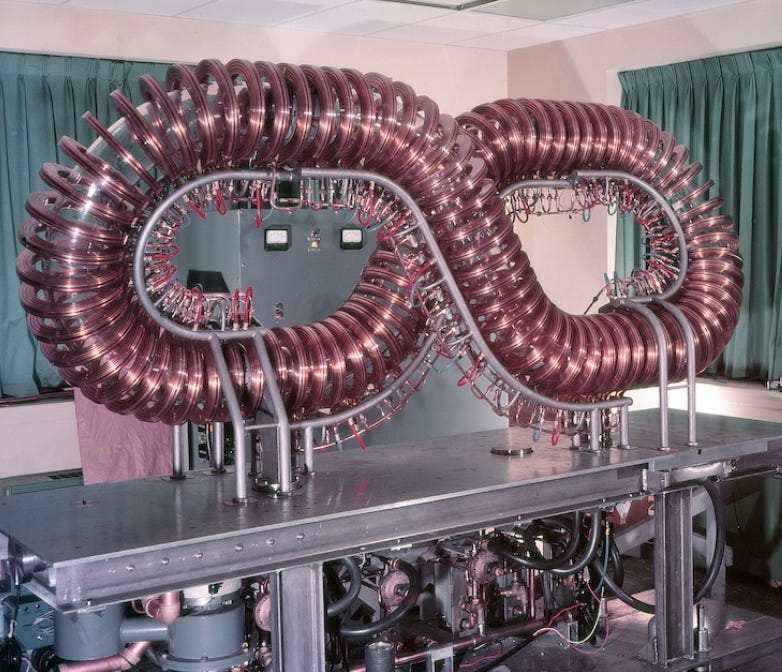
Will We Ever Get Fusion Power?
“Every one of the stars in the sky uses fusion to generate enormous amounts of energy. Why shouldn’t we?”
construction-physics.com
251 points · by pseudocoup · 2y ago · 297 comments
1. I think it's highly likely that, at some point (and probably in the not-too distant future with ITER and DEMO), humans will produce fusion reactors that are self-sustaining with net positive output (ignition).
2. Given the inherent complexity and difficulty with fusion, I think it's unlikely to ever be cost competitive with simpler power generation technologies.
3. Perhaps most importantly, at least in the next human lifetime, I think fusion will be largely irrelevant in the quest for carbon-free power generation, mostly as a result of the timescales required. I think right now that everyone pretty much understands that the problem with decarbonization tech is base load and storage: carbon-free renewables like solar and wind are already the cheapest form of energy generation, but they're intermittent and unreliable. Given the latest climate data, I think it's imperative that we develop base load and storage tech in the text 10/20/50 years, or we're REALLY f'd. But I haven't heard even fusion's biggest boosters say that fusion will be ready for large scale deployment in those timeframes, at cost-competitive economics. Point being, by the time I think fusion might be ready for large scale deployment, we better have already solved the base load and storage problems with cheaper tech.
But as you said, of course it's an open question whether fusion will actually be more economical at scale. It could conceivably turn out to be a day late and a dollar short on Earth, and more relevant elsewhere.
I'm keeping my eye on Helion (the one Sam Altman invested in). Seems they're making some pretty big claims, and have already entered into contracts to deliver to customers by 2030 or face financial penalties. Could still be vaporware, but they seem to think they have something.
But that's no longer the world we live in. The lowest cost energy is now from intermittent sources, and the optimal grid design will look very different.
It's a well done article that had a lot of research behind it.
FWIW if you're interested in Fusion the book 'The Future of Fusion Energy' is very good.
https://www.goodreads.com/book/show/43700662-the-future-of-f...
Also Commonwealth Fusion Systems put out a lot of interesting stuff about how they are going. Even having a look at their YouTube channel is worthwhile.
Metaculus has a lot of stuff on predictions about when fusion will be made viable :
Whatever happened to Lockheed's compact fusion program?[1]
[1] https://www.lockheedmartin.com/en-us/products/compact-fusion...
My long run prediction is that ITER will work and everything people on HN kept insisting would work in 5 years will suffer a similar fate.
I'll stake my claim now that I think Helion is probably not going anywhere (just a vibe, but there's something off about their recent big marketing push).
    South Australia has just chalked up what is undoubtedly a world first – a run of
    more than 10 consecutive days over which the average production of wind and solar
    accounted for 100 per cent of local demand.

    No other gigawatt scale grid in the world has come close to this amount of “variable
    renewable energy”, or for such a long time.

    RenewEconomy reported on Monday that South Australia had just enjoyed a seven day
    run of wind and solar that produced more than 104 per cent of average demand. Closer
    inspection proved it was even more impressive than that.


    According to Geoff Eldridge at data providers GPE NemLog2, the supply of wind and
    solar averaged 100 per cent of local demand for 10 days and 9 hours (a total of 249
    hours) from 08:20 on Friday, December 9, to 1720, Monday, December 19. [1]
Denmark is a nice example why this matter. During optimal weather their wind power produce around twice their local demand. However, in terms of actually consumption each year they need to import about 50% of their total amount of energy. This despite the fact that they export more energy than they import. The only way that would make mathematically sense is if export and import occur during different periods over the year.
This has multiple issues. The biggest being that they are heavily dependent on nearby countries fossil fueled power plants. A secondary problem is that prices they get for exports are low, since optimal weather conditions means a general surplus of energy in EU, while periods of bad weather results low supply and very high import costs. Their exports do not pay for their imports, despite exporting more than importing (in terms of energy, not money).
One can not remove the word averages and conclude that they ran fully on solar/wind/storage for 10+ days. It would be the same as saying that Denmark is running fully on wind a decade+.
Was compelling. Belief we're prepared to invest seems lacking.
I think achieving multi second "stable" plasma conditions has been amazing. But, I think that's a cigarette lighter held next to petrified wood (to use an atomic bomb era analogy) away from ignition as a useful energy over time equation.
We're also somewhat behind "what's embrittlement" or "what's xenon poisoning" problems. Things which don't emerge until a few months in your life of run-time. Again, from early fission reactor design, these things can sink a project.
Or, unexpected fission or other nasty behaviours. Things which make it hard to get inside the structure to fix it. The unknown unknowns in this feel huge. But, linear energy in, energy out, and the approach to viable ignition temperature. That's science and engineering at its best.
Fusors tapped out. "Mr fusion" isn't happening.
Can you, or anyone, explain the lore here? I get it's impossible to light it on fire, but what's the context? I tried searching for the expression and couldn't find anything.
From "Dark Sun" by Richard Rhodes.
Of the fusion startups mentioned in the article, I’d say that makes Zap Energy the one worth gambling on (if you’re a gambler that is), as its success apparently depends on exploiting a fluid dynamics effect which was not well known in the past (“shear flow”). If this sufficiently solves the confinement problem, the resulting device looks ludicrously simple in comparison to contemporaries.
Of course it may not work at all, I sure don’t know if it will; but if you had to invest in one of these, that seems like the one where successful power generation actually creates a marketable product.
The entire premise of fusion generation is based on world view where the limiting factor for generating electricity was the cost of providing fuel for combustion to generate heat. This thinking was pretty natural if you looked around the world in the first half of the 20th century when coal and steam engines were still kings of energy. This was a pre-semiconductor and pre-plastic age. That's why they ended up using long of fairly primitive technologies: a chemical (combustion) process to generate heat, a heat capture process to boil a tank of water, a mechanical process to convert the steam pressure into mechanical energy, and an electro-magnetic process to extract usable electricity.
But in an age of advanced materials and semiconductors, it feels more and more that fusion is an attempt to solve a problem that is no longer really relevant. Working towards a "better" heat source for an electricity generation process which still involves steam-age tech is akin to trying to breed faster/cheaper horses to improve modern transport.
The cost of fuel is almost negligible for fission - non-fuel operating costs are killing off perfectly functioning nuclear plants like at Indian Point[1] - so the problem that fusion will "solve" is not actually a significant problem.
I'm convinced that we have moved beyond boiling water and generating heat, etc. in electricity generation. We no longer need massive steam engines to generate electricity. Modern technologies like wind, solar and batteries dispense with all this cost and complexity and the shackles of Carnot efficiency.
[1] https://en.wikipedia.org/wiki/Indian_Point_Energy_Center
Wind, solar and batteries are products of combustion-fueled industry. The extent to which we have electrified the world industrial base is minimal, and to do so at the current scale on the basis of wind and solar would take a larger quantity of several metals than is available in the crust, to set aside the consequences of a massive expansion in mining, the poor recycling rates for most of the relevant materials, and the fact that, even with a much-improved recovery rate, this would only buy us on the order of several hundred years.
A more promising energy production system for a resource-limited world is thorium molten salt, which is comfortably Carnot in spirit, relatively cheap and easy to build, fuel and operate, no danger of meltdown, no "dual-use" for weapons, can consume existing nuclear waste... And we would do well to explore alternative battery chemistries as lithium is neither unique nor optimal, simply popular, and our hunger for it at present seems to be motivating some unpleasant political machinations.
Yes they do give a much better return than any thermal source according to any recent study of LCOE I've come across. Reflected in investment numbers - renewables account for 70% of new global capacity added last year.
Wind, solar and batteries are products of an energy intensive process NOT a combustion based process.
The shift to electricity as the primary energy source is well underway in multiple industries and sectors. Growth appears slow because industrial equipment is built to last decades. In transport (equally as energy hungry as industry), it's happening a lot faster as with domestic (induction cooking and heat pump sales).
Thorium molten salt, promising? You mean they were back in the 1950s/1960s in Oak Ridge? The first experimental molten salt reactor ran for a few days before springing a leak and being decommissioned. Or the later one in the 1960s which ran for 4 years (only managing to operate for 40% of the time)? There's a whole bunch of reasons that the PWR emerged as the dominant nuclear generation tech from forest of experimental reactor designs in the mid 20th century.
Sure, modern materials make for a more modern wind turbine. But they don't shift the paradigm. Nothing has since fission, right?
> Wind, solar and batteries are products of an energy intensive process NOT a combustion based process.
The fact remains that energy intensive industry is currently accomplished mainly via combustion. The degree of electrification is small and an effort to fully electrify faces what appear to be prohibitive resource limitations. If you have any ideas on this point I would be interested to hear them.
Electrification is happening in personal transport. We have made minimal progress towards an electric shipping fleet, electric air travel, electric trucking, etc. And if we do begin to make serious progress, it will come with serious environmental (and likely political) costs.
Oak Ridge was a testbed. The Chinese have an MSR that has been selling power to the grid for several years. Copenhagen Atomics is building them to fit into shipping containers. Is this not enough to prove the technology viable? The main reason traditional fission became dominant, as I understand, is that it allowed nuclear-capable nations to conceal nuclear weapons programs with energy programs. And once the supply chain and institutional expertise gets some inertia, it is hard to change tracks.
Will we get fusion power in the next few decades? I wouldn't bet on it, but I also wouldn't bet against it.
The bigger problem is that fusion plants aren't useful for making weapons. Fission plants were basically a side project of the nuclear arms race, which is why they're a dying industry now. The world already has all of the nuclear bombs it will ever need and despite all of the promises they never managed to compete on cost. It's so much easier and cheaper to install wind turbines, solar panels, and grid scale batteries that there will probably never be a market for a commercial fusion power plant.
The real reason for fusion was that fission is not a renewable resource. In a few thousand years there will be a fuel problem with fission and we would be forced to switch to fusion if we had a fully nuclear power system.
Solar decreases as 1/r^2. Cube root? Where did that come from?
The future is wind/solar/battery on cost alone.
The sun is able to use gravity containment. Terrestrial fusion has to use magnetic and physical containment. The extremely high energy neutrons produced rapidly deteriorate common engineering materials. A replacement schedule is very difficult because of induced radioactivity, which means that the reactor cladding would need to be replaced by robots most likely.
https://en.wikipedia.org/wiki/International_Fusion_Materials...
China are churning out regular old fission plants, and have 27 under construction right now. Even still, the average build time is 7 years.
So even if we get some breakthrough and figure out how to build a commercial fusion plant, it's a certainty it won't be up and running for something like 10-15 years. Solar and batteries will be so cheap there won't be any discussions.
Battery prices are pretty stable, which is huge problem for wind and solar energy.
The price of batteries has declined by 97% in the last three decades: https://ourworldindata.org/battery-price-decline
> Perón is the only Argentine president elected three times and holds the highest percentage of votes (61.86%) in clean elections with universal suffrage.
https://dothemath.ucsd.edu/2012/04/economist-meets-physicist...
However, with advances like REBCO tape and so on, it's far more realistic now. I hope we get it in my lifetime, but I'm not confident.
By 2013 (25 years later), still no real progress on protein folding.
In 2018 (30 years later) AlphaFold was revealed.
technical challenges aside, fusion power as a research + building + disvtributil project is so expensive - for the same amount of money we could already build a decentralized solution out of over-abundant solar cells, but it seems looking for the one big thing is still more interesting.
They'll have unlimited energy based on some quantum shit.
...probably mining the center of the earth after finding it is methane or similar like thomas gold theorized, something like jupiter.
With no evidence, I believe that there is a quantum computing algorithm for fusion. It feels like there might be some way of using quantum computers to fuse "qubits" in such a way as to generate netenergy, one particle at a time.
But of course, ancients fantasized a boat could land on the moon.
We already have technology that can take the electromagnetic waves this fusion power plant produces and directly convert it into electricity without needing pesky intermediaries like boiling water to turn a turbine.
This technology is relatively cheap to produce, extraordinarily safe, can last for decades with minor maintenance, can scale almost indefinitely, and there are many practical improvements we can make to it that are going to applied commercially in years and not decades.
I don't doubt that trying to achieve commercially viable fusion is a worthy engineering and science challenge and that we will learn and develop many useful technologies along the the way - but fusion is probably the hardest engineering challenge humanity has ever attempted and after many decades of R&D there is still no clear path to commercial viability.
Solar panels today work, and they work well, and we can practically throw endless amounts of money building them and it will work. Today. And we needed solutions that work today, not 50 years from now... maybe.
Similarly, we should keep investing in the prospect of commercially viable fusion reactors. The harnessing of fusion reactors would be instantly revolutionary as opposed to the incremental progress solar promises. Therein lies the difference. Once is not necessarily better than the other.
And it's not a zero-sum game.
Renewables all together is growing faster than nuclear ever did. And solar is now a huge part of that.
We have models where solar or solar+wind is providing all the power to everything from small remote weather stations through houses to large islands. Some small countries and regions are getting close too.
It’s clear that we have all the technologies we need to do 100% renewables. There’s studies that indicate that the long term costs of this is lower than the traditional fossil and nuclear energy infrastructure. We just need to build the factories to continue scaling up. And of course the transition is more expensive than it’ll be when we just maintain and expand on the system.
Not without very large capacity gas/etc. plants available on standby (unless you’re fine with will below 99% availability)
Solar power can 100% solve our energy needs today. It’s cost effective at the unit level. It works at scale. It decentralizes nicely. Did I mention that it works? Every home could have rooftop solar for less than it costs to produce centralized power plants. (I have rooftop solar and it cost significantly less than a new car now my power costs won’t go up for 20 years at which point the panels might need a refresh but that part of the system is the cheapest part)
We could easily flip from subsidizing fossil fuels to subsidizing rooftop solar today and realize significant gains (higher roi by shifting the investment). If you spent one years investment in fusion and fossil fuel subsidies on deploying rooftop solar and grid scale batteries you’d change the energy story permanently. Energy would suddenly be plentiful. Fossil fuels would permanently shift out of relevance. Fission reactors would look like quaint and staggeringly expensive tools of a bygone age. And fusion which DOES NOT WORK. Would look even more like a silly dream.(We are no closer to fusion than we were 30 years ago.)
Why the fuck are we still talking about fusion when we have something that works?
That said, we still need a grid to distribute electricity to places that consume more energy than roof space. Think apartment blocks, factories etc. And yes, a huge chunk of that load can still be supplied by grid-scale solar and wind etc.
Even with large-scale storage (another fruitful place to spent investment money) there's going to need to be peak-generation.
However you look at it, I don't think fusion will be the answer. Since fusion was first proposed and the landscape of requirements have shifted. By the time it's practical, it'll be solving a problem we dont have.
The science may lead to a working reactor. But no one will build it at scale because it simply won't solve the problem well have then.
But not tonight
Distribution and storage are way more tractable problems than fusion.
If you want to be really ambitious you can go to space and have 100% capacity :).
It’s never going to be cheaper than solar, but it does have the advantage of working at night and through cloud cover.
In the very long run it might make more sense to launch whatever’s using the power into space as well, saving on the cost of the transmission and receiving infrastructure, but also removing further sources of pollution from Earth.
* Capable of 100% capacity - power generation can be 24/7/365 if in orbits around the sun or stationed at the Earth-Sun Lagrange points.
* Greater panel efficiency - less energy lost to the atmosphere that can be captured by the panels, closer orbits will increase efficiency even more due to more power/area
* Surface area - minimum 1x10^20 square kilometers of area you can build panels
There are of course many cons - but it could be a vital part to a space based industry - you need a lot of fuel or power to really do anything in space, and the power from space based solar could to be used to kickstart a fuel production facility off Earth. Fun stuff but not very terrestrially relevant.
EDIT: Some more numbers: You get about 40% more power/area in space vs on the ground. You need about ~22 TW to "power" humanity. So you need about 70,000 km^2 of space based solar assuming 25% end to end efficiency, which might be a generous estimate. So lets round it to 100,000 km^2. But thats a significantly smaller area than the terrestrial equivalent of about 500,000 km^2. Right now it costs about $1B installed for a square kilometer solar installation, so we if can build solar panels on the Moon or something anywhere close to the same cost as on Earth (very very BIG if), potentially a difference of $400T dollars at todays terrestrial prices.
https://ieeexplore.ieee.org/document/9837910
"With every iteration in the research and with every technological breakthrough in these areas, 100% RE systems become increasingly viable. Even former critics must admit that adding e-fuels through PtX makes 100% RE possible at costs similar to fossil fuels. These critics are still questioning whether 100% RE is the cheapest solution but no longer claim it would be unfeasible or prohibitively expensive."
Or winter sufficiently close to the north pole (i.e. significant proportion of Europe). Days get short and it’s usually cloudy so solar becomes extremely inefficient.
Indeed even theoretically we can do 86% multi and 99% with quantum dots——in the current state of technology these remain science fiction considering the commercial manufacturing processes available.
IIRC, the sum total of all fusion research throughout all of history is USD$100-200B. It's obvious governments/industry/humanity doesn't really want it, or they'd go fund it.
Modern designs depend on material science and computing abilities which could never have been made in the 70's no matter how much money was thrown at it.
But you're right about better alternatives. Right now that alterative is a combination of solar, wind, hydro and storage, with perhaps a bit of more exotic systems (wave power? solar towers?) in the mix.
It took 12 years to build first unit of Belarusian NPP - of a type that's been built by the dozen for decades, and in a country where all-powerful government controls and owns everything, there is no NIMBY or the "society" thing in the Western understanding at all, and where if you try to protest you just disappear. Can't be done faster. By 2036, fossil fuel electricity will be a thing of the past in some places, and quickly disappearing in all others.
The country's current fleet stands at 56 reactors. China expects to build 6 to 8 new nuclear power plants each year for the foreseeable future and is projected to pass the U.S. in nuclear-generated electricity by 2030. In total, China intends to build a total of 150 new nuclear reactors between 2020 and 2035.
China is also expanding coal power stations (while closing older shitty coal stations) to provide base energy for its planned and ongoing expansion of both solar and nuclear.
Currently something of the order of 60% of the energy requirement of building solar (for local use and for global supply) in China comes directly from coal power.
I'm all for renewables, it's the sensible direction.
I'm also big on factual statements.
Had we shoved as much money at fusion as we have at, say, horizontal drilling for liquified dinosaurs, we'd have fusion right now.
The argument "with funding, it will come" is cargo cult thinking, reversing cause and effect.
"Rotation Of Earth Plunges Entire North American Continent Into Darkness"
https://www.theonion.com/rotation-of-earth-plunges-entire-no...
The transition to EVs - which is a hard necessity to solve climate change, and well on the way - implies battery production that’s already within an order of magnitude of storing enough solar to supply power year round. As long as you’re not too close to the poles, but most people don’t live there anyway (said as someone who lives relatively close to the arctic circle.. so I don’t mean to ignore our people, there’s just not that many of us so doesn’t matter so much in terms of global warming impact)
Nuclear energy can often benefit from some energy storage too. One of the first pumped hydro plants was to balance nuclear. It’s the opposite problem: people consume most of their energy during the day (when the sun is shining!) but nuclear should ideally run 100% 24/7.
I suspect a renaissance of nuclear, whether it’s fusion or fission, will also be paired with lots of battery storage. As batteries will probably soon be a cheaper way of load balancing than having to ramp production from nuclear up and down.
Not if you live in Northern Europe. Solar is basically worthless there during winter. I’m not even talking about polar nights, just places like Denmark where the difference in production between January and June is 20x. No batteries (that we know of) would solve that.
If we're talking about batteries, trains don't need them. While we'll never get rid of cars/trucks entirely, we are massively overdependent on cars/trucks for the bulk of our transport and (land-based) shipping needs. Especially in cities.
> insulting vacuum rendering the radiation harmless
Not even this is correct. Vacuum doesn't really "insulate" against radiation, at least not very effectively. It's the earth magnetic field and atmosphere that protects us. And even with that it's not harmless – surely you heard of "sunburn" and "skin cancer"?
It must be done, we have no choice (longterm).
Renewables are not even close to others in for example energy density.
Covering half the country with expensive and costly solar panels is not a scalable option.
Given the U.S. consumes about 4 petawatts hours of electricity per year, It would take about 13,600,000 acres or 21,250 square miles of solar panels to meet the total electricity requirements of the United States for a year.
Energy density doesn't matter, cost does.
It would not be necessary to "cover half the country", as you would know if you had done the arithmetic.
Any other easily debunked points you'd like to bring up?
Helion Energy has a contract to deliver Microsoft a fusion reactor by 2028. It's only four years away so we don't need to speculate about it. Helion will either deliver or they won't:
https://www.reuters.com/technology/microsoft-buy-power-nucle...
https://www.youtube.com/watch?v=_bDXXWQxK38
MIT's Commonwealth Fusion Systems has started construction of their small scale SPARC reactor. Once that has proven itself they will build a larger scale ARC reactor. They should get to first plasma in 2025:
https://www.youtube.com/watch?v=w3Giq6NuPYs
https://energy.mit.edu/news/mit-designed-project-achieves-ma...
https://www.technologyreview.com/2024/04/23/1090425/mits-sup...
If it takes 7 years to build something that is known and has been done a couple of hundred times before, I think it's safe to say it will take more than 4 years to build something of similar complexity that has never been done before.
https://en.wikipedia.org/wiki/Helion_Energy#Development_hist...
The prototype currently under construction is Polaris. It's 25% larger than the previous prototype and they expect it to achieve net electricity production:
This is ultimately a capital game and without enough capital researchers and engineers have to go with the safest bets lest they lose funding. So you get ITER which will almost certainly work but has taken forever to build because it's a gargantuan feat of overengineering in all the ways that matter to make sure it works.
And for what it's worth, ITER's new baseline schedule will be announced this upcoming Wednesday (July 3). Likely first plasma will be in the next 2 or 3 years with first fusion operation some time between 2035 and 2040.
i.e. we know a well defined lower bound on the conditions required for energy positive fusion.
These bounds are more or less what we expected so sustainable energy positive fusion is essentially guaranteed to be feasible, it's just ungodly expensive until we can learn how to reduce the lower bounds for fusion or improve our ability to achieve those conditions.
So ITER will work. There really isn't a discussion on whether ITER will work or not. Like technically there's a small fraction of a percent chance it won't work for a number or reasons but even then it's less likely to be "it will never work" and more "we need to make changes and it'll work eventually".
This is actually part of the reason for the updated baseline schedule. It's apparently going to be far more aggressive now that there are better assurances that the existing model is in line with experimental evidence.
Anti nuclear sentiment had been building in Germany since at least the 70s. Then Chernobyl happened in 1986 and it got even stronger. It was part of what propelled the Greens into the administration 1998.
That administration reached an agreement for the nuclear exit in 2000 and the first plant went offline in 2003.
Merkels cabinet tried to extend the planned runtimes for the remaining plants, and it was that extension that was rolled backed after Fukushima.
Now, you can think that it was a big mistake, but it certainly was not a knee jerk reaction. It was a decision that was 50 years in the making.
Given the extortionate cost of building and maintenance and nonzero risks, its only really "benefit" is for the military industrial complex to keep a ready supply of nuclear skills and supply chains.
It's the latter that formed the basis of the American led PR campaign to shame Germany. Pioneering a low carbon zero nuclear generation mix was threatening to established nuclear. It had fuck all to do with the environment. None of them ever gave two shits about Poland's chronic coal addiction next door.
If a fusion reactor can be made practicable, then we have a clean, low-radiation power generation system that will still work in the face of nuclear / asteroid-impact / supervolcanic winter.
...granted, any of those events could take out most or all of the hypothetical reactors, but it still seems worth noting to me.
https://brilliantlightpower.com/shareholder-meeting-presenta...
https://web.archive.org/web/20151122183613/https://brilliant...
BrilliantLight has developed a commercially competitive, nonpolluting source of energy from water. A SunCell™ catalytically converts H2O-based solid fuel directly into brilliant light which is converted to electricity using photovoltaic panels.
If they actually had this "commercially competitive, nonpolluting source of energy" they'd be selling the machines or selling the electricity by now.
Though the main suncell page mostly just claims to be a solar concentrator? Like, okay, you can do that, but carefully aimed mirrors don't really save you any money over the same surface area of solar cells. Or twice the area of solar cells, looking at the efficiency claim on that page.
What puts fusion development in peril is the rapid improvement of known renewable technologies, and the likelihood that 100% renewables is possible in the near future using only those technologies at lower cost.