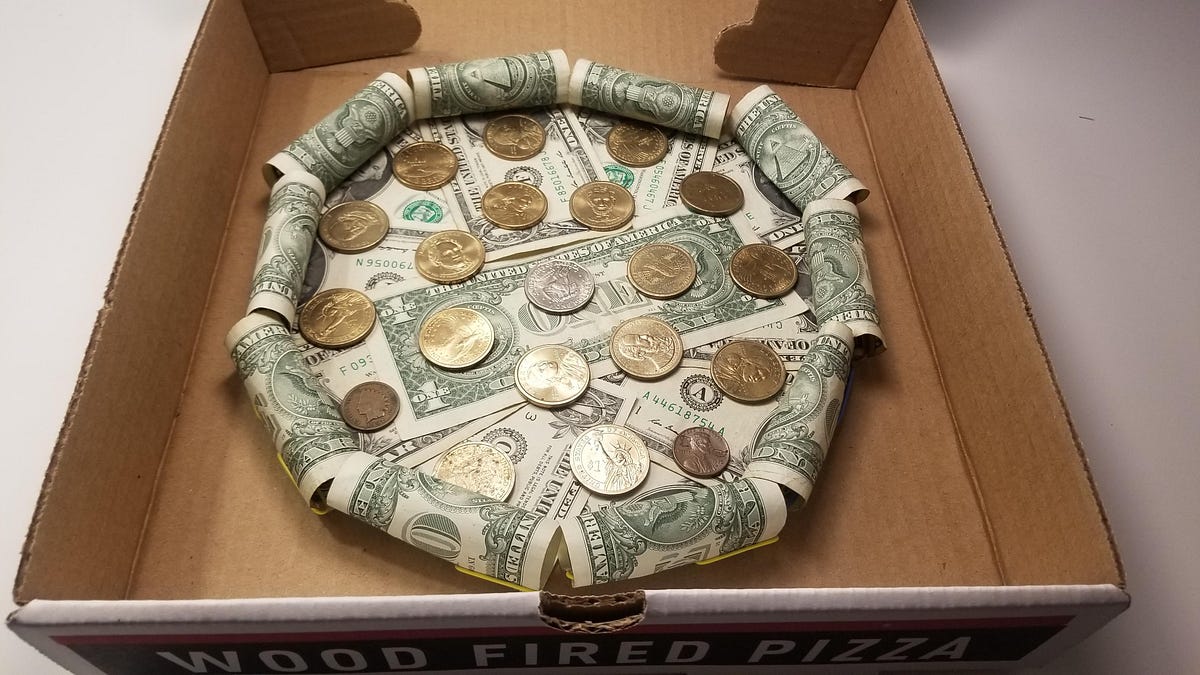
Doordash and Pizza Arbitrage
There is such a thing as a free lunch
readmargins.com
204 points · by thunderbong · 2y ago · 142 comments
Inequality is driving this. We have let money become so accumulated, that the owners of the capital are being silly with it at the same time that workers are having a hard time. We have to tax this capital and make it work for everyone.
The only flaw with this is that people have to work economically inefficient jobs delivering food, instead of the wealth transfer occurring through taxes on the rich and funding something like basic sciences.
Even Dominos is using 3rd party delivery services now, instead of hiring drivers, it has made their prices skyrocket on top of already ridiculous inflation. It even prices people out of being able to afford pretty much D-class pizza. Even if the model melts down, the original (more valuable) business model may be so decimated that it won't be able to be brought back.
Our world is suffering from trust funders with bad and amateur business ideas, all trying to become market-cornering monopolies, it's long overdue to encourage them to find better and less destructive idea builders and better ideas by others to fund instead of launching poorly though out and highly exploitative profit schemes.
I think these apps just need to go away and business that want to offer delivery can go back to how it used to be done. It was cheaper and better.
Also I live in a pretty good sized city of about 350k in our metro area, and before these delivery services only the national pizza places delivered. When I moved here from a larger city I was shocked there wasn’t a single Chinese delivery place. So I’m thinking that the costs and management were just too high.
The right model might be the Waiter on the Way model, which hires regular drivers but can offer the service turnkey. But there needs to be more of those, and there doesn’t seem to be for some reason.
Isn't most of that money being paid to people working for those companies?
People are not forced to use DoorDash, UberEats, etc. We never do and are surviving just fine.
The problem here is that there's a $45B company (doordash) in the middle of the person cooking the food and the person delivering the food instead of a high school kid in a funny hat.
Exchanging the overhead of a dining room for the overhead of unskilled labor taking food to a place is an easy win for a restaurant. Doordash and the like are taking jobs that you could train a child to do in an hour (take an order, deliver it to a place) and spending billions on the technology to do instead while still requiring unskilled labor to do the job.
This is the kind of software that needs to be a small scale distributed open source affair instead of a $45B company with several competitors at the same scale.
They started selling their product as if it were basically free by burning investor cache and now they're riding the limited rails of brand recognition and habit while trying to charge for the ridiculous amount they're doing for such a simple task.
Related: a few years back before DoorDash and the like exploded in popularity there was a local company near me who tried to start a food delivery business. They lasted one summer (busy) season and then made a post on social media about how unsustainable it was. These services (Uber/DoorDash) are only seemingly viable because of the mountain of "investor cache".
I think that's probably a viable model for the future, assuming they don't have VCs that will push them to squeeze restaurants like the big apps, at some point.
But not at this scale; it was always a side offer from a more select number of restaurants catering more to pressing needs than an "immediate satisfaction" culture driven by same-day shipping.
Is this DoorDash's plan once they've driven their competitors out of the market? The market will shrink and it will take quite some time to recoup their expenses. Maybe that's okay in their books. Own the whole pie even if you shrink it.
Even picking up your own food is becoming destroyed. Orders get made with no regard to the estimated pickup times you used to be able to rely on. Your order might get made immediately and just tossed onto a pickup shelf where it sits getting cold for half an hour.
This is all because DoorDash guarantees absolute shit quality and accuracy. Cold food, wrong orders, and they've trained people to not complain by threatening to ban you from the service. So instead of the son of the owner of the pizza place rushing right out to make your order right with an apology, you just accept that an 80% correct order is OK.
A whole generation of young adults has come of age with this thanks to COVID, so we're just stuck with it now.
No, you've got that backward. Customer behavior is driven by the tides of capital. Advertising is a pretty clear example but it's not the limit. I mean, how many people were ordering DoorDash before DoorDash existed? I'm not being entirely facetious - it's impossible for customers to behave in a way that's not allowed by the market.
That you are resistant to these tides is not evidence against, it's just accounted for. You're not the target audience. Nor am I. But neither of us has ever made a decision in a vacuum; we choose our purchases from what's available, according to the information we're exposed to.
Source?
The best argument against this is how elastic demand was when ZIRP ended. Customers responded to an underpriced product. When the price was raised to a profit-clearing level, it no longer cleared most of the market.
There is a massive market of lazy AF people who also are terrible at personal financial management, and they are the ones complaining.
I order delivery through the apps a ton, but it's not because I'm bad at financial management. Like many here, I have a well paying job that takes up a ton of my time and energy during the week, and cooking every night is simply not feasible. Takeout is expensive, sure, but if it enables me to hold down a job that let's me afford it, it's a conscious trade-off that I can make.
Could I spend more time meal-prepping and freeze meals instead? Sure. But again, time and energy.
I can't make your argument make any sense.
No, this does not distribute wealth down. It's a ploy to gin up enough excitement that people who are already wealthy can expand that wealth dramatically with weak business offerings while leaving other people (smaller investors, employees, customers, other businesses, the government, the public at large) to hold the bag.
Not every start-up is like this, but a lot of 'em sure are!
C suite gets giant cuts, office workers get medium-large cuts based on career, gig workers just have a new type of low-wage part-time labor to fill their hours with.
Money technically changes hands, but calling the existence of a company with status-quo wages “wealth redistribution” is really taking the term too literally.
Is that not just an inherent part of the debt cycle that we are at the tail end of?
It's possible that if one company does end up with a monopoly, they will treat their employees better. Because then they will finally be able to charge higher prices to the customers without losing those customers to the other more exploitative businesses.
Suppose you were to discourage accumulation, with a tax for example. Wouldn't that lead to investors investing in even more random bullshit?
If they can get away with paying employees so little, why would they voluntarily pay more as a monopoly? (Presumably they wouldn't have a monopoly in the labour market, in which case I would expect pay to remain the same, rather than worsen.)
There you have it. The actual “business model” of Doordash.
How much of the recent US economic growth can be attributed to monetization of public and private balance sheets?
This video "What everyone gets wrong about student loans" really taught me a lot of things. https://www.youtube.com/watch?v=wzY-b2Vj9Ug
Using a standard supermarket freezer bag makes a HUGE difference.
I don’t understand how it’s not a hard enforced requirement by doordash, Uber eats, etc. It’s nuts. I have seen it more common in other countries where it gets colder. They’ll have branded delivery bags. Though more often they are also bike couriers rather than cars.
Especially since they so often drop two orders now.
I'm surprised people are siding with the restaurant owner here who's a millimeter away from just being a dick and making demands of a rando who he's not the boss of. Making "damaging my reputation" a thing just invents the very worst of copyright but for restaurants. The only thing objectionable about the interaction was the delivery app giving the impression they have a relationship with the restaurant when they don't.
Making "damaging the restaurant's reputation" a thing is absurd in all aspects. By the restaurant owner's own logic picking up my own order without an insulated bad shouldn't be allowed -- after all what if I get home and the pizza isn't as good because it's cold? That could hurt their business. Utter nonsense. Do we now have to decide whether "it's fair" that something potentially hurts their reputation? Is a bad review fair if it's about the food, but unfair if it's about the wait?
What DD did is bad because they impersonated the other business, not because people got soggy fries. You stop getting to curate the dining experience the moment they walk out your door.
Inserting themselves unrequested into the ordering process, then delivering cold food, the wrong food, etc. the customers just blame the restaurant ultimately.
https://www.eater.com/2020/1/29/21113416/grubhub-seamless-ki...
This blows me away every time I’m in New York. They all do it. An everyone seems to be fine with it. (In that nobody is suing.)
I'm not. They have every reason to expect DoorDash to throw the book at them if they did that. They'd likely end up bankrupt.
Doordash and Pizza Arbitrage - https://news.ycombinator.com/item?id=23216852 - May 2020 (518 comments)
>Note 1: We found out afterward that was all the result of a “demand test” by
>Doordash. They have a test period where they scrape the restaurant’s website
>and don’t charge any fees to anyone, so they can ideally go to the restaurant
>with positive order data to then get the restaurant signed onto the platform.
>If we had to pay a customer fee on the order, it would’ve further cut into our
>arbitrage profits (though maybe we could’ve incorporated DashPass as part of
>the calculation).
https://www.readmargins.com/p/zirp-explains-the-world
These should prove to be historical pieces of import, capturing the state of tech in the last days before raised interest rates.
I realize that in many places, they provide services that never existed before, but here in NYC they've driven hundreds of wonderful mom and pop restaurants out of business while they lost billions.
Those entrepreneurs who ran successful businesses for decades were forced out of business, as their quality, inexpensive food (especially in an expensive place like NYC) only netted them 5-10% profits, which were more than eaten up by the 15-30% charged on every order.
I'd rather starve than give any of those jerks a nickel.
> Those entrepreneurs who ran successful businesses for decades were forced out of business
If you can’t adapt to a changing market then you may not be much of an entrepreneur. Regardless, I’m not sure how much delivery services affected these businesses vs “the rent is too high”.
Has this changed? Do all these companies still losing money?
https://www.theverge.com/2024/2/8/24065999/uber-earnings-pro...
Having to do it via huge price hikes and screwing drivers makes me dubious about their ability to do so more than a few times.
So here's my dumb question:
What's with all the people that talk or even brag about how much money they make doing ridesharing, food delivery, etc?
Are they just lying?
Are they misinformed, bad at math, etc?
Do 10% of the drivers actually make money, while the rest break even or lose money?
Got any examples?
I can think of a few possibilities:
1. I wouldn't put it past a company like Uber to pay to produce propaganda where someone lies about much money you can make driving for them. After all, a steady surplus of naive and enthusiastic drivers is essential to their business model.
2. You might have some schmuck doing that for the for free, by trying to brag about themselves as personally successful on social media (either for ego reasons or just trying to get clicks).
3. I think a lot of the drivers are "misinformed, bad at math." I've read it's pretty common for casual drivers to be totally ignorant of some of the major costs they're paying indirectly (e.g. not factoring in the wear and tear on their car or (more egregiously) fuel costs).
4. Being a rideshare/food delivery driver may be profitable if you're really savvy and have unusual advantages (like you live near a stadium and only drive after a baseball game during maximum surge pricing).
For example, a reddit post I read a little while ago (can't find it again) the person said they do ride sharing so got to take a lot of deductions on their taxes so they said "on paper" it "looks like" they make "much less" than they "actually" do.
The comments rightly pointed out the poster's "on paper" income is their actual income, because they are deducting expenses they paid and it wasn't an accounting trick.
There are more incentives to flaunt success then bankruptcy. Even if the success isn’t real.
Specifically, data is only worth as much as the buyer is able to exploit it to make money. Meta and Google have figured out how to immensely profit off of personal data - but that's because they own the largest ad networks on the planet.
Few other players can leverage personal data to this financial extent. More importantly, the players that can leverage personal data for immense profit also collect their own data, and so externally-sourced data is only of marginal utility.
And you see this in the discourse around this issue. We theorize for example that some grocery chain would "pay a lot" for personal data. But to what end? So they can offer just-in-time enticements to go to the store?
A lot of these supposed "applications" of personal data seem pretty flimsy, and even where they are genuinely useful, their monetary worth is marginal.
Data is worth something, but it isn't worth nearly as much as widely believed.
Who is going to pay anything, let alone millions, for Uber trip data?
Most investments are actually Bad https://www.lynalden.com/most-investments-are-bad/
It's idiotic. Just phone it in directly and go pick it up.
I don't have a car at the moment — am I just never supposed to eat outside of home-made food anymore? I've done that math many times, Ubering both ways to a restaurant is even dramatically more expensive than a delivery service.
If you don't live in an extremely walk-able place, sometimes it's the only option.
It's often hot or rainy out, or I don't want to get dressed yet, or the restaurant is far away. Paying a premium for time and convenience is far from "idiotic."
If you mean DoorDash, I suspect it depends on whether there's something in their presentation that fraudulently impersonates the pizzeria.
Doordash doesn't get the pizza they paid for and want to resell.
Given the restaurant was receiving calls from customers, would it be okay if a customer who ordered from DoorDash called to change their order? If so, we can add an imaginary step where the person who "ordered" these pizzas had them changed to just dough without demanding a price change.
As far as the restaurant is concerned the order was made by the dasher and can't be changed by seemingly random people who happen to call.
That isn't to say it isn't 100% possible, it is.
As for why fill the boxes, technically DoorDash would be the store's customer, so if you didn't give them what was ordered they could press the issue. It'd be hard to police, as the person making the DoorDash order wouldn't complain, but it adds a way things could fail.
Plus, the post said dough at that scale is practically free.
If I was driver and the pizzeria handed me empty boxes I’d refuse to deliver and I’d call DoorDash. Ain’t no way I’d take empty boxes to a customer and then have the customer potentially accuse me of removing all of the food they paid for.