The Death of NYC Congestion Pricing
And What is Says About the Institutional Problems in American Cities & Infrastructure
apricitas.io
171 points · by gmays · 2y ago · 365 comments
I eventually moved to New England because it became clear that despite the city having good bones, the leadership (and many voters) were more interested in coming up with ways to make it convenient for drivers to drive and/or park in every neighborhood in the city than making it a pleasant place to live. The ghost of Robert Moses influences everything there.
So I was floored when it seemed like such an incompetently managed city as NYC was actually going to implement the obviously correct solution of charging money to allocate a scarce resource. What was less surprising was the fact that it was derailed by a state politician but only at the last minute and after hundreds of millions had already been spent.
I’ve looked at a bunch of different apartments this summer with my lease coming up, but I don’t think I want to deal with the noisy other parts of lower manhattan
Per car, per minute? Sure.
Per car, per trip? Not clear, but probably not. Per block, per day? Also not clear, but probably not.
Still, when living in NYC I felt constantly surrounded by car traffic, far more than other cities I've lived in.
And the construction, you can't deny the amount of construction going. A lot of it isn't even active work; contractors seemingly throw up scaffolding and let it sit forever because I guess the fines for letting scaffolding sit forever are cheaper than the costs of fixing crumbling masonry facades, so that is what is done. Don't get me started on the trash situation either, what an embarrassment that corrupt aspect of nyc life is.
Every time I fly into LAX from northern Canada I get a punch in the lungs - it's horrible. There must be some severe long-term health impacts.
What US city do you think does a better job?
My criticisms of NYC traffic aren't based on the throughput efficiency for drivers, but the impact on the people who live there.
At least when I was in NYC, every attempt to charge market rates for parking, improve daylighting at intersections, get people to stop parking on the sidewalks, build protected bike lanes, stop making mountains of garbage bags on the sidewalk, etc were all met with fierce resistance. (Though I gather from this thread that things have improved in the last ten years or so.)
While the pedestrian fatality counts in NYC are breaking records, just across the Hudson River you have Jersey City and Hoboken prioritizing safe, pleasant streets for residents and have achieved "Vision Zero" with no traffic deaths.
Hoboken's traffic fatalities have always been low or zero, even long before all the daylighting, because Hoboken is only 1 square mile with only a handful of entry/exit points. Quite simply, it's difficult for a car to get to a sufficient speed to kill someone there. But they can certainly cause non-fatal injuries on a regular basis, and they do. I saw quite a few out my window at the intersection closest to my home, and it took over seven years for the town to even add an extra stop sign there.
Part of the problem is Hoboken's weird fear of traffic lights. The busiest commercial street has them on every block, but the rest of the city only has a handful. Everywhere else, it's stop signs, usually only in one direction, which changes unpredictably between blocks.
Compare this to NYC outer-borough neighborhoods of similar density and character, like Astoria or Park Slope, where they put traffic lights on nearly every intersection. Much safer to be a pedestrian in those places because you have a pedestrian traffic signal telling you when it's safe to cross. In Hoboken you just have crosswalks which may or may not have a stop sign, and drivers who may or may not stop for you, and complete lack of traffic enforcement by authorities who don't care when cars fail to yield to pedestrians.
Oh, and about that busiest commercial street in Hoboken that actually has traffic lights: it didn't even have pedestrian signals until 2017, many decades later than pretty much every other busy place in the entire NYC metro area.
The commentary here is always focused on the strawman terrible people commuting to lower Manhattan, but there are a million reasons why convenient travel to or through Manhattan is needed.
It’s also unfair to characterize the governor of New York as “some politican”. The MTA and most river crossings are owned by public authorities controlled by the state, and the entirety of the system is dependent on New Jersey Transit and the multi-state Port Authority. Congestion pricing was a state initiative all along.
> The problem is other stakeholders live in the provinces.
Exactly. People who live in New York City often end up being beholden to the preferences of people who live outside the city.
There are downsides to the culture of localism in New England, but one nice thing is that cities and towns are typically able to prioritize the lives of their own residents which makes them nice places to live.
Greater Boston is a suburban hellscape. If traffic is your Kryptonite, beantown is worse in some dimensions.
NYC prospers today because it’s a regional hub. All of the business that required physical presence (shipping, industry, etc) is long gone.
Also note “the provinces” include NYC itself. I grew up in Queens, and congestion pricing certainly didn’t align with the needs of my relatives who live in the old neighborhood.
Sorry but this statement is not true. Compare NYC today vs 1980s or earlier. There are more bike lanes, parks, walking paths than ever before. Roads in Manhattan are narrowed frequently to allow more pedestrians.
The west side highway is amazing for biking, I love it. Just because it is not Copenhagen or Amsterdam doesn't mean progress isn't made.
source: Lived in Manhattan for 20+ years. Own a car, bike regularly and walk to work.
That's wonderful to hear! I lived in NYC for the better part of a decade and was a big supporter of orgs like Transportation Alternatives and their work with the DOT to advocate for road diets.
At least when I lived there the painted bike lanes were a running joke and more dangerous than just taking a car lane because every block there was at least one taxi or truck blocking the bike lane. And in cases where there was physical separation you had to contend with moped drivers riding at unsafe speeds. The Queensboro Bridge bike path was dangerously overcrowded and every year they claimed they'd open another lane; it looks like that's still "just around the corner" https://nyc.streetsblog.org/2024/04/08/first-look-the-dot-fi... but I wouldn't hold my breath. The Queensbridge Greenway shared use path became a muddy parking lot soon after it opened and it seems like they're still struggling to keep cars off it. NYPD still seems more enthusiastic about ticketing cyclists than drivers who park illegally.
I didn't mean to imply that the NYC bike/ped folks haven't notched some wins. And I used to tell myself that as bad as it was, other US cities were worse for cyclists and pedestrians. But that wasn't true and every time I go back to visit friends and family I'm still grateful when we leave.
Now all they need to do is calm traffic on the transverses...
EVs due to the simplicity of the drivetrain (which is already engineered for various electric motor sizes since we've been using them for 100+ years in 1000s of applications) can be adapted quickly and cost effectively to many different vehicle sizes and platforms:
- electric hand scooter - maybe this has happened already, but the mini micro kids scooter design seems ideal to human application. more stable, turns well, better balanced. It folds up and is totally hand-portable when you get to your destination, so no locking up. Modern battery performance should be able to do dozens of miles at 10-15mph if necessary.
These can be almost effortlessly carried into a subway car.
- electric bike - as anyone who has been to the netherlands, this encompasses a wide range, from a simple bike to various cargo carrying versions and basic trailers. The downside of the electric bike is securing it at the destination, but theoretically secured parking should be a lot more compact for a bike.
- electric vespa/moped - the big difference here is speed and danger. In a city, I argue this is right at the line of being too big and dangerous. It can't be adjacent to pedestrians or bicycles, needs to be in dedicated car lanes, but its kind of too small. These can go faster, carry more, and are more secure since they are harder to make off with.
- electric motorcycles/trikes - like mopeds but bigger/faster still
- electric K-cars/golf carts - this is where there is a big empty spot in US vehicles. You can see them starting to develop with side-by-sides, but an urban electric golf cart or similarly sized vehicle is tremendously useful and much more compact and cheap to make in theory. I would argue that outside of specifically permitted deliveries, nobody should have a vehicle larger than this in Manhattan.
IMO these are the big three that cities need to start planning to adapt to, and big vehicles are strictly for special situations. A "golf cart on steroids" can really pull quite a lot given EV motors ability to produce torque.
I lived in downtown Minneapolis for quite a while, it was amazing how much a bicycle shrunk the city once the snow melted. Anything under 4 miles of distance wasn't worth taking a car, because the parking delay and walk-to-destination removed any time advantage.
e-bikes and e-hand scooters are like that, but expand the accessibility to a far bigger age range and fitness level.
An e-handscooter that is portable takes a subway system and expands the radius/distance accessible from the base stations by a factor of 3 to 10. With a e-scooter you carry off the subway, you can easily go 1-2 miles from the station, weather permitting.
Finally, e-scooters are QUIET and CLEAN. Which when people get used to them will really highlight how much ICEs stink and are loud, and will turn them into pariahs socially. When that happens tipping point wise who knows.
Savvy point that's often missed in these discussions. I'm on the boards of two buildings in Manhattan and see these invisible "taxes" all the time.
Lot of mechanisms setup to punish & tax buildings but not to facilitate the timely curing of whatever they are fining you over.
One favorite was after an elevator incident a few years ago, the city passed some new law that required mostly software updates to elevators. It was essentially an update to prevent elevator repairmen from overriding the safety mechanism preventing motion when the door is open. So putting a safety on the safety.
However of course there are only like 2 companies in the city and they colluded on how much they'd charge. So in effect it was a $10k per elevator tax on every residential building in the city. Not huge in the grand scheme of things, but in my condo that was a random 4% of budget blown away at the stroke of a pen. And they do this all the time.
We had to do facade inspections and the city institutes all sorts of rules & fines around it, but then we ran into a stubborn neighbor with axe to grind with sponsor disallowing access on adjacent side for our scaffolding. City of course does nothing to force compliance by neighbor, it's your problem. Eventually had to be paid off in some manner.
Very much city of no.
The default response to government inaction is typically a) the citizen can't do whatever thing they're trying to do without violating the law, and b) nothing bad happens to the bureaucrats not doing their jobs. If those two things inverted you'd see government become more efficient overnight.
We ended up burning through the contingency because this project started right at the beginning of COVID. Parts and labor suddenly became scarce.
Something that stood out to me: there's been a marked decline in state and local funding for NYCT since before COVID. I wasn't fully aware of just how much the city and state had independently cut back: it looks like NYCT part of MTA alone is receiving $3B less per year than it was in 2019.
Congestion pricing is sound policy regardless, but this hammers home the perception that NYS treats the MTA (and NYCT in particular) as a financial sponge that can be squeezed for spare change whenever a boondoggle needs funding somewhere else.
I'm all for funding mass transit.
But the city is not using MTA revenue to pay for other things.
Take a look at the third image in the post: both state and local funding from the MTA have been reduced in recent years, dating back to the FY before COVID.
Similarly, here’s an example of the state using MTA as a piggy bank for upstate ski resorts[1].
[1]: https://jalopnik.com/new-york-mta-gave-millions-to-bail-out-...
I've gotta point out though, the writing in that article is truly abhorrent. This is the weird Frankenstein of The Onion and Gawker that was picked up by private equity, right? The web is a better place without this style of publication, I think.
I'd encourage you to get your news somewhere else my friend :) This reporting makes Buzzfeed look Pulitzer worthy.
Its just a scam to grab money from already broke people that are suffering and only awful people support this because they can't think for themselves and are followers.
That ended, in part, because the MTA received a huge operating boost from federal COVID funds, which are now (4 years later) running dry. So we haven't seen the return to the 2017 subway yet, but we almost certainly will if essential maintenance and system improvements are once again deferred to keep the lights on. As with everything about public infrastructure: the best and cheapest time to fund infrastructure is before it breaks. If the subway is allowed to continue to fall into disrepair, it'll only cost us more down the road.
[1]: https://en.wikipedia.org/wiki/2017%E2%80%932021_New_York_Cit...
It's dumb, but it does "stop the problem", the same way charging 5x more for petrol would, or closing all the highways into the city.... whilst also hurting a bunch of people.
Notably, NYC congestion pricing does not affect the highways into the city: if you take a highway into the city and stay on the highway, you won't be charged. The charge is only for entering the city grid, where the (reasonable) argument is that the transportation system is more than sufficient and the traffic, noise, and tailpipe emissions of your car do more harm to local residents than they fairly benefit you.
That's technically true, but it ignores the fact that both the Lincoln Tunnel (495) and Holland Tunnel (78) require you to enter the city grid. With the way the congestion pricing was designed, if you take either of those tunnels, there's no way to avoid the congestion pricing fee -- this was confirmed multiple times in FAQs and Q+A's.
I'm mostly in favor of congestion pricing, but I really think they need to figure out a better solution for that tunnel issue.
It has played out in other cities, there is only one way for it to play out.
It's okay if you disagree with the facts, but it's fairly easy to understand how pricing people out is a poor attempt at a solution, but solves the problem by brute force anyway.
>where the (reasonable) argument is that the transportation system is more than sufficient and the traffic, noise, and tailpipe emissions of your car do more harm to local residents than they fairly benefit you.
Yes. I never said that less cars is not beneficial. I understand this, that's why I said what I said.
There's no such thing as "fairly benefiting from other residents"...
You're still not solving the problem by slapping a $ figure to the entrance of cars. It's just a lazy and bad solution.
The plan was structured in a way that it would affect every resident of the city via higher prices on goods and services, surcharges on delivery, taxis, construction, etc. Setting aside the issue of local residents with cars (which I could care less about), the planners refused to make sensible carve-outs for things like cargo trucks, construction vehicles, and so on. They could have done it, they just didn't. It was about maximizing revenue for the MTA, not about making sensible policy.
Maybe the fees would be small when amortized over a truck full of groceries or a tanker full of oil, but that didn't change the fact that it was a regressive tax on everyone who lives here, and taxes here are already amongst the highest in the country. This stuff adds up.
I find the math on that claim highly dubious. The toll for a truck is set to be $36 at peak times. $9 non peak. And they get up to $20 credit towards that when travelling through one of the tunnels, as many do. When I think about the amount of goods that can be carried in a truck and divide the $36 minus $20 or $9 across all those items… how much are we really talking about here?
I ask the question earnestly because I don’t know, but at a cursory glance it just doesn’t seem like that big of a deal. Some drivers might even be quite happy to pay if it means they don’t spend hours stuck in traffic!
We already pay a congestion tax on all of these things, it just takes the form of paying for the labor of someone sitting in traffic. It's not obvious at all to me that the cost of the tax will be less than the gain on the labor cost.
Right now, you have Group A: people who are ok with some members of their city getting to deal with congestion, so that they can have cheaper goods.
Group B: The people who deal with the effects of congestion, who have to find a ways to have their needs met.
as mentioned: >Setting aside the issue of local residents with cars (which I could care less about), >someone who lives here and doesn't own a car
The status quo should suit you.
That said, the inefficiency caused due to congestion, ends up affecting both group A and group B. This will add to costs, in either wait times / Delays, wastage, wear and tear, pollution etc.
Those costs are borne by you, but not associated with congestion.
It's much easier to solve the problem like a brute and attack people and say they're wrong when they point out the nature of the solve.
It's not even about money, if it were about the usage of power, food, travel, etc. it'd also be terrible. If you were to convince people they can't eat meat because it's wrong and then offer a solution as bad as "just become vegetarian", it'd also be laughable... but of course people would attack anyone pointing it out.
I live in London they brought it in and it's been ok overall. It doesn't stop congestion but reduces it a bit. For commuters it's probably a bit better as they mostly use the train/bus etc and benefit from less traffic. For workmen needing to deliver and fix things it's a bit of a pain. For me living in the center I'd probably take the plus of less traffic over the minus of getting a plumber to visit being expensive.
Re the tax grab - yeah but they have to get tax money from somewhere to pay for services and the like.
The one thing that has been bothering me about NYC congestion toll is I figured there was be a cut in the fares for subways and rail to entice more riders. But I don't see that mentioned; just for capital projects it seems.
If driving is so bad, and public transit is so convenient, why are people still driving?
People like this author write from a position of "people are stupid; they don't know what's good for them, so let me enlighten them". It's this assumption that is stupid.
People want the most convenience in their lives. If you want them to use public transit, make the public transit more convenient and cheaper than driving! I mean, take a look at a city like Tokyo. How many people drive there? Almost everyone takes public transit, putting NYC to shame. There is no need to drive in Tokyo! As a tourist, a 3-day all-you-can-travel subway pass costs less than $10, which is < $3.50/day and subway stations are every couple of blocks. How's that for convenience?
Instead of trying to tax the people into complying with your desires, make them want to do so of their own free will!
But that's exactly what they did in Tokyo: owning a car (and finding a place to park it!) is so expensive that few resort to it. I've probably been in a private car in Tokyo only once. Whereas in NYC car costs are socialized (Manhattan street parking is quite cheap when you can get it; you don't need to prove you have parking in order to own one, etc) while public transit is not.
Yes there's a phase transition issue (driving in suburbs is easier than driving in the city, but there's little incentive to transition from one to the other. Congestion charges do exactly what you suggest: make public transit cheaper than driving, and provide the funds to improve public transit.
In the Netherlands for example, lots of people go by car to Work, because that’s relatively far away; but then they’ll use their bike or transport for everything else. Stuff like groceries, dentist visits, meeting friends, going to the gym, etc. because all those things are within (their district of) the city.
I think we feel the pain of waiting for a subway, and think boy it would be so much easier to drive, but few people think while they're working an extra <period of time> a week to pay for their car+parking+insurance+maintenance+... boy would it be nice to not have to own a car.
That is what the top level post was objecting too. If the theory relies on everyone being consistently wrong, then perhaps it isnt properly accounting to the benefits of cars and inconvenience of public transportation as it exists today.
I dont think anyone is challenging the idea that cars are expensive, or people would prefer something else, provided it is actually better.
Got a lot better from 90s thru about 2010 or so and has been reverting since. Remember the "Summer of Hell" in 2017 which just sort of slowly faded into the COVID transit issues and now we are here with budget shortfalls. Hard to see it getting materially better before it gets worse.
https://en.wikipedia.org/wiki/2017–2021_New_York_City_transi...
I was curious so I looked this up.
Tokyo transit ridership is 3.46B / year
Tokyo population is ~39M (Urban figure on Wikipedia)
NYC transit ridership is 1.81B / year
NYC population is ~19.5M (Urban figure on Wikipedia)
In terms of ridership / population, NYC is actually higher (93.17 vs. 88.47)
40 million passengers (counted twice if transferring between operators) use the rail system daily (14.6 billion annually) with the subway representing 22% of that figure with 8.66 million using it daily. [1]
Re the reality check, though, I wonder if this is going to be one of the no-questions-asked positives from AI. If, every time someone makes a claim that's not, but can be quantified, similar to what you just did with these ridership and population stats, an AI umpire would cite the stats behind the claim to better-educate the audience about the reality. Of course this assumes a non-biased "AI," but it seems like something that could become a reality sooner than later. I experience this multiple times per day, on HN a lot, where people make claims and I'm like "is that really true?" And I'm not being an ass; I'm always genuinely asking the question to make sure I'm getting properly educated.
P.s. I just typed "is Tokyo more transit friendly than New York City?" into 3.5 (yes, I'm still on 3.5. Some of us HN folks are actually tech laggards!). I won't paste the answer here since no one will read the comment given its absurd length, but your human answer is better, and more to the point, than 3.5 (+1 for humanity, I guess).
I fact check myself all the time too, often when I realize a "fact" in my brain isn't really a fact, it's just an intuition, or when I can't remember where I learned something and I question its validity. My wife and I both frequently pause conversations with "Hang on, let me fact check myself on that [because it might be BS and I don't want to spread misinformation]".
So I can't help but verify it when I read something that sounds true, intuitively, but I'm not certain.
So charge drivers for the actual value/cost of the land they park on, the lanes they drive on, the maintenance and infrastructure for the roads, the safety risk posed to those outside of cars, and the gaseous and noise pollution caused to others?
Sounds good to me. We can call it a "congestion charge" or something.
Public transportation needs to become more affordable first. I would have happily taken the train if it was comparable in cost.
But, I guess I am the minority case.
You can fit four adults in a small plane that costs $150/hr to run and goes roughly 150 miles an hour - or a dollar a mile.
It doesn't take that much of a charge for four people on a train to equal that.
And cars are way, way cheaper.
This is why we have HOV lanes that lower or make tolls free.
But also, if you take the subway regularly, there are multi-use and unlimited passes, students get free metrocards for weekdays, and so on.
Collecting revenue and making driving worse is easy (the stick).
But the carrot of actually making timely, meaningful improvements in transit is hard (the carrot) and no one believes its really going to happen.
You can't summarize the world with "People want the most convenience in their lives" and use that to explain or justify the state of things.
A couple examples: Cars compete with public transit and are highly subsidized. "Roads" are a public transportation method that doesn't have to be profitable in people's minds. But "Public transit" does. There's so much more and the information is readily available.
Unless you live in New Jersey, a short hop across the river from Manhattan but might as well be on the moon as far as the subway is concerned. The NYC Subway is great where it has service, but has for years neglected to expand into areas where the people live. Queens is also terribly underserved. There are bus options, but they get stuck in the same traffic that makes driving so miserable.
This starts compounding, because those pockets still need to get to work, etc, making it harder to get new transit in later.
Paradoxically you almost need to tax the locations that don't have access to public transit to pay for public transit, so the pricing inequality goes away.
> If you want them to use public transit, make the public transit more convenient and cheaper than driving!
Yup. I live in south Queens which is mostly suburban and a lot of people drive around. I'm two blocks from the A train so driving to Manhattan is pointless when I have a 30 min express subway ride. But if I wanted to go to the nearest Microcenter in Kew Gardens it's 20 minutes by car and an hour by bus, each way, with a transfer - guess what mode of transport I'm taking...
Your position is that NYC should, at the cost of the average resident, make it easier for outsiders to drive into the core of Manhattan at a time when physical proximity for business is becoming less and less important.
I do agree this particular program was a dumb idea that advocates tried to push through with the COVID nadir in traffic and office occupancy.
… do you have any idea of the costs that are associated with owning and operating a vehicle in Tokyo?
They made it very, very inconvenient to drive.
But a car? Parking it? Tolls? Insurance? To drive around in traffic going no where fast?
You're daydreaming.
Taxi/Uber when needed and subway the other 90%. I'm two blocks from the subway with coffee and a diner on the way there. Man, it's awesome. I'm annoyed def some days more than others at the mta, but this is a no-brainer.
Gd it America! Not everything can be low cost now/today and have long term soundness ... there are too many cars polluting too much in too small of an area going nowhere fast. As a would be business operator of the city, I damn near have a moral imperative to make some cash on that imbalance.
I've spent many a $25 going 2 miles or less (say when raining) in a yellow cab. I always feel half stupid for paying it given how slow it is to move two lousy miles.
That's like saying that since land closer to Central Park is worth more than land further away, that we should demolish Central Park and replace it with more apartments. Property in NYC would be worthless if there weren't roads you could use to reach it.
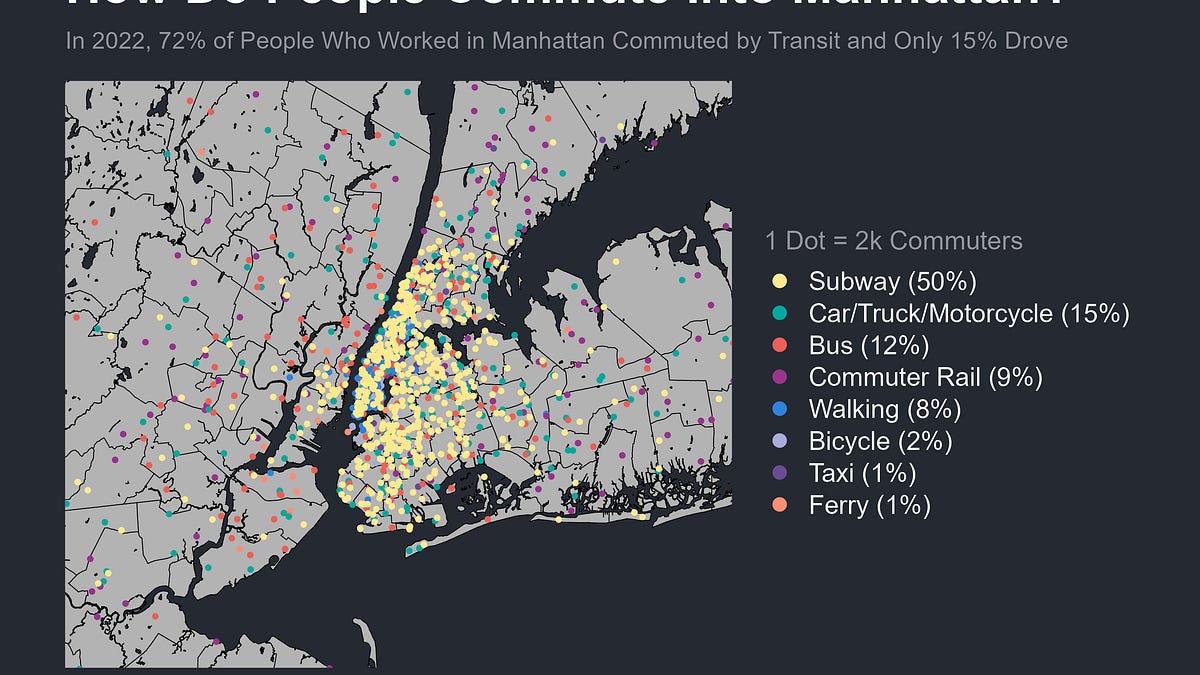
Most of the people who go to Manhattan get there by subway, bus, bike or walking (especially the people who have to work for a living), at a fraction of the space cost of those using cars. Access to property is certainly an important part of making that property valuable (hence why property around stations is worth more), but Manhattan spends far too much (in space) on roads for the amount of access throughput it gets in return.
(But at the same time: I don't think anybody has claimed that it's a panacea. Congestion pricing can be both good policy and still have gaps.)
Only after thorough and deep cleanup it would gain taxpayer trust and be on a get-well plan to be more sustainable financially.
It would still operate in maintenance mode in the interim, while going through restructuring, NYC has no lack of financial restructuring professionals in downtown
Time to break these regulatory capture for the public good and benefit of taxpayer, not the organized mob
At least I would love to see the discourse in oublic and honest communication about actual issue and its root causes. Not some bogus “congestion”.
There are actual people with names that have caused the mess
In Melbourne, Australia, the state-run Public Transport Corporation was an MTA-style mess and the trains in particular were notorious for delays. In 2009, the operating contract was handed over to the company behind the Hong Kong Metro, and punctuality has ratcheted up from the low 80s to the mid-90s; not quite HK-style 99%, but still a marked improvement, all on the same crusty old infra.
People are freaked out about inflation and the prices of everything rising and I think they're very sensitive to anything that is going to add more expenses. Even in Ithaca, NY apartment dwellers have developed a consciousness that rising property taxes are going to get tacked on to their rent.
In terms of national politics, Democrats feel vulnerable, and I think Democrats everywhere feel pressure to drop unpopular policies that could affect them nationally. For that matter the rest of New York is rich in competitive House seats that could go either way.
Now we just see a probably illegal power grab by an executive which kills a bunch of popular and needed projects while very publicly demonstrating that Democrats can’t fucking deliver.
https://scri.siena.edu/2019/03/18/2-3-of-voters-say-amazon-c...
More recently
https://nymag.com/intelligencer/article/poll-congestion-pric...
they found 23% of people opposed the decision to suspend, and about 45% of voters supported it and that support was not very different for D's, R's and I's.
But it's not a new concept, and it turns out that people like being able to drive easily, having quieter streets, and tax money for other services. Once you go from fear of the unknown to seeing the results a lot of policies get more popular and in every other example we have that absolutely applies to congestion pricing.
In summary, Governor Hochul has now pissed off both opponents to congestion pricing, and also supporters of it. It was a terrible move, politically.
If you steal enough of the other guy's issues you win.
Look how they abandoned single payer and a public option during the Obamacare period. Then they lost the Congress immediately after.
Democrats do centrist or rightward pivots seemingly blind to the fact that Republicans will not vote for them anyway and that these actions will alienate the base. If they drew stronger contrasts and gave people a reason to vote for them, I think they would do better electorally. Sometimes it feels like they live in a fantasy world where it's still the pre Gingrich era and bipartisanship is much more of a thing.
This guy has it all backwards. No developer in his right mind is going to plow billions of dollars into high density housing without existing rail access. The new subway and commuter lines have to be built first, then the high density development becomes viable around it.
To the article's point, in urban areas, increased density often happens even when mass transit isn't expanded (which then often leads to ever worsening traffic). So, for urban areas that are organically becoming denser, mass transit becomes ever more important, which was partially the article's point in the section you quoted.
Also, to generously read the article, it seems to be making two related points, but not actually imposing a "one should follow the other" ordering that you read into it. The full paragraph:
> Globally, that is nothing notable—in most urban cores a majority of workers take public transportation for work and daily activities. Increasing the density of jobs, hospitals, restaurants, homes, schools, and more is key to the agglomeration effects that make cities such economic powerhouses, and as density grows mass transit becomes essential since it can far surpass the maximum throughput capacity of even the largest roadways.
It is saying two things: 1) high density is critical to be an economic powerhouse and 2) mass transit becomes even more essential as density increases. That paragraph isn't inherently saying mass transit should follow densification (vs preceding densification). Ideally you build out mass transit in anticipation of densification vs playing catch up.
Anyway, to your point, it's absolutely true that building out mass transit is critical in attracting more high-density development (especially very high-density development), and critical in enabling high density development in places that otherwise might not attract that sort of investment.
Retroactively building a subway line in an already densely populated area is a hugely expensive exercise, as most recently demonstrated in NYC itself with the 2nd Ave extension.
https://en.wikipedia.org/wiki/Metro-land
Nowadays it's common to build a new station in an area that needs redevelopment, perhaps a former industrial area.
You can definitely predict what will attract people to an area - rapid access to everything that the downtowns of cities provide is one such thing.
Actually, here the municipalities were not even requested to invest, but just to allow higher density.
The Shady Grove end of the red line has a large development of mixed commercial and residential of buildings that are uniformly about 5 stories (I think) tall that was built to go with the transit line, I understand it is like that in Virginia too.
China is famous for building metros before building the rest of the city.
https://www.amazon.com/This-Pacific-Electric-Stephanie-Edwar...
https://www.planetizen.com/definition/streetcar-suburbs
Most of those have since had the streetcar lines removed or abandoned as cheap cars and gas replaced them, and the incentive for the original developer to maintain them went away.
Not if it’s low density housing, which it will be if there is no transit.
I highly, highly doubt it would be harder for those problems to happen here. In fact I think if it ever happened, it would be a huge corrupt mess.
this is the default option? build a big complex with a courtyard, then surround it with a parking lot or dedicate 1/4 of the building to a garage.
I'm interested to see what happens with the new potomac yards wmata stop. I appreciate they are trying to expand rail in anticipation of growth, but it looks kinda dumb right now. it's a good 15 minute walk through parking lots to get to the nearest store or apartment building. you would never use that stop if you could afford a car. to be fair, the station just opened. it could look very different in 5-10 years. if they waited for it to densify first, people might be complaining about how much more expensive the station was.
With congestion pricing stop, New York City enters new era of economic gridlock - https://news.ycombinator.com/item?id=40625307 - June 2024 (150 comments)
NYC Congestion Pricing Delayed Indefinitely by Governor Kathy Hochul - https://news.ycombinator.com/item?id=40587485 - June 2024 (16 comments)
MTA board votes to approve new $15 toll to drive into Manhattan - https://news.ycombinator.com/item?id=39841703 - March 2024 (831 comments)
NYC's plan to ease gridlock? A $15 toll for Manhattan drivers - https://news.ycombinator.com/item?id=39549726 - Feb 2024 (24 comments)
New York approves the first congestion toll in the US: $15 to enter Manhattan - https://news.ycombinator.com/item?id=38583532 - Dec 2023 (155 comments)
NYC Congestion Toll Could Cost Drivers $23 per Trip Starting Next Spring - https://news.ycombinator.com/item?id=36512248 - June 2023 (41 comments)
New York City will charge drivers going downtown - https://news.ycombinator.com/item?id=36270597 - June 2023 (671 comments)
Meanwhile, many other US cities were developed around regional agriculture, ranching, frontier settlement, and/or sea and river ports. Some explored sophisticated public transit systems at one point or another, but by the time they got really urbanized, cars were widely available and it was easier to justify roads and highways for personally-owned vehies than far more expensive train/tram infrastructure. We now see how car-centrism introduces limits on growth, but there wasn't a consensus sense of what those limits were or whether growth would really encounter them.
What older cities have, due to their age, is a metric ton more people in a smaller area because they ran out of space to expand and have to redevelop existing land.
Phoenix has 5% of the density of Paris and is not even 150 years old. Paris is over 2,000 years old. If Phoenix keeps growing for the next 2,000 years, will it have great public transit? Probably.
I gave up my car when moving to Manhattan and now subway, walk and bike everywhere. It's a dream and saves $5000+ per year including capital cost, maintenance, gas, tolls, parking, insurance, repairs, cleaning, traffic tickets. As a society there's another $N000/year saved on the marginal cost of another car: road maintenance, traffic cops, people sitting in traffic instead of living their lives, etc.
Robotaxis change a bunch of this math: utilization shoots up and drives down cost per user, and people can live/work (on their cellphones) while being passengers.
One interesting dynamic here is the media's bias towards negative news. In the run up to congestion pricing the NY Times was putting out these very anti-congestion pricing articles (we need to be anxious that congestion pricing is happening!). But as soon as it was cancelled they flipped and now have put out a bunch of articles portraying the cancellation as a blunder (we need to be anxious that congestion pricing is _not_ happening!). I wonder in the long run what the steady state media framing of this whole episode will be.
Justice would be immediate termination from her position along with a prison sentence.
Congestion pricing seems like a pathetic attempt to squeeze money to fund bloated MTA salaries and bogus overtime[2]. that just eats MTA's budget. Widely cited $15 bln budget hole is roughly comparable to the decade of bogus $1.4 bln overtime that MTA workers accrue
Transit agency must go through a deep and thorough cleanup and restructuring of its finances, before it demands more funding from taxpayers
Same like city of San Fransicko spent $24 Bln with a B with nothing to show for it, arguably situation got only worse[3], while nonprofit and homeless industrial complex only got record funding and record fraud charges
  1. https://slate.com/business/2019/09/mta-elevators-are-the-perfect-example-of-new-yorks-cost-problems.html
  2. https://www.masstransitmag.com/management/blog/55017643/op-ed-excessive-mta-employee-overtime-continues-year-after-year
3. https://www.cbsnews.com/sanfrancisco/news/california-homelessness-spending-audit-24b-five-years-didnt-consistently-track-outcomes/This is still more than it should cost, but it's important to have the facts straight.
The larger answer to the MTA's financial mess is multitudinous:
1. It's really 5+ independent transport systems folded into one big, unwieldy authority. Some of those systems (particularly the LIRR and MNRR, but not NYCT) are famous for overtime fraud[1].
2. NYCT runs 24/7, which means that maintenance operations need to happen at night or other overtime periods. That means higher baseline costs for labor.
3. The MTA intentionally under-hires, under the financial theory that overtime pay is more sustainable than more heads on the 20-year pension pipeline.
4. Any amount of capital development on the subway is fundamentally expensive, both due to the age of the system, the complexity of the infrastructure that's developed around it, the need to minimize disruption to the rest of the system and city, etc. The MTA has repeatedly opted for bigger, more expensive capital programs that minimize disruption throughout the city, with the SAS's extremely deep tunnels being a good example of this.
[1]: https://www.justice.gov/usao-sdny/pr/highest-paid-mta-employ...
(Taxes don't bother me, mind you. What bothers me is that NYS treats NYC as a piggy bank while also keeping the city in a permanent financial chokehold.)
If you look at what CP advocates say: it is all about ecology, emissions, congestion, freeing up the road for cyclists, etc. Some people mention MTA capital projects and ADA compliance, etc.
But no CP advocate has actually and honestly told the truth: MTA is underwater, its finances, collective bargaining agreement is unsustainable, fraud is rampant, without this extra tax they will simply go bankrupt.
This is the clearest case of mismanagement and dishonest communication with the taxpayers. CP funding should go directly to the city, and any capital MTA funding should come from loans that are repayable (either via additional citywide tax/tolls/fares/City general fund/etc).
You can't keep throwing good money after bad money into this financial black hole
I don't particularly disagree about the city deserving the money instead. But that would have to come with MTA giving NYCT back to the city, and that is unlikely to happen.
On the other hand, in reality, making new transit funding conditional on the MTA cleaning up all its inefficiencies and corruptions will simply translate into transit being underfunded.
Private sector would never have allowed it
Nobody has every really successfully monetized this kind of mass transit in the US; it's a service that taxpayers fund in exchange for its enormous economic benefits. TFA explains this upfront: NYC would be nowhere near as big and prosperous as it is today were it not possible for millions of people to take trains into the city.
?!!? No: 1. North Berkeley is extremely low density housing. 2. There's a casual carpool pickup right in front of the station, which siphons 100s of riders away from BART. It's very fast, there's little wait time and it's free.
If North Berkeley had skyscrapers and riders didn't have a better option then you'd see NYC level ridership.
It's absolutely disgusting. Yes the MTA is a mess, yes this money could have been spent more efficiently by a better run organization, and I'm sure the plan wasn't perfect; but to see Dems very publicly go out of their way to show they can't solve problems if doing so upsets a handful of rich people is somewhere between disheartening and enraging.
How dishonest must you be to lie in such a blatant way?
From the Wikipedia page referenced from the article: "Local consultative referendums regarding whether to permanently implement the congestion tax were held in Stockholm Municipality and several other municipalities in Stockholm County on September 17, 2006. It was only the referendum in Stockholm Municipality that the at the time reigning government would use as a basis for the decision. The municipalities surrounding Stockholm in Stockholm County, especially those that are part of the city of Stockholm, showed discontent with the fact that the people of those municipalities get no say whether the congestion taxes will be implemented permanently."
And the data shows unambiguously that it was only the resident of the centre tha voted yes.
Once again this idiocy! Planners love so much to talk about throughput, and then they are surprised when people "do not understand". People do understand: people know that the only important metric is door-to-door time!
Nobody could care less about how many people can get to the station! Everybody just wants to minimize the time wasted within transportation, because the 24 hours in a day are not expandable.
I've never been to New York, please don't take this as a critic specific to this city. It's just that I'm tired of planners trying to "evangelize" the people while ignoring their actual concern.
In many places this would be called this socialism.
MDs at my firm can easily afford any such surcharges, and for many it will be business write offs, and not even their own.
Fund public infrastructure - put more buses on roads, maybe even limit some avenues and roads for buses only. Reduce the costs - yes, I know NYC tickets are really low, but make them simpler and easier for people to get a monthly pass and hop on buses, Really, buses everywhere even if they operate at net losses - get the business to subsidize bringing their workers in.
At some point we just have to make decisions about land use and infrastructure. Do we want this space dedicate to driving and parking for cars with one person who can afford to pay congestion charges, or instead used for busses, dedicated bike roads, etc. that can move more people in less space with less pollution and less risk of serious injury.