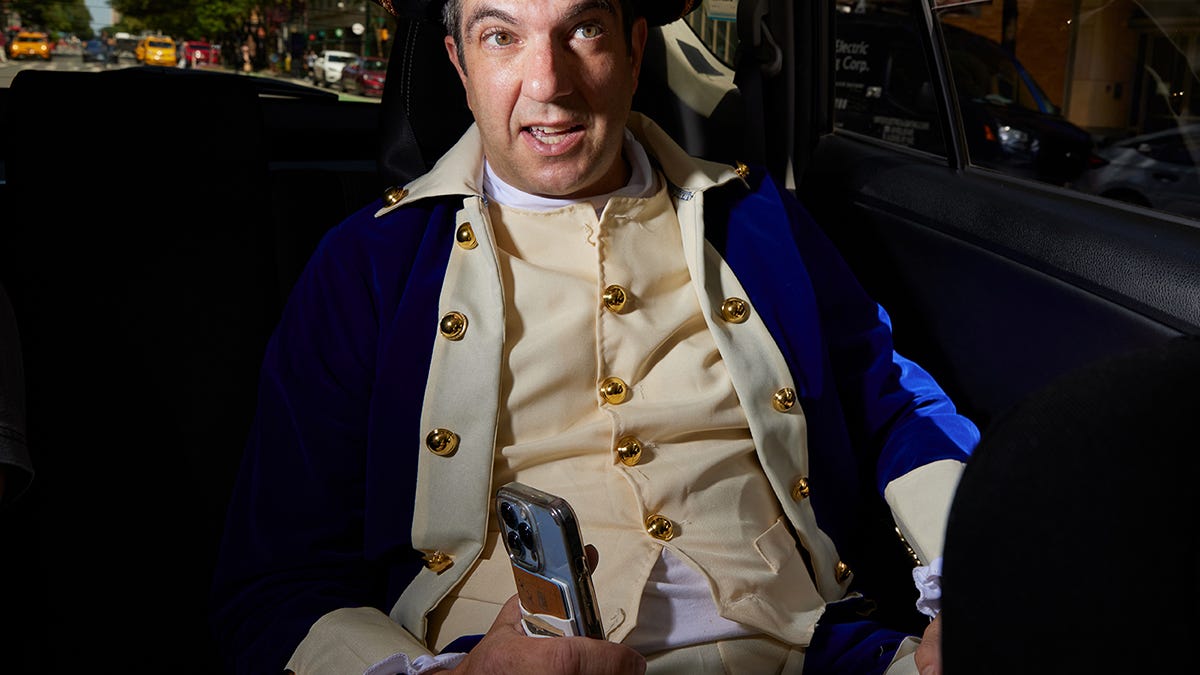
Your Constitutional Right to Be a Pirate
Congress can grant any American permission to be a pirate. A.J. Jacobs found out what happens when you apply.
thefp.com
82 points · by wslh · 2y ago · 78 comments
https://gooden.house.gov/2022/3/gooden-introduces-bill-autho...
yarrr...
I don't see how this is at all irrelevant. The United States cannot sanction civilian property for military use such as quartering soldiers. Why would anyone think such a prohibition is out of date?
A problem, rightfully, of extending “no quartering of soldiers” to mean “no sanctioning of private property for any military use” is that it leaves interpretation to the courts. And we continue to have issue with courts choosing to interpret plain meaning or original intent or twisting the two to their own agenda.
The case against the police for doing something they had no right to do, or the seperate case that what they did was a violation of the US third amendment?
https://www.reviewjournal.com/local/local-las-vegas/judge-po...
Police taking over your home to setup base for observing and taking out a neighbour with no warrent or permission is something that should be illegal and not require casting local police officers as Federal soldiers to whom the quartering restriction applies.
I would read this amendment as permitting no persistent government presence in any home, such as and including electronic surveillance.
Besides, if the President declares that you must as an official act, alas you must or face the unmitigated consequences (according to recent rulings).
This is not accurate. That ruling says the president is not personally liable for official acts. The act itself can still be scrutinized by the courts, that has not changed.
That is not true... at all. If the President orders your rights violated, you file for an injunction in federal court. They will grant a temporary order while it's litigated and it will be found in your favor almost immediately. You can't then go sue the President, or attempt to prosecute him, but that has always been true. The United States and all its officers have immunity. Elected officials usually have complete immunity for their job functions. If you don't like your mayor you can't prosecute him for neglect.
One interpretion of the Ninth Amendment is that it allows (but doesn’t require) the states and the judiciary system to protect additional rights.
Well... other than the 18th Amendment.
I don't know what the ideal kind of government is, but when the weight of it can crush some and shield others depending on the will of a minority it's no longer a government for the people, by the people.
The framers of the constitution greatly feared this and wanted to create a document precisely to avoid the mob rule of the majority. Thats the reality of the constitution.
You may not like that maine has the same voting power than California. But thats by design. It was meant to create a more equal union. And thats why the united states experiment has outlasted almost all governments [1] that ruled the day when a tiny band of settlers in the boodnocks decided to declare independence from the world's then superpower, UK.
I find it silly that some contemporaries, who cannot begin to even grasp that basic tenet of how the constitution was created in the embers of pure danger, would think that a modern bystander would have a "better" grasp of what the founders meant. It reeks of lack of humility and empathy
[1] I believe only the swiss has had uninterrupted lawful government since 1776.
But, besides that, I am at a loss for solutions.
Although I found this recent discussion with Jon Stewart left some more breadcrumbs in my mind to follow. https://youtu.be/n_EofYXRBnM?si=6GL_bT6siM9A7IHn
I think it'd be awesome to have a little variety in initial primary settings EDIT: and for the ordering to be dynamic and to change from cycle-to-cycle.
The other thing to do would be to rate limit donations --- corporations are people? Money is speech? Fine. Set the maximum donation to be some multiple of the current Federal minimum wage (about what one could reasonably expect an individual to donate) and each political donation must be done individually in that amount, and any donation after the first must be done as a printed check mailed in a first-class envelope with a handwritten note explaining what the donation is for.
Where things get messy is trying to limit contributions to “independent” groups making political comments. We obviously don’t limit donations to groups making a movie or publishing a newspaper. How do you propose doing so? Would you limit the size of a donation to Wikipedia?
I personally don’t like the outcome of the citizens united case, but I can’t argue with the case itself.
Very very difficult to rally behind someone who wins through a bad quirk of our democracy.
It is a sad history[1] and the only fix I know of is the National Popular Vote Interstate Compact
[1]: https://en.m.wikipedia.org/wiki/List_of_United_States_presid...
In reality, it was meant to be a living document that evolved with the times
The paragraph as a whole was written as if the above two claims were contradictory. To the degree that the framers intended the constitution to be a living document, there is provision for a court to interpret the document and for the legislature and states to apply updates. Are there some other unrealized means for a constitution to be more alive?
The motte of this sort of claim is the essence of English common law, in which precedent and interpretation of the written law is the responsibility of the courts.
The bailey is the premise that judges who dislike the law should disregard it, and rule the country by proclamation of new law which they have claimed to discover within the law as written and understood before their inventions.
I support the first of these, not the second. If you don't care for the law we have, there are mechanisms to change the law of the land. Yes, some of them are difficult. That doesn't give the judiciary the right to cheat the process.
The other side believes in the Logos, the living word of the Constitution, which changes its meaning as our society evolves to a more perfect Union.
Everyone considers the canon to be closed and virtually unamendable barring an act of God. If that all is not a religion, what on earth is?
That seems to be the point of the experiment in TFA, considering that previously this guy did this exact same thing with the Bible.
Constitution is like morals or guiding principles. They should not change frequently. If the overwhelming majority agrees on a change, then of course it can happen. It has happened many times.
It is much harder, requires much more bloodshed to remove tyranny of the majority.
> If the overwhelming majority agrees on a change, then of course it can happen.
You should trying listening to yourself.
It is fundamentally valid to question whether or not the constitution is still an effective vehicle for advocating for the fundamental rights of U.S. citizens.