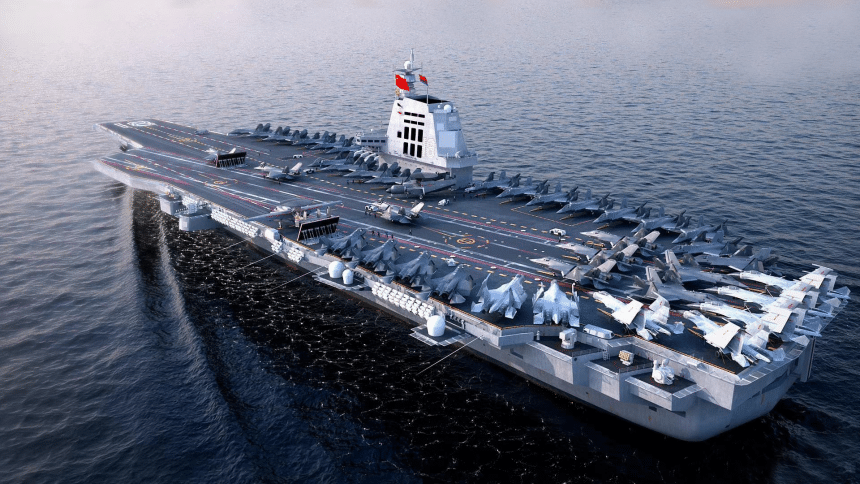
The construction of the 4th Chinese aircraft carrier has reportedly started
While the first Chinese aircraft carrier entered service less than 7 years ago, the Chinese Navy received a second ship, the first of the design
Meta-Defense.fr
23 points · by belter · 2y ago · 68 comments
Is this supposed to be a new Type 004, or another Type 003 like the Fujian?
With the Fujian completed and in sea trials, it would make sense to keep the production line going and crank out a few more. The US suffers from on and off warship production. Some years ago, after winning a carrier order, the head of Newport News Shipbuilding and Drydock announced, in a letter to Congress, that if the Navy would order two at once, Newport News would throw in a third one for free. The Navy declined.
On the other hand if China were to prepare for a war in the South China Sea aircraft carriers would be very useful. They have a couple airstrips there, but they are vulnerable and not as flexible as bringing a couple carriers to the coast of your enemy. It's also a good deterrent as a pure show of force.
Keeping the Malacca Straight open might also be a big part of it.
Otherwise I'd say it's just as silly for China to build obsolete carriers as it is for the US to keep building them.
Missiles outrange carriers which in turn outrange battleships. The battleships became obsolete in 1941. The carriers became obsolete in the early 2000s.
If you can operate a jet fighter-bomber for less than (say) $200 K an hour* I'd be very surprised. And that doesn't take into account the servicing time on modern 'hangar queens' to get them ready for their next sortie. And what's the cost per hour of operating a carrier??
Try to include ALL your costs in working out the cost-efficiency.
* Let's be really generous and say you get 10,000 hours of service life out of a fighter jet. (The designed service life is only 8,000 hours.) The F-35 costs around 130 million bucks so over 10,000 hours that cost comes out to $13,000 per hour in just amortising the purchase cost, without adding in the operating costs themselves.
…”weaponry studies”? Now I’m curious to what extent there exists an academic commentary on stuff like this, separate from internal researchers/stakeholders…
But more to the point if you can't defend a mobile ocean-going fortress, what can you defend?
Underground bunkers (I believe Sweden has a decent history of converting caves into aircraft hangers). Just as we don't really have conventional fortresses on land any more, only trenches and bunkers, as munitions get better we're reaching a point where the only way to keep anything safe is to bury it.
Carriers are increasingly vulnerable against things like missiles and drones that are multiple orders of magnitude cheaper. Think about how a carrier group would defend itself against, say, a heterogenous attack of 100-200 combined simultaneous ballistic missiles, cruise missiles, drones, and/or manned aircraft.
Obviously carrier groups have multiple layers of missile defense: CWIS, combat air patrols, etc. But you only need one missile to get through and that carrier is quite possibly going to be unable to launch planes for quite a while.
And even if you don't hit the carrier, the carrier is going to be undertaking evasive maneuvers during the attack. That means no planes taking off and landing. For a very early example of this, look at the Battle of Midway. The American air attacks were disorganized and sporadic. And yet, they largely kept the Japanese carriers from flying planes for much of the day, leading to a crushing American victory just as their window of opportunity closed.
None of this exactly means carriers are "obsolete." Against non-peers, that is still a whole lotta force projection.
And I feel the better comparison is does "missile on aircraft on carrier outrange hostile missile?"
The reality seems to be that PRC is profoundly not serious about building carriers. They now have ~300x ship building capacity vs US, and outputs in one year as much tonnage as entire US WW2 5-year ship building program, yet is building up carriers at extremely slow rate (2.5 in ~15 years - with 01/liaoning rebuilt from USSR Varyag hull), when they can be spamming 2-3+ carriers PER year. For reference US was laying/building/launching/commissioning a Forrestal class and other large displacement carriers almost every year post WW2. It would be fairly easy for PRC to build 10+ carriers within a few years, but they don't, nor do they seem to be prioritizing building out requisit airwings. Relevant carrier programs are moving along, but it seems far from urgent. This is not the aquisition posture of a force that prioritizes / values carriers.
Compare to say PRC subsurface... they had shit subs until recently, but have consistently tried to close gap and built a lot of boats. Now that latest gen PLAN subs within 1ish generation of USN, they're expanding sub shipyards to build 6-8s simultaneously, i.e. 3-4x than US. Good sign they really care about subs.
TLDR is I don't know if PRC sees expansive role of carriers for future priorities, but it's still worth hedging / building up capability just in case. Real question is, why is PRC building so few carriers, why do most major carrier operators maintain minimal carrier fleet, which includes USN, whose minimum carrier #s are constrained by law (11+10 operational carriers/amphibious assault ships from 10 USC. 8062) and therefore we don't really know what USN priority would be if planners have freedom pursue any force composition. We do know USN insists it needs to build up against PRC but future navy force design is hedging on distributed lethality of more smaller hulls while maintaining the LEAST amount of carries they are legally obligated to operate, which to my knowledge they've never exceeded.
The Houthis are using medium range Iranian drones to attack ships, but they have mostly been failures since they are easier to shoot down. Also, being controlled from land limits the numbers and makes vulnerable to jamming. They also don't have range to catch carriers out at sea.
The longer range "drones" that Iranians have developed could change things. They are basically slow cruise missiles, not drones. But they could be used in large numbers because they are cheap. There is no indication they have developed anti-ship guidance which would bump up the price. However, they haven't had much effect in Ukraine, Israel, or Red Sea.
Also, we haven't seen what counters to drones look like. The same guidance for autonomous drone could lead to accurate cannons taking them down. Cheap missiles could mean cheap defensive missiles to shoot down all the drones.
And even a direct hit wouldn't come close to sinking an aircraft carrier. You'd probably need a dozens of direct hits.
Multiple direct hits from torpedoes couldn't even sink an old, decommissioned aircraft carrier.
Cruise missiles were not effective.
https://en.m.wikipedia.org/wiki/Future_of_the_United_States_...
One other factor is that they mostly work for shore defense since carrier or aircraft would use more effective weapons.
Direct hit would hurt a carrier. I don't we have warhead sizes for Iranian ones but normal anti-ship missiles are 500-1000lb. Those probably wouldn't sink but could cripple it, forcing it to withdraw or knocking it out of action which makes more vulnerable.
    Wouldn't aircraft carriers be able to shoot
    down slow cruise missiles extremely easily?
1. Lots of other types of missiles, like hypersonic ballistic missiles.
2. You generally shoot down missiles with missiles. Your carrier group has a finite supply of missiles. I believe it's around a few hundred. There are close-in weapons systems but they're kind of a last resort and I don't know if they can counter ballistic missiles.
3. A carrier group can only shoot down X targets at a time. Nobody knows the exact value of X. But imagine dozens or hundreds of missiles, drones, etc. at once.
4. Even if you don't hit the carrier it can't take off and land planes while undertaking evasive maneuvers. (see the Battle of Midway for an early example)
    And even a direct hit wouldn't come close to sinking
    an aircraft carrier. You'd probably need a dozens of
    direct hits.
Now one of these would probably do nothing against a carrier. It wouldn't reach it, and if it would it wouldn't get through the armor. But a bigger swarm can overwhelm your defenses and repeatedly hit the same spot to get through armor. They can be mass-produced, and no matter how much firepower and armor you bring your enemy can always spend less money than that on just making more drones.
They are also something new that nobody has developed defenses for. The US has working on small boat defense, so maybe improved guns will work for drones.
One variant that would be interesting are semi-submersible drones.
A modern carrier group has plenty of air defences and anti-drone capabilities to hold off a small- or medium-sized enemy, and it would still provide a very useful mobile platform to bomb them from.
If our basically defunct navy can deal with Iran drones and missiles, then I’m fairly certain an aircraft carrier can.
I feel bad for the Taiwanese, similar to how I felt about Hong Kong. I was hoping we’d offer Hong Kong citizens aslyum (you’d make great US citizens!) but I realize we’d probably also get a few… dissidents caught in our net with that program. I even debated marrying a Hong Kong girl for citizenship but couldn’t find any online, also what a weird offer to make, no one took me up on it (couldn’t find where Hong Kong people posted to advertise even).
Anyhow, I do support strengthening our military. I was younger and thought our military budget was silly but after more reading and more nuance in my worldview, I realize our military is source of consistency - a necessary evil that’s helped to avoid larger wars. Still wish we had better healthcare though.
Other conceivable options, falling short of a full scale invasion of the Taiwanese mainland, would be a naval blockade of mainland Taiwan or missile strikes against it.
With all the evidence it seems the “threat of Chinese invasion” may also just be the US imperial coalition trying to increase defense spending again. Just like Ukraine and Israel.
I'd trust these rumors about China about as much.