Ex-Meta scientists debut gigantic AI protein design model
EvolutionaryScale’s protein language model — among the largest AI models in biology — has created new fluorescent proteins and won big investment.
nature.com
124 points · by gmays · 2y ago · 51 comments
The classical approach was to understand how genes transcribe to mRNA, and how mRNA translates to polypeptides; how those are cleaved by the cell, and fold in 3D space; and how those 3D shapes results in actual biological function. It required real-world measurement, experiment, and modeling in silico using biophysical models. Those are all hard research efforts. And it seems like the mindset now is: we've done enough hard research, let's feed what we know into a model, hope we've chosen the right hyperparameters, and see what we get. Hidden in the weights and biases of the model will be that deeper map of the real world that we have not yet fully grasped through research.
But the AI cannot provide a 'why'. Its network of weights and biases are as unintelligible to us as the underlying scientific principles of the real world we gave up trying to understand along the way. When AI produces a result that is surprising, we still have to validate it in the real world, and work backwards through the hard research to understand why we are surprised.
If AI is just a tool for a shotgun approach to discovery, that may be fine. However, I fear it is sucking a lot of air out of the room from the classical approaches. When 'AI' produces incorrect, misleading, or underwhelming results? Well, throw more GPUs at it; more tokens; more joules; more parameters. We have blind faith it'll work itself out.
But because the AI can never provide a guarantee of correctness, it is only useful to those with the infrastructure to carry out those real-world validations on its output, so it's not really going to create a paradigm shift. It can provide only a marginal improvement at the top of the funnel for existing discovery pipelines. And because AI is very expensive and getting more so, there's a pretty hard cap on how valuable it would be to a drugmaker.
I know I'm not the only one worried about a bubble here.
For decades, CV was focused on trying to 'understand' how to do the task. This meant a lot of hand crafting of low level features that are common in images, finding clever ways to make them invariant to typical 3D transformations. This works well for some tasks, and is still used today in things like robotics, SLAM etc. However - when we then want to add an extra level of complexity - e.g. to try and model an abstract concept like "cat", we hit a bit of a brick wall. This happens to be a task where feeding a large dataset into an (mostly) unconstrained machine learning model does very well.
> The classical approach was to understand how genes transcribe to mRNA, and how mRNA translates to polypeptides; how those are cleaved by the cell, and fold in 3D space; and how those 3D shapes results in actual biological function.
I don't have the expertise to critique this, but it does sound like we're in the extreme 'high complexity' zone to me. Some questions for you:
- how accurate does each stage of this need to get to useful performance? Are you sure there are no brick walls here? How long do you think this approach will take to deliver results?
- do you not have to validate a surprising classical finding in the same way that you would an AI model - i.e. how much does the "why" matter? "the AI can never provide a guarantee of correctness" - is true, but what it was merely extremely accurate, in the same way that many computer vision models are?
The lack of asking "why" is one of my biggest frustrations in much of the research I have seen in biology and genetics today. The why is hugely important, without knowing why something happens or how it works we're left only with knowing what happened. When we go to use that as knowledge we have no idea what unintended side effects may occur and no real information telling us where to look or how to identify side effects should they occur.
Researching what happens when we throw crap at the wall can occasionally lead to a sellable product but is a far cry from the scientific method.
> When we go to use that as knowledge we have no idea what unintended side effects may occur and no real information telling us where to look or how to identify side effects should they occur.
Alright and what if this is also a lot quicker to solve with AI?
Because without a "why" (causal reasoning) they cannot generalize, and their accuracy is always liable to tank when they encounter out-of-(training)-distribution samples. And when an ML system is deployed among other live actors, they are highly incentivized to figure out how to perturb inputs to exploit the system. Adversarial examples in computer vision, adversarial prompts / jailbreaks for large language models, etc.
Don't read too deeply into what exactly is AI. Likewise I recommend not being too cynical about it either. McCarthy and those around him absolutely did pioneer some incredible, world changing work under that moniker.
Regarding your particular critiques, natural intelligence very often also cannot provide a "why". If you follow any particular technical field deep enough it's not uncommon to come across ideas that currently have deep rigorous proofs behind them, that basically started as hunch. Consider the very idea of "correlation" which seems rooted in mathematical truths, was basically invented by Galton because he couldn't find causal methods to prove his theories of eugenics (it was his student Pearson, who later took this idea and refined it further).
Are we in an AI bubble? Very likely, but that doesn't mean there's not incredible finds to be had with all this cash flowing around. AI winters can be just as irrational (remember that Perceptron basically caused the first AI winter by exposing the XOR problem, despite the fact that it was well known this could be solved with trivial modifications).
Take weather prediction for instance. This is something that the AI companies are pushing hard on. There are very good physics-based weather prediction models. They have been improved incrementally over many years and are probably pretty close to the theoretical peak accuracy given the available initial state data. They are run by governments and their output is often freely accessible by the public.
So firstly, where on earth is the business model when your competition is free?
Secondly, how do you think you will do better than the current state of the art? Oh yeah, because AI is magic. All those people studying fluid dynamics were just wasting their time when they could have just cut a check to nvidia.
Nature doesn't understand the problem domain, and yet it produced us. Capable of extraordinary achievments.
Do you have references for this approach? It’s my understanding that structure solutions mostly lag drug development quite significantly and that underlying biological understanding is typically either pre-existing or will end up not existing for the drug until later. Case in point look at recent Alzheimer’s drugs where the biological hypothesis is even straight up disproven.
- It's statistics if the goal is to figure out why it works
- It's data science if nobody cares why it works
- It's ML if nobody knows why it works
- It's AI if it's actually impossible to figure out why it works
The definitions are not quite mutually exclusive.
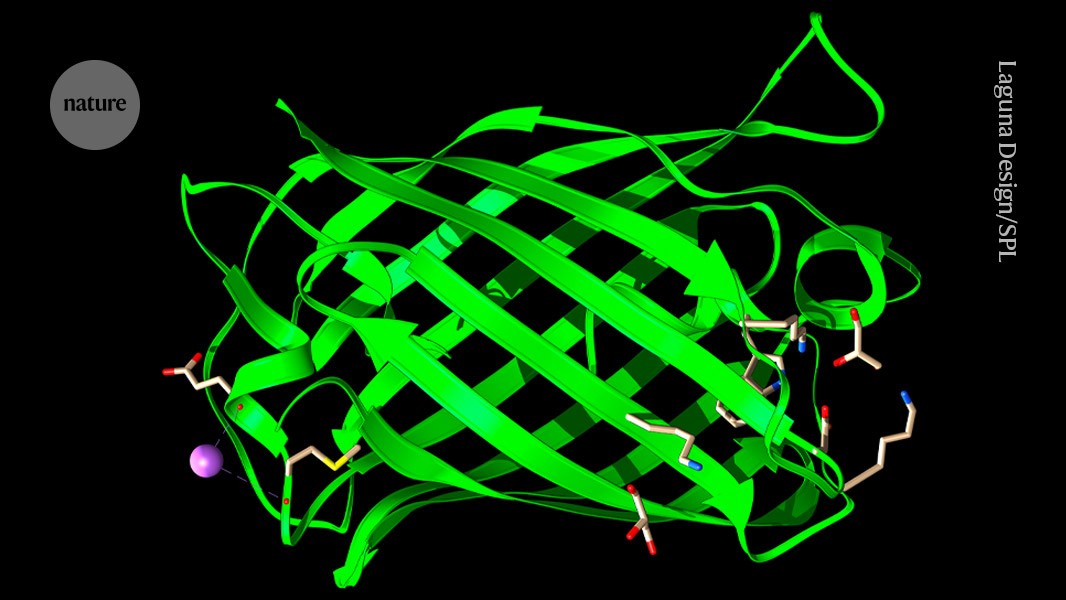
> When the researchers made around 100 of the resulting designs, several were as bright as natural GFPs, which are still vastly dimmer than lab-engineered variants.
So they didn't come up with better functionality, unlike what some commentators imply. They basically introduced a bunch of mutations while preserving the overall function.
Relevant: https://en.wikipedia.org/wiki/Conservative_replacement
In grad school, I worked on proteins that were 12%-15% sequence identical but had sub 4 Å RMSDs once the structures were solved.
EDIT: Actually, bragging about it could be a nigerian prince thing, where they do it to scare away investors that might actually hold them to some standard.
Depends entirely on the context and details.
My layman's understanding of LLMs is that they are essentially "fancy autocomplete". That is, you take a whole corpus of text, then train the model to determine the statistical relationships between those words (more accurately, tokens), so that given a list of tokens of length N, the LLM will find the next most likely token for N + 1, and then to generate whole sentences/paragraphs, you just recursively repeat this process.
I certainly understand encoding proteins as just a linear sequence of tokens representing their amino acids, but how does that then map to a human-language description of the function of those proteins?
That sounds like a glove being thrown down.
Not to downplay this achievement, but 60% sequence identity is nowhere near “vastly different”.
The part of us that can't cope with that is our System 2 reasoning: our minds' rules based thinking is great at F=ma but cannot enumerate the rules necessary at the level of retina cell activation patterns to recognise a tiger; our System 1 can, and always does, we just call it "intuition" or "common sense" or "a gut feeling".
"It's just three guys and a model and they think it's worth X hundred million"
we just had to wait for this approach to be apparent
Except for the part where a sequence is actually deemed more fit, ie natural selection? And the part where mutations are random, instead of sampled from the training data manifold, so much more constrained?
...so really it's a worse version of random search?