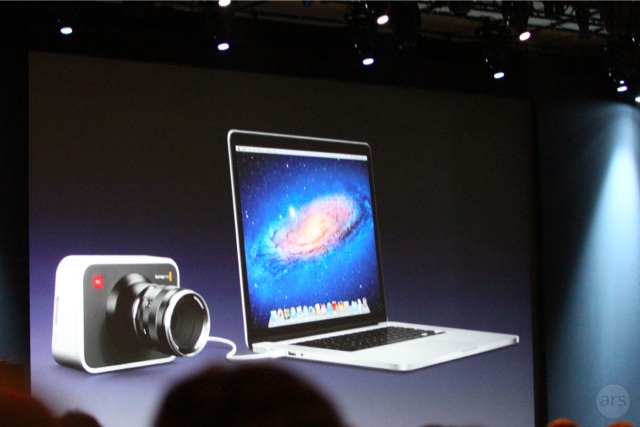
MacBook Pro gets Retina Display; MacBook Air also updated with Ivy Bridge
Tim Cook touts "World's highest resolution notebook display."
Ars Technica
378 points · by sciurus · 14y ago · 525 comments
Then I watched this keynote.
I'm buying a Macbook Pro.
By all rights I should be the biggest fanboy ever. All my computers are Macs. I have an Apple TV. I stood in line to buy the first iPhone on launch day and have owned nothing but iPhones since. I have an iPad. I insist on using Apple services like iTunes so everything "just works" with all my Apple devices. I even converted my whole family from PCs to Macs and, yes, my "family tech support" calls have dropped.
But I'm not what you would call a "fanboy".
If someone asks why I like Apple products, I try to give rational reasons but I admit from the start that I'm biased and just "like them", plus I "think they're cool". I never sneer at PC users or people with Android phones. I don't make lame jokes about "Winblows" and such.
I guess my point is it's possible to become a total convert and still not annoy the heck out of everyone around you. I'm not saying you don't know that, just that you should monitor yourself. Once you become loyal to a brand (Apple, BMW, B&W loudspeakers, whatever) it's sometimes difficult to tell the difference between being a proud evangelist and an annoying cultist.
Luckily, I had some friends who helped me whenever I veered too far in the latter direction. :)
It's a well-built solid metal portable development workstation. With BSD UNIX. And a pretty layer on top.
Among programmers, I never need to explain why we would buy these things.
It's outside the programming groups that the conversation gets hostile. I find most programmers avoid this completely, knowing that they're simply using the best tool available for the job, and ignoring the hype, criticism, and fanboyism. Props, hackers, keep it up.
It appears that both of the major computer platform makers have come to the same conclusion: they don't want to make computers that their customers can program for their own purposes; they want to make ever-more-tightly-sealed point-of-sale devices for buying digital products and services from the device maker and its partners.
In other words, if you think the sealed iPhone, tethered to giant companies with strict rules about what you may and may not do with it or put on it and its design esthetic of "enjoy the beauty, stop resisting, do exactly as we say, and why not buy something with it, you'll feel better" is your idea of a great "pocket computer" for hackers, then you should be happy about where our computers are going. Otherwise....
I think we hackers are going to be driven to Linux on the desktop over time, which I would have no objection to if only there were an "Apple for Linux" company making the hardware and matching drivers of Apple-level quality. I can live without MacOS, but the hardware is a big deal.
Sure, I like getting a new shiny thing just like anybody else. But it does seem a little less shiny once I've tried to put my employer's dev environment on it and found that Apple's customized version of a common C library broke the build. Or an Oracle dependency we (very unfortunately) have hasn't been upgraded by Oracle in a couple years and crashes on the new OS.
The lot of the programmer seems to be that you never get to have your tools "just work".
Edit: Given the lack of real interesting updates in OS X since Leopard and recent iOS versions, I am actually quite interested in Windows 8 and Windows Phone after ~18 years of using Unix-like operating systems and ~5.5 years a Mac.
I really miss "all windows" Exposé; Mission Control is not a worthy replacement. Any word on Exposé changes in 10.8?
That retina display is dead sexy though.
- The unified menu bar makes sense and saves space, but it's still somewhat disconcerting to someone who is used to their menus having some spatial context with what they are controlling.
- I've always hated the "three gumballs". I much prefer Windows' minimize, maximize, and quit windows controls. Again, the "maximum useful size" feature makes sense, but it's almost never what I want. I really miss Aero snap. There are some programs that will help you out for this stuff. I'm pretty partial to Moom myself. UPDATE: Moom JUST got updated with a "snap to corners" feature. I like it!
- The Finder is still pretty brain-dead. Windows explorer is much better for a power-user.
- And then there's XCode. Oh how I miss Visual Studio. Yes, XCode is getting nicer by the year, but I also do Windows development on my Parallels VM so I'm constantly reminded of how much nicer it is to code C# in Visual Studio than Objective-C in XCode (and I don't even mind Objective-C as a language).
I'm thinking regular users don't use the finder either. My wife uses spotlight to find her stuff and apps.
  > The Finder is still pretty brain-dead. Windows explorer
  > is much better for a power-user
The new Windows 8 Metro UI will create an ever bigger gap between the two it seems.
All that being said, w/r/t an OS it seems like the one you're most comfortable on is the one you should use. Its really hard to say any one that is objectively better at this point.
It took some time to relearn my windows modifier keys (CMD = Windows Key; ALT is where the Windows key normally is), but after that expense I run Mac and Windows app in the same session, and more importantly, without switching hardware.
[1] http://itunes.apple.com/us/app/lock-me-now/id464265594?mt=12
If you want an living room PC for entertainment, Windows is king. Neither Linux or OSX support Bluray properly and Windows still has a huge edge in gaming. Windows also supports the most hardware. That's become unimportant to most people, but if you work in a research lab with various oddball computer controlled devices around, you are often forced to work with Windows simply because that's the only OS supported by drivers for a lot of things.
OSX is the perfect OS for your mother. There's the one "Apple way" of doing things, so if she needs help it's easy to give her some. OSX gets decent battery life (on mac hardware) and still has a few Unix friendly features that haven't been locked away by Apple yet. If you're looking for a ghetto linux workstation, OSX will do in a pinch. I actually spent the better part of last year working under OSX on a Mac Book air. I've used Mac's off and on for decades and this is just the most recent stint (The MBA hardware lured me in this time). It worked, but the OS still puts up too much fight you when you try to customize it. OSX has also gotten rather buggy. I'm relieved to have retired it. As I said, while it would be great for my mother I personally detest OSX. Also, Mac hardware is moving away from the DIY crowd. e.g. The MBA's actually use proprietary screws to keep you out of your own laptop's innards. If you've ever saved a laptop from a coffee spill by disconnecting the battery and opening it up and doing a little cleaning, just bear in mind you won't be able to do that with most future macs.
Linux is bug central. Don't get me wrong, it's come a long way from the days when Slackware was king. You can install Ubuntu and almost everything will just work. The devil is in the details though, and if you have a low tolerance for flakiness you'll have to tweak away. However, no other OS is as powerful and flexible. If you want it to do X, it can do X in dozens of different ways. If the journey is as important as the destination for you, Linux is your OS.
Windows is all things to all people, but entertainment first and foremost. OSX is for your mother or people who would rather not use a real computer. Linux is for those who embrace the quest. Decide (and be honest with yourself) what kind of user you are and your OS preference will become clear, although what you are forced to use may be different. I currently use both Windows and Linux extensively, and occasionally help my Mom with OSX.
Perceived hardware quality is something Apple is fantastic at. Their laptops look and feel great. They feel like they'll last decades. This is misleading since they're actually built to be disposable. e.g. If you spill coffee on your Macbook Air, it's dead. You can't fix it because you can't remove the battery in a timely fashion and don't have the tools to open it. Apple won't fix it because their warranty doesn't cover spills. They won't even open it up and help you clean it up. They'll just tell you it's now off warranty and to kindly buy another or PFO. This is the big apple lie. Their stuff feels like heirlooms, but it's built to be binned at the first sign of trouble or obsolescence (or when the non-user-replaceable battery inevitably fails).
For some strange reason Apple has managed to put retina displays in their laptops before LG or Samsung (who probably manufacture those panels) manage to put them in their own laptops. While other laptop manufacturers are pretty timid about doing new things these days, they are getting faster at following in Apple's footsteps. We'll likely see Samsung or LG putting out their own laptops with retina displays within a few months. At least some of them will have proper screws that you actually own a screwdriver for.
Samsung really has the potential to be an industry leader. They make everything. SSD's, memory, displays, you name it. Some of their efforts (e.g. the Series 9) have actually been innovative in certain small and specific ways. It's frustrating to watch them sit back and let Apple do things "first" with their own parts though. Someone at Samsung is really dropping the ball and I hope they're shown the door soon.
There's nothing strange about this. Apple has been pushing very high resolution as a differentiator for 2 years now. They've made huge investments in new factories for Toshiba, Sharp and likely other display makers. They've signed huge contracts taking almost all the production from other vendors. It's not like tomorrow Samsung Mobile can say "shit tear up that $3 bln deal with Apple we want to make a 2880x1800 laptop now"
"Samsung really has the potential to be an industry leader."
The fast follower strategy has been ingrained into Samsung for what, decades? I don't see how it's frustrating to watch them execute the strategy they've been very successful with and I don't expect them to turn around and bet the farm on a new market leading approach.
I've replaced the batteries for them, actually, I've had Apple give me new batteries due to them failing early... but I've never had issues with Apple not servicing my laptop. They have dents in them, they have scratches from wear and tear, they have stickers all over them, but they still work extremely well. Still run the latest version of OS X, still run all of the software I use on a daily basis.
I used to own an iBook that I had purchased in 2004, an iBook G4, when I purchased my new MBP in 2007 I sold my iBook to my dad and he used it till 2010. The iBook is still up and running, it is simply too slow for my dads needs so he bought a new MacBook Pro and absolutely loves it.
This is basically a longwinded way of saying that I disagree with your assessment that they are disposable machines. The amount of life and longevity in a Mac are to be envied, and the way they hold their value even after a couple of years is simply awesome.
Battery replacement is $99.
For some strange reason Apple has managed to put retina displays in their laptops before LG or Samsung (who probably manufacture those panels) manage to put them in their own laptops.
Windows probably doesn't support retina properly (which is sad, considering that MS has been working on retina support since Vista). Also, Apple may have outbid Samsung for the panels.
Samsung really has the potential to be an industry leader. They make everything.
Except software.
Amen brother. It's astonishing to me that so much of what Apple creates is actually made by Samsung, and yet they constantly seem so far behind.
Have you seen their new 15" Ultrabooks though? They are awesome. 15" screen and weighs more than a pound less than the new MBP (obviously, with tradeoffs)
The batteries are actually designed to last for many years and pretty easy to replace with a screwdriver.
My MBP from 2008 is still going strong, and that's the less solidly built pre-unibody. Unlike many others, Apple extended the warranty because of the nVidia chipset bug.
I'm still typing on it today. But man, those new retina MacBooks are tempting.
Looking into it further at the time there's actually a good chunk of your macbook that you can fix yourself it's just not officially blessed by Apple
What's gone wrong with them?
MBP - The case is full of dents, and the screen is starting to get dark. It's balls slow these days and Apple really doesn't want to support it anymore.
Netbook - it can't detect how much battery is left anymore, but otherwise seems fine. It's also balls slow, and there's not really a way to support it.
All that being said, replacing my netbook with something similarly priced will cost me $300-400 and get me a hell of a lot better piece of hardware. Replacing my MBP is going to cost me a pretty penny that I'm not looking forward to.
Note: I actually did "replace" my MBP with a Dell Studio a couple of years ago for about a thousand bucks and got a ridiculous amount of hardware for that price. It still looks almost new, but it "feels" cheap and fragile, even if it hasn't actually shown any wear and tear. My MBP on the other hand feels incredible, but has collected so many battle scars from fairly undramatic handling that I wonder if aluminum really is a good case material in the long run. The metal around one of the ports in the back is so buckled the port is no longer usable.
Note 2: It's interesting, being an East Coastie, that when I see MBPs it's usually young professionals at Starbucks or some such putting together business consulting slide decks or something. It's mildly unusual to see developer types out here with Macs (or see them with Macs not running Windows). I'm sure it's an effect of banking and government on the ecosystem. But it's almost always non-tech types using Macs here...usually as a response to having crappy corporate Windows XP/7 systems forced on them in their cubes at work.
Note 3: I'm not really a developer type, so personally I think Macs are "OK". I can see why West Coastie Web Startups use them. The Unixland is decent enough, the GUI is pretty good etc. For folks who want to do that kind of stuff the ecosystem is pretty nice.
For me, most of the stuff I want to do with a computer either isn't as good, doesn't exist, or is a second class citizen in the Mac world (it's mostly music composition, retrogaming, other entertainment) but is miles ahead in maturity and choices in the PC world. Portable software practices make lots of that go away when I'm stuck on my Mac and want to have some fun, but it still feels less mature than the Windows counterparts.
For business, almost none of my customers are using Macs, so I'm back into Windows land again.
It's frustrating, I'll sit down to really work with my Mac for a bit (and did for a few solid years), but find myself inevitably drawn back into Windows world to "just get shit done" in many cases.
Running Windows on an expensive MBP seems silly as the hardware seems to be about as durable, but the Windows machines are virtually disposable they're so cheap...and I couldn't care less about the feel of the machine.
I think changing work environments to a different kind of shop would probably offer me a better opportunity to stick with OS X, it's a kind of network effect.
But outside of some personal frustrations, I can see why either ecosystem would be a perfectly valid choice.
One constant, though: over the past 10 years, I've moved my life further and further into the Cygwin command line, so that I'm insulated from the frippery going on at the edges; with my setup, I'm approximately as at home on Linux, Solaris, Mac and Windows. I'm not optimistic based on what I've seen of Windows 8's direction.
Linux GUIs (Android only partially excepted), in my experience, are amateur in the worst way: dilettantish, faddish, inconsistent, incomplete, and replaced with something new and differently broken long before any stability emerges. I also really dislike the UI scaling: the font selection, border sizes, etc., KDE / Gnome defaults are all too widely spaced for my taste, and customizing it so that it would be acceptable seems to be a full-time job. As it is with Windows, I had to install Classic Shell to get a usable explorer tree view and start menu I could live with.
There isn't a single graphical app available exclusively for Linux that I'm jealous of. And for command-line / server stuff that's Linux-only, I'm perfectly happy with ssh running in mintty on Windows.
Or a BSD.
Unless you use that other text editor, you know, the one that makes you always have to reach for the escape key...in that case, I suppose you should map it to escape instead.
echo 'inoremap kj <Esc>' >> ~/.vimrc # works like a charmNonsense. Map caps lock to control regardless of whether you're an emacs or vim user. If you use vim, control+c does the same as escape and since vim does still use control sometimes, it makes sense to keep control easy to access and just use that (IMHO very easy to press) key combo instead.
After this announcement, though; the Retina display, awesome graphics, HDMI port (Macbook dongles turned me off for a while), 700MBPS read on the hard drive (I'll have to confirm this -- that just sounds too sexy) -- Even the 0.70 inch thickness (I've never really cared about thickness before, but holy hell that's really thin). There are probably some things I've misinterpreted from these announcements, but so far, this laptop far outweighs what I thought was possible through existing PC laptop vendors.
Such announcements provide opportunity for a pivot point. It isn't so much the announcement itself as that the announcement provides a claimed justification for changing positions.
I bought my first Apple product ever a few months back (an iPad 3rd generation). Then I added an Apple TV (ridiculously good value).
I still use Android for my smartphone (and have no plans on changing that anytime soon, considering iOS a serious downgrade on the smartphone side), however I have to confess that this release provides me such a pivot point for my desktop/laptop use. I'd long considered getting a Mac but could never justify it. Microsoft is so rudderless and ill-directed now, and Apple is so large and in charge, this product such a technical powerhouse, that I will likely grab a new MBP "Air".
Uhh, are you joking? In the past few years, Microsoft has shown the most direction in 2 decades. Windows, Windows Phone, and Xbox are all converging on the Metro UI (which is a true breath of fresh air), and Microsoft has finally stopped allowing big business to hold back innovation on Windows. Windows 8 dumps the Start Menu, and on ARM, you won't even be able to install any traditional "Windows" software - everything will have to be in Metro.
Windows 8 tablets are going to be usable for actual productivity, rather than the consumption-focused nature of the iPad. Tablets that can convert into laptops and vice versa are going to become popular in the corporate world in a way that iPads never will, due to their lack of native support for Office.
OTOH, there are a lot of people that have grown tired of iOS. It's been out for 5 years now, and little true innovation has taken place since the release of the original iPhone. Upgrades to the iPhone have mostly consisted of adding features that should have been present all along, such as a proper notifications system (which still has problems) and support for 3rd party apps (which should have been present from the beginning). You still can't have widgets on the home screen, and the chance of Apple adding some kind of split-screen view, like you can get in Metro, is extremely slim.
As for OS X, it's an absolute nightmare. The window manager is horrific, and things are only going to get worse as Apple starts restricting the installation of software from non-approved sources, all in the name of a more "beautiful" experience.
In contrast, with this announcement, I've probably bought my last Apple product.
Edit: Oh, and as soon as I have a job, I'm getting one! I've been drooling over Ivy Bridge specs for months.
http://www.notebookcheck.net/Intel-HD-Graphics-4000-Benchmar...
Why do I think I should buy Macbook Air? Because laptop should be that light and thin.
Why I use Linux? It's dead simple. A single command or a simple script can make system management and other tasks so straight forward and no brainier. I have total control on what I want on my system. Of course their is a learning curve but that's the main reason I visit HN.
And not just because of their advantage in hardware; Windows is notoriously hard to program for in a resolution independent way, and the first double resolution laptop displays are going to cause early adopters no end of pain. Even if Windows 8 brings APIs to fix it, the long tail of apps are not going to be updated any time soon.
I expect this to be an unusually large and concrete reason for everyday people to choose a Mac laptop for the next few years. Side by side, Macs will look amazing. Looked at a 3GS recently? Eww.
Of course, this is assuming OS X has resolution independence nailed; though I'd be amazed if they shipped this if that wasn't the case.
(This is a repost of my comment from a rumor thread; not much has changed)
Really? Using which API?
My point is that the long tail of apps in the wild are going to be problematic, regardless of what new apps do.
At a high level, they're really just upgrading to Ivy Bridge, USB 3.0, and Retina displays across their notebook line. Nothing mind-blowing really.
It looks like the big difference in price is not the display, but the hard drive.
But you're absolutely right. There's nothing in this one single keynote that's like WAPOWW!!!!
On a wider note, I feel myself... drifting away from all of this. In previous years I would have been all over WWDC live blogs and so on- this year I'm already fed up with my Twitter stream being filled with it, and am dreading the Hacker News front page being liberally coated with Apple. I am happy to just read the post-game analysis after the fact. Reality Distortion Field Fatigue, perhaps?
Lack of gigabit Ethernet on the big pro air makes me sad, though.
Presumably the logic is that its all wifi these days anyway.
But if you're going to do that, just sell your existing Air and buy a new one..
That happens. In my case, it's the "seen it all before" effect.
It would be exciting if something really noteworthy was happening, but a bump in resolution or a new I/O interface are not groundbreaking changes in computing.
Personally, i think the 2011 Air is a great machine and offering 8GB on it now is all that needed to be done to keep it a great machine for another year.
But definitely, certainly, the 2010 to 2011 update was important in terms of performance.
As I understand, the "Retina display" label takes into account the recommended viewing distance from the display. An iPhone display will be held much closer than someone (with proper posture) at a laptop.
Full screen apps with the magic pad swipe between them mitigates this somewhat for apps like Mail, Sublime Text, or Terminal, but 1440 x 900 is a poor choice for dual page word processing.
That said, after development, my second most common activity is photo triage and editing. For this, the 15" retina display could present a far truer representation of what can be expected in the final print.
But I'm concerned about the "less glare" feature. I've also always and only purchased the matte screens. They have no glare, and no false brilliance from the glossy screen. For photo editing for print work, the matte screens have always felt more accurate. I'm curious if they've gone to a single screen surface, based on glossy, but with somewhat less glare. I'm not sure I'd be interested in that.
On the plus side, a MBP 17" only fits in carry on bags that can't quite go in a commuter jet's overhead bin, while the 15" will fit easily in most any commuter jet compatible bag.
That said, the iPad 3 64GB with iPhoto and SnapSeed can ingest and edit a great deal of photos even at today's DSLR resolutions. On recent trips, I carry an iPad 3 plus a Nextodi external portable photo HDD with integrated card reader. I edit one day's worth of photos on the iPad, while archiving the full memory cards on the Nextodi.
(Example: http://www.phillips-safety.com/store/product_info.php?cPath=...)
"Supported resolutions: 2880 by 1800 pixels (Retina); scaled resolutions: 1920 by 1200, 1680 by 1050, 1280 by 800, and 1024 by 640 pixels"
I think you've confused "resolution" with "my preferred resolution". The new MBP has both a higher density and a better resolution then what you're looking for. You may be disappointed but I bet Apple thinks it can make more money by selling 2880x1800 MBPs.
I'm guessing a reason we haven't seen high DPI screens from Dell/HP/Sony/etc is partially because the Windows OS doesn't really support it that well just yet. Hopefully things have changed in Windows 8.
Hopefully the Linux devs will start taking this into consideration.
Supported resolutions: 2880 by 1800 pixels (Retina); scaled resolutions: 1920 by 1200, 1680 by 1050, 1280 by 800, and 1024 by 640 pixels
This is odd.
I.e., the approach they've taken is fully scaleable from current resolutions to high resolutions, but it'll take some cooperation from third-party software.
In the end, you'll be better off.
I guess we'll have to see how that works out.
That may be true, but they're going to need a monocle if they want to see 9-pt courier at native resolution on one of these bad boys.
That said, the one thing that continues to concern me with Apple is the continuation of their closed philosophy. The Mac App Store being the latest incarnation of their quest for total control. I, frankly, don't know what to make of it.
An Apple ecosystem would have no competitors. Like it or not, Microsoft enabled an incredible level of global competition that, ultimately, has been responsible for bringing us the Internet as we know it. Stop and think about what I just said before you disagree. Nearly all of the hardware developments in the last thirty years have come on the backs of the MS platform. You can build inexpensive and powerful servers today because of MS. Same with Linux and other advances. They lit the fire that triggered an incredible evolutionary chain in both consumer and professional computing.
While I understand why Apple does it this way --and they are fully entitled to do so-- I would not want to see a world where their computers are adopted en-masse unless they let go and break the chains.
That's pretty rich. Networking was a fundamental feature of many operating systems that predate Microsoft's existence . The first web browser was developed not on Windows, but the precursor to OSX (NextSTEP) and MS played catch up in basic browser features around the web's early years. The vast majority of servers are Linux based.
It's silly to attribute the rise of commodity PC hardware to them as well - it's only their lawsuits that prevented Linux from seeing widespread distribution, which would have enabled just as much innovation.
I did not attribute the Internet to Microsoft.
What I said is that "Microsoft enabled an incredible level of global competition" and it is this competition that, in turn, allowed the internet to evolve into what we have today.
Yes, networking existed way before MS.
Yes, TBL wrote the first browser on NS.
Yes, MS played catch-up with browsers.
That is not the point.
Linux didn't begin life until 1991. By that time the MS-ecosystem-driven PC evolution was very well under way. Linus Torvalds wrote the initial version of Linux on a '386 based PC. By that time PC clones ruled the world. The evolution had gone through the 8086, 80186 and 80286 processors. Machines cost a fraction of what the original true IBM PC cost, were faster and did a lot more.
None of this would have happened with a closed hardware model. In fact, it did not. Apple was around at the same time, of course. They focused on keeping it all to themselves. MS, in turn, just did the software and let everyone else figure out the hardware. Yes, it was chaotic but it worked.
As the internet begun to heat-up it was Linux running on PC hardware that made it explode. The internet required hardware to grow and explode into every corner of the world. It was the cheap PC hardware that resulted from the evolution of the PC around the MS software that, among other things, enabled the internet to explode like it did. Nobody can even attempt to credit Apple with any of that.
Again, I am not anti-Apple here. Among other things, I develop iOS apps and have a nearly equal number of Windows and MacOS machine in the shop. I will likely buy more Apple hardware in the next few months. No issues there.
My original post was not about bashing Apple, it was to highlight my concern for the increasing closed-everything (not just hardware) approach Apple is taking --which is a fact. In some cases it is almost despotic. As a developer, that concerns me a great deal. As a consumer, I prefer to see competition at all levels. I'd really like to see Apple open-up.
  http://en.wikipedia.org/wiki/History_of_Linux
  http://en.wikipedia.org/wiki/History_of_Apple_Inc.
  http://en.wikipedia.org/wiki/History_of_personal_computers#The_IBM_PC
  http://en.wikipedia.org/wiki/Web_browser
  http://en.wikipedia.org/wiki/List_of_web_browsers
  http://en.wikipedia.org/wiki/WorldWideWeb
  http://en.wikipedia.org/wiki/Mosaic_(web_browser)
http://en.wikipedia.org/wiki/Timeline_of_web_browsersMicrosoft had nothing to do with the openness of the PC architecture. By the time MS had any influence, the PC market had already been well established with several manufacturers churning out PC clones.
It was the cheap PC hardware that resulted from the evolution of the PC around the MS software...
Isn't it the other way around? At least in the beginning, the MS software seemed to evolve around advances in the PC hardware. At some point Microsoft probably got enough leverage to influence the process, but another company (or a consortium of companies) would have probably got to do that if MS had not been around.
    * Two Thunderbolt[/DisplayPort?] ports
    * One HDMI port
    * A Geforce 650M (capable of driving 4 active displays [1]).
EDIT: "Up to two external displays" (thanks dsirijus)
With USB3 now, you could probably run several. I bet you could get 4 HD monitors easy.
Even with just Visual Studio and normal office usage, I found it very frustrating using a 1080p screen over USB. Very choppy and annoying.
It looks and I would guess it would be magsafe 1 compatible. Maybe it has extra features or power to it. Pretty much any MB* can be charged on any power adapter albeit slower (or not at all if heavily using it).
My two guesses: 1. The entire window draws as doubled pixels, as if it didn't support Retina at all 2. The window gets two separate paint events, one retina and one non-retina.
Anyone know how this works yet?
Source: manual testing under 10.7.4 with HiDPI resolutions activated using QuartzDebug
Unless there's a "just one more thing" with these, it seems that the Mac Pro appears more and more dead.
1- The transcode from h.264 (what my D7000 outputs) to Prores 2- Transitions, overlays and basic comp'ing effects 3- Export from FCP 4- Transcoding from Prores to h.264 again
The editing itself, no, it isn't that bad really anymore. On my old Macbook Pro (2009 model?) it was pretty hard still. Yet, everything surrounding the render is just terrible. I feel that with a 16/32 core Mac Pro, 64GB+ of RAM that that many of these problems would go away. I saw where someone had built a Hackintosh the other day that was 16/32 cores and 128GB RAM... which is very tempting currently.
My intuition for the cause, is that the more surface area of the screen, the harder it is to consistently manufacture the panels without defects. But I'm not convinced because I'd imagine such incredibly high resolutions on laptop panels must be pretty demanding technology as well.
I just want 2880x1880 30" monitors for my office :)
Since you're comparing with "most desktop rigs", you should also remember that most 15" laptops are 1280x800 or 1440x900.
Today, most are the appalling 1366x768. I have to give Apple major points for sticking with decent resolutions and 16:10.
However, with laptops, you can only keep making them so big (and indeed, it seems that the 17″ MacBooks are getting axed). Similar to phones, the only innovation that makes sense in this market is to increase DPI.
But hey, they finally made a Thunderbolt Firewire adapter cable.
I throw a lot of data around. I like backups. The difference between USB2 and USB3 will be non-trivial for me.
http://www.amazon.com/Thermaltake-ST0022U-Plastic-Docking-St...
all the thunderbolt ones are very expensive.
For perspective: my (larger) 2010 MBP 15" w/SSD gets very warm even when not doing anything with the GPU. Compiling in IntelliJ will get it to burn your lap off. When I've tried to use it to play games, it practically melts itself.
Still doesn't explain a higher price.
I hate the glossy screen and was happy to pay extra for matte on my current MacBook.
edit: Apple Store Berkeley says no.
Exhibit A: http://instagr.am/p/LvfFx3CPKI/
I ordered online.
1600x900 is perfect on a 15.6, and 1920x1080 is the maximum I'd go for on a 17 inch display. Any higher and I'd just connect a bigger external display...
Can anyone give me an idea of what this resolution can actually be useful for?
I prefer Windows--I'm going to try this out vs. the new Macbook Pro, but I may indeed pick up the ASUS.
Sadly, screen resolutions have been decreasing and moving towards 16:9 ratio. It's nice to see Apple emphasize the screen again and push competition.
At work I have a Core2Duo Mac Mini that runs Windows 7 in a VM for my "work stuff" on a second monitor. At home I have the current Core i5 Mac Mini for my main system, with an AMD Bulldozer-based Windows box for games and things that require Windows. Sure, I prefer *nix, but I'll admin and use whatever gets the bills paid.
When it comes to laptops, I have a 2010 Macbook Air 11", a 2010 Macbook Pro 13", a Thinkpad T61 with Ubuntu, a Lenovo G470 with Win7, and a Thinkpad X120e running Windows 7.
A couple of hours ago, I sold the MBAir and MBPro to friends and ordered the new Core i5 11.6" Air with 128G SSD and 8G RAM. It's not often that I will buy the "current" machine without waiting for a refurb to be available.
granted its not an air, but - are you sure you want one?
I think the 15 inch macbook as just announced is a far better option, with a single weak point (7 hrs) compared to an air-style form factor which would be weaker at everything - except weight and slightly thinner form factor.
basically, if all someone wants to do is type on it and not have to think about carrying it with them or not (e.g. a reporter for stories, student for essays, CEO for emails), a 15 inch air was not announced today. for everyone else, what was just announced is better than the 15 inch air.
    Air 11": R$2699 -> R$3699 (1849 USD)
    MBP 13": R$3599 -> R$3999 (2000 USD)
    MBP Retina: R$9999 (4500 USD - WHAT??)
    MBP Retina maxed out: R$15973 (~8000 USD...)
Apple prices went from ridiculous (buy a Mac or buy a car) 6 years ago to very competitive, until this update - apparently the good days are over.
Also I love the hardware and design. They only company who comes close to Apple's design is Asus in my opinion and even then they are still not quite there.
Does anyone know if the SSD is a standard SATA drive or a custom built in one (i.e. not user upgradable)?
Anyone who would know (an Apple employee) isn't going to comment publicly today.
This combined with on-board RAM and on-board SSD storage... are any of the components in these new retina display MacBook Pros replaceable?
Details here: http://store.apple.com/us/browse/campaigns/back_to_school
I guess it wasn't selling as good as the 15inch, ans is obsoleted by the retina one. But it's funny how there is so little mention of it, even if it was the top of the line for so long, representing the "everything's on board" mentality, just as the mac pro is.
Having a USB port on each side is nice, IMHO. For example, I have a pair of external speakers where the right speaker connects to the USB port, which is a bit awkward when you only have USB ports on the left side of the laptop.
And yes, thunderbolt devices are really, really fast. I have a TB RAID and a TB display on my MBP.
The most common use is probably external monitors, via mini-DisplayPort adapters.
Back to waiting...
I only use Linux, but if no one else competes with this LCD I'll buy a Macbook Pro for sure.
Did all Macbooks get Ivy Bridge update or not?
http://store.apple.com/us/browse/home/shop_mac/family/macboo...
In the meantime I got myself this[1] and can highly recommend it. No more fiddling with USB-dongles, you can just leave it in the bag and a single button press gives you a Wifi->3G bridge (for up to 5 clients).
[1] http://www.amazon.com/UNLOCKED-HUAWEI-HSDPA-MOBILE-Velvet/dp...
So what you're saying is carriers are not "technically" prepared to handle it? I wonder if 4g has any new technologies to handle making more efficient use of resources?
From my understanding of LTE, there's a lot of cool things being prepared in the specifications for 4G that make this scenario less burdensome. For instance femtocells are likely to become more common. I personally know of a specific carrier that's working on a technology so you can share resources between two sectors. OFDM in particular is good for minimizing interference which should allow networks to become more dense, I believe as technology evolves there's a lot of benefits to even the carriers to allow users to use 4G from their laptop.
Edit: I'm curious, why the downvotes?