298 points · by bookofjoe · 2y ago · 312 comments
I was never interested in going the clearance route, but got into a conversation with a grizzled industry vet that seemed like a character torn from a hard-boiled detective novel.
At the time I had recently learned that polygraph exams were "fake" and when the topic of the exam came up I was quick to point this out. His comment surprised me, and, in a sense, demonstrated to me that saying a polygraph is "fake" is akin to saying WWE wrestling is "fake". Of course it is, but that is a misunderstanding that what you're watching is a real performance.
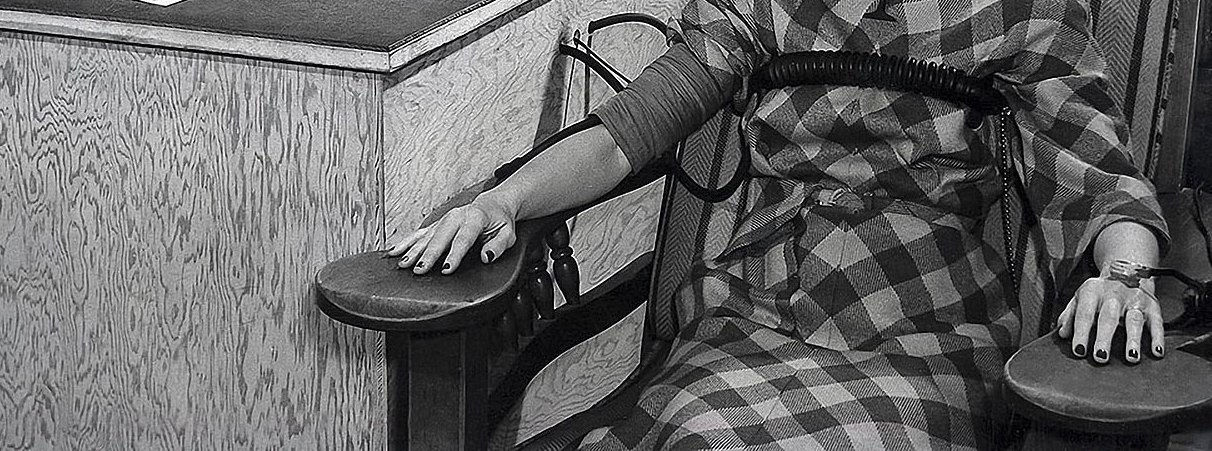
He said the polygraph itself is just a tool for the interviewer. The real value was in someone who knew how to use the machine to convince the subject that they knew the truth. He continue that in his time he knew some mighty good interviewers who could easily extract anything they needed from you.
My father did go the clearance route, and when I asked him about the polygraph he told me he confessed things to the interviewers he would never have told my mother. "Fake" or "real" the polygraph does work in this sense.
If it actually worked, they'd have data and results. But, spoilers, they don't.
Seems like it's a useful prop for manipulating people, and in that role it really is effective.
Similar to e-meters in Scientology.
It means that the polygraph works as well, and in the same way, as the ancient Roman(?) method of having a tent sealed off from light, with a donkey in it. The examinee is told that he is to hold the tail of the donkey and if the donkey brays while he says the thing he's being tested for, then they know for a fact that he's lying.
The actual test, though, was that the donkey's tail was covered in soot. If the examinee comes out of the tent with clean hands, they know that he didn't hold the tail and so is deemed to be untruthful.
Which would mean that the polygraph is really good at filtering out genuinely good people from the recruitment process (in the case of this article people whose actually never done drugs or talked shit about their superiors).
And this is exactly the problem, people make stuff up all of the time under stress.
> Of course it is, but that is a misunderstanding that what you're watching is a real performance.
This is not the value. The value is that the polygraph is that its an end-run around employment law. You can't use a polygraph on a general employee to fire them nor can you fire them for many of things that they ask in a polygraph interview. However you can revoke their clearance and fire them for not having a clearance.
And then there's the opposite, when the subject continuously makes no sense, because they have brain damage: https://www.youtube.com/watch?v=_c_lmx4LdNw
That's the core of the Reid technique, isn't it? Here's two rationales, one socially acceptable and one socially unacceptable. Pick one.
We don't actually care which one you pick, because a confession is still a confession, but we're handing you a convenient narrative you can use to justify your actions (a carrot), and an alternative people might believe about you if you don't pick Box A (a stick).
Something similar happens in high-pressure sales. I bet those guys would make great interrogators.
>In 1955 in Lincoln, Nebraska, John E. Reid helped gain a confession from a suspect, Darrel Parker, for Parker's wife's murder. This case established Reid's reputation and popularized his technique.[3] Parker recanted his confession the next day, but it was admitted to evidence at his trial. He was convicted by a jury and sentenced to life in prison. He was later determined to be innocent, after another man confessed and was found to have been the perpetrator. Parker sued the state for wrongful conviction; it paid him $500,000 in compensation.[4]
Yes, but as you note, the point is to make it sound like barely a confession, the minimum possible confession. This makes it just as attractive to the innocent as for the guilty. It's offering a minimally painful way out of a deeply stressful situation.
And as you say, the punchline is that not confessing would lead to minimal or no pain, and every level of confession will equally turn out much worse. An innocent person is just trying to escape from that room, and is being conned into agreeing to a long prison sentence in order to do it.
Without question. The best, most accurate, and most comprehensive texts I ever read about how to go about manipulating people was a series of books aimed at car salesmen. To the degree that "mind control" is a thing, these books were clear how-to guides.
And they convinced me to never talk to a car salesman.
Maybe on the context of US criminal interrogators, where discovering what actually happened isn't one of the goals.
It’s a weird place to be when you are rooting for the child molester/arsonist/muderer hoping they’d come to their sense and fucking CALL A LAWER YOU FUCKING IDIOT and SHUT YOUR PIE HOLE!!!
But oddly, I guess maybe it’s a good thing “rape the kids and wife, shoot them point blank and burn the house down” criminals are too stupid to exercise such a basic right. Even the scummiest of police investigators give these people the option to shut the fuck up and call the lawyer. Sure the person might have to wait an obscenely long time before the lawyer shows up but they still are given the out yet these moron criminals think they can outsmart a highly trained police interrogator and choose to dig their holes.
Usually these people already dug their hole well before they are drug into the police station though. The on the ground evidence usually pretty much points to them already. All the confession does is save the state millions of dollars taxpayer money with courtroom proceedings.
So yeah… really mixed on the whole topic. Of course these videos on YouTube are selected to be the most interesting of the bunch. There are probably a hundred more mundane interrogations that go unseen for every one that makes it to a widely subscribed YouTube channel.
This is not to challenge anything you said, but you have two rights here: the first is to have a lawyer present while you are being questioned, the second (and more important right) is the right to remain silent.
Talking to a lawyer is obviously a good idea if you are in any sort of legal predicament. Even if you were not arrested or charged, but have certain legal obligations or are considering signing a binding contract etc.
But when it comes to police "interviewing" you, you don't even have to go as far as to ask for a lawyer. You can simply leave it at "I don't want to talk to you." Even THEN you don't have to go that far. You can literally communicate absolutely nothing. Catatonic non-responsiveness is not a crime. This applies whether or not you are under arrest or being detained. You can always refuse to speak. That is your constitutionally protected right.
It's possible I just haven't watched enough of them, but I've never seen that. Usually the interviewer is a calm and dispassionate Columbo type who asks clarifying questions and then lets the suspects slowly trap themselves in their own web of lies. It is fascinating to watch.
That said, even though I have a healthy respect for the criminal justice system, I will still NEVER talk to the police without a lawyer. (Whether or not I've committed a crime.)
The bottom line is that these interviews are all recorded and the police are well aware that if they make a misstep and if the defense has a competent lawyer, they may inadvertently set a thief, killer, or rapist free if they are not extremely careful in their questioning and processes.
Thing is, there isn't an academic journal for voodoo. There is at least one for polygraphy.
Then they use the polygraph to obfuscate information (EG about the process of selection, knowledge gathering, and a considerable amount of other things); to have a highly spacious separate "stage" for the real sensors; and can NEVER retire it because that would reveal several bits of information.
Consequently they ALSO can never state this.
But what would be the interviewer's strategy, if the subjects insist that they are telling the truth regardless of how the interviewer manipulates the machine? Wouldn't it immediately start discrediting the whole process if the subject is in fact telling the truth? I'm telling the truth here, and yet your machine says I'm not, hence it's broken, and hence I'll happily lie in the subsequent questions when it actually matters.
I would imagine the entire point of doing a test would be to find out who is innocent and who is lying about being innocent. If you pressure the innocent into false confession, wouldn't it just make everything even more difficult?
Eg instead of saying "it's 20 degrees outside" they will say "last I checked it was about 20 degrees".
They change their phrasing because they want others to not think that they are wrong. By doing this they undermine their own credibility though.
Given all the ways polygraphs can be misused or abused, the only real use I see is as in interrogation tool. But given the issues with false confessions in general, I think the interrogation should hold less weight, but that is a whole other issue.
Same with poly. If they don't like something, they can just say "He failed his poly"
1) are you willing to play by the rules and follow orders, even if sometimes they don’t make sense?
2) if you are being lightly interrogated, do you immediately freak out and tell the interrogator everything? Do you have a really bad reaction to pressure?
If you don’t match these criteria then you probably aren’t fit to know extremely sensitive government secrets. But like I said, it’s more of a ritual than anything, the value for even those two tests is unproven.
Even smart and informed people who know exactly what a poly does can say and do things they wouldn’t normally when they’re strapped to a chair, hooked up to machines, and being yelled at for hours
It isn’t going to “catch” everyone but it is another way to reveal people with vulnerabilities that could be exploited. I think the real issue is people that “fail” the polygraph, since it isn’t actually a lie detector in any sense. It would be better if they just considered it a polygraph assisted interrogation.
I've done periodic polygraphs, both lifestyle and full-scope, every 5 or so years since 1997. None of mine have ever lasted longer than 30 minutes.
You just sit in a chair while wearing some straps and there's never been any yelling involved.
It's all quite prosaic and relaxing actually.
It has been my experience that the clearance investigation process is quite simple, although I lead a very boring and law-abiding life.
I know of some people who have had quite long polygraphs and failed them repeatedly but my hunch is that the examiner has the findings of the background investigation in-hand and is trying to clarify some findings.
Many people with past financial, drug, or legal problems have gotten through the process with no issues just by being open and honest with the investigators and polygraphers.
So yeah, if the background investigator interviewed a friend of a friend of a friend and was told that 20 years ago you used to get stoned in college and whip your dick out but when asked during the polygraph about past drug use you go "I've been a squeaky clean boy my whole life" you're gonna have issues.
The annual financial disclosure is much more stressful just because of all of the damned paperwork.
Nobody in my circles seemed to think the polygraph was anything but a tool. In fact, the sibject is sometimes gossiped about in thise circles about the "relevancy" of the polygragh today anyways. The thing about buearacracy though is that change happens incredibly slow. If everyone decided to get rid of the polygraph alltogether today, it would still take some years to actually happen.
Consider the boiling water/oil thing: If you're innocent, you can "stick your hand in and not get burned."
What they did was, they faked the water being hot by blowing bubbles in it. All then that was needed was for everyone to "believe it worked," The innocent sticks in, and then the guilty confesses.
> All then that was needed was for everyone to "believe it worked,"
https://rationalwiki.org/wiki/Dianetics#E-Meter
"Basically it is a simple ohmmeter that measures galvanic skin response (electronic resistance of the skin), somewhat similar to a polygraph; the user (the "preclear") provides one of the elements in a Wheatstone bridge."
One guy knew it was BS and could not get worried enough for them to come up with a baseline - he was too calm. So they took the tack of rescheduling it a bunch of times, making him go home after showing up so he would be good and pissed off when they actually did the test. He passed.
Another lady I know had the interviewer go so hard on her she was crying through half of it. Afterward, the interviewer told her the goal was to make every interviewee break down so they would reveal stuff.
There was someone I knew who claimed that dowsing rods worked a similar way. A good practitioner of the dowsing rod was really using the information from his audience and was Hans the Mathematical Horsing his way to water. The audience of course had this information from the subtle way they picked up on cues of water, ways even they didn't recognize until the dowsing rod was in action.
They all think this. Some can even bend spoons.
When I was a kid, a new house was being built downhill from my parents and they dowsed out a "good" place for a well. They were all set to drill before my dad went out and told them they were directly downhill from our septic tank.
Still-- total bs.
Put simply, the polygraph is a powerful tool if the subject believes it is a powerful tool.
> Even the United States government isn’t dumb enough to believe the polygraph works. The machine’s real purpose is symbolic, as an icon of the power of the state. Law enforcement agencies don’t use the machine to detect lies. They use it to coerce confessions. [...] It’s a fact, part of a story power tells itself to justify its power. Maybe you can beat the machine— they don’t detect lies, so it’s not that hard—but you can’t beat an entire country that believes in it.
Even if you know its nonsense, there's still something coercive of any system where it can be used as a pretext to punish you, or where you are punished for not pretending to believe in it.
It boggles my mind than confession even counts as evidence but then again, so does any other testimony. Sure, it made sense when we had almost no forensics (and that's the times that shaped our legal systems) but today we do, don't we?
This comment is a perfect study of this almost uniquely American insane phenomenon.
But then I don’t question Koreans about fan death.
Here's a good example: https://www.salon.com/2013/11/03/lies_i_told_to_become_a_spy...
The polygraph obviously has no basis for working, but while a sugar pill doesn't make a tumor disappear, it can be very good at pain management.
I still wouldn't use it in the context of the justice system, though.
The placebo effect is measurable. If there is no measurable improvement, there's no placebo effect either.
Bear in mind that what most claims in favour of the polygraph measure is not truth but potentially-false confession. Extracting false confessions is relatively easy, it's also completely f-ing useless to wider society and massively harmful to the victim.
To stay in your metaphor:
- Not only do sugar pills not cure tumors, but imagine - 60% of recipients don't report decreased pain levels (no placebo effect) - 20% of recipients feel more pain
https://slatestarcodex.com/2018/01/31/powerless-placebos/
https://www.dcscience.net/2015/12/11/placebo-effects-are-wea...
Where do you draw the line?
https://www.hg.org/legal-articles/is-a-polygraph-test-admiss...
For sure, you have:
- your opinion
- your knowledge (which is a subset of all that is known/"known", which is a subset of all that exists...though, it all typically seems other than this, such is culturally conditioned consciousness), have you something over and above this?
Just in case, please do not do this:
https://www.logicallyfallacious.com/logicalfallacies/Shiftin...
Saying "there is no evidence" is sloppy cable political TV tier rhetoric. There is absolutely evidence[1]. You and others may not find that evidence convincing, or otherwise think polygraphs shouldn't be used, but nevertheless it exists. A brief survey of the evidence suggests that the polygraph is probably slightly better than chance, but with high enough error bars that we should be very cautious about its use.
Obviously once you hit a certain point of drunkness obviously maybe a test like walking in a line can demonstrate something useful. But so would a breathalyzer. The false positives is the problem because they're being used to illegitimately subject innocent people to criminal charges.
By the time the police are commanding you to do a field sobriety test, they have already decided to charge you with DUI. There is literally nothing you can do during the test to change their mind. It's a formality, and the "test" is vague enough that the officer can cite any little twitch or misstep as "evidence" that you failed the test.
If you pass a breathalyzer test (blow under the limit), and they still want to charge you with DUI, they will likely do a field sobriety test because the results are non-numeric and are subjective. Heck, you can blow 0.0 and still get arrested for DUI[1][2], and if you tell the world about it, the police will sue you for defamation[3].
1: https://reason.com/2024/02/14/iowa-cops-arrested-a-sober-col...
2: https://www.youtube.com/watch?v=QGWSbAHaHUw
3: https://iowacapitaldispatch.com/2023/10/02/after-traffic-sto...
Oh what am I thinking? The important thing is, the interviewer can produce a lot of "confessions" and "revealing of truth". They will be evaluated a good interviewer. Secure their job position. Sounds good. /s
Arguably the bigger/worse false belief right there.
> First the exam makes you doubt or forget your memories. Then, by forcing you to re-access them again and again under stress, it literally rewrites them.
To some extent this happens naturally, so if the questioner really wants accuracy, you won't force people to re-access the memory for no good reason.
Really? There are therapists who will try to convince you that you were abducted by aliens?
If it keeps you coming back for another session, they'll keep doing it, even if they know the whole process is bullshit.
After hours of uncomfortable prodding, an interviewer came into the room and suggested I see a doctor for what looked like heart arrhythmia. I did shortly after and they were right! (It was deemed nothing too serious though.)
I'm actually curious. Do you get an annual physical? Does your PCP give you an EKG? That would be the appropriate way to catch this.
Even the telltale spike in the polygraph chart, itself largely a myth created by TV and movies, can indicate anything from a heart problem to sexual attraction. (Indeed, the machine’s inventors used it to detect both of those things. Larson married one of his first test subjects, and Keeler discovered a heart defect while testing the machine on himself.)
>A polygraph, often incorrectly referred to as a lie detector test, is a junk science device or procedure that measures and records several physiological indicators such as blood pressure, pulse, respiration, and skin conductivity while a person is asked and answers a series of questions.
Naturally, my co-workers and I discussed this among ourselves and we all agreed to test, we knew we were innocent. One of the men said all they're trying to do is see if anyone cracks under the pressure of the test. Being kind of a nervous type of person, I was concerned they might misread my domineer. I talked to my sister and she told me to try my best to control my breathing during the test.
For me the problem wasn't that I was guilty, it was they would think I was guilty. We all passed the test and went back to work, later it was revealed the thief was someone on another shift. Or were they just nervous?
I only post the correction because it took me a couple of minutes to figure out. Domineer is an uncommon word, so initially I thought I had a gap in my vocabulary, but couldn't find any definitions that made sense in this context.
https://chatgpt.com/share/2400c631-fc68-4f95-b4e7-861324a3dc...
On my own volition and expense, I took a polygraph test about it. On one of the control questions, I kept reacting in a manner the examiner said indicated untruthfulness. I was certainly being truthful, though. No matter how he reworded the question, I failed it.
Fortunately, it wasn't the "payload" questions. He swapped that control question out for a different one and declared me truthful. I presented the results to my manager at the same time as I quit.
That experience, though, got me very interested in polygraph examinations and started a hobbyist interest in the entire field and history of lie detection.
That led to me understanding that it's not a thing that is (currently, anyway) actually possible. What is done instead are psychological tricks that very much depend on the examinee believing that the whole thing is legitimate.
In either case it was complete BS and just shows the sorry state of labor in the past few decades.
You'd be alarmed to know how many restaurant owners tell the staff to clock out when the store closes and then finish closing duties off the clock, among other types of wage theft.
Eddie: Checks out. OK, sir, you're free to go.
Moe: Good, 'cause I got a hot date tonight. [buzz]
_A_ date. [buzz]
Dinner with friends. [buzz]
Dinner alone. [buzz]
Watching TV alone. [buzz]
All right! I'm going to sit at home and ogle the ladies in the
Victoria's Secret catalog. [buzz]
[weakly] Sears catalog. [ding]
[angry] Now would you unhook this already, please? I don't
deserve this kind of shabby treatment! [buzz]There was a big robbery at a place I worked, luckily I was not a suspect but the FBI came and administered polygraphs to anyone who could have done it. I asked what happens if someone refuses, and the answer was basically "they won't."
Of course it ended up being someone that didn't even work there. The test was clearly for intimidation purposes, at least from the view I had.
HOWEVER. Law enforcement can still use them as another tool in their questioning process to produce a confession when there is other evidence pointing to the guilt of the suspect. But of course is only effective against defendants who represent themselves, don't seek their lawyer's advice, or ignore their lawyer's advice.
You ask them, and a week later they bring in a badly beaten bear, who shouts "Okay, I'm a rabbit! I'm a rabbit!!"
Judges are like every high-level decisionmaker ever - the thing they fear the most is publicly being proven wrong so they always go for the safe option where they can share the responsibility of their decisions with 'experts'.
But then I learn truth detectors are? What more movie tropes are not tropes?
https://www.theguardian.com/us-news/2022/apr/28/forensics-bi...
It turns out just throwing handcuffs on someone is enough to get a false positive GSR test. And matching a shell casing to a specific gun is essentially impossible.
The false positive rates on forensic "tests" are hard to study because no one has an incentive to, and if you go digging you'll find how bad they can be. Like for example K9 units have about a 50% false detection rate (dog indicated but no drugs/weapons/bombs found). If a cop told you they flipped a coin to decide whether to search a car then the search would be tossed out of evidence immediately!
It's a factless and truthless system.
In the US, I’ve always heard something like every 3 months or 3,000 to 5,000 miles. The cars even warn you in that timeframe.
In Europe, a mechanic was very confused when I talked about an oil change when one was done the prior year. He said it’s more every 2 years or 20,000 to 25,000 kilometers. Once again the cars were set up to warn at that distance.
I’d love to get to the bottom of it. Why such a difference? I can understand the garages wanting the extra business, but why would the car manufacturers go with it?
There is also the case of changing oil for hot and cold seasons- getting thinner oil in the winter and thicker in warmer weather to adjust. I think thats more or less a thing of the past as well, my Honda does not specify/recommend this in the owners manual but perhaps some cars do?
Old adages sometimes stick around forever though- especially when there is money to be made in keeping them alive.
Specifically, transmission fluid is often considered 'lifetime' fluid that doesn't need to be changed, and, if you follow that advice, you end up replacing the transmission, an expensive endeavor, whereas if you don't, you can typically double its usable lifetime.
You also have to be careful about engine oil, because the margin of error is very small. Most modern cars have an oil minder, and those work well provided the oil itself is in spec.
Don't forget to make your swap space double the size of your ram!
1) Opportunity to upsell other services,
2) Some people (quite a lot, actually) have alien-to-me car buying habits and might be convinced to trade in their new car after only a year or two and buy another new one if you can just get them into the dealer at the right time.
No clue if that’s why they do it, but maybe.
Those extremely long intervals will only work for cars that travel long distances, where the engine has a chance to warm-up and burn off any residual gasoline that gets in the oil during cold starts. If said car spends most of its life in a city, doing short trips, the oil gets rapidly dilluted and loses the ability to lubricate the engine properly.
Most modern cars will take all this into account when trying to determine when the next oil change is due. Also, manufacturers nowadays usually specify shorter intervals (6 months or 7500km) for modern direct injection engines that only drive in a city.
Next time when you deal with these agencies, as a fun mental exercise, try to figure out which one of the two types you've got in front of you. When it comes to climbing to the top through the ranks, which ones will get there more effectively?
If online stories are to trusted, this has occurred in a lot of government clearance related situations.
Ames was CIA and speaks from prison with some authority [0], hinting at internal conclusions polygraph is ineffective.
And that's the deeper issue here: the American criminal justice system is mainly retributive or punitive. Long setnences for minor crimes. High conviction rates. Abuse of the power imbalance between prosecutors and defendants. Judges that essentially work for the prosecution (eg [3]). Juries that just want to convict. Of anything.
Yet there's ample evidence none of this is effective whereas something as simple as giving inmates cats to look after is extremely effective at reducing recidivism [4].
My point is that technology can be (and has been) used as a crutch to confirm biases and that criminals are still people and we should treat them as people.
[1]: https://www.propublica.org/article/understanding-junk-scienc...
[2]: https://axeligence.com/polygraph-admissibility-in-united-sta...
[3]: https://www.rollingstone.com/music/music-news/young-thug-ric...
[4]: https://www.indystar.com/story/news/local/indianapolis/2020/...
Not sure how this relates to the article, but this is news to me (European). We slowly began potty training somewhere between 1 and 2 years. I have never heard of anyone doing potty training at six months. Babies are just barely able to sit upright at that age.
Where did you hear that? Admittedly here in the UK we've been doing our level best to extricate ourselves from the continent, but I've only ever heard of one mum even thinking about it before 18 months. Ours is just over a year and we haven't thought about it at all yet, same with our ante-natal group and friends with slightly older babies.
I googled around a bit and this reddit thread has a lot of Europeans with similar experience to me: https://www.reddit.com/r/Mommit/comments/tdb1f2/what_are_non...
https://www.google.com/search?q=baby+abhalten+*.de
Our baby was born potty-trained (which actually means the term is misleading in our case) and a relative started at their childrens' birth.
It's a system that works quite well if the baby is exclusively cared for by a stay-at-home parent or a long-term nanny (and no other babies or toddlers in the house to distract the parent/nanny). But try to leave the baby with a new sitter or at a daycare - they have no idea what your baby's cues are and cannot be bothered to learn them; so back in diapers the baby goes.
Hailing from Poland; first I hear of this. I know of total of two people who said something like this before - one person is saying a lot of other borderline insane things about parenting, and the other has a business selling webinars around the idea of potty-training kids less than a year old.
Funny. I am European and we have this myth about Asia.
Wait, what do you think potty training is?
https://en.wikisource.org/wiki/The_Wisdom_of_Father_Brown/Th...
The evidence it "works" reminds me of alternative medicine.
However, I also had an interview with a psychologist which was very intense and manipulative, but effective, in eliciting true information about how much I was drinking at the time (too much, quite frankly). It was only years later that I realized that was the information they really wanted and all the other embarrassing sex questions were just to set me up.
Bloody hell, that is scary.
Woah. It's actually the MD of Timpson, whom Starmer has parachuted into the role along with a peerage. So an unelected Minister, but apparently he's very into prison reform, so there's that.
I've been out of Aus for a few years, but in NSW I understand they're still largely banned (Lie Detectors Act) for employment, courts / evidence, insurance etc (and if they weren't by legislation, they would be for evidence by precedent, which is how the Act came about). As I understood it, this and the Canadian precedent that NSW relied upon, have basically made them a non-starter for courts in Australia ever since.
It's a bit horrifying if they're making a comeback, but then our politicians have always been a bit prone to right wing shock jock rhethoric around election time.
Fair question. I'm not sure that's 1) been shown to be true 2) the fault of a polygraph; it's a policy decision not a mechanical one.
> As he pumped up the cuff, Kevin asked if I was comfortable. He didn’t seem to be joking.
Yeah, he probably was serious. Kevin has a job to do and it's to ask you questions and record your responses; not to torture you. Sometimes people really forget that not every examiner thinks you're the next Aldrich Ames.
But I mean also if you're in a very uncomfortable situation and somebody asks you how you are, maybe being honest will help resolve that situation? Like clearly you can't resolve it on your own otherwise you wouldn't be in such a panic.
> Except for the last two, all of them seemed open to interpretation. For instance, I absolutely had misrepresented my past drug use, but only the number of times, not the drugs or the fact of doing them.
If only there was somebody that could've helped you determine what the answer should be. Maybe Kevin?
---
I mean yeah, if you go into a polygraph expecting a fight I don't think it's fairly surprising you don't get the job. Who wants to hire somebody combative to your employees? Sure, it's unfair but you're taking it out on Kevin who didn't come up with it.
UK police increasingly using polygraph tests - https://news.ycombinator.com/item?id=39161771 - Jan 2024 (5 comments)
Spanish police plans to extend use of its lie-detector while efficacy is unclear - https://news.ycombinator.com/item?id=24905780 - Oct 2020 (38 comments)
Accused spy Alexander Yuk Ching Ma evidently beat the polygraph - https://news.ycombinator.com/item?id=24197310 - Aug 2020 (186 comments)
We tested Europe’s new lie detector for travelers and triggered a false positive - https://news.ycombinator.com/item?id=21358288 - Oct 2019 (114 comments)
Why Lie Detector Tests Can’t Be Trusted - https://news.ycombinator.com/item?id=20556201 - July 2019 (190 comments)
Attempts to Censor AntiPolygraph.org - https://news.ycombinator.com/item?id=20311040 - June 2019 (45 comments)
The Lie Behind the Lie Detector - https://news.ycombinator.com/item?id=18431683 - Nov 2018 (96 comments)
An AI Lie Detector Is Going to Start Questioning Travelers in the EU - https://news.ycombinator.com/item?id=18351733 - Nov 2018 (202 comments)
Personal Statement of a CIA Analyst - https://news.ycombinator.com/item?id=18155548 - Oct 2018 (104 comments)
The Lie Generator: Inside the Black Mirror World of Polygraph Job Screenings - https://news.ycombinator.com/item?id=18120270 - Oct 2018 (95 comments)
NCCA Polygraph Countermeasure Course Files Leaked - https://news.ycombinator.com/item?id=17277049 - June 2018 (4 comments)
Do Polygraphs Actually Work? - https://news.ycombinator.com/item?id=12951926 - Nov 2016 (4 comments)
An Ex-Cop's War on Lie Detectors - https://news.ycombinator.com/item?id=10002889 - Aug 2015 (64 comments)
How to Beat a Polygraph Test - https://news.ycombinator.com/item?id=9481385 - May 2015 (92 comments)
Man accused of teaching people to beat lie detector tests faces prison - https://news.ycombinator.com/item?id=6308878 - Sept 2013 (152 comments)
The Lie Behind the Lie Detector [pdf] - https://news.ycombinator.com/item?id=6307479 - Aug 2013 (22 comments)
Seeing threats, feds target instructors of polygraph-beating methods - https://news.ycombinator.com/item?id=6229185 - Aug 2013 (4 comments)
All lies? Scientists threatened with legal action over lie detector article - https://news.ycombinator.com/item?id=457996 - Jan 2009 (1 comment)
My NSA polygraph experiences - https://news.ycombinator.com/item?id=428489 - Jan 2009 (46 comments)
It’s not a lie if you believe it. - George Costanza
Polygraph "examiners" are like drug dogs who always fail to find drugs because, since they do not find the drugs, they receive no praise and they do not receive their "toy."
1. The average person who hesitantly wishes that the examiner will supportively pursue establishing the true state of his/her personality and the World at large.
2. Someone entirely lacking empathy, unable to value the examiner as someone seeking truth.
3. Those who effortlessly pass, every time.
I think the reason three-letter-agencies maintain such expensive theater is to discover and protect #3.
That’s not to say it wasn’t interesting; but it could have been 1/3 the length and provided the same information value. It’s as if the author wanted us to experience our own suffering, wondering when “the rest of the story” would finally be delivered.