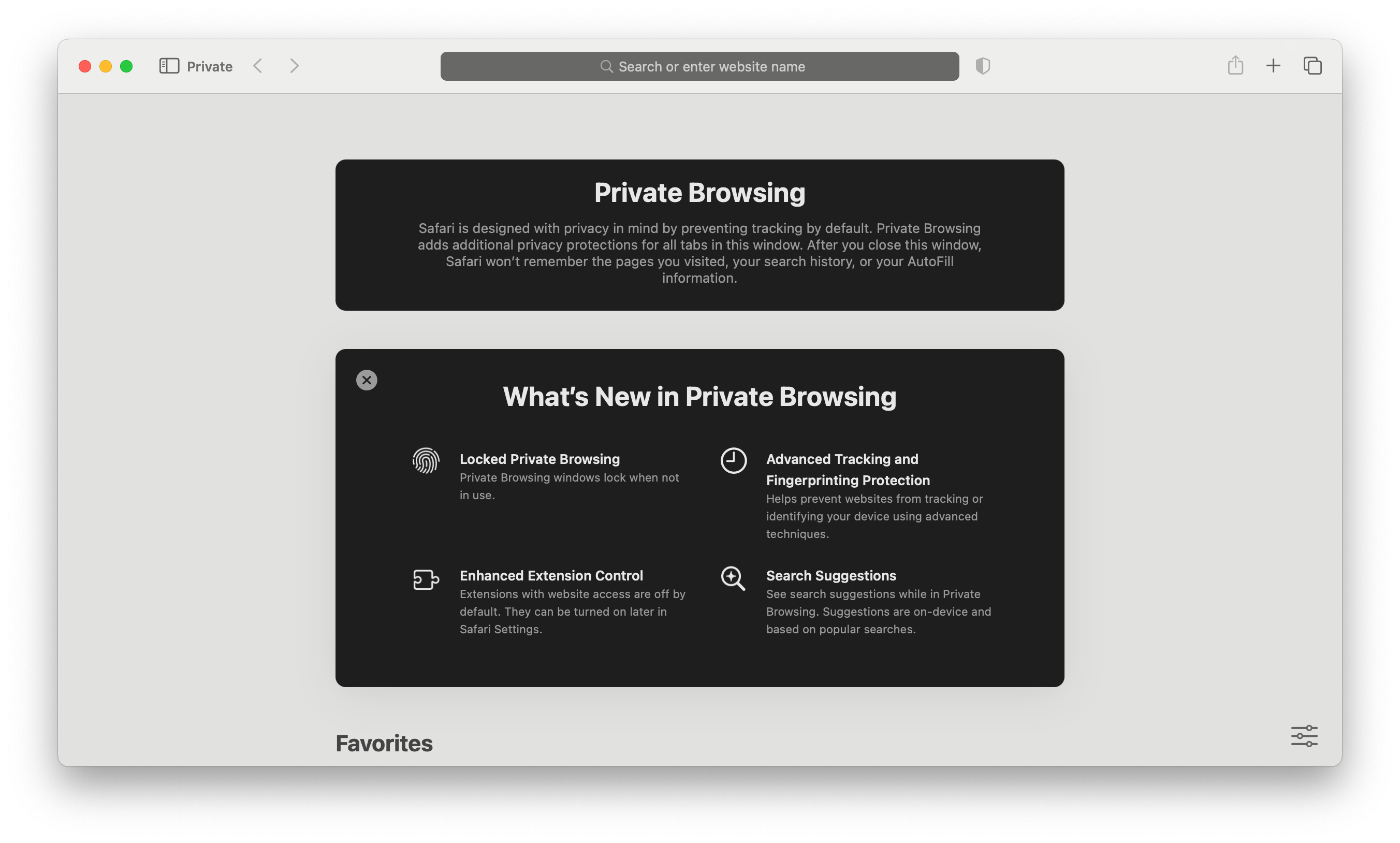
Private Browsing 2.0
When we invented Private Browsing back in 2005, our aim was to provide users with an easy way to keep their browsing private from anyone who shared the same device.
WebKit
190 points · by frizlab · 2y ago · 106 comments
Yes I cannot agree more. Personally this shift in people's expectations of Private Browsing or Incognito Browsing came in a way that felt sudden. The recent lawsuit about Google tracking you in Incognito mode was absolutely dumbfounding to me: of course websites can still track you! If only people still remembered the origins of this feature in 2005 (or 2008 in Chrome's case). But even on HN the opinion was pretty split. It is indeed clear that it is now time to change what private browsing means.
However, I don't think this is going to stay this way for long. The word "private" when it comes to computing has many varied definitions and it all depends on who the information is made private to. In the extreme case, if your threat model is privacy from eavesdroppers on the network or the ISP, then a browser can easily claim any HTTPS connection is private enough; the majority of browsing is already private browsing. If it is privacy from others using the same machine, then this older private browsing already works. But I cannot help but feel that a few years down the road people are going to consciously or subconsciously substitute yet another definition of privacy.
I'm not entirely surprised they got this "wrong" given that the question was, "What should we call it?" Naming things (correctly, "future-proof"-ly) is hard.
Naming things may be hard, but in addition, this isn't even a bad name. The popular colloquial name at the time (porn hiding button, or maybe that was only because I was a student when it was introduced) could hardly be seriously used, of course it is called something related to not leaving traces on the computer you're using
Private browsing was so your gf wouldn’t find out about the engagement rings you were looking at!
https://www.osnews.com/story/140252/safari-already-contains-...
https://addons.mozilla.org/en-US/firefox/addon/cookie-autode...
Without fail, the knee bends. This also just got quietly enabled by default in Firefox 128, go check and turn it off if you are so inclined.
dom.private-attribution.submission.enabled1. They started using USB Type C.
2. They are the only major manufacturer that appears to actually take privacy seriously. Even their AI endeavours look the most privacy focused that exists.
I'm sure I could go buy some no-name brick and flash my own security focused OS and run my own relays and ... I don't want to do that. I want to buy something that everyone else uses and for it to respect me.
So as much hate as Apple gets, they have my trust in good faith, for now.
Apple's deceptive marketing has made me lose all trust in the company. It will take a lot more than USB-C for me to consider Apple for computing devices.
* These guys are truly working very hard at guaranteeing privacy;
* That will probably break some websites (I'm trying out the advanced tracking protection in normal mode, we'll see).
* It will also put them on collision with Google, which is essentially an advertising shop with a free browser frontend.
> Alongside the new suite of enhanced privacy protections in Private Browsing, Safari also brings a version of Web AdAttributionKit to Private Browsing.
This is worse for privacy. No other browser does this. No other browser even lets you opt in for this because it's so nonsensical.
That seems like an exaggeration? How could another solution possibly be worse for privacy than the open season it was previously...
The worst it could be is the same.
> No other browser even lets you opt in for this because it's so nonsensical.
That also does not seem true
Google has their topics API: https://developer.chrome.com/blog/new-in-chrome-115/#topics-...
and according to another poster here, Firefox added something similar.
Don't get me wrong, I hate that they had to make these concessions, but what was their choice? If they did not give something (while giving users the ability to opt out) we would have seen browsers being blocked (and no way Google was going to not do something given their entire business is ads, so they could just keep saying use Chrome).
Previously, there was no ad tracking at all in private mode.
> That also does not seem true
No other browser enables any such tracking in private mode or incognito mode. https://developers.google.com/privacy-sandbox/relevance/attr....
The Topics API you mentioned returns empty topics in incognito mode. https://clearcode.cc/blog/google-chrome-topics-explained/#:~....
> but what was their choice?
Do what other browsers do. Don't enable ad tracking in private mode.
Is this a cat and mouse game?
> Fingerprinting
Does this prevent Google's cookieless tracking technology?
In many ways it is. When I first started blocking using pac files. It was painfully obvious that samesite advertising is the harder thing to block. Luckily for the blockers most companies have been lazy about adverts and put them in known locations. Which works just as well for whole site blocking (known trackers). However, once the adverts are blended into the real data it becomes much harder. Such as what youtube is experimenting with (putting adverts right in the same data stream remuxed). As long as the adverts follow known patterns blocking works fairly easily. The next 'arms' race will be AI detection and block. It will only be a matter of time until someone comes up with a plugin that does exactly that.
> Does this prevent Google's cookieless tracking technology?
To a point. But you do not need much data to fingerprint. Think it is something like 12-13 bits plus your IP even with a VPN.
Is that legal under GDPR?
- Blocking requests to known trackers
- Remove utm_ and other such parameters from URLs
- Fingerprinting resistance
- Extension disabling
- Cap third-party cookie lifetimes
- Partitioning for sessionStorage and blob URLs
- Proxying encrypted-to-the-resolver DNS traffic
- Proxying HTTP, but only when it's unencrypted
With a subscription, you also get per-tab sessions and a VPN
---
The fingerprinting resistance is interesting as it claims to remove user behaviour characteristics like typing speed and how you move the cursor. Does it fire keyboard events with randomised delays and adds random offsets to mouse locations or how could this work? Games would be unplayable with mouse offsets and random input lag, but if that's not it, then the website gets the data so this has to be it right? For canvas specifically, they say there'll be small but probably visible artifacts from noise injections. So no web-based photo editing in private navigation? Curious how this'll work out in practice
Also cool is that they offer an open platform (Mastodon) as a place where you can respond to the author!
Incorrect. Safari does not remove utm_ parameters. See: https://lapcatsoftware.com/articles/2023/6/2.html
> When we invented Private Browsing back in 2005, our aim was to provide users with an easy way to keep their browsing private from anyone who shared the same device.
I wonder if anyone actually involved 19 years ago was also involved in writing this piece, or if it just sounded reasonable to whoever drafted it up.
I use and love StopTheMadness Pro. Do you know if it breaks the whole extension or only some parts of it? If so, which ones? (I don't use the copy URL shortcut for example).
Yes, I assume it's a bug.
> I use and love StopTheMadness Pro.
Thanks!
> Do you know if it breaks the whole extension or only some parts of it? If so, which ones?
Not the whole extension, no, only the parts that depend specifically on the URL query.
This is like a bad dream.
Really, just ... what if the software on my computer tried its best to do exactly what I asked it to do, and was not concerned with anyone else's problems?
Anyway, here are the AdAtributionKit docs:
- Technical / API: https://developer.apple.com/documentation/adattributionkit
- High-level: https://developer.apple.com/app-store/ad-attribution/
I think a reasonable answer is that you are using their website for your own purposes; that running a website has costs; and that many businesses choose to fund those costs by advertising. If you don't want to be advertised to, I would suggest paying a fee to use ad-free services.
Apple specifically gets mentions as a website data sharing partner in the privacy policies of my health insurance, my dental insurance, and my mortgage provider. I can assure you that none of those companies are lacking for funds to run basic websites and equally that none of them have ways to pay to "opt out".
Adtech gaslights everyone into accepting that just because it is technically possible to perfectly track and personalize ads in digital media, that they have some sort of moral right to do it.
What an oxymoron.
No thanks, Apple!
I trust my ISP more than you. Multi-hop wont matter if all nodes are managed by you.
Every request goes via an Apple node first, then is sent to a 3rd party node for final routing. That way neither Apple nor the 3rd party have a complete picture of where a request came from, or where it went.
Not entirely sure why you would trust a random ISP, and everyone else involved in routing that connection, more than Apple. Last I checked most ISP don’t have the tightest privacy policies, or even the best data handling practices. Apple stands to loose millions if they slip up on their privacy promises. Most ISP wouldn’t even bother telling you if they accidentally misplaced your personal details.
Contrast this model with Tor where you have 3 hops that are selected in such a way that there is a lower probability that logs from the node operators will be combined. If two nodes, let's say node 1 and 3 are coorporating, then the best that they can do is a correlation attack or other probabalistic methods.
If two nodes (all of them) in WebKit are adverserial, then the content is linked back to your IP address with 100% probability.
What if your ISP is working with the local cops or US government directly?
A user's residential IP address is in many cases almost static, and doesn't change that often. If you use the same residential IP for other services from Apple, or sites that are protected by Cloudflare's MITM DDOS protection, the content of the HTTP site can be linked back to you with a high probability through your IP address, and possibly in combination with other metadata such as the user-agent, or other headers.
If that is your threat model, you need something a lot stronger than Private Browsing, whose purpose begins and ends with "I do not want other people to know what porn sites I visit". Tor is a good start.
(I don't use iCloud Private Relay.)
I’ve got one too, it’s taken me 25 years to find.
See also Mozilla turning on routing DNS traffic to Cloudflare by default because that's the level of trust this American organisation has in their ISPs, but after concerns raised in other countries they decided to turn it off by default at least where I'm from in western Europe (not sure about the rest of the world)