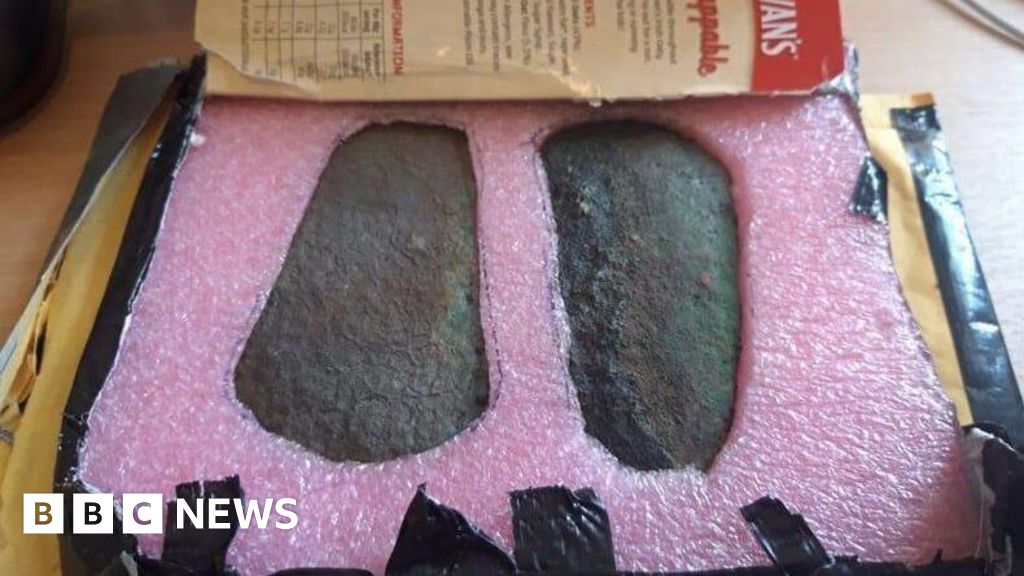
Mystery over 4,000-year-old axe-heads sent to Irish museum
The Bronze Age artefacts arrived at a museum packed in foam and accompanied by an anonymous note.
bbc.com
99 points · by thunderbong · 2y ago · 105 comments
> However, appealing to the sender to get back in touch, staff said information about the discovery of the axe-heads would be "treated with the utmost confidentiality and used solely to verify the find location and its circumstances".
Says the current administration until someone else replaces them or someone eager to see justice served from the law enforcement forces them to disclose their source.
So, unless a formal procedured issues a legal valid document granting immunity, I hope this guy/gal keeps quiet.
Source?
It’s for abuse so we’re not talking about a few old axes. But such a thing as a concept does exist.
No wonder they donated anonymously, what an insane law.
By contrast, where I live in Philadelphia, developers are not required to perform any archaeological studies before excavating - even along the Delaware River waterfront, where the oldest European settlements are, as well as countless indigenous sites.
Sometimes, before history gets scraped away and sent to the dump, bottle diggers will excavate the trash pits, typically discarding anything that's not 100% intact, and selling the 18th and 19th century bottles on eBay or at flea markets. However, like the axe heads in the article, these artifacts are absent context, removing nearly all historical value. And of course, the stratification of the pits they're extracted from is also destroyed, further reducing the ability to interpret any finds that might otherwise have been saved.
It's only projects paid for by our federal government that are required to do archaeological studies, and when they do, it's not uncommon to find early colonial artifacts, but also remnants of pre-contact Lenni-Lenape sites.
You only really get one shot at recovering history through archaeology. That doesn't mean that preservation holds permanent veto over progress, but a little bit of disincentivization can go a long way in the study of history.
If the builder is compensated for the costs associated with working around the fonds, plus a little extra, they will be happy to report everything they find.
I'd throw in making museums obliged to display which builder company found the item when displaying it.
This probably costs a lot more than the average government wants to spend on archeology though.
Or worse, hold up the construction of a motorway for a decade and lead to its eventual re-routing at the cost of millions.
As for your Wikipedia link, it's a good idea to actually read the whole text in it.
However, this law can be interpreted from many angles, as it is difficult to define what is archaeological or not. There are certain associations which defend “leisure detection” as long as it is not located on a registered archaeological or historical site. But their point of view is not shared by archaeologists, who consider that any place can be considered an archaeological site, relegating leisure detection to fine sandy beaches.
In this context, case law says that there are no completely accidental archaeological discoveries with a metal detector.
>The letter stated that the axe-heads were discovered in County Westmeath using a metal detector.
>The museum explained those "severe penalties" are in place because unauthorised metal detecting can cause "serious damage to Ireland’s archaeological heritage
Good luck with that.
Most things of value are going to be archeological. If you want gold you do panning.
https://www.smithsonianmag.com/smart-news/amateur-treasure-h...
TL;DR finds of over 2 grams have to be given to the state (you might get it back).
I believe the term, here is "hoist with his own petard," to quote an Englishman (or Dane) of some repute.
If it's on private land and you have permission from the landowner, you don't need the license. You still need to report any treasure or archaeological finds to National Museums NI though.
EDIT: Shout-Out for metal detecting in the UK: https://en.wikipedia.org/wiki/Detectorists
As someone who used to be in that field, I never understood why people don't do any research before getting into metal detecting. It should be obvious after even a tiny bit of reading about it that most finds are mostly useless without the context in which they were deposited. This context is usually completely destroyed by digging without knowledge of how to properly document it (that's why so many archaeologists kind of hate Schliemann, even though it has been 150 years). And on top of that most laypeople don't even properly record the location of the find. But many people, once they have started, seem to develop a sort of identity around it, and from that point on, most are impervious to new information. I've often heard that "these greedy archaeologists / government officials want to take what's rightfully mine" or "they don't appreciate me, I'm just trying to preserve history".
It's generally either total ignorance or "I didn't want to get fined" that lead to situations like the article. The latter is the same reason shady companies don't record where they disposed of chemicals in the woods, but somehow it's okay for you? Because you have convinced yourself you are "preserving history" by removing a bronze axehead from a location that has preserved it for over 2000 years?
It's truly a shame. There are of course some who work with local archaeologists, have received a bit of training and know how to dig and document, and when to stop digging, but from what I've seen, they are a tiny minority. And even many of them do more harm than good.
Some archeologists only work with them because they know that these people would dig or loot without them otherwise, and destroy much more in the process. But they can't say that openly, because in today's climate of anti -intellectualism, this would be seen as "ivory tower behaviour", and even more people would go detecting completely unsupervised. Just like rolling coal and the like, some people just really don't like being told what to do, no matter the disparity in knowledge about the subject.
Sorry about the rant, it's just all rather frustrating sometimes. In my country, the laws surrounding excavations are so stupid that no-one is happy with them, but archaeologists don't have a lobby of course, so we'll just have to live with the status quo.
You’re heaping a lot of assumptions on to people who do metal detecting.
What makes you so confident that these people went out with the goal of finding and destroying archaeological sites with their metal detector? Finding archaeological artifacts is an extremely rare edge case in metal detecting. I doubt these people had any idea they were digging up valuable artifacts until they were completely out.
> It's generally either total ignorance or "I didn't want to get fined" that lead to situations like the article
When the fine is on the order of a decent annual income, it should come as no surprise that people don’t want to get fined. It should also come as no surprise that anyone who discovers any artifacts like this would be highly incentivized to hide their origin.
I don’t know what you expect. For someone to generously turn their probably accidental finding in and pay a massive amount of money for the privilege?
I know that finding hoards of 1000+ year old coins is completely par for the course and is really the goal of the exercise. It may be different in the new world where ancient metal is uncommon, but that's how it works here.
Groups like the one my relative is in get special permission to search on building sites before they lay the foundations. I believe the developers are obliged to allow this. Destruction of the archeological context isn't such a concern there because the site is being destroyed anyway, but detectorists are still legally obliged to report any treasures to the authorities and can be forced to sell them to a museum.
https://www.theguardian.com/uk-news/2023/feb/18/change-to-uk...
Because people do it for fun, not to do archeological research
> And on top of that most laypeople don't even properly record the location of the find
what detectorists find is 99.9% of the time just crap, and the 99.9% of the 0.1% remaining is just stuff that is not interesting for archeology or history. Interesting finds are extremely rare
> The latter is the same reason shady companies don't record where they disposed of chemicals in the woods,
Yes, polluting a place and finding a badly damaged roman coin on a field used for centuries is exactely the same
> but somehow it's okay for you? Because you have convinced yourself you are "preserving history" by removing a bronze axehead from a location that has preserved it for over 2000 years?
They don't preserve history, but neither do historians and archaeologists in the cases mentioned, because they don't and won't carry out any research in these places anyway. It's obviously different when detectorist work on archeological places but it's forbidden almost everywhere
If they were smarter, archeologists should push for more sensible rules, and for collaboration with detectorist associations instead of blind repression.
That's a bit of a disingenuous argument though. To a first approximation, no-one's out to find ring pulls and bottle caps. The fun is feeling like you might win the lottery, encouraged by reports of people who do. If it wasn't for the 0.1% no-one would be doing this.
> "archeologists should push for more sensible rules"
...like what?
The thing that is of value is the site with the artefact in place. Digging up and sending in the artefact on its own with no other information is like scraping all the paint off a painting and sending the scrapings. Yes, your paint detector found some paint, and for once it wasn't junk. You've won the lottery. Great! Awesome! Bully for you! I bet it felt wonderful. But it's too late. You've already destroyed the thing that made it interesting, valuable and important.
A rule that fails to discourage this destruction is not a "sensible rule". Sure, once the destruction has happened, it's better to have the anonymous paint scrapings than to have nothing at all; but the archaeologists will still grieve when they receive that package, just as you would grieve if someone broke something important to you - even if you weren't previously aware of its existence! - and sent you some of the broken pieces; and they will push back on any change that might in any way encourage more people to pull this crap.
> because they don't and won't carry out any research in these places anyway
Until the site is destroyed, it's possible it will be identified and researched. Once it is destroyed, this can never happen.
It might be a better attitude than criminalization. People are still going to do it, so instead of repression, try to reel them in and teach them the basics for harm reduction.
Wait, can't something similar be written about pot or abortion?
Them to Sender: "Where did you get these from? It is very important!"
Them to Public: "We want to remind everyone that metal detecting for something like this is illegal and will be fined!"
Also Them to Sender: "Oh...err...but we won't apply that to you!" wink wink
For instance, digging up a graveside and pulling all the artifacts out, without extensively documenting every inch of what was found at the graveside even uninteresting things like arranged rocks, destroys the context that might have yielded insights about burial customs.
Archeologists prefer everything to be left alone undisturbed, and generally the idea is you only go looking for artifacts when trying to answer a specific question, or if the site is going to be destroyed anyway for construction. From their perspective treasure hunters are going out there and destroying the record of history.
It is of course appealing if you think that all an artifact is good for is looking nice in a glass case. But if you want to gain knowledge about the past, this would certainly be the worst policy you could implement (apart from obviously insane ones, such as a bounty for destroying artifacts on sight, of course).
But I already wrote an extensive rant about this in another comment, which you might find interesting if you are curious about the topic. If so, sorry about the bad writing style and potentially divisive rhetoric, I'm supposed to be working decided to take a quick peek at hn where I found some discussion about a pet peeve of mine, which is of course a recipe for disaster.
So if you were (say) digging some footings for your new garden shed, found the items, and didn't much trust law enforcement - but were, in abstract, a patriotic sort, who wanted to do the right thing...
True story: A friend of mine was digging foundations for a new shed in the back yard of a house he owned - and discovered human bones. Police got involved, and it was a big, big PITA. Even though experts from the local university pronounced "the remains were buried over a century ago; the victim appears to have died of infectious disease". And my friend had bought the house (from an unrelated party) just a few decades prior. And the house had been used as a hospital a century or so earlier, when "bury the paupers in the back yard" could easily be tiny-hospital SOP during an epidemic.
What if you use it to search for non-archaeological objects, but then accidentally find one?
Not surprising they receive anonymous donations without information if they treat finders like that.
It's more difficult to rule out the idea that a thousand-year-old painting was restored with usable paint.
What if you are searching for gold, lost items, underground cables, or other, and you stumble upon an archaeological object? You were not hunting those objects, so I would say you were within the law. What you do with the fortuitous find is another matter (IANAL).
My brother and I were the first to buy a house in our immediate family. My Uncle Vic was the first to say you never really own your house or land. You pay property taxes after you have paid off your house. Your land can be taken with little compensation in some matters, etc. I can see why you would be happy and worried at the same time discovering artifacts whether you were looking for them or not.
Prospecting for gold, on the other hand, is a legally thorny subject in Ireland. Finds above a couple of grams have to be reported and handed in.
If you happen to “stumble across” historical artefacts on your land you are meant to stop doing whatever caused you to find them (eg construction), report it, and then wait forever while archaeologists eventually show up and spend ages poring over the find to ensure you don’t destroy anything of historic value.
Now, if there were ample of compensations, then it becomes tenable and possibly fairer.
You should pass on this brand of British & Wales “presumptive justice” until they treat their citizen (as well as their jailed subpostmasters) better.
Maybe there is a way to deal with it? With licenses/permits including training and a ban on reselling?
The law is intended specifically to prevent random people digging up stuff and causing damage to historic sites.
The nanny state is allergic to common sense.