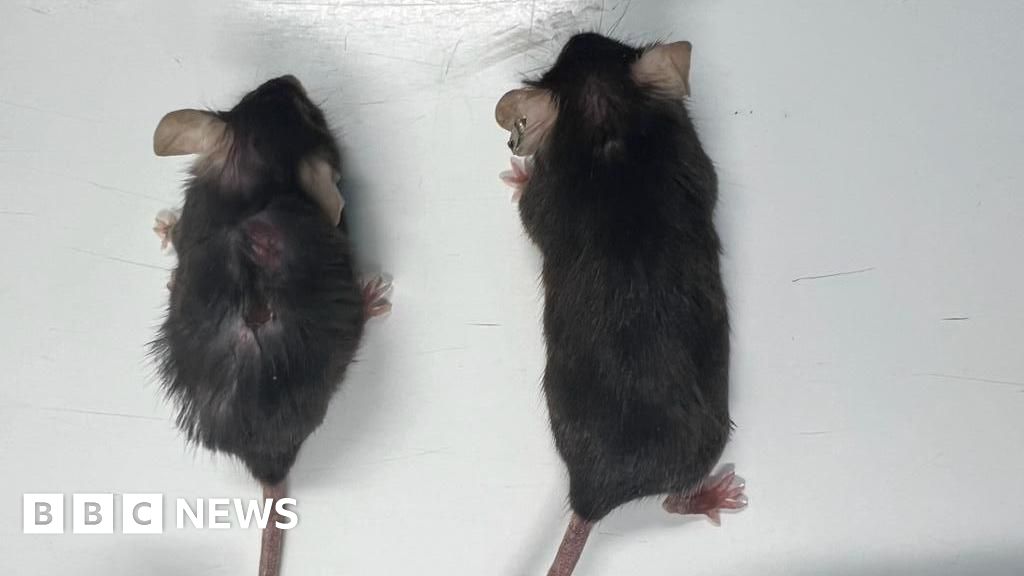
Anti-ageing 'supermodel granny' drug extends life in animal tests
The drug is already being tested in people, but whether it would have the same effect is unknown.
bbc.com
39 points · by isaacfrond · 2y ago · 48 comments
On the "lack of evidence in patients" ... does "testing" this in humans mean decades long trials? Given that the effects in their animal model was 25%, it seems like measuring if there was such an increase in humans (and beginning taking it in late middle age) it would be a generation before you had results.
On the "unthinkable to treat every 50-year-old" comment, I think we as a society would need to change as a function of our changed lifespans -- making all the middle-aged people live to 100+ would exacerbate issues around social benefits, housing stock, etc. But if we all had longer, more productive lives (i.e. worked longer, added our skills and expertise to the economy for longer), could that more than offset the costs? If a drug raised your life expectancy by 20 years, and most people worked another 15, that's still pretty good.
Many countries are seeing the birth rate decline. If people could extend their life with 20 healthy and productive years it would change everything. Suddenly you could choose to change your career or make more long term financial choices.
This would also allow folks another 20 years of planning/saving for retirement, which could greatly improve the quality of those years for the average retiree, but probably won't.
The biggest social impact of this drug, I think, would be its affect of the wealth gap. Another 20 years of compounding market returns would buoy the net worth of the 30% who make up the "upper class". An ever-increasing number of people would be able to achieve financial "escape velocity" by building nest-eggs which can sustain them indefinitely via 3% withdrawals, allowing them to retire "early" (i.e. before the new "standard" retirement age of 80). Folks who speed-run their careers and retire in their 40s-50s could enjoy 50 or 60 years of retirement! Inheritances would rise dramatically, but come later in life. This would also result in a backlash, of course. Envy is the oldest and most powerful organizing "principle", and politicians will happily use this new prosperity to generate enmity for their own purposes, just as they always have.
My main concern would be the dysgenic impact of such a thing. If it becomes generally available, it will no doubt encourage thinking folks delay having children even more, while also granting another decade of fertility to the "oops another baby" cohort. It seems clear that this would significantly accelerate our decline toward idiocracy.
Because rich people are "net-productive" and poor people are "net-recipients"?
This is wrong on so many levels. And even today rich people live on average longer. Can't see the benefit myself.
Yes, in the context at hand this is obviously, objectively true. Poor folks earn little, "pay" negative income taxes, and are eligible for lavish (relative to their contributions) benefits, thus they pay less in taxes than they receive in benefits, making them net recipients from social programs. Some to the tune of tens of thousands of dollars per year. We used to call them leeches--we should probably start doing it again, frankly.
Meanwhile others pay large amounts of taxes without receiving any services beyond those which are forced on them by the state (which are generally a raw deal), making them massive net contributors.
It's not "wrong", it's the basic arithmetic that undergirds your beloved welfare state. Ignore it at your peril.
More discussion: https://news.ycombinator.com/item?id=40987224
Though in seriousness, pretty amazing if this works in humans. Peptide therapy seems huge lately.
Peptides are very short amino acid sequences.
1. https://www.sciencedirect.com/science/article/abs/pii/S13601...
We’ve gone—globally—from 5.3 births per woman in 1963 to 2.3 in 2022 [1]. 2.1 is replacement [2]. In the rich world, where longevity treatments will first become available, it’s 1.6 [3]. (3.3 in 1960.)
There are arguments against longer lifespans. Population growth is not one of them.
[1] https://data.worldbank.org/indicator/SP.DYN.TFRT.IN
To achieve that, I can only see a few classes of solution. We could reduce our per-capita consumption, our lifespan, or our number.
I'm assuming that the overshoot day is roughly correct. The details of exactly how much our birthrate has dropped or by how much our consumption has increased isn't important to know that there is a massive discrepancy between where we are and what is sustainable. Doing anything that increases that discrepancy is probably going to make it worse.
What is your evidence for shorter lives promoting long-term thinking? Like, look at a map of life expectancy in America [1]. Is Mississippi the bastion of ecological awareness you’re looking for?
Number and per-capita impact are the important variables. Wealth reduces the former and exponentially increases the latter. Longevity reduces the former and linearly increases the latter. (Poverty and reduction in lifespan exponentially increase the former while linearly reducing the latter; you don’t worry about efficiency when you have a short, brutish life.)
[1] https://en.m.wikipedia.org/wiki/List_of_U.S._states_and_terr...
https://www.forbes.com/sites/michaelshellenberger/2019/07/29...
https://www.newscientist.com/article/mg22029445-000-admit-it...
What value do you get out of believing in Earth Overshoot Day? Does it provide real, actionable utility? Does such a belief instill good feelings?
If I had to guess: it tickles the reward pathways in your brain, connected to your survival instinct to be aware of possible threats, whether real or (as I would argue is the case here) imagined. I would doubt there's anything you plan to personally do about Earth Overshoot Day, and I doubt thinking about it instills positive feelings. It's doom porn.
Though I don't think we desperately need to make more people, as some people think we do, I also don't think we need to restrict lifespan progression.
When I look at sustainability of the planet I consider 1) significant portions of the population are obese, and these numbers continue to trend higher. This suggests that we have an abundance of calories available to support more people. We have too much food.
2) water, and particularly fresh water is probably the most restrictive element we require. But I don't think we are restricted by a lack of water, we are restricted by a lack of clean water in the right geographic regions, and of course, the damage that we have caused to the supply. However, we are generating methods of creating fresh water.
3) energy may be the last resource, and particularly that major portions of our current energy needs are provided by damaging and non-sustainable methods. This doesn't mean we need to pause longevity potential, we need to find clean methods of producing energy, which is, and has been in development for a long time.
Is there something else big that I'm missing here?
By what metric? If it's a matter of available land, there's plenty to go around: open Google Maps, turn on satellite imagery, center the map on Arizona, USA and zoom in. Absolutely nothing but interstate roads and bushes. No buildings, no people, no nothing.
"There are over 11 million blocks in the U.S., and 47 percent of them are uninhabited."
https://www.fastcompany.com/3029826/mapping-all-the-places-i...
Our large, metropolitan cities may be more crowded than sustainable, but Earth != NYC.
Already on it, boss!
It might be useful as a lead to that master regulator, though. Or it might be not.
(20-25% longer life x 80 year current lifespan.)