173 points · by RafelMri · 2y ago · 113 comments
My current method of perturbation is to cap the total # of activations per candidate globally. When at least 3 improvements in the best global fitness score have been achieved, I cut the global activation limit in half. Obviously, this is fairly catastrophic for the current population. Each generation can increase the limit by 1% if no improvements made. This provides aggressive selection pressure for more efficient networks and forces a different kind of partial restart of the training process (I.e. do what you just did with 50% resources now). Very often this does result in optimization of the network. It also seems to make the networks rebound faster after restarts. At first, a restart can take 10-20 generations to recover. By generation 1000, this is closer to 1-2.
If I understand you correctly this is similar to the philosophy behind simulated annealing isn't it? The idea being that adding some peturbation can be enough to jog the evolution out of local minima and you probably want to reduce the amount of those jogs over time so it ends up converging.
I've found that reducing this specific mode of perturbation over time has not been necessary. The simulation will oscillate its way right into a perfect fitness score assuming everything else is good.
Convergence seems to rely much more heavily on the quality of the fitness function and population management (i.e. size, selection criteria, mutation strategies). I apply random mutations to delays and weights, but using a spectrum of mutation each time (I.e. some clones are heavily mutated while others are barely touched). This spectra of mutation is constant all the way through the simulation.
I am not aware of any DL startups that are interested in techniques which are incompatible with GPUs and back propagation. I think this is a solo journey through the dark forest for now.
Enjoy your adventures in the Dark Forest.
In academia there's quite a bit of stuff on neuromorphic computing going on.
Still it, like alternate activation functions, data beyond matrices and vectors and non-linear networks, remain very unstudied.
Is your thought that it is some novel approach that nobody is doing and has obvious market implications? Even then, the implications matter only if you are in a position to take advantage.
The Internet used to be a place people shared cool shit because it was cool, not for some monetization scheme or personal gain beyond the joy of sharing. Content creators (as a job) and hustle culture are a blight.
I am an academic researcher (not in this field) and everything I do is 100% free and public, but I still either patent or publish it, because getting the credit is what allows me to keep doing what I love. I actually hate that part, and would rather just do the work, but I already push that line too far sometimes, and risk losing my funding aka "publish or perish."
By global activation limit, I assume you mean the total sum of neuron activation during one forward pass? So halving it would strongly encourage sparsity? How do you enforce the reduced limit? Just put it in the loss function? Or does the spiking nature allow you to "sparsify" the spiking by raising a threshold?
Very very interesting stuff. I'm working with differential evolution, and incorporate correlation measures between candidates to (try to) allow for multiple divergent solutions, and it also feels fairly off the beaten track, compared to mainstream AI. But who cares, let's enjoy the dark forest! :-)
Yes. For each candidate network I keep a counter of the total # of neuron activations. This figure is constrained by a global limit (which varies based on prior performance). We simply break out of the simulation loop once the allotted resources are exhauted. This means that more efficient networks are more likely to score higher.
I will say that less is more and "The Bitter Lesson" applies here. Chasing biologically-inspired rabbits, such as STDP and LIF (see paper above/wikipedia), does seem to be a waste of time, especially when we have this thing entirely outside of biology that can arbitrarily replicate, serialize, mutate and simulate billions of instances of the same parent candidate in minutes-hours.
Leaky charge carriers and inability to persist learned weights between candidate instantiations are limitations, not features to emulate. Imagine if you could be reincarnated with all of the exact knowledge you have today. Then clone that 1000 times and apply subtle mutations to it. Then, put these clones in an FFA arena and see who wins based upon a very well crafted fitness function. Then, do all of that over and over thousands of times per hour.
Unless physiological compatibility with a biological brain is considered an interesting endpoint? If you think about Neuralink for example, wouldn’t it be interesting if our brains could directly engage the model? Not just a translation layer but perceive it directly and natively though some kind of synaptic modem that converts analog exchanges of neurotransmitters to the synthetic network in the digital domain.
I spent many years on an ALife+ANN simulation that did this. For each new generation, I kept the top X% unchanged, the next Y% were changed a little, next Z% changed a lot, etc.
It was pretty fun and I wish I had the time+money to continue on a larger scale.
Also see his Desirable Difficulties: Using Hormesis to Learn More Effectively - https://www.youtube.com/watch?v=Zc0PZe08Ues
https://en.wikipedia.org/wiki/Antifragility contains a mathematical heuristic of the term applied to some function.
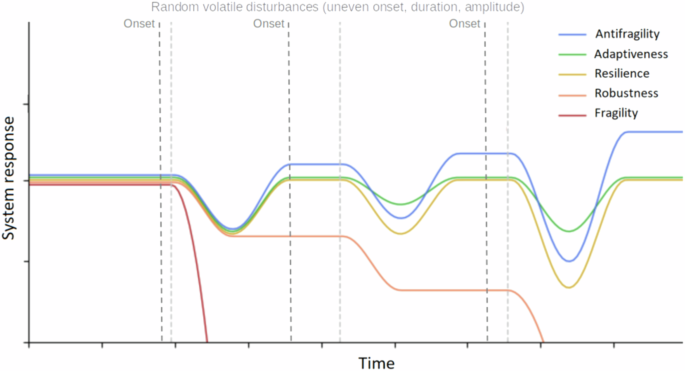
Systems or organisms can be defined as antifragile if they derive benefit from systemic variability, volatility, randomness, or disorder.
If that's a riddle, death fits. Those things are characteristic of the pestilence, famine, war, etc. that feed death. The decay surrounding death is complex and dynamical. And death is more sustainable than any living system.https://en.m.wikipedia.org/wiki/Autophagy
https://en.m.wikipedia.org/wiki/Secondary_succession
https://en.m.wikipedia.org/wiki/Restructuring
https://en.m.wikipedia.org/wiki/Code_refactoring
https://en.m.wikipedia.org/wiki/Shiva
https://en.m.wikipedia.org/wiki/Tandava
it's all the same shit
death is entropy. do you know of a system without entropy?
>or organism...
boy are you going to be surprised when you answer that knock on the door, eh?
At the same time organisms themselves can be antifragile at a different scope. My body gets stronger when I stress the muscles, and gets weaker when I do not.
Edit to add… it is also very dose dependent. Zero muscle stress and I get weaker. Some and I get strong. Too much and I get rhabdomyolysis — an absorbing barrier.
Same goes for the species. No death means no evolution. Some means evolution. Extinction level deaths are an absorbing barrier.
FWIW, I tend to think of it like this: Antifragility is a property of something that benefits from a bit of hammering. Like young tree saplings tend to do better in older life when they've been whipped around by the wind a bit. It's basically "whatever doesn't kill you makes you stronger".
The sentence they want should capture the notion of being robust when poked with a stick.
A pencil on it's tip is a fragile system, one burp and it falls to the table, far from the intial state. Marbles in fruit bowls are anti-fragile, given a good shake (up to a threshold) and they remain in the bowl and return to the low centre.
Reading further, they want more; that repeated perturbations should deliver benefit, that systems in an warped egg carton configuration can be annealed to reveal an optimal point by vigorous shaking slowly reduced in degree.
Having now read the whole paper it doesn't seem novel wrt to the state of dynamic system discussions in the mid 1980s other than the insertion of "antifragility" as nomenclature into the mix.
I believe what you're describing is a stable vs unstable system, not fragile vs antifragile.
You can perturb a bowl with a marble, and the marble will still end up in the middle because it will return to stable equilibrium point (an "attractor"). Yours is an illustration of a stable system. Whereas a marble placed in an upside down bowl (with no ridges, just a half sphere), when perturbed, will fall off. This is an unstable system. These are classic examples used in (Lyapunov) stability theory.
Fragility and antifragility aren't about stability (returning to equilibria), but gains or losses after perturbation, which is related to convexity/concavity.
When you perturb an anti-fragile (or convex) system, it doesn't return to equilibrium but in fact improves. Conversely, when you perturb a fragile system, it degrades. The analysis is usually done with Jensen's inequality rather than Lyapunov.
EDIT: not sure why the downvotes. I'm pointing out a fact. The examples do not demonstrate antifragility, but stability, which is not the same concept.
I’ve worked with amazing folks who aren’t native English speakers.
I’ve come to prize simple writing.
It's also worth checking out more of his works as he initiated the field of cybernetics.
[1] https://users.sussex.ac.uk/~ezequiel/AS/lectures/AdaptiveSys...
The person who first translated this idea into math was James Clerk Maxwell, in his paper, "On Governors", in 1868.[1] Maxwell was the first to get a mathematical handle on stability of feedback systems. He wrote: "If, by altering the adjustments of the machine, its governing power is continually increased, there is generally a lin1it at which the disturbance, instead of subsiding more rapidly, becomes an oscillating and jerking motion, increasing in violence till it reaches the limit of action of the governor. This takes place when the possible part of one of the impossible roots becomes positive. ... I have pointed out that, under certain conditions, the sudden disturbances of the machine do not act through the differential system on the governor, or vice versa. When these conditions are fulfilled, the equations of motion are not only simple, but the motion itself is not liable to disturbances depending on the mutual action of the machine and the governor." That, right there, is the beginning of the mathematics of antifragility. Today, we call this turning up the P term of a PID controller too high and getting outside the stable region. Maxwell was the first to formalize the role of delay and damping (he calls it "viscosity") in this.
There's "robust control", a useful theory of "antifragility" in industrial use for decades. Here's an excellent video on how this is done.[2] That's worth a watch. Note the emphasis on how the combination of delay and noise can cause instability in a system resistant to both delay and noise separately. This can be dealt with by moving the areas of instability around in the frequency domain.
(Modern control theory has become insanely complicated over the last few years. Until recent years, control theory was mostly linear control theory plus some self tuning. Now, control theorists are trying to figure out how to get the benefits of machine learning while still having predictable error bounds. This means getting into the innards of what neural nets are really doing. I still get IEEE Trans. on Control Systems Technology, but don't understand it any more. So I'm not sure how that's coming along.)
[1] https://archive.org/details/jstor-112510/mode/2up?view=theat...
On the other hand, "persistence of excitation" (a phrase I've heard of but never applied) suggests this too is well trodden ground (Wikipedia suggests end of 70s & 80s)
Not really. But using a step input to get info to tune a control system is well known. Eurotherm's auto-tuning system for temperature control was one of the first commercial products to self-tune PID loops that way. It started by setting the control value to 0 and listening to the sensors for a while to get data on sensor noise. Then it set the control value to some large value and watched the sensed value ramp up, being careful not to overshoot the goal. This provided enough data to tune the controller. Simple, but practical.
The paper is much more general, but doesn't cover how to do much. One of the references, the one on traffic control, is more interesting.[1] It's about traffic signal control in the presence of disruption. They only did some simulated experiments on one road setup, though. It's hard to tell if that actually works, but it's a reasonable idea with some data behind it.
“The impediment to action advances action, what stands in the way becomes the way.”
What he is getting at here is that adapting to and overcoming challenges improves your skills, and opens up new ideas and possibilities. The stoics believe that if life goes smoothly and easily, it is actively harmful, and that hardship is required for personal growth.
The core idea of antifragility (which Taleb rigorously defines as a math/engineering principle in his papers) is also that a certain type of system that responds to a stressor in a specific way, can be progressively improved in a lasting way by experiencing that stressor, and conversely, harmed by not experiencing it. For example, an astronaut that spends time in zero gravity loses muscle mass and can lose the ability to walk, whereas a person doing heavy strength training on earth could train themselves strong enough to stand and walk while holding many times their bodyweight.
A more subtle aspect of this for the stoics would be where someone creatively turns a hardship into a unique opportunity. Think someone that loses their job because of a neurodevelopmental disorder, but then ends up studying ways to manage the disorder, and becomes a bestselling author sharing what they learned.
Seeing other comments, I think 'hormesis' might be a better word to start using instead of "antifragility" which, again, is a just an awkward word that feels kind of fake when you use it.
However, I guess "antifragility" isn't the worst of these.
As you point out; "making people think in more novel ways" (or making them think at all given the amount of parroting in the education system) is the usp of Taleb's books. People need to stop focusing on the attributes of the author (arrogant etc.) but instead need to learn to focus on the content of their writings.