139 points · by sawirricardo · 2y ago · 106 comments
From what I recall, I don't think that it was running on that many machines at once. Mainly because it required the high memory nodes that were expensive. I think it was only running on ~10 possibly 50 machines concurrently. But I could be wrong.
What it did have was at least one dedicated fileserver though. Each of the file servers at the time were some dual proc dell 1u thing with as much ram as you could stuff in them at the time (384 gigs I think). They were attached by SAS to a single 60 drive 4u raid array. (Dell PowerVault MD3460 or something along those lines. They are rebadged by Dell and were the first practical hotswap enclosure that took normal 3.5" SAS drives, that didn't cost the earth)
The array was formatted into 4 raid6 groups, and LVM'd together on the server. it was then shared out by NFS over bonded 10gig links.
Anyway. That simulation totally fucked the disks in the array. By the time it finished (I think it was a 2 week run time) it had eaten something like 14 hard drives. Every time a new disk was inserted, another would start to fail. It was so close to fucking up the whole time.
I had thought that the simulation was a plugin for houdini, or one of the other fluid simulation engines we had kicking around, rather than a custom 40k C++ program.
It also mentions that ‘several hundred’ of their 1633 10-core, 156GB (weird number?) blade servers were used, but didn’t seem to go into details on data storage.
Is it possible you were working at the compositing phase, which would have been very heavy on random read and writes, resulting in more wear on the disks?
I was a systems engineer at the time. Compositing is actually really quite ideal linear streaming. You read the images serially and tend to write them back serially. which for spinny hard disks is about as optimal as possible. each frame tends to be between 20-150 megs (resolution, layers, bitdepth). but they are rarely read in a random IO way, you start at frame 1 and go to frame
there were 32 primary fileservers at the time, two were spare, and, including the nearlines (which were _n_ lustre machines and each had 4 raid arrays attached by SAS rather than one) we'd normally expected to replace twoish disks a week.
They ran particle sims all the time. Water, smoke, explosions are all staples of VFX. It was just something weird about this particular sim.
My understanding was that the actual simulation was causing the disks to die, rather than the render. A render can be restarted, a sim, less so. Well, this sim at least.
Either the renders were heavily paging memory to disk, or OP was working at the compositing phase.
Long story:
Forgive me if you already know this, I'm going to start with a toy example and then ramp up the scale.
Imagine that you are doing a "normal" simulation of something like a ball rolling down a ramp into a pot. That's fairly simple, but you need to know the position of the ball, the force vector and the location of any object near by that might collide with it.
It gets a bit harder when there are two balls, as they might also interact, so you need to store the state of two balls.
At a thousand balls, you start to need to think about scaling/threading/parralising (I mean you probably don't, you'd just use physX from nvidia and make it the library's problem, but bear with me) One way is to divide up the simulation area into a bunch of voxels and treat them as individual processing areas. When an object enters/exits an simulation area, you pass the object over with its force vector, and mass, and let that simulator deal with it.
Now, I'm not a physics engine person. The above may or may not happen as I describe, but the key thing is, there are sub simulation to allow you to run in parallel. You need to make sure that each processing voxel has completed it's processing for that time step before you can move on.
Once you have calcuated the position of each object, you can save that to disk and begin to calculate the next frame. Note, this isn't rendering, this is just working out the "pose" (position and rotation) of each active object.
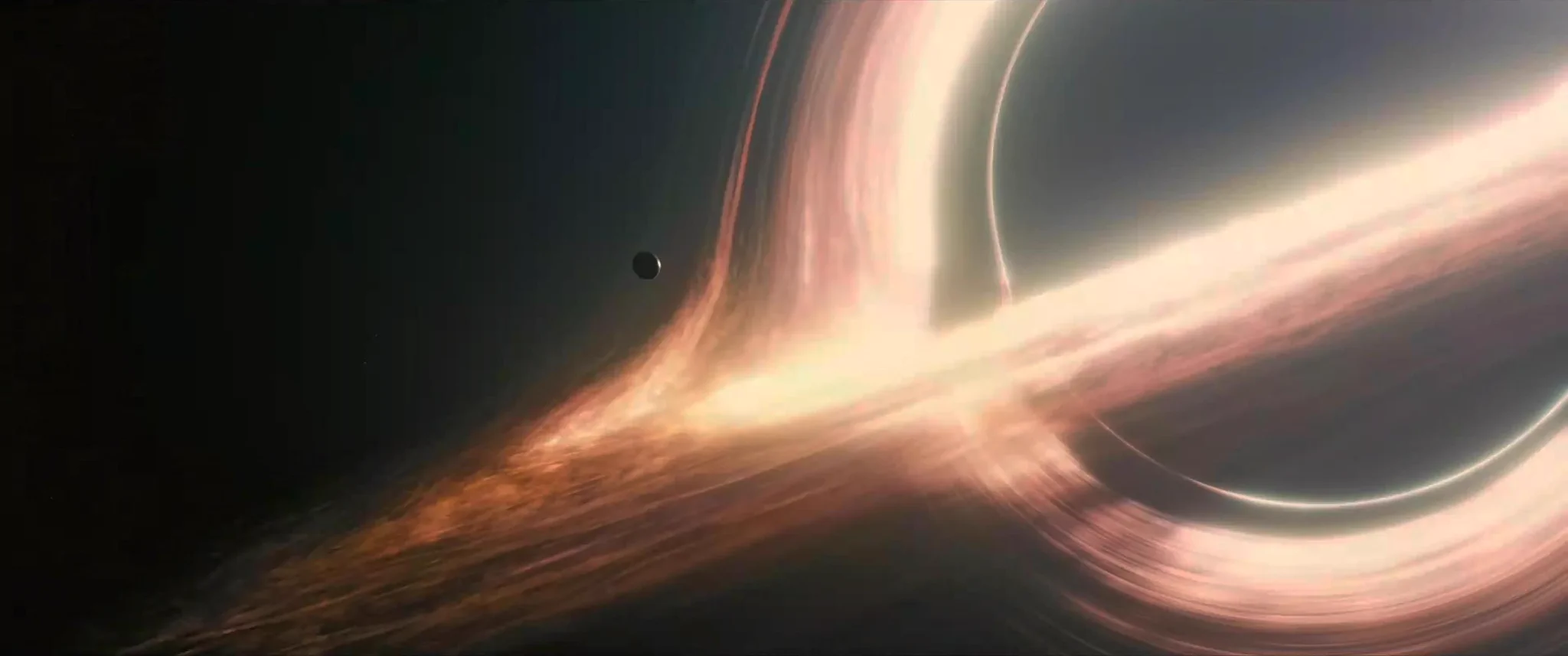
The simulation of the black hole was effectively a massive particle simulation. I don't recall how many particles, but something like 14 billion sticks in my mind. It might have only been a billion. So they need to calculate and store the id, position, rotation, velocity and probably other details for every single particle. Even if everything is in a single float for a billion particles, its 28 gigabytes for position and rotation alone (xyz for position, quaternion for rotation) That's without any other state info like heat, force vectors, the weird quantum stuff or weight.
Once you have the position of all the particles, you then need to fire photons through them to work out what colour the pixel should be. That involves loading in the position of the particles, firing rays through them all and recording what it hits and why.
But why so much file IO? didn't the machines talk directly?
DNEG at the time was as close to being a "perfect" unix/linux shop as you could get. everything was ephemeral, even the file servers. All the nodes in the render farm could configure themselves from scratch (pretty much) from power on. You'd plug it in, switch it on and it would work out what it's hostname is, image themselves and join the rendering system autonomously. Most binaries that you used were stored on an NFS share somewhere. this meant that you had more or less complete control over the data flow. For example `rm` wasn't actually rm, it was a wrapper that moved files into a 'deleted' area, rather than binning them.
There were many layers of backup, all the way to tape.
Your home directory followed you everywhere, which meant so did your environment. This meant that if you wanted a specific version of a program, we had a wrapper that set that for you. So typing "maya" would spin up the right version of maya, use the correct plugins, and safe your files to the correct fileserver.
Everything was divided into shows. so you'd cd /shows/$showname/$department/$shotnumber/$version and you'd magically be on the right fileserver. This was done via the magic of symlinks.
So everything was files, and if you wanted to exchange large amounts of data, you'd use files.
If anyone is interested I'll talk about the system they used to coordinate all the rendering (no it wasn't k8s)
most certainly, please share. and thank you, this is very interesting.
Would be a better title
The geodesic equations are not Einstein's equations.
The code for Interstellar only had to ray trace on a fixed analytical background spacetime (Kerr metric),
rather than solve partial differential equations for the metric itself.
https://x.com/duetosymmetry/status/1020714102354776064Chris Nolan doesn’t shoot digital. His more recent pictures (Interstellar included) are shot on a mixture of 35mm, 70mm and IMAX 70mm (!)
[1] https://history.siggraph.org/learning/double-negative-presen...
Is Intersetllar the movie where Matthew McConaughey turned into a bookcase?
No not that one.
Not that one either.
TLDR “A typical IMAX image has 23 million pixels, and for Interstellar we had to generate many thousand images, so DNGR had to be very efficient. It has 40,000 lines of C++ code and runs across Double Negative’s Linux-based render-farm. Depending on the degree of gravitational lensing in an image, it typically takes from 30 minutes to several hours running on 10 CPU cores to create a single IMAX image. Our London render-farm comprises 1633 Dell-M620 blade servers; each blade has two 10-core E5-2680 Intel Xeon CPUs with 156GB RAM. During production of Interstellar, several hundred of these were typically being used by our DNGR code.“
Small VFX shops do typically render on GPUs nowadays, but the high end is still dominated by CPU rendering.
NVIDIA H200 GPU has 141 GB of memory, and the AMD Instinct MI300X GPU has 192 GB of HBM3 memory.
https://www.shadertoy.com/view/lstSRS
No idea if it's doing the same simulation though.
I can't remember the actual size of the simulation in terms of number of particles, but it was using something like 2 150TB fileservers to store it on.
With NVME and cheap ram, it would probably at the point where it'd be useful on a GPU.
Jokes apart — this is the best SciFi movie ever! It’ll become one of these movies one’s got to rewatch every 5y or so.
~26 2/3 frames per minute, not bad
Cooper sobbing as he listened to years of messages from his family? I wish I could've written that. The twist where Mann activated his beacon because he didn't want to die alone? Solid.
We need the gravity equation to get off Earth because the crops are dying? Love can escape a black hole through the tesseract? This is just patent technobabble nonsense.
Where _Interstellar_ fails is in exposition. Love is the most powerful force in the universe? The Fifth Element pulled that off by not pretending to be serious. Anything is permitted in science fiction, but once you commit to explaining it, you need to make sense.
The small craft could launch from a planet with twice the Earth’s surface gravity, make it to escape velocity, and meet the Endurance?
Why would they need better propulsion than that to leave the planet and build space habitats?
If the planets they visited had much lower gravity then earth this may be possible, but this wasn't noticeable or talked about. And even on Mars you need much more fuel to get into orbit than could be stored in their tiny ship.
Heck, you could even ignore the jet aspect, and go for full rocket. (An ICBM only weighs around 50 tonnes, after all.) Getting the heavy thing into orbit, though, requires proper, multi-stage rockets.
We have a plague on Earth and doing an interstellar travel is the solution?
I was very disappointed. I’m OK with a few plot holes, but this is so fundamental to the story that the movie can’t stand on its own.
and then just a lame story culminating in "space ghosts"
for me, arguably most disappointing movie ever
It'd more like a producer going:
"is it done yet?"
"what do you mean it'll take half our rendering budget, I need that for delivery"
"Is it done yet?"
"can you make it look more spacey?"
"no thats too spacey now"
"Why isnt there lens flare?"
"Why does it take two weeks to render, can't you fake it?"