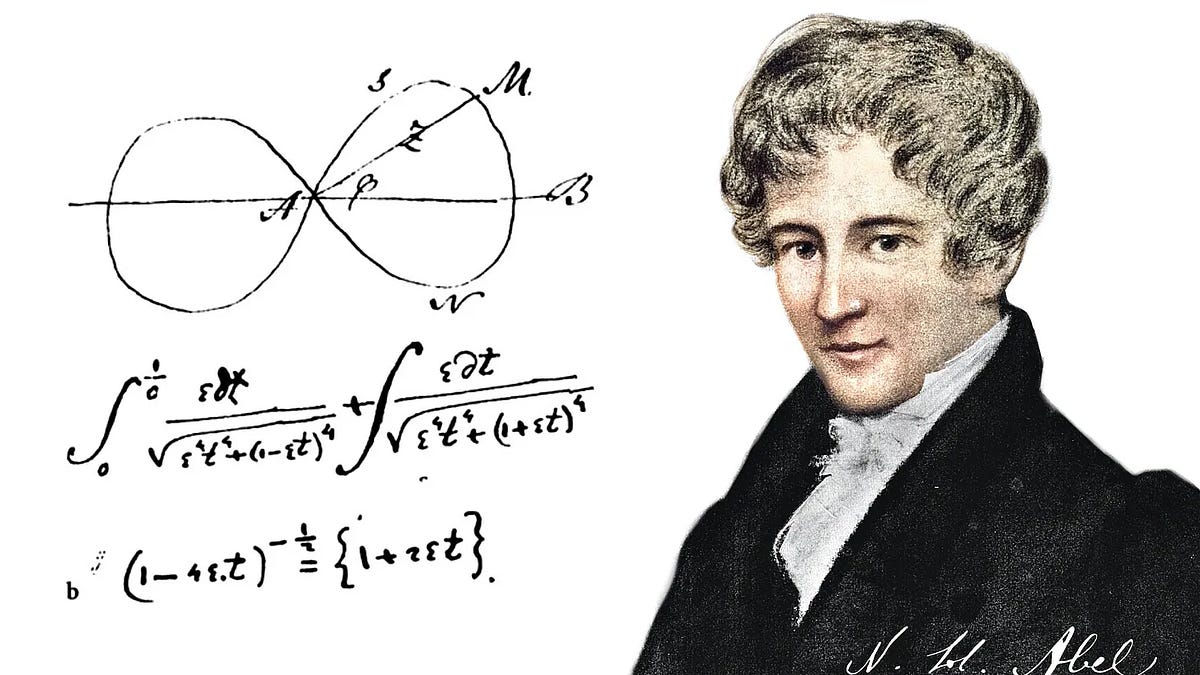
Abel: The Mozart of Mathematics
“Although Abel shared with many mathematicians a complete lack of musical talent, I will not sound absurd if I compare his kind of productivity and his personality with Mozart’s.” — Felix Klein
privatdozent.co
112 points · by chmaynard · 2y ago · 30 comments
> "...study the masters, not their students" —NHA
It appears to me that if one wants to make progress in mathematics one should study the masters and not the pupils.
— N.H. Abel (1802–1829), quoted from an unpublished source by O. Ore in Niels Henrik Abel, Mathematician Extraordinary, p. 138.
This is my absolute favourite quote too and i always keep this in mind. I think this is very relevant today since it seems every "Tom, Dick and Harry" wants to write a book most of which is mere parroting from other sources with no insight/simplification/intuition whatsoever. It is only the "Masters" who have a way of directly getting to the heart of the matter in the simplest manner possible. To this end i try and collect some of the original texts with detailed explanations so that i can learn from them. Some interesting ones are;
1) A Source Book in Mathematics by David Eugene Smith (Dover Publications) - https://archive.org/details/sourcebookinmath00smit
2) Newton's Principia for the Common Reader by Nobel-prize winning Physicist S.Chandrasekhar - https://archive.org/details/newtonsprincipia0000chan
3) Maxwell on the Electromagnetic Field: A Guided Study (Masterworks of Discovery series) by Thomas Simpson - https://archive.org/details/maxwellonelectro0000simp
4) The Annotated Turing by Charles Petzold - http://theannotatedturing.com/ and https://en.wikipedia.org/wiki/The_Annotated_Turing
If this is true, why are three of your four references secondary references? Surely if the master said it in the 'simplest manner possible' you would be reading Newton, Maxwell and Turing directly, rather than the paraphrasing/annotating by Chandrasekhar, Simpson and Petzold?
It is the Concepts/Models/Ideas/Intuitions as given by the "Masters" which we need to focus on and not the specific language/phrasing they were expressed in (as long as they are not relevant) since these are a artifact of their Time/Context/Culture. Think of the differences between Transliteration vs. Translation vs. Interpretation while maintaining fidelity to the original either in a different language or the same language. The early scientific papers were written in various European languages, but in the absence of reading the original paper in the original language ourselves (due to not knowing the language or the language being too archaic and unfamiliar) most of us nowadays study them only in English trusting to the translator/author to do their job faithfully.
Two examples;
1) In the Principia, Newton uses the phrase "Quantity of Motion" to define what we call today as "Momentum". The former conveys intuition while the latter is merely a formula.
2) "Imaginary Numbers" were called "Lateral Numbers" by Gauss which is intuitive in a geometric sense (without generalising too much).
Or from 'Enter the Dragon' - "It's like a finger pointing to the moon. If you focus on the finger, you'll miss all of it's heavenly glory.".
But great essay about Abel, wonderful and somewhat tragic life.
“He is like the fox, who effaces his tracks in the sand with his tail.”"
Gauss was also not responding to this specific criticism (which he probably never heard); it was a general statement of his, reported in an obituary afterwards:
"Gauss's aim was always to give his investigations the form of perfect works of art. He would not rest sooner and never gave a piece of work to the public until he had given it the perfection of form he desired for it. A good building should not show its scaffolding when completed, he used to say. In his demonstrations he used almost entirely the synthetic method, which he had come to prize through his studies of Archimedes and Newton. It is distinguished from the analytic method by its brevity and comprehensiveness. But the road leading to the discovery remains veiled; and indeed it often seems that Gauss frequently and intentionally turned aside from the road that led to mere instruction." https://archive.org/details/gauss00waltgoog/page/n79 1856
> The invention of group theory. In proving that there are no general algebraic solutions for the roots of quintic equations, Abel invented (independently of Galois) what later became known as group theory. In addition to Galois, the topic was also studied in the same period by Joseph-Louis Lagrange (1736–1813).
How are quintic equations related to group theory?
https://en.wikipedia.org/wiki/Fundamental_theorem_of_Galois_...
Roughly speaking what you do is you start with a polynomial over some field, for example over the rational numbers, then you see what you need to add to the rational numbers to get to a field in which you can fully factor that polynomial into linear factors.
For example say we have the polynomial x^2 - 2, we know there isn't any solution to this in the rationals, so we can't factor the polynomial. We then consider the expanded field you get when you add the square root of 2 to the rationals. This expanded field includes root 2, and all products and sums of root 2 with rational numbers. You can check that the elements of this new field look like
a + b sqrt(2)
where a and b are rational. In this new field you can factor the above polynomial as (x + sqrt(2))(x - sqrt(2)).
The connection with group theory comes when you realise that the central object of your study is the bijective (invertable) functions which map this new extended field to itself, while mapping the rationals to themselves. For example for the field formed from the rationals by adding root 2 there are two such bijective functions: the identity function which maps everything to itself, and a second one which swaps root 2 with minus root 2, and leaves everything else the same.
This jump to having to think about these groups of functions (automorphism groups) is a big imaginative leap, but let's you turn hard problems about polynomials into easier problems about groups
https://www.smh.com.au/lifestyle/terence-tao-the-mozart-of-m...
[1] https://www.spectator.co.uk/article/the-einstein-of-maths/ in spite of the fact that Einstein probably would have considered himself the Einstein of maths.