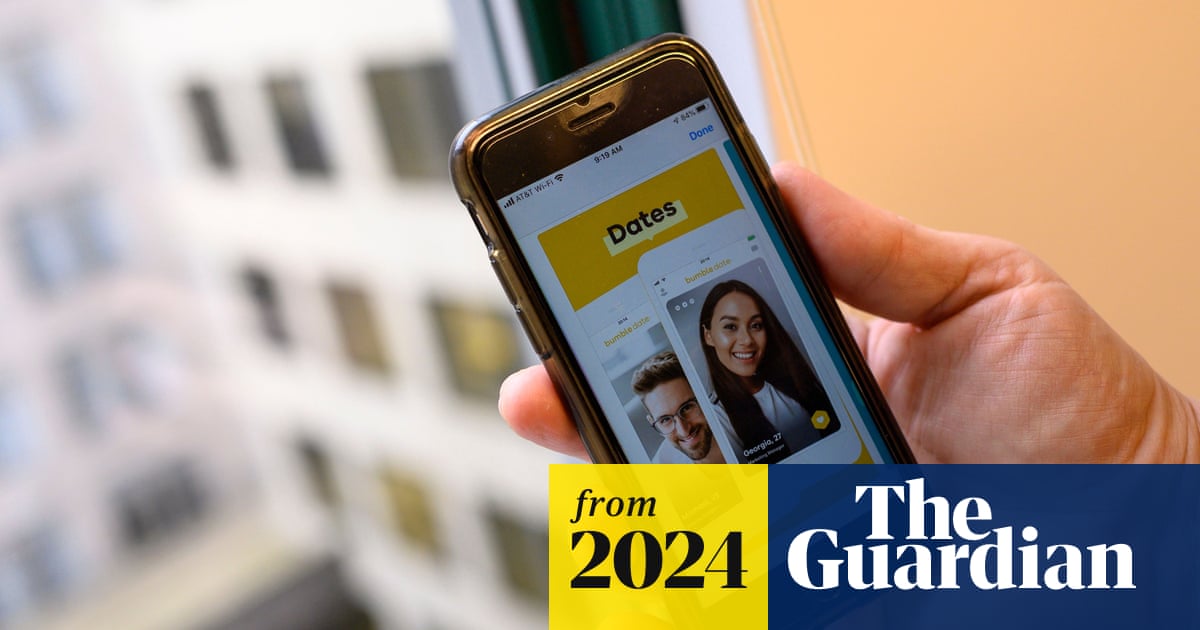
‘Bumble fumble’: online dating apps struggle as people swear off swiping
Online dating industry in crisis as shares fall and nearly half of all users report negative experiences on the apps
the Guardian
54 points · by geox · 2y ago · 97 comments
Men's experience is relevant to them, but not the owners of the app.
Men are typically the vast majority of paying customers. If guys have a terrible experience they will stop paying eventually. But there's a sucker born every day, as the saying goes...
Are they suckers? Probably. Do the platform owner care? Nope.
The real reason women are on bumble at all isn't because they like the gimmick. Instead they just hope that men there are better than the ones on tinder.
Luckily, every man I met was a legitimately interesting and cool person. I only got _slightly_ uncomfortable vibes from one of them, and he (like all the others) handled it very maturely when I later told him I just wasn't feeling a connection. None except one ended up being a romantic match, but I had a really nice time talking with all of them.
Maybe part of it is just that I'm pretty particular with who I bother talking to and meeting. I don't have much energy or time for meeting new people, so don't schedule many dates. On the other hand, this also means my positive experience is not very trustworthy, as it is likely I just haven't met enough people to give myself a proper chance at a negative experience.
Nevertheless, I do not find dating apps fun or pleasant in any way - they're more like a means to an end that I'd rather step away from as soon as I meet someone I actually like. This tends to be a bad strategy, as from what I understand the other party often doesn't approach focus or exclusivity on the same timeline. So there's a risk of a mismatch in investment (time and emotional), which can become a problem.
When I've met an unjaded newbie we've had a great conversation, we've met for a date easily with no hassle and in one case it's worked out for a decent period of time, and in most if it doesn't we part with good communications. I've even become close friends with a couple of women I've met this way.
The old pros are people you constantly see on the apps, they're flaky and jaded and addicted to the swipe/match/chat/move on paradigm.
Dating apps are akin to being in dante's pergatory.
Operator would need to know who is a good matchup for you and then not present you that person but present you enough other subjectively attractive (but again somehow not good) matches so that you keep swiping. That's almost omniscience when it comes to dating which they would need to attain from a phone number, pic, couple of sentences, and maybe whatever they can buy via adtech.
Most of these apps use ab testing to determine what features are launched. The speculation is that they optimize for retention and conversion into paying users, not for forming long lasting relationships. Retaining users is good for a business but terrible for people trying to form long term relationships.
It's pure speculation that this is what they are optimizing for in their experiments but I wouldn't be surprised if it's the case.
They don’t really need any algorithmic matching magic.
Also, the pool of people online dating is going to be somewhat (perhaps heavily) sample biased. People who are likely to form long term relationships will, over time, leave the dating pool at a higher rate than those who aren’t. By the time you hit age 35, you find the dating pool to be mostly people who haven’t permanently paired off for very obvious reasons (myself included, btw).
So overall, I just don’t think they worry at all about people leaving the dating pool.
I do think their incentive structure is broken and that plus the fact that they are all owned by two companies (and even one of them, Bumble, doesn’t just buy up all the competition) does prevent them from making the metric about user satisfaction though. I just don’t think it’s broken for this reason.
The operator simply encourages behaviors which people _feel_ moves them closer to meeting someone but which are relatively time-inefficient. So the user has to spend much more time on the app, which increases all the relevant metrics of engagement and profit.
To fix the problem, one would expect an app which either charges a lifetime fee upfront or upon delivery.
Since it is hard to collect payment on delivery, the best case to eliminate the principal-agent problem would be a $2,499 one time fee for unlimited lifetime service.
Even if they meet someone there, they will come back to meet more.
Also my wife is from Tinder.
It’s almost as if you can’t commoditize emergent social behavior.
I also have a hunch, though, that some of what makes relationships click is hard to formalize in an app focused on dating per se. In person chemistry, development of an initial relationship without an explicit shared dating goal, and so forth. Sometimes I wonder if it would be better to just incorporate dating options and features into a more general purpose social app.
[1] https://www.bbc.com/news/uk-42546586
[2] https://www.arkansasonline.com/news/2007/may/22/no-love-lost...
I surmise that a big portion of people that hooked up via dating apps are incompatible at a fundamental level and they just don't know better.
Of course, just a list of profiles may not be helpful either e.g. I met my husband on Grindr but that required a lot of effort and enduring the emotional downsides of the experience. Dating online also deprives one of using all of one’s senses to “feel” if the person(s) in front are a good match.
PS: For some of us, online dating is not always a choice as you can imagine, so even with the downsides, these apps are needed still.
Citation?
1. The app algorithms are usually black boxes, so who knows whether they’re really using scientific methods
2. Apps often include questions such as height due to customer demand, which are known to be very bad predictors
3. The interaction between the factors is very significant and complicated/unknown
4. People don’t answer truthfully
5. People don’t know what they want
What is known however is that there’s a strong placebo effect initially, i.e. the mere suggestion that somebody is a good match although they aren’t increases the success of first dates, but not in the long term. There’s also research on how these systems can be designed to be addicting, which is surely being done.
One of the strongest known predictors instead is “shared emotional experiences”, e.g. a study about making people walk over a wobbly bridge together. Hence why “running groups” and so on are popular nowadays among people disillusioned by algorithms
In 2008, in her final year of law school at Duquesne University in Pittsburgh, she met a guy on JDate whom she subsequently married in 2012; they just celebrated their 12th wedding anniversary.
Here's the thing: he lived three blocks from her; at the time he was an associate at law firm Jones Day, working 90 hours/week; no way would the two of them ever have met absent the internet.
That’s weird because at least in the US and UK people definitely do date based on this and it makes sense.
If you are mildly politically literate, then in those two countries, you know there’s really two realistic parties you can pick who are opposed from each other.
Given then it’s pretty strange to want to be with someone who is diametrically opposed to making your country better, and actively voting to make the country worse, regardless of your POV either way.
Most people in real life don't really give a fuck about politics.
My wife is a lot more conservative than me. But I don't care about politics that much, neither does her. We both like traveling, we both like football, we both support the same football team, we both enjoy cooking and have similar tastes for food, so on and so forth. All of those I rank higher than being with someone that happens to think like me in politics or economics.
Which is a shame because if they did they wouldn't vote against their own interests.
You’re basically saying you’re fine either way so it doesn’t matter to you. But it does matter for a bunch of real people who’s freedoms are compromised by policy decisions.
You cannot solve real problems in the real world or actually make the future better with blind application of a simple ideology- real life is too nuanced and complex. You have to approach each individual problem with creativity, and an open mind. You also have to take an active leadership position to solve a real problem, not just watch TV and vote.
If someone sees the world like you are suggesting, they are not intelligent enough to date. I want a partner, not a pet.
That seems super dismissive and disrespectful. Honestly HN is usually better than this.
Being politically aligned is nothing like “wanting a pet” wtf.
If anything it’s more equitable that you are aligned on your values whatever they might be.
I have no idea how you can fail to recognise that a polarised two party system draws some pretty hard lines along your value system.
Would you date a republican who supports removing abortion rights for women, would you date a tory who supports privatising vital public services for personal gain of the few? (Note I’ve used right wing policy's but you can pull left wing examples of this as well).
> weird is an important dating requirement for me ;-)
This is such a strange thing to say, you’re not quirky or more interesting for having written this, I have no idea why you would write that on HN.
If I answer 500 questions and 400 are about basic decency, that doesn't give a good match.
If I answer only 50 questions but they're all about relationship and intimacy that works much better.
Regarding ecomonics: IMHO there is a general social breakdown related to the general economic breakdown for the non-rich in the U.S.
It's easy to have fun with social and sexual life when it's easy to take care of your basic needs like food, medical care, housing, etc. The 1970's was a lot of fun I guess at least in certain places of the country. Having fun in general has gotten much more difficult for non-rich people over the past 30 years, and it makes intimate/fun social relations also much more difficult. Example: Being a single person living with one's parents because they cannot afford a house or apartment places one at a significant disadvantage, more so if male than female, but females living with their parents and trying to have a dating life may have a hard time.
Totally not something I want as part of my life.
Please just eat me after we’re done doing the dirty.
What the men do is irrelevant.
If you’re in a place like NYC, the more attractive people don’t go to these events. They just don’t need to. Most of the folks I know meet their partners through apps because everyone is super picky about looks, income, status, and so on. Going to random bars and events isn’t efficient for that.
Personally, I’ve been single the entire time. I can’t get matches on apps due to poor facial attractiveness. So, I stick with IRL scenarios. It works a little better but it’s still bad.
Finding a life partner by being recommended by a relative/friend/coworker/college organization/etc is probably way less work and stress for the individual, assuming they have a decent social network.
I think that's why a lot of dating apps start out as regional, often niche focus, and slowly expand out. They know that they'll be review bombed with negative reviews like the above if they try to do a national/worldwide launch.
Social media gets a lot of deserved blame for worsening our ability to connect meaningfully across interests and differences in beliefs.
But I have to imagine dating apps have been nearly as bad in terms of their impact on emotional development alongside another person.
They commoditized relationships, whether intentionally or not. They squarely fit the bill of “too much of a good thing”. Relationships are hard, and dating apps removed the incentive (i.e. avoiding the effort of having to find someone new) to work through the hard shit.
I’m sure there’s been a net positive effect for some demos or cohorts. My bet though is a significant number of people are facing an increasingly harder time finding meaningful, long-lasting relationships, either because they or their partner have too high of expectations for how “easy” they should be, and they know they only need a few swipes in an app to reset and try again.
For example, folks rarely go out of their weekly habits. We tend to go out to the same places which means there are probably people out there we'd enjoy spending time with but we never get a chance to meet. The neighbour you never meet can potentially be a good match.
So there is definitely a need for a way to "put oneself on the map". I don't think apps need to take on the ambition to "find my next spouse" which is a big undertaking and unlikely to happen while swiping left or right.
I’m currently on a self-improvement journey where I’m literally now injecting “research chemicals” shipped in from China just because it’s the only way I’m gonna get good looking enough to compete in this ridiculous market. As much as I’ve improved myself over the years I’ve been alive, the standards have gone even higher. That said, I’m not sure if the improved version I’ve made of myself would’ve done well ten years ago either. Maybe I was always doomed to die alone.
I can only think of cosmetics (makeup), skin care (acne, moisturizer), botox, and steroids/PEDs/HGH/etc that could improve physical disadvantages that cant be improved otherwise. But not an area I'm too experienced in. What type of chemicals are you talking about?
It’s insane that I have to go to these lengths though to even be considered in this dating market. I’m still waiting to see evidence of effects in my own body for a couple of these but if they pan out for improved recovery (e.g. bpc-157) then I’ll be doing more cosmetic surgery. My biggest complaint with cosmetic surgery is that it’s just so painful for the recovery, recovery takes forever, and it’s why I don’t do more of it. Cause I have very obvious facial flaws that could be improved by a skilled and knowledgeable surgeon who focuses on improving beauty.