56 points · by kiyell · 2y ago · 41 comments
This is just generating CVE numbers for the sake of it.
Someone's added it to a commercial security scanner recently, so we have a lot of "severity 1" tickets to disable it.
Yes, severity 1 for something that's been there for 25 years. Very important CVE obviously.
As it is now, I can look at a CVE and determine for myself and my organization whether it something we need to care about. I’d rather that decision stay in my hands, not someone else’s.
Except it doesn't work like this.
A security scanner will include a CVE. People want no red flags on the security scanner. They don't care what the CVE is, they just want red mark go away.
The attitude to accepting useless crap as a CVE is diluting what an important CVE actually is.
CVSS has been around since the mid-2000s, so it isn’t as if there’s no way to discern critical vulnerabilities from informational ones.
You'll have to email my bosses that :)
That's already the case now, since there's no perfectly objective way to decide whether a bug is even security related or not.
This is just an example of where that already existing subjective distinction was applied in a way that not everyone agreed with. It's an unavoidable problem that is going to happen once in a while.
It doesn't mean that CVEs are useless and it doesn't necessarily mean we need to be more liberal about what warrants a CVE either.
Sure, you are right that a line already exists. However, that line basically boils down to "could this bug conceivably affect security". The decision tree is 4 questions long -- very simple.
What I am opposed to is someone else answering "yes, this could conceivably affect security" and deciding on my behalf that I don't need to worry about it. That is a line for me (or someone who knows the organizations infrastructure, risk tolerance, etc.) to draw.
Unless there’s a minimum standard it becomes noise, and the real CVEs are lost.
Trying to ignore the extreme hyperbole here...
I want me or my team to see every security-related flaw affecting the products in our network, yes. That's literally our job.
A CVE like this takes maybe 2 minutes for a junior on the team to mark as no risk.
Yes, but one can envision a scenario where everything gets a CVE number and you, or members of your team, spend an inordinate amount of time looking up CVE numbers. Then along comes a service that you have to pay for that scores each CVE number for you. Due to any lack of discretion (in a database maintained by "experts"), you'll pay with your time, or your money.
If they change the decision tree and spelling mistakes start being assigned CVEs, I am sure I will change my mind.
In a perfect world, you should be able to treat a CVE number in a scan or bug report as something of importance, but in practice you need to filter out the "time protocol allows reading the time" class of CVEs as well. CVEs might as well be links to Github issues if they're treated like this.
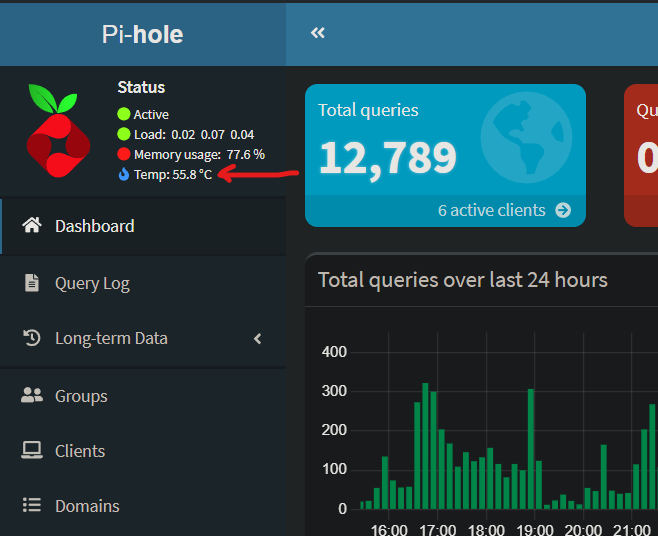
The bug here is that unauthenticated users can change a setting that only an administrator should be able to. The maintainers acknowledged the bug and accepted a patch to fix it.
Is changing the temperature unit shown on a dashboard a serious problem? No. But it is a problem and one that could be classified as a security issue.
What's the point of the CVE assignment? Well it creates a public record of this flaw and helps Pi-hole administrators make their own decisions (patch / ignore). It also puts the issue in the hands of other security researchers. For example, is there a possibility of using this vulnerability to conduct a DoS attack? I didn't test this and have moved on to other things but others can.
Setting aside that the vulnerability doesn't actually allow that, isn't this potentially a Spectre / Meltdown vulnerability? This is an unprotected endpoint that conditionally executes code taken from user input. If the branch predictor can be trained to speculatively execute arbitrary code from the input, information could be extracted via endpoint timing using a similar methodology to Spectre or Meltdown, right?
Not to snap at you, but I'm forced to deal with these "what if" scenarios weekly and it drives me nuts. I know the security guys have a job to do, but I feel like half of their job is just trying to drum up scary looking things to justify their employment.