Euclid
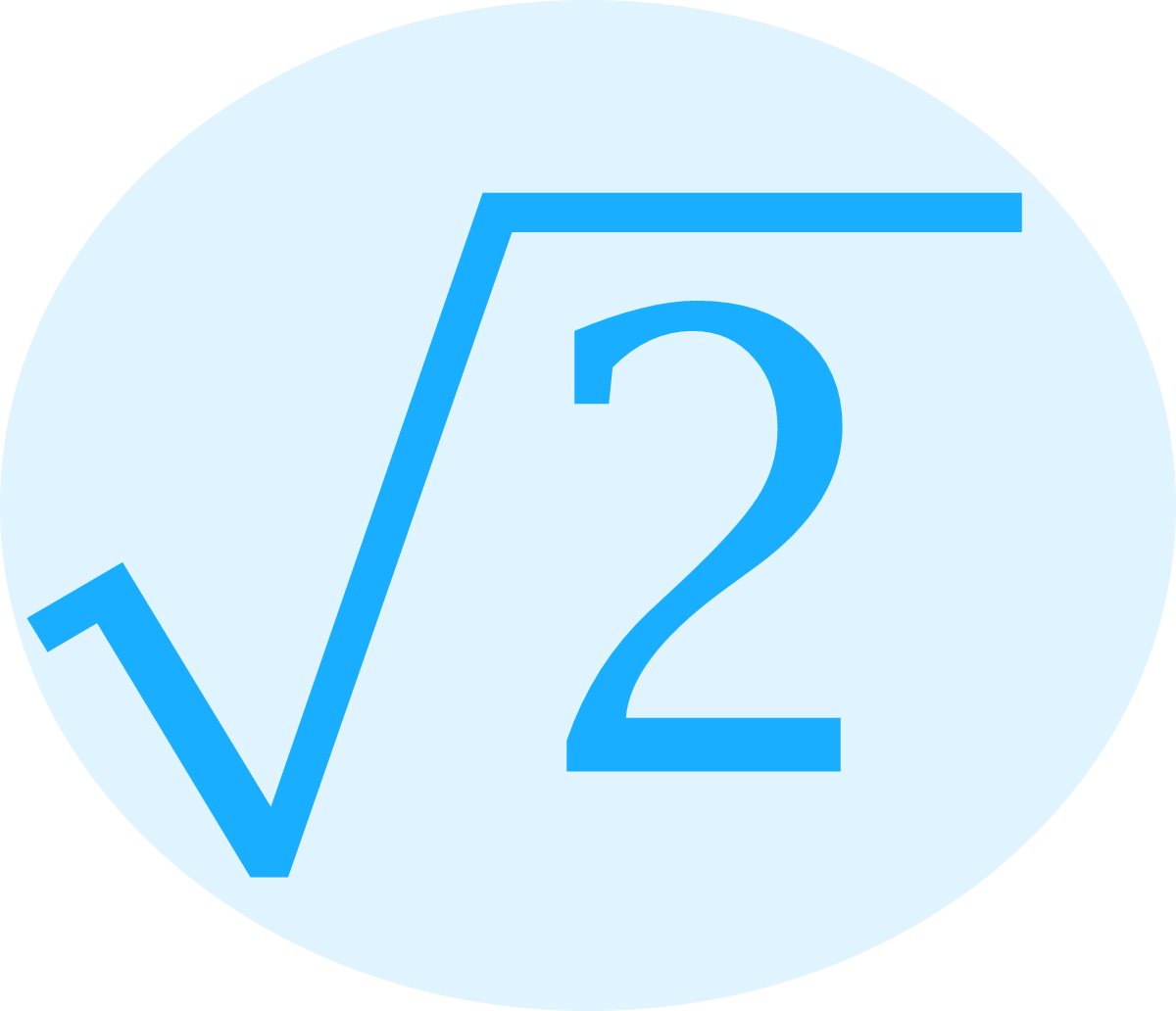
Euclid proved that √2 (the square root of 2) is an irrational number. He used a proof by contradiction. First Euclid assumed √2 was a rational number.
Math is Fun
172 points · by thunderbong · 2y ago · 93 comments
x^n + a_{n-1}x^(n-1) + … + a_1x + a_0.
It turns out the set of such roots is actually closed under multiplication, addition, and subtraction, and there is even an analogue of prime factorization if you squint. Moreover, the intersection of these “algebraic integers” and the rational numbers ℚ are exactly the usual integers ℤ. This is why you sometimes might hear an algebraic number theorist refer to ℤ as the set of “rational integers”.
I did a maths undergrad, but I don’t think I ever studied algebraic integers. That’s something I shall have to remedy now, thanks!
What does "usual integer" mean?
…, -2, -1, 0, 1, 2, …
The exact disciplines are doing themselves a terrible disservice by muddying up established terminology like this (and "algebraic integers" are far from the only such case).
There's a good explanation of the motivation for this concept, here.
I've always referred to that set as "algebraic numbers" ( https://en.wikipedia.org/wiki/Algebraic_number ). Since they are equipotent with integers, you _can_ call them that, but it's misleading.
Algebraic integers are much cooler, since there is a number theory on them: https://en.wikipedia.org/wiki/Algebraic_integer . (And also because the most basic facts about it, like that it forms a ring, are not trivial to prove, that's a good sign for a concept to be cool and useful.)
These two number sets are more or less in a relationship like regular integers (with a number theory), and rational numbers. In fact A = O/Z where A denotes the set of algebraic numbers, O denotes the set of algebraic integers, and Z denotes the set of integers.
I like teaching this kind of stuff to my grade 9 and 10 advanced math classes. It’s not that hard to understand and yet it gives students a sense of wonder about how math works. I might try to show the grade 10s algebraic integers now.
In commutative algebra one says "the ring Z is integrally closed in its field of fractions Q", or short "Z is normal".[1]
[1] https://en.wikipedia.org/wiki/Integrally_closed_domain#Norma...
Then if we figure out that both p and q are even, it means that p/q can be simplified (by dividing p and q by 2), which contradicts the assumption about the simplest form - and we don't need to use the infinite descent.
> Rational numbers or fractions must have a simplest form.
They make no claim about uniqueness, but that is not needed in the argument.
I’m not sure when infinite descent would be considered to have been formally proven to a modern mathematician but I bet it wasn’t in Euclid’s time!
So if you manage to produce an infinite sequence of strictly decreasing positive integers starting at a particular positive integer, then you've reached a contradiction.
In practice though, concepts with infinity are very tricky, and the Greeks definitely did not have a strong accurate theory of infinity, Aleph-zero even, much less (as is the point talking about the sqrt(2)), the reals.
In this case, I think embedded in a high school proof would be the assumption that for any integer you can list there are not an infinite number smaller than them. This is manifestly true about the integers, but it is not true for the rationals, despite the two sets having the same cardinality, and a solid proof would need to be able to distinguish the reasons why. It’s this part that I think would be beyond the Greeks.
(I'm talking about adapting the ideas of this divisibility-based proof. abstractbill's post https://news.ycombinator.com/item?id=41314547 about Conway's method, https://www.youtube.com/watch?v=wNOtOPjaLZs, is a completely different (and very cool) way to do this that I hadn't seen before today.)
https://existentialcomics.com/comic/189
See also: https://en.wikipedia.org/wiki/Hippasus#Irrational_numbers
  1. Introduce ℤ & ℚ - this is easy. Perhaps, fingers and slices of pizza. Now s/he's ready to be as surprised as the members of the Phythagorean cult

  2. Go over the classical proof for √2 given here. We now have a number that's not in ℤ or ℚ!

  3. It's one thing to show a result, a very different thing to *grasp* it. Why is (2) a big deal? It smashes the simple notion Greeks had that *any* two lengths (rational numbers) are commensurable, which is a perfectly simple and obvious (and wrong) thing to believe: "Have one stick for one side of a square and another for the diagonal. You cannot cut both sticks into pieces of the same length, no matter what length you choose." *This is amazing*

  4. We only discovered one such weird number. Are there others? Motivated by the above, how about checking √3. Show that it's weird, too.

  5. √4 is just 2. How about √5? OMG, that's weird, too.

  6. So the square root of an integer is either an integer or one of these weird numbers. It cannot be of the general ℚ form p/q. This is an interesting proof. (While thinking about that with the youngster you can think about another generalization: roots higher than second. Turns out it's true for those, too: https://math.stackexchange.com/questions/4467/how-to-prove-if-a-b-in-mathbb-n-then-a1-b-is-an-integer-or-an-irratio

  7. How do we work these weird numbers? For example, can we add them up, e.g. √2 + √3? How do we do that? Is that another weird number or could it ever be an integer? Some facts about these sums are trivial to prove: https://math.stackexchange.com/questions/157245/is-the-sum-and-difference-of-two-irrationals-always-irrational

8. Using the wacky notion of adding two numbers as "mating" you can generally outline some higher algebra concepts, e.g. if a lion mates with a lion the result is always a lion. What if it mates with a tiger? (depends, liger or tigon). Can we think of adding a ℚ to one of these weird numbers the same way? Such intuitions may be misleading (remember the Greeks?) but are fun.To explain why it’s obvious, squares always have an even number if factors of two (an even multiple of any prime factor since it’s a square but just focus in on 2 here for now).
A square times two always has an odd number of factors of 2 since it’s the above (an even number of factors of two) plus one more factor.
An odd number of prime factors on one side can’t be equal to an even number of factors on the other side. q^2 can never equal 2m^2 for any integer value of a or m. Therefore it’s irrational.
This ends the proof much earlier right?
Why do I claim that it's not obvious? Consider the ring of integers with sqrt(-5): that is, all complex numbers of the form `a + b sqrt(-5)` with a, b integers. This is a ring - it has all the nice additive and multiplicative properties that the integers do - but it doesn't have unique factorisation, because 6 has two distinct factorisations.
Have you considered a career in mathematics?
Mostly because you need the Archimedean property for it which can not be derived from Euclid's axioms.
The proof would be more compelling if this was proven instead of being taken as an obvious fact.
Because of the fundamental theorem of arithmetic, we know that x must be representable as the product of a unique string of prime numbers.
Because 2 is prime, then since xx = 2r, there must be a 2 in the string of primes for xx.
But since 2 is prime, it must be in x as well, because a prime cannot come out of nowhere. In other words, if there is a given prime P in xx, there must be at least two P in xx, because there was at least one in x, and the number of each one got doubled in xx.
Therefore xx = 2r = 2*2*y = 4y for some integer y.
Therefore n = 4y and sqrt(n) = sqrt(4y) = sqrt(4)sqrt(y) = 2sqrt(y) which is an even number.
Therefore sqrt(n) is even.
Even x Odd irrelevant if squaring
Odd x Odd results Odd
Which made me wonder if the original sentence isn't already assuming something about sqrt(2) and even/odd properties.
(i stopped at the same step as OP wondering if this is as trivial as it seemed)
This isn't obvious and can't be taken for granted. The explanation posted above (2k+1)^2 by Smaug123 explains this part.
2) I am not a fan of this phrasing "we can't simplify forever". Why can't we? It's obvious if you phrase it in the usual way as "the denominator is strictly smaller than it was before", but the "simplify" operation is kind of complex! They don't even mention "decreasing" until the very final Note box where they say offhand that actually it's an infinite descent (which is a critical part of the proof they've otherwise handwaved).
I don't get your complaint. It is a proof of a negation, yes, the conclusion is that √2 ∉ ℚ.
But the proof is done by contradiction; "it's not a proof by contradiction" is flat-out false. "Proof by contradiction" describes the method of the proof, and "proof of a negation" describes its conclusion, which is why one of those phrases uses by and the other one uses of.
And this proof matches that description exactly, with P = "√2 ∉ ℚ". The only case where these would be different ideas is the case where ¬¬P ≠ P.
And of course, that can never happen.
That isn't actually a critical part of the proof; you can just assume that your initial two integers are relatively prime and then derive a contradiction directly.
(I will retract a whole bunch of my worldview if you can inhabit the type "not-not-rational -> rational" in something like MLTT.)
His proof exploited the fact that the continued fraction representation of any rational number terminates. The CF representation for e does not.
that feeling you get when you realize the person who lived ~2300 years before you is smarter than you now...