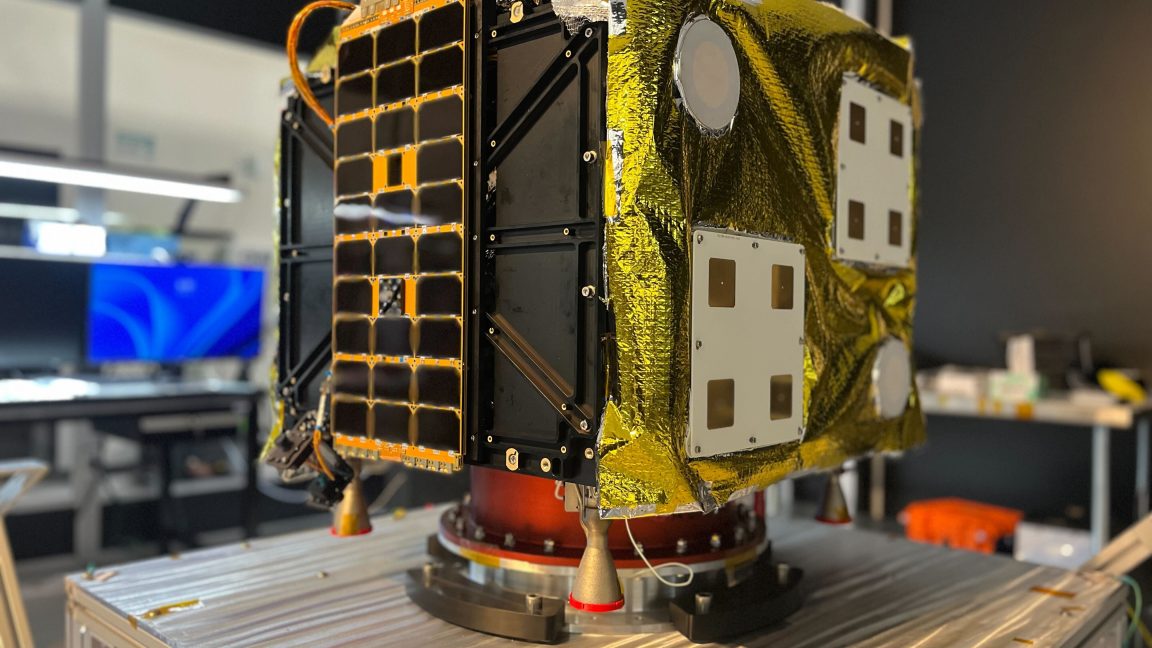
Against all odds, an asteroid mining company appears to be making headway
It's not easy to ever raise for an asteroid mining company, right?"
Ars Technica
154 points · by bookofjoe · 2y ago · 177 comments
I suspect that near term they might make some decent money just returning small samples for labs to analyze. If they can figure out how to do that economically they can likely survive off of grant money from various government entities. Contracting their asteroid lander for various science missions is also a good opportunity.
It’s true that the relative value of these materials will be higher in space (since your alternative is lifting it out of the gravity well) but there may be so much supply that you can saturate the space market and justify the extra transport cost to sell it on earth too.
Suddenly you only need to get to orbit, as everything else is cheap, because you can refuel and get water. You can go where you want to go, you can grow food, you can stay in low earth orbit for cheap.
That said, we're a long long way from being able to build a skyhook. I'm only objecting to the "never, ever" part of your post.
Sure, let me qualify "never, ever" as having a time horizon of "so long that anyone claiming that you, the eager investor, will see an economic return on this endeavor in your lifetime is secretly banking on breakthroughs in life extension technologies to make that statement technically correct".
Getting all the other elemental material we need without screwing that up will be a win for our descendants.
In geology, we do something incredibly similar called the Bowens Reaction Series. Take a bunch of stuff, melt it and cool it, watch what precipitates and crystallizes from the melt in order to determine the overall composition.
Can't you just throw it in the shade and wait? Space is an excellent insulator, but radiation cooling still happens. Just let it sit there for a few weeks/months and you're all set, right?
Scott Manley did a good video about it.
https://youtu.be/5kl2mm96Jkk?si=Uf9ntP6R39SJrVBm
Skip to 3:45 for your exact "well meaning suggestion from people who aren't rocket scientists".
It does not work for asteroid mining.
There you have just pieces of iron with a low content of alloying elements.
Among the alloying elements, nickel is the most abundant (17.3 times less than iron), then cobalt (20.9 times less than nickel), then germanium (20.4 times less than cobalt).
The precious metals that would justify the mining operation are present as a few grams each for a ton of iron.
Melting the alloy will never separate the metals by itself.
However perhaps some kind of floating zone melting could enrich the proportion of precious metals in a part of the iron, but it is very unlikely that a high enough enrichment could be achieved by a reasonable number of zone melting passes.
On earth the cheaper metals could be dissolved by an acid solution, but on metallic asteroids you have neither water nor acids.
The SciFi solution would be to vaporize and ionize the metal alloy and separate the metal ions by their specific charge, like in mass spectrometry.
This would need a lot of energy, but at least it does not need reactants and it is the only method that achieves almost perfect separation.
However for now, the throughput of such a ionic separator is extremely small, too small for industrial production. Perhaps it will become possible to scale such ionic separators to acceptable productivities.
Someone talked about 3D printing mostly hollow golf balls in outer space and dropping them onto a desert where they could be picked up .
It seems to me that when people make the kind of argument that you're making they're forgetting to price the negative externalities that Earth based mining cost our society via environmental damage.
If the environmental damage and species decline that we're experiencing from our planet-side economic endeavours were properly priced in space based manufacturing and asteroid mining would look a lot more attractive.
NEO is too resource starved for it to ever be independent enough to be cheaper than just managing resources better on the surface of Earth.
Design the robots out of materials that can be found in space. Then make them capable of reproduction. Then you can just scrap damaged robots as long as you can replace them fast enough. This also has the benefit that you just need to send up a tiny bootstrap population, but with time you will have quite the formidable workforce.
If we had these materials in absurd excess, we could literally build hospitals from silver and the electric grid from gold, and it would be great for our civilization.
https://pv-magazine-usa.com/2023/11/20/reconductor-existing-...
https://haas.berkeley.edu/wp-content/uploads/WP343.pdf#page=...
https://www.entsoe.eu/Technopedia/techsheets/high-temperatur...
Nevertheless, in the crust that covers the surface of the Earth, the abundances of gold and silver and of platinum-group metals are many orders of magnitude lower than their average abundances in the Solar System.
For instance most of the silver has remained in deep parts of the mantle when the crust has formed, so silver is 11 times less abundant at the surface of the Earth than in the Solar System.
Gold and the platinum-group metals have gone to even higher depths, in the iron kernel. So at the surface gold is almost 300 times less abundant than in the Solar System, rhenium almost 600 times and nickel more than 900 times less abundant than in the Solar System, palladium around 3000 times, platinum and ruthenium around 5500 times and osmium and iridium around 50000 times less abundant than in the Solar System.
Similar numbers apply to all of the 8 planets that are big or medium-sized and also for some of the small planets and big satellites, because all these have been melted at some point in their history, when all the metals with high affinity to iron or sulfur have gone to inaccessible depths below the surface of those planets.
In the outer parts of the Solar System, the bodies are covered by thick layers of ice, but for the 4 inner planets the silicate crust that we see covering their surface is similar to the slag that forms at the surface of the iron smelted in an iron furnace and it is similarly depleted in the metals with low electropositivity.
You sure about that? Here's just one asteroid made of mostly gold, nickel, and / or iron that's supposedly worth many times more than the entire global economy. Pretty sure that anything we have here on Earth also exists "out there" in much greater abundance than we could ever possibly imagine here on our finite little speck of a planet (except maybe "life", which we only have absolute proof of here on Earth).
I wouldn't expect asteroid mining to be viable until we have Starship or something like it at scale, doing thousands of launches per year. If most of those flights return empty, then that's a lot of cargo space already available.
Starship uses $1 million in fuel to launch 100 tons to LEO, so half that much should be plenty to take 50 tons back down. But Starship's propellant mass for launch is 2600 tons[1] so that'd be up to thirteen launches to put the landing fuel in orbit. Actually it'd be less, since a lot of the orbital velocity is burned off by atmospheric breaking, not sure how much.
Ideally though, get the fuel from the same asteroids you're mining already. Starship uses methane, so you're just looking for water ice and carbon, both abundant in asteroids.
At current prices, 5000 tons of gold is worth about $400 billion, so it's not obvious that this wouldn't be economical. The world mines about 3000 tons of gold annually and the price of gold has still been going up, so if our asteroid miner returns a couple thousand tons per year it might not crash the price too badly.
[0] https://space.skyrocket.de/doc_lau/super-heavy-starship.htm
That would enter the atmosphere orders of magnitude slower than meteors do. Would that be enough for it to largely survive the fall to the surface either stay largely intact on impact or break up but the pieces would all be in the same general area?
i mean i'm not an expert in the area, but i think this is a well-understood set of problems. passive reentry vehicles have been used for decades for spy satellite film canisters, v-2 ballistic missiles, scud ballistic missiles, icbms, mirvs, and space capsules like those used in the vostok, apollo, and mercury programs. it gets easier in this case because you don't care if it breaks when it hits the ground, so you don't need parachutes or retrorockets; you just don't want it to vaporize
specifically, a hunk of mass at rest at the von kármán line of 100 km has 981 kilojoules per kilogram of gravitational potential energy with respect to the ground. one degree of temperature is roughly one kilojoule per kilogram, so that's roughly 981 degrees of heating if it falls to the ground from that height with no further air resistance—not enough to melt steel, nickel, gold, platinum, or even mafic rocks. and it's still 981 kilojules per kilogram whether it's a kilogram of platinum or a thousand tons of platinum. but it gets better! that heating is shared between the reentry vehicle and a somewhat larger mass of whatever it hits, roughly in inverse proportion to their stiffness. and of course there is atmospheric resistance, even without a parachute—quite a significant amount of it at the comparatively low sectional densities you need to lose most of your escape velocity from hitting the atmosphere. so, typically, when meteorites land, they aren't even hot. the arguments above explain why in most cases they can't be hot unless they hit so hard as to blow open a crater
980 kilojoules per kilogram is 1400 meters per second, about mach 4, so you really don't want it to hit you. but it won't even melt, and newton's penetration depth approximation assures you it won't penetrate very far into the ground, like, less than a meter
so basically you're worried about a nonproblem
The first obvious assumption is would have to be launched from space and return to space because the cost of getting a payload from Earth to LEO is a huge extra expense.
Then you have to consider the delta-V of getting to the asteroid, doing a rendezvous and getting back. If that's so significant that the Earth launch cost is trivial then the delta-V budget is so huge, it must make the endeavour even more uneconomical.
I believe humanity's future is in a Dyson Swarm. There are simply too many advantages. This is a deep topic. The question is how do you bootstrap that? Where do you get raw materials?
I don't think it's from asteroids. I very much suspect it's from a larger body and my money is on Mercury. Why? On pretty much any body in the Solar System you're living underground so Mercury is at no disadvantage here. It has no atmosphere. That's an advantage. Mars's super thin atmosphere is the worst of both worlds. Additionally, Mercury is metal rich and due to its proximity to the Sun, energy is abundant (ie solar power). Interestingly, it has a higher orbital speed than Earth (47km/s vs 30km/s). That's really interesting because it's free velocity to leave the Solar System.
Resources on EArth are so ridiculously cheap. You can mine iron ore for a few dollars a ton at scale. You can convert it into steel really cheaply too (again, at scale). Doing anything in space requires having truly stupendous amounts of cheap energy available.
Considering just the initial mining and construction, bodies with low gravity and proximity to the earth feel like an efficient starting point, right? I always thought the moon would be a good place to bootstrap the first few thousand space habitats.
Your point about energy will probably be the biggest deal. Wondering how complicated it would be to ship a bunch of nuclear reactors to the moon. There seems to be quite a few companies working on small, "mass produced" reactors currently.
And the sun is a gravity well. Mercuries higher orbital speed will not help you leave the solar system. In fact, it is the other way around.
Oh, and solar cells are already crazy good. With all the space you have out there, higher energy density on mercury will be very marginally important.
We can't even just laugh.
Or so that you can do other things, like drink it...
Highly doubt such chunks are floating around our solar system but it's an amusing thought that one day hundreds of years from now we could nudge a (much) smaller chunk into orbit or park it in a Lagrange point and shave off pieces to return to earth.
Aren't neutron stars 12 miles in diameter on avg?
A neutron star 12-16 miles in diameter contains the mass over HALF-MILLION earths, it is very hard to fathom but yet they exist!
So popping out an earth-sized chunk of gold after collision with say another neutron star (kilonova) and ejecting matter to "normal" density is plausible.
You've also got to slow it down when it gets to where your smelters are. For that I'd propose we just let it smash into the moon and then mine it on the surface. We can alternate which sides we smash into in order to prevent the moon's orbit from changing significantly.
Of course you still need to provide the initial nudge, which ain't nothing, but it's a far cry from towing an asteroid or towing a smelter.
Based on my calculations, with optimistic assumptions (including the asteroid being made solely of the desired material), you need 5 Falcon 9 launches and in-space assembly to bring back one ton of material, which would require selling the material for 350k$/kg for parity. But gold is only 80k$/kg, platinum is 30$/kg, etc.
Doesn't look feasible with current technology.
If you don't pay the demanded price before it arrives in orbit, it will be delivered a full speed on your lawn. Your entire city will be destroyed.
Nothing about actually mining resources and returning those materials to Earth. So they've gotten funding from investors? In the past, even dumber endeavours have gotten even more funding than this, it really doesn't mean anything.
While that sounds simple, it does make it sound like the mining part just became much more difficult.
Thinking about some of the sci-fi regarding asteroid mining, I've always liked the idea of bringing the asteroid to park into an orbit around earth to make it easier/cheaper for multiple deliveries, but I've always wonder what kind of ownership claims that would imply. If I took the time and effort to park an asteroid in orbit, would I have sole ownership of it or would you be able to mine from it as well?
I think you're dramatically underestimating the difficulty of doing this.
If you look at rockets, they're 90-95% propellant. Even relatively svelt upper stages like Centaur III (the upper stage from Atlas v) are more than 50% propellant. And that's for just taking payloads to LEO - for higher energy missions, the usable payload gets smaller, which means the percent of the upper stage that's propellant increases.
How difficult would it be to get an amount of propellant, say, 5 times the mass of the asteroid to the asteroid? You'd also have to get the engines and other structures to let you use the propellant in a productive way.
It's way easier to extract valuable parts from an astroid and move a lot less mass there and back.
As for moving the asteroid you could use extremely high specific impulse ion thrusters, in situ propellant from the asteroid itself, or a solar sail. But you are right that simply firing the valuable stuff back to Earth is probably easier.
Mass drivers and linear rails are also viable ways of bringing raw material into Earth's orbit from asteroids of a certain size.
So what you’d want is a LEO starting point/station. You launch a barge from there to snag an asteroid. You could use a mass driver using solar or nuclear and mass from a previously spent asteroid to get to the asteroid belt, then snag an asteroid and use its mass to get back. You strip the important parts of it, construct a capsule for what you mined, and nudge it so it falls someplace in say a shallow part of the ocean. Then recover from there.
Or hell why mine it up there? Simply nudge an asteroid on a collision course towards Earth to make sure it falls someplace “safe”. Sure most of it will burn up but not all. It’s free material after all.
The biggest amount of delta-v is necessary to leave Earth's gravity well. Once you're there, going from and to asteroid is time-consuming but doesn't need that much delta-v, moving ore from the asteroid to Earth would cost some fuel, proportional to the mass.
So moving it into orbit would save time but require us to pay for the fuel all at once.
So why should someone do this, unless you need a permanent human presence on the asteroid?
Activity is only economically valuable if it is valued - i.e. by people.
Unless there's a population of people living in space, the ore or products derived from ore need to eventually make their way to Earth in order to be worth while.
Nobody cares in sci-fi about whether something should/could be done. That's not the purview of the plot. It's also not the purview of the original comment.
I guess one risk would be introducing unknown biological or chemical nastiness. Another would be how precise we could be to target open ocean/desert/etc.
As all these options are cheaper and easier than asteroid mining, and as none of these bright-eyed ‘entrepreneurs’ are undertaking these tasks, I can only assume the things being ‘mined’ are gullible investors. (Not that I’m blaming them… what’s easier? Finding an asteroid with a precious metal, mining it and getting it back to earth at less the cost of mining it here? Or, finding a gullible venture capitalist who will cover your salary for a few years? Probable the latter…)
Water, volatiles and carbonaceous materials anywhere else in the solar system: priceless
(1) Build a solar sail factory on a CC asteroid and you can deliver sunshades to Earth-Sun L1 without wasting volatiles as reaction mass
(2) If you read this paper and really thought about it
https://arxiv.org/pdf/2011.07487
You’d realize that it strictly dominates all other space colonization schemes that have been proposed because it doesn’t waste volatiles for transportation. Certainly O’Neill’s ideas look infeasible in comparison (where do you get the nitrogen to fill those big airspaces? My plan for a baby Bernal sphere intended to be a luxury hotel in LEO still takes 15 starship loads of LN2 for the atmosphere)
Even Musk’s plan to colonize Mars is something that only makes sense to people who were born on a planet. If “grabby” aliens capable of interstellar travel and building such things here they might find the Earth a curiosity at best.
Using ion thrusters it is already the case that we have access to power-generation-limited domain of specific impulse; Nobody thinks a mission at 30,000isp instead of 3,000isp is superior for interplanetary because of the sheer amount of waiting time and the extreme mass fraction of the solar panels. Solar sails, even moreso.
And one more dream to kill - large open volumes are probably never going to happen. This is implied by the mathematical engineering reality of the thin-walled pressure vessel, whose minimum mass scales directly with (volume * pressure) / tensile strength. Contrary to my naive expectations, there is no square cube ratio to the structure of a pressure vessel, so every cubic meter costs mass.
Better these two as a role model than Theranos though.
Obviously the lack of any squishy humans that need to be part of the process makes it less of an issue when nothing comes of it.