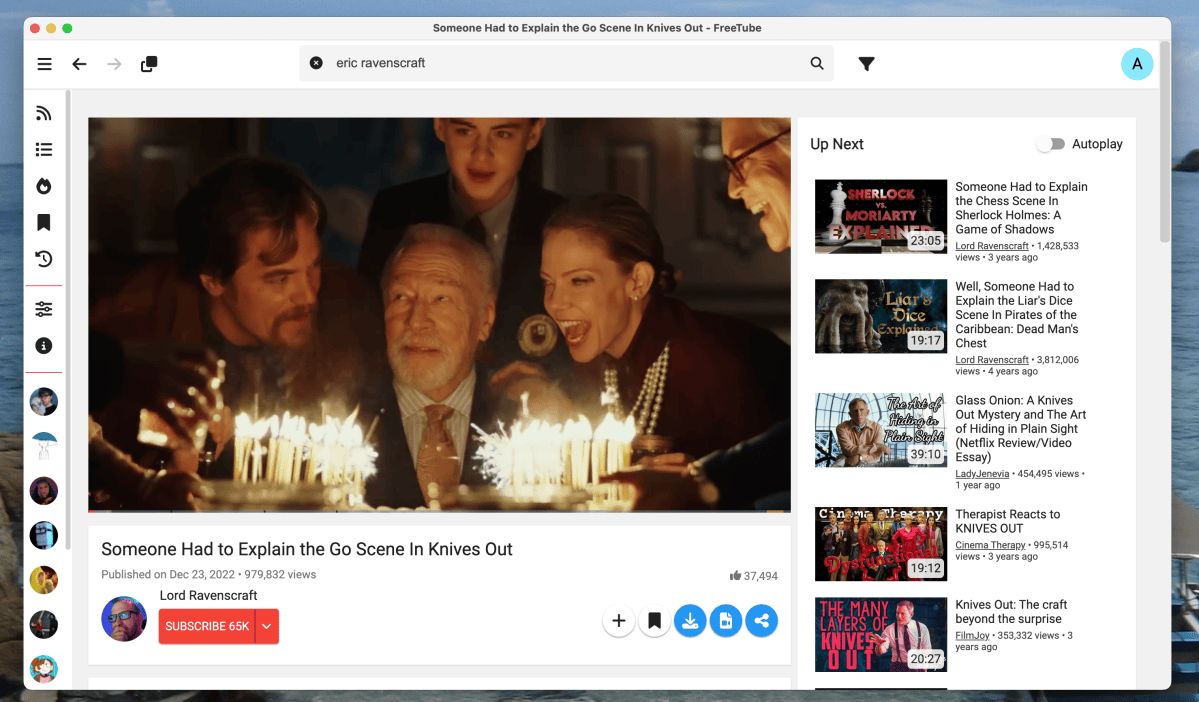
Freetube is the best way to watch YouTube
Customize YouTube to work exactly the way you want it to.
Popular Science
87 points · by geox · 2y ago · 133 comments
There is an unwritten social contract here. Google is willing to host and organise a vast number of videos because that'll attract an audience for ads. If there are too may freeloaders resisting the ads then Google won't host the videos, and on the path to that the freeloaders are really just leeching off a system in an entitled way (unless their goal is to destroy YouTube in which case good on them for consistency and for picking a worthy target).
If people aren't going to be polite and accept that contract then fine, enforcement was always by an honour system. But strategically if Google's social contract doesn't work for someone then they shouldn't use YouTube - they'd just be feeding the beast. They should go make PeerTube work or investigate the long list of alternative video platforms https://en.wikipedia.org/wiki/List_of_online_video_platforms .
Why is running ads the _only_ choice? Why can't a creator opt to pay to host videos on their channel with limitations? $10/month? That's 30 videos in HD max. $100? 300 videos in 4K... etc. ... or whatever.
As a content creator with seven years experience, hundreds of videos and thousands of hours of content: I use Freetube. Please use it until abusive adverts and practices aren't a thing anymore.
There's no guarantee creators can collect as much income without Google either. Google has proven they can get way more income from ads than pretty much everyone else, and even bug channels with sponsorships still derive a very large income portion from Google ads (based on what I've heard from LinusTechTips videos)
Genuinely curious, would you still go for it?
For Google? You think Google get a monthly bill for their bandwidth?
Conceivably an option for professionals with business models but hard to see it being a default for a service that wants traction.
$100 wouldn't even cover the storage mate. Let's say you've got 2 thousand hours of content (smallest amount that qualifies for "thousands")
At 2k resolution, that'd be around 30TB And you'll want to preprocess it to 1080p, 720p, 480p, so add another 15tb for the other resolutions.
And YouTube supports 4k, so if you're shooting at that resolution, you can add another 50tb on top.
Purely storage you're already looking at a ~$2500 monthly bill.
And then you're gonna have to host and serve it to hundreds of thousands of viewers, the bandwidth cost is gonna be astronomical. Every 100 hours of streamed content is gonna be another ~$100 on top. With a 15 minute video, that'd be 400 views.
And I significantly rounded down on every calculation as this is napkin math. If you'd use AWS S3 pricing for storage and egress you can safely double my dollar numbers.
$100/month for 50TB probably isn't feasible but start compromising on resolution and something could be made to work.
Also let me opt-out of the algoritm.
It seems the problem is, with YouTubes monopoly, other services have almost no chance to succeed because of the "Network Effect"...
[1] https://en.wikipedia.org/wiki/Nebula_(streaming_service)
"Freeloading" off a $2T company. Not really. What is really going on.
If Google was concerned about "freeloading" then they would not be encouraging people to store their data "in the cloud"; they would be encouraging them to store it on their own computers. Google wants people to upload data "for free" to Google servers. They design software and hardware to coerce people into uploading, e.g., "syncing".
It's not cool to invade peoples' privacy for profit. That is a social contract that has been broken.
Google could charge fees for storing peoples' data, these fees could cover the costs and allow for some profit, but then they would not be a $2T company. Only a relatively small number of people would pay. The Google customer is the advertiser not the uploader. Thus, this alleged "social contract" to allow Google to spy on people through their computer use, including surreptitiously sending data to Google, is motivated by greed.
That's the ugly culture.
https://news.ycombinator.com/item?id=41404530
Top comment: "If [the university computer science department's] cluster somehow ever runs out of disks, I'm happy to donate a terabytes worth, but like hell I'm giving money to big-G for cloud storage."
it's not ugly at all: parasites deserve their place in the ecosystem right alongside carnivores.
What I don't like is people like this who broadcast and evangelize as if google will allow it to keep happening. I'd rather it survived longer hiding under the radar.
"hey everybody I discovered a secret hack to get a free donut with your coffee!!!"... how about just keep doing it yourself, donuts for life?
Just be prepared for the good times to end at any moment.
Sounds like they can't really complain if someone took that information and made it universally accessible :)
Is this the same unwritten social contract which means we shouldn't use a mute button on ads? After all, the TV company gets paid to send ads to us, and muting those ads means less ad effectiveness.
Don't use the toilet during an ad break either.
Nor use the +15 seconds functionality on video recorder playback to skip ads.
You can see how the social contract for my entire life include the option to avoid ads, and even with 'freeloaders', the broadcast TV business model worked.
YouTube started long after Sony Corp. of America v. Universal City Studios, Inc. ("the Betamax case") established time shifting as an allowed practice in the US. Their business model, based on any implied social contract, must therefore include that possibility, eg, that people may watch content via downloaders.
They could respond by, for example, placing ads directly in the downloaded video steam. This would mean less profit, but no social contract requires customers to keep a company profitable.
And it would be odd indeed if broadcast TV had a more effective business model in the face of freeloaders than online video.
No one has the right to control my client just because I visited their server. If Google doesn't want my client, they can easily block me.
Acting like people running custom clients are thieves or something is ridiculous.
This also frees me from any qualms about using alternative clients, which are superior in certain situations.
Hosting videos costs a lot of money and alternatives to Youtube will see only limited success as long as Google can subsidize the service with the money from the massive spy machine.
Causing maximum drain of resources for Google while providing as little as possible for their spy machine is the ethical choice. Let them bleed. Youtube is the largest obstacle to honest businesses that provide video hosting and viewing in exchange for money - instead of making money from spying on users in ways they are unable to fully comprehend and consent to.
It's not a contract though, its a dictatorship (which they have the right to do) but it's been getting worse and worse for the consumer, and is just another loss leader until who have consumers trapped and then start charging, abusing, etc... I'm with you in spirit, but google is not a good participant in this agreement as of late.
Then don't complain if people block your stupid ads and count yourself lucky that the government didn't split your megacorp into several tiny companies
The only morally wrong thing here is NOT blocking Google's ads
On paper it looks something like a choice between one company with one shareholder or two companies with ... the same shareholder. It isn't clear what has really changed; the company was only ever a legal fiction anyway. If there were incentives to collude then they haven't gone away.
From a business perspective the building is a shop. Anyone without money is provably there to just wander around looking at things. Doing this a lot is weird, especially given that 99% of visitors buy a coffee or a pencil to keep the museum going.
From a user perspective it’s a museum — the whole point is to wander around looking at things! Should it be required that you buy something, or at least be forced to exit through the gift shop?
All we need is hosted APIs and frontend frameworks to wrap content as the user desires.
Charge API users for their bandwidth.
I don’t want Google also deciding what to boost to help them gobble up more human agency.
Reduce redundancy by making HR its own thing.
At the end of the day Google’s core engineering competency is load balancing date center use. The rest is behavioral economics research influenced gamification of our agency
Don't like the ads? Don't visit the site then. Simple as that.
Google have provided an invaluable source of information all for free. The least you can do is watch some ads and let them harvest your data.
But now it's intellectually dishonest at best. We're not serving static images with hyperlinks anymore, either, but full-blown malware that tracks people against their will.
So who's really being unethical here? The amoral ***** who write this malware "because it's their job", or the people who are simply trying to protect their privacy from being raped?
> So who's really being unethical here? The amoral *** who write this malware "because it's their job", or the people who are simply trying to protect themselves?
No one is forcing you to visit sites with "malware", you are equally as free to visit an alternative site that doesn't have ads or trackers. And call it what you will, that "malware" is essential for the web as we know it to survive. How else will Google be able to maintain the monopoly on video hosting if they can't harvest and profit off the data off freeloading users?
Also, for YouTube there is a simple solution: it's called YouTube Premium. You see no ads and you get great perks to boot. And Google promises to respect your privacy so long as you use YouTube Premium.
I have no moral issue with this either. If Google wants money then they need to be more legitimate in their business dealings. No ignoring DMCA abuse, no ending user accounts with no appeal, no dark patterns period.
After a few minutes I would say this is easily the worst way to watch YouTube short of printing the videos out.
They present a perfectly valid choice to you, and it works great. It’s a reasonable enough price (not great but reasonable), but it supports the creators you watch with part of your subscription money.
Plus it has other benefits if you care, like free TV shows and movies and YouTube music. I don’t use that stuff but it is there.
Why are you entitled to ad free viewing?
“It’s only a few so it’s ok I take something for nothing” is not a legal concept I think would hold up in other contexts.
What I'm entitled to is to do whatever I want with every bit of data I download through my browser. The day this stops being the way things are, is the day the web dies, and I can't believe anyone (particularly here) could be defending that.
YouTube provides their data freely. You don't have to sign-up or accept a contract. You open a link and locally download said data. It's on my device, and I control my device, not Google. I can do whatever I want with the data I download, I can make the background pink, I can change some text for something else, and I can take out the parts that I don't like, like ads.
If YouTube wants to stop providing their data with no strings attached, they can. Reddit didn't like the way many of their users used their API, so they blocked it, and I don't use Reddit anymore. If someone doesn't like the way the open web works, they are free to leave, but they can't change the rules.
You ask why we are entitled to ad-free viewing. I ask why do you think Google is entitled to dictate what I do with the local files in my personal device. Do you feel entitled to open your browser's dev tools right now and modify this comment I just wrote?
Some of these are open source and easy to run, like https://github.com/iv-org/invidious
https://github.com/FreeTubeApp/FreeTube?tab=readme-ov-file#d...
I am looking for a better open-source alternative tbh.