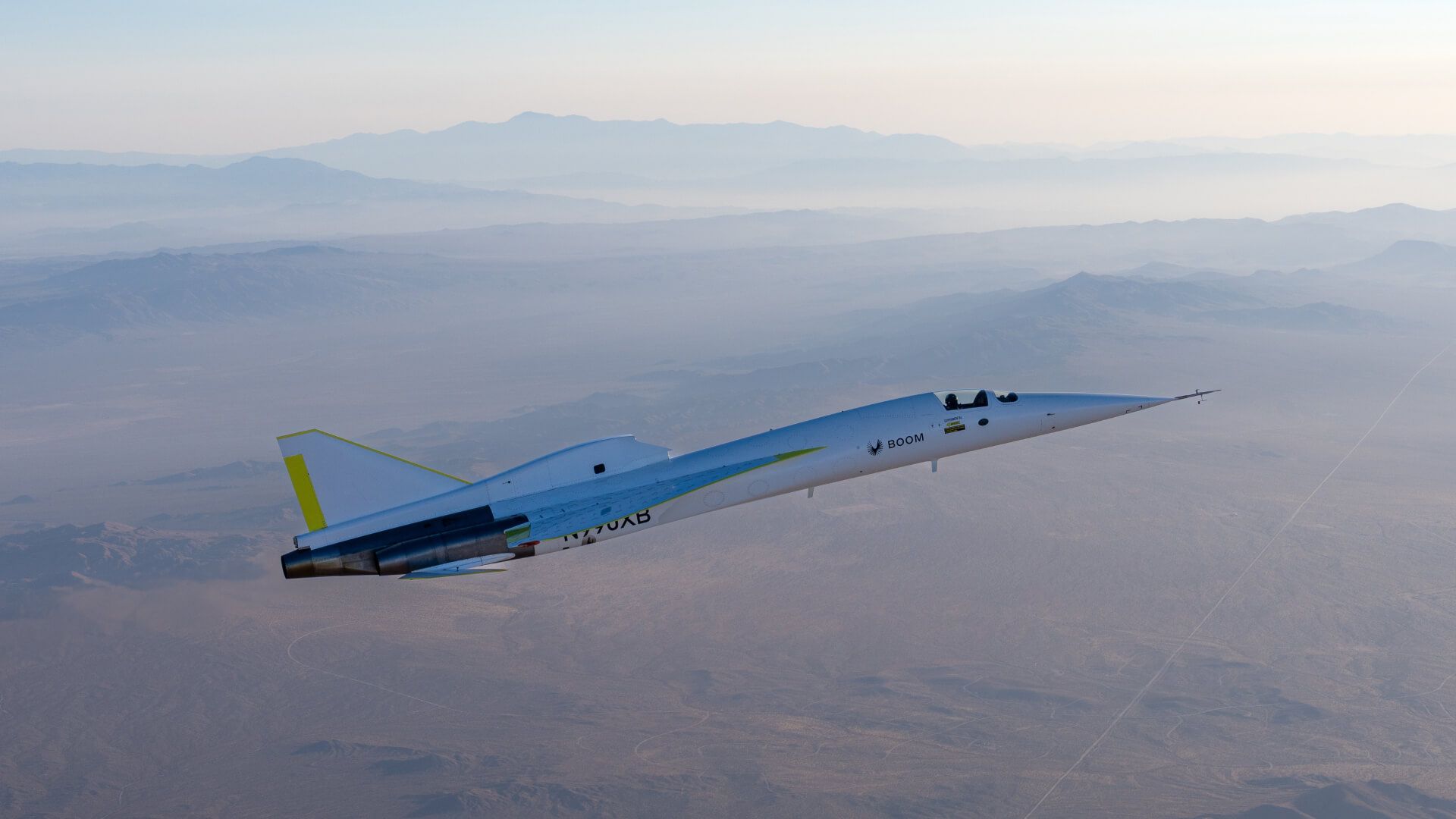
Boom Supersonic
The flight tested the vehicle
Space
123 points · by belter · 2y ago · 119 comments
The model for all of these aerospace startups is to just develop something interesting enough for an acqui-hire. Boom will never build a passenger jet. But some of their tech may make it into the next generation of GE engines if they're successful.
Ferengi Rule of Acquisition 35: Peace is good for business.
The economics of the Concorde were significantly impacted when India prohibited Singapore Airlines / British Airways from flying over Indian airspace[1].
[1] https://www.heritageconcorde.com/singapore-airlines-concorde...
Overture targets ICAO Stage 5 noise levels, the most stringent international noise standard [1].
[1] https://hmmh.com/resources/news-insights/blog/stage-5-aircra...
The XB-1, the 1/3 scale model, uses standard General Electric J85 engines.[1] Old, reliable, not too expensive, and used by many prototypes over many decades.
It echoes my criticism of Virgin Galactic checks notes ten years ago.
That said, Boom started dancing with the DoD in ‘22. That’s a deep pot of cash, and could help make up for inexperience.
Hahahaha. No.
That China still has trouble is one thing. The fact that Russia also has issues, with around 80 years of experience, tells you everything you need to know about how non trivial the task is.
If I'm reading things correctly it looks like Stage 5 caps out at 50dB, whereas a cursory search on the decibel levels for a supersonic boom comes up with 110dB.
That seems like a pretty large divide! Am I missing something?
Edit: A sibling comment appears to have addressed my confusion.
Short answer is we aren’t able to predict how loud a sonic boom will be [1]. Raw decibels produced at source is one thing. But you also have components like direction, dispersion (spatially as well as temporally) and frequency and how altitude and even moisture effect all that.
We’re making progress [2]. But the conventional wisdom is you need a perceived loudness on the ground that matches subsonic airliners to have a hope in hell of FAA approval. (Would note that a sonic boom in this context is not a physical phenomenon but summary of perceptions. There will always be an acoustic reaction to supersonic flight. But the far field effects that characterise a “boom” aren’t inherent to supersonic flight.)
[1] https://digitalcommons.usu.edu/cgi/viewcontent.cgi?article=1...
[2] https://www.sciencedirect.com/science/article/pii/S037604212...
Note that they are talking about takeoffs (and presumably landings) only where there isn't any sonic boom anyway, not cruising.
Hell of a claim with zero evidence. By your logic, I could disprove the Sun by not observing it at night.
Yes, the ICAO rules are for takeoff and landing. When subsonic planes are the loudest. Concorde, for example, couldn’t have met these requirements.
We don’t know what Boom are targeting for in-flight noise. But we can guess, based on its parity with ICAO take-off and landing requirements, that it aims to match subsonic noise levels on the ground. There is strong evidence we can soften and disperse a high-altitude boom [1]. Whether it’s doable by Boom is an open question.
So no, it’s not a lie.
[1] https://www.nasa.gov/centers-and-facilities/langley/nasas-su...
Boom will still have to meet all noise pollution rules now and in the future. Noise rules are designed for normal passenger aircraft, they will not get any exceptions.
I don't doubt that they can make something much quieter than Concorde but can they make it as quiet as subsonic aircraft?
90 minutes out of 17.5 hours of travel ( 16 hour flight from SFO to Singapore) represents a small amount of 'incompressible' time - cutting that 16 hour flight down to 8 or 10 would make a HUGE difference, especially given timezone/IDL issues.
If not, there's always trans-oceanic flights.
1. How did a SWE start and raise funds for this company
2. How did he/they recruit the kind of talent you'd need to actually build a test plane
3. How much is left to do before a real commercial flight, and can they really do it?
A few months ago the conversation was "if they depend on next-gen engines and next-gen fuel this entire company is hindering on tech that isn't even available yet" so as a very non-aviation person, what does this test flight prove? It's not the air frame, its not the engines, its not even the full control suite.
This? Nothing of general consequence. Once XB-1 goes supersonic, which Boom says it’ll do later this year, we’ll get real-world sonic-boom reduction data that could influence the FAA. It will also demonstrate the drag of their nose design, which should inform fuel-burn estimates for their airliner.
Following that, the hurdle is the supercruising engine. The XB-1 uses afterburning J85s to go supersonic. Presumably, getting the FAA to flip on overland bans would unlock the capital needed to finish Symphony [1].
Impressively experienced folks behind the Symphony engine.
None of the majors were interested in making a 35K engine (or apparently modifying their cores with the previous 4 engine design), it would be in a zone between large biz jets and commercial single-isle. The former are hundred million dollar iterations of existing designs, the latter are billion dollar developments now. As this is not a conventional engine, it will cost $1B to certification if they're lucky.
I guess it's theoretically possible if KSA is funding it like Lucid and your expectations are way lower than Lucid.
edit: not a Fourier transform
2. People want to work on cool stuff, if you have the cash for it, it's not actually that hard to find talent, particularly if you are working on something without a competitive hiring market (ie jets, not AI atm).
3. I feel pretty confident they can build a plane, there are many people who have worked on planes, many components are off the shelf, etc. The question in my mind is if they can meet somewhere in the middle on sonic boom reduction with regulators in a reasonable amount of time.
Building a large jet-liner isn't something many companies have done. Let alone a supersonic one.
Ultimately being a great founder requires humility to hire people smarter than yourself, drive to face adversity, and storytelling to build allies + capital.
Doesn’t matter if you’re a high school dropout or a PhD if you can’t rally a team to believe in a mission.
Beck didn't attend Uni, was a tool and die maker at Fisher & Paykel (they make fridges and respirators).
He then went on and took on the world who said "you can't build a rocket company in New Zealand".
Pretty interesting story overall
Back when I was a CompSci student two of my friends did their dormmate's fluid dynamics project overnight in exchange for half a liter of fluid dynamics. Personally I was more into helping my other friend with his analog circuit assignments.
What I'm getting at is that Software engineering is not completely removed from the rest of STEM fields.
He was a SWE at one point but it seems like his career was more in the executive/leadership space before starting Boom.
If nobody else is doing it already that just means very smart people have crunched numbers at those giant corporations and decided against it.
10 years ago I would've been excited but when I see outlandish valuations and startups without relevant experience in the very field they are going after, I assume bad faith
Thus far it looks similar to an upgraded T-38 to me. The XB-1 and T-38 are similar (ish) sizes, have roughly the same takeoff weight, both use the very old/proven J85 engines, etc.
If Boom can pull off the Mach 2+ supercruise concept for this demonstrator, they might well secure a spot as a low cost 5th gen fighter trainer with good export potential as a cheap fighter/recon platform.
This has been explicit for at least 2 years [1]. It’s why I think their idea of an airliner (and in-house dry super-cruise engine) isn’t just vapourware.
[1] https://aviationweek.com/shownews/farnborough-airshow/boom-u...
When has the U.S. military ever acquired a contractor?
> Why does that help make it not vapor-ware?
The military has money. There is obvious strategic value in a second supercruise turbofan, particularly one optimised for high thrust and efficiency.
Avionics and radar seems to be very expensive and where fighter jet manufacturers can make their own to capture the margins but I'm questioning whether a founder with no aerospace experience is able to produce military jets with even more stringent regulation than supersonic flights
From what little I remember of reading about the first attempts at supersonic flight, there were a lot of unknowns and somewhat counter-intuitive factors, and it was being calculated on slide rules. Can modern engineering and simulation software reasonably predict the effects of supersonic flight on a model?
Why is it a startup without the same engineerforce or airline experience?
Is the goal to sell another dream after dream to enough whales to be able to cash out on secondary like Uber and WeWorks?
Seems like the most successful startups isn't actually finishing a product or providing forever jobs but sell enough of the half baked dream to enough investors to discover liquidity.
That doesn't seem like a very good thing for the economy in the long run. Money and resources are spent with the sole purpose of producing a few billionaires who will park their money outside the economy and pay little to no taxes and have it insured by bailouts by the people who made it happen.
In my opinion it's because it's been tried already and no one, including Boom, has managed to figure out how to make it part of mass market air travel.
Boom Overture will be slower than Concorde, carry only 80 passengers, and will only be allowed to be supersonic away from land. The range is 4 250 nautical mile which is a little further than Concorde's 3 900. Perhaps that might be enough to tip the balance and make it profitable but it seems unlikely to me. Concorde carried between 90 and 120 passengers.
An Airbus A340-500 has a range of 9 000 nautical miles and carries at least 270 passengers so it carries three times as many passengers the same distance in only twice the time. Which surely makes it more economical. But in can also carry them twice as far before refuelling.
So it looks like Boom is only competing directly with Concorde and it's only selling points will be reduced fuel consumption and more comfort.
I dare say I've missed something because a lot of smart people seem to think it will work.
Because for the most part their costumers aren't asking for it. And therefore the market is very uncertain. You need to sell a large number of planes, to make this work. Projects like the A220 have been selling 100s of planes and aren't jet profitable.
And even beyond that, they have plenty to do. They have huge existing backlogs, and they need their engineering talent to develop next generation planes that can pass future legal restrictions for noise and pollution.
I will believe Boom will actually make money when they actually do.
The Overture airliner, with an entirely different configuration, will also only operate supersonically over oceans.