29 points · by ChumpGPT · 2y ago · 147 comments
The reality is ICE in general, hybrids doubly so, are extraordinarily complex machines with over 100 years of highly funded research invested.
EVs are incredibly simple machines with a limited amount of research applied mostly by a few companies that are very young.
The engineer in me sees the complexity argument as insurmountable. Over time ICE improvements will be flat as diminishing returns set in two decades or more ago. Their complexity isn’t going down, every improvement adds a more complex manufacturing process and complex machine - either in terms of materials or process.
EVs are almost certainly on the other path where their machine becomes simpler in exchange for a more complex science, but the science is effectively the same science that yielded modern computers - solid state, in the end, in a manufacturing process that can scale absurdly. The machines if built with intention will effectively never break or need maintenance beyond a few simple parts. The disposable parts are 100% recyclable.
As t->inf the age of fire is already over, and the age of maxwells equations is starting in earnest. As we put down our distilled flaming dinosaur juice and take up fundamental forces, these discussions will feel anachronistic rapidly. The infrastructure discussions are simply engineering and investment challenges, which will yield, as the complexity of the underlying machine has already doomed the ICE.
The programmer in me dislikes complexity too, but if we apply your argument to cell phones vs land lines, we can see that simplicity doesn't always win.
If you could only drive electric-based cars around your own neighborhood, the usage modes would also be entirely different and they never would have taken off either. (As, case in point, did effectively happen in the era of electric golf carts. It wasn't until they got real cars with real car range that things were comparable enough to challenge the status quo.)
Why would you presume that? The guy I replied to made an argument about ICEs being more complex than electric motors.
And fwiw, it looks like that post has been edited a ton. I was replying to a relatively simple (and questionable) statement.
Dude said: (1) engines are more complex than battries. So that means battrie cars will do really well on the long term, being simpler and all. The complexity makes engines (also known as "frozen water") more expensive to make, less reliable, and more tedious in general. (2) stringing a bunch of wires is complicated, and you ain't got to mess with that noise with a cell phone because it don't need no wire and is therefore simpler
I agree with this to a large degree, but it's somewhat beside the point. Those challenges haven't yielded yet, and the state of things in the now are what's important when deciding what sort of car to buy.
Few people are going to buy a car that increases the problems in their day-to-day lives on the hope that those problems will be resolved in a few years.
Yes they are complex mechanical things by some measures, but really not more so than say, a mechanical clock. Intermeshed gears, cams, cranks and that sort of thing. The materials and durability demands are different sure, but these problems have been solved.
Many of the other things that are complicated in modern cars are the same in an EV: automatic climate controls with flaps and dampers, the air conditioning system itself, which is even more complex on a battery EV that has to manage battery temperatures, antilock braking systems, automated suspensions that adapt to road conditions, lane-keeping, automatic parking, variable power steering, etc.
I’d also note you’re only considering the manufacturers perspective. As a consumer of cars, the complexity of the machine results in a long list of expensive regular maintenance, of which almost none of applies to EVs.
Finally I’d note that saying both have a basis of complexity that’s unchanging doesn’t in any way change the point that ICE then have a ton of additional complexity. Just because at our current scale and research the unit cost of the complexity is about as small as it can help doesn’t mean it has a better future. The complexity of EVs will drop as well, and faster, since it’s still an immature technology and supply chain. I think BYD demonstrates clearly that EVs are already cheaper end to end than ICE, and it’s mostly political and infrastructural work. The political side falls apart in face of economics, and the infrastructure side resolves over time just as oil infrastructure did.
I think the real inflection point will be when gas stations start installing fast EV chargers that captures convenience store traffic and conversion better than the pumps, which are already basically break even or worse margins.
Yet, when you buy used car - do you look at climate system or make sure engine works well?
Cost is self-evident: Manufacturers need to broadly address affordability and they've been slow to do so.
Infrastructure pains: Chargers are not ubiquitous--charger hogs, who want to eek that last 10%--and not every home/owner can charge (apartment dwellers). Pro-electric owners are doing a disservice, by pretending that this problem doesn't exist or that this problem is solved. This is what Hybrids solve.
Battery concerns: By stats, the % of battery fires and the % of ICE fires are on par. This is where pro-electric owners tend to stop their argument, but it's the details that matter here.
When an ICE model has a tendency to start a fire at home--especially without warning--that's a major recall and considered a defect. When a battery is dangerously damaged? How does one even reliably assess whether battery damage is negible or a risk?
It's still somewhat of the Wild West.
Battery safety issues may be resolved in a satisfactory manner but that's not a guarantee. If the batteries can be made safer, then great. If it requires civil engineering and planning, then that's a bigger battle.
There's also a matter of sunk cost and market forces: ICEs are fantastically complex machines, but also well-known. Most if not all of the edgecases have been worked out over the decades; and the cost to support the old infrastructure and supply chains are all known quantities.
With EVs, manufacturers will need to build batteries or have redundant suppliers; which is also an unknown quantity and cost. You mention BYD, but given how China is dumping EVs and batteries below cost; the cost isn't exactly a useful metric.
One hopes EVs take off for the sake of climate change, but there are real roadblocks that may stall uptake of EVs.
The problem for me is that I have ADHD. It's extremely easy for me to forget things like removing my car from the loading zone, so there's no way in hell I'd be compatible with going in and out to constantly move my car around. I'd either never get my car charged, or I'd piss off everyone for leaving it parked in charging for days.
Even if the governing body somehow relented and we could install dozens of charging points, it still wouldn't alleviate the problem for me. There's no way I could organize my life around the ceremony of charging.
EVs just don't work for some people. The math might look right on paper, but the shape of reality has more dimensionality to it.
I recently worked, for free on my own time, to help a condo association to plan and install infrastructure to support 200 charging stations across two buildings with ~100 units. Total time investment was ~8 hours. A few folks paid to plug into that infra, but those buildings are now future proof.
If you want help, I can reach out; let me know. We will electrify all the things, because we must [1].
The other problem i see with electric cars is the how long it takes to charge. I'm sure people will respond and say that's just another problem to solve but I just don't see charging ever being as fast as filling up at a gas station. Clearly the activity of using an electric car is going to be different from how an ICE powered car has been used. Has anyone written about this?
I don't think anyone is saying it's impossible. They're saying it's a problem right now, and that's a large part of why so many people avoid EVs.
If someone figures out a way to mitigate that problem tomorrow, then the equation changes. But tomorrow isn't here today, and people have needs to met today.
Surprised you are allowed cars then. Perhaps stick to horses and see if state changes their mind.
At the same time, the engineer in you/us also needs to understand the circumstances of supply and demand. The completely better technology is unaffordable for a large group of consumers, so the transitional technology is selling better.
From TFA:
"Hybrids are also sort of hurting EVs, aided by competitive pricing that is cannibalizing EV sales. Battery-powered cars and light trucks will account for just nine percent of industry deliveries in the U.S. this year. That’s down from the previous forecast of 12.4 percent.
"some Toyota dealers tell [...] that customers are waiting two or three months just to take delivery of a new hybrid.
"eventually EVs will take over, but customers and infrastructure just aren’t there yet. Until then, hybrids are a fantastic middle ground.
The future of EV's depend on one thing: the price of batteries dropping. Once they drop another 50% it's all over. Maybe it's already all over in China.
Batteries are anything but simple. They are effectively nano engineered chemical factories done at massive scale, a scale so big they use 1km sq factories (about 0.4 sq miles) to produce them. Unlike maxwell and silicon, batteries haven't seen decades of cumulative R&D. Right now the press reads like they are at the wild west stage, with new chemistries and production techniques popping up every month.
So yeah, we are at a point in time, but that point in time is being driven by developments in applied chemistry, which is driven by chemists and chemical engineers, not electronics.
TLDR Bet on folks not saving anything for the swim back.
[1] https://www.reuters.com/business/autos-transportation/volksw...
(disclosure: early TSLA investor, no current exposure, know people inside at GM and VW, thoughts and opinions always my own)
I would strongly agree that prices for EVs must be driven below combustion vehicles (we cannot expect people who cannot afford EVs to stretch to buy them; price compression and government incentives are material here), but legacy auto must be driven out of the market if they choose to avoid the electrification transition to maintain their profit levels. If I have to argue why (the emergency that is climate change), there is likely very low value in further discussion. Less profits, as many EVs as possible in the hands of people who drive [4].
[1] https://www.reuters.com/business/autos-transportation/detroi... ("Reuters: Detroit Three automakers should exit China, leading analyst says")
[2] https://www.bloomberg.com/news/articles/2024-05-26/xi-s-chin... ("Fast forward to 2024, and China has become the world’s largest auto market and sells more electrified vehicles than any other country, with 9.5 million cars delivered last year. It also controls the majority of the battery supply chain. Homegrown champion BYD Co. dethroned Volkswagen to become the best-selling brand in China and in the last quarter of 2023, surpassed Tesla as the world’s largest producer of EVs. China also overtook Japan as the largest auto exporter, sending 4.14 million units abroad with 1.55 million of them being EVs or plug-in hybrids.")
[3] https://www.bloomberg.com/news/articles/2024-03-02/how-the-s... ("Bloomberg: How the EV Transition Is Reshaping the Global Auto Industry")
[4] https://www.epi.org/blog/uaw-automakers-negotiations/
> Profits at the “Big 3” auto companies—Ford, General Motors, and Stellantis— skyrocketed 92% from 2013 to 2022, totaling $250 billion. Forecasts for 2023 expect more than $32 billion in additional profits. CEO pay at the Big 3 companies has jumped by 40% during the same period and the companies paid out nearly $66 billion in shareholder dividend payments and stock buybacks.
Based on the data, we can afford it, if we stop enriching those folks ^ I just don't care for the lies that we cannot. If legacy auto must die for the EV transition to accelerate or succeed, ¯\_(ツ)_/¯ them's the breaks. These are choices. If legacy auto (both US and EU) makes poor choices, China will force their hand regardless.
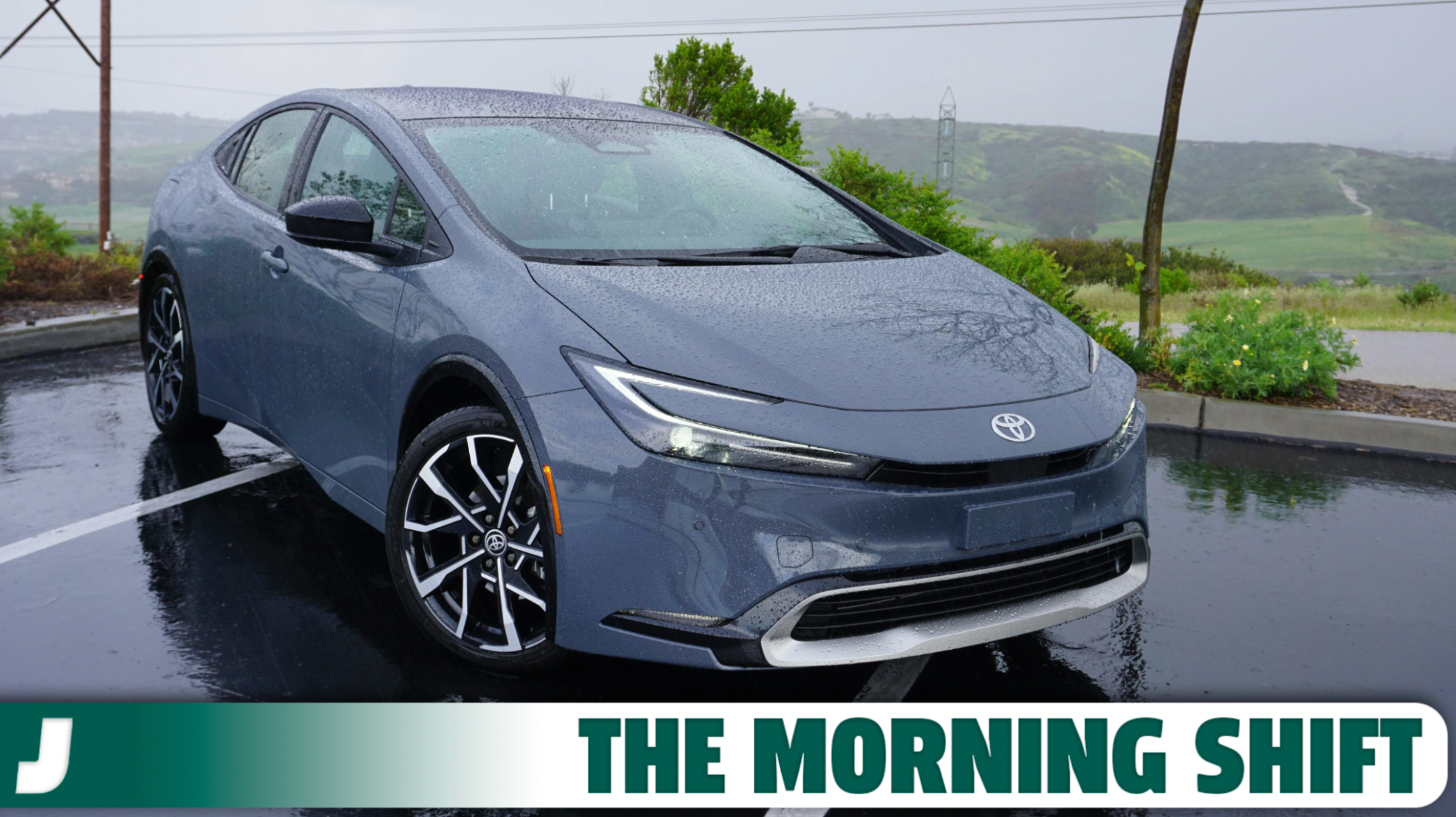
> Hybrids are also sort of hurting EVs, aided by competitive pricing that is cannibalizing EV sales. Battery-powered cars and light trucks will account for just nine percent of industry deliveries in the U.S. this year. That’s down from the previous forecast of 12.4 percent.
Ah, lies, damned lies, and then statistics. The industry forecast of 12.4% may have been too aggressive (which rectum did that number even come from, by the way? The manufacturers still haven't even committed to 12.4% growth on the supply side, they aren't making EVs that fast), but 9% is still a strong year-over-year growth and a faster growing rate than the hybrids mentioned in the article. The statistic here seems to be that Prius sales aren't shrinking. They aren't growing. They don't seem to be "hurting EVs" they seem to be continuing plain ICE sales. But it's not statistics is an easy math field or anything.
I wish we could have a carbon tax instead of efficiency standards but voters vote based on gas prices so...
Edit: You’re also still paying for oil changes, transmission changes, and any other regular or unexpected maintenance on the ICE drive train with a plugin hybrid.
I think this is very doable with sodium ion in advanced lfp.
I think the issue for investors with a car company is that it represents a lack of ability to handle the evening transition and so it really does Mark your company as a dinosaur and keeps them from properly innovating and transitioning.
With sodium ion and advanced lfp, the cost of a very very capable EV is going to permanently drop underneath an ICE. There's simply too much simplification of the drivetrain in EVs once batteries become cheap.
This seems like an easy win for legislation: we just mandate that every consumer vehicle has to have a 35-mile minimum all-battery range with plug-in capabilities; the same way we mandate that consumer vehicles have to have catalytic converters.
Really surprised haven't seen these EREVs in the west, although Hyundai is supposed to launch in US in 2026. Could be game-changer when that happens...
Also, would you classify a Prius Prime an EREV?
I would love to have an EV only car, but there is basically zero charging spot , public or otherwise, made available by the city in the streets (where we park our cars).
As long as cities do not improve their urban environments with A LOT of charging stations everywhere, then pure EV is not practical.
Please explain to me how being in the wilderness camping or fishing without a charge network close by is the clear choice?
Please explain how waiting an hour to charge your vehicle or doing “micro” 20 minute top ups followed by 35 minutes of driving followed by another 30 min top up is the clear choice versus a 5 minute fill up?
Please explain how to get charging when you don’t own your own house and street parking cannot accommodate charging your car overnight?
Please explain how EV is the clear choice when you do have your own house and still cannot get a charging solution installed?
Please explain how one can get a used gas car and repair it and do maintenance for years before hitting the cost of a new EV is the clear choice?
So are EVs the clear choice for affluent, urban people with discretionary income and time to waste when traveling? Are they for people who shouldn’t travel or dislike it? Where’s the clear choice here?
Also, the repair angle hasn't been properly addressed, is there a repairman near me? We all know the dealerships are wolves when taking your car to them.
EVs are often the clear choice for those that exclusively can charge at home or at a supercharger, but pretending there aren't all kinds of drawbacks for common use cases is unhelpful.
But also, the big reason that there isn't the same money in chargers as in gas pumps is how different the equation with home charging available to many, even if not available to "all". It's a different market/ball game from gas pumps no matter what, because electricity is not a centralized fuel source in anything like the gas model, no matter how much you dress up chargers in gas station drag.
Superchargers don't have giant billboards advertising them, they are often very subtly tucked into a hotel or gas station. But they are there.
As a simple example, there are no EVs that serve the regional markets where a Subaru is the inexpensive car of choice. Those long-range, high-clearance AWD vehicles are not some weird lifestyle flex in the markets where half the people drive one, they fill a concrete requirement that EVs currently can't fill.
If that EV is a Tesla, every one of those families I know uses the Tesla for their road trips. Leaf drivers don't. Other brands are mixed.
For my daily driving I'd probably use little to no fuel at all with a plugin. I have not upgraded my car in 8 years as I'm waiting on a good plugin hybrid. I'd have a hybrid and an EV but not an EV as my primary. Gasoline still packs way more energy per unit volume and is easier to store than electrical charge.
Properly designed, it would make "charging" as quick as filling a gas tank, would make having an EV a reasonable choice even for people who can't do home charging, and would make such "jerry can" scenarios entirely doable.
It would also disconnect (to a great degree) the value of the car from the state of the battery. I wouldn't buy a used EV because I'm worried about the batteries -- but if the battery were something apart from the car itself, that would eliminate that concern.
I mostly do commuting, grocery runs, etc. EVs are great for that. But then I do road trips about once a year, and an EV just adds to the complexity of planning currently.
People don't like the _idea_ that they could one day be stranded without a nearby charger, or (even though this has literally never happened to me in 6 years), being _forced_ to wait 3 hours to charge your car.
I think NACS will help with this since the Tesla Supercharger network is quite amazing in its coverage and speed of charging. So as other cars get access to it, it'll make owning an EV more palatable.
The fun part of the original uses of "range anxiety" was that it was also used in contrast to EVs at the time. You might not know where the next gas station might be, but electricity is easy to spot and you could charge an EV at any friendly house or business you stopped at with an exterior outlet to pick up a few miles to get back to where you needed to be. EVs were the cars where "fuel" was everywhere and plentiful and there were few worries about if you needed to make an extra stop somewhere that you could find a plug.
At some point we're going to see things flip back to that. When gas gets expensive enough, when gas pumps start to close fast enough, when more people have practical experience with EVs and home charging and even Level 1 charging as cheap and ubiquitous (if not the best charging experience; this is where Edison bites us by pushing the main US electrical outlets to be half the voltage of other continents out of losing the AC/DC war) things will flip back to that original "range anxiety" perspective. Gas is the weird, flammable thing that should be hard to find. Electricity is almost "everywhere the (LED) light touches".
But yes, "anxiety" isn't always rational and you can explain that to a lot of individuals, and they may get it rationally, but it will take a lot more momentum to sway the more emotional parts of their brain, especially those tuned to the zeitgeist and feeling a shared "cultural anxiety" here.
(I also think NACS is going to help. It was dumb for us to have two competing plug standards for quite as long as we did. The latest model of the Hyundai Ioniq 5 is the first non-Tesla NACS "native" car available to purchase and early reviews are quite favorable about that.)
Most of my driving is electric because it's around town, but I can go a long distance without any stress or delay. One day I hope I won't feel the need to burn fuel.
Is this "Hybrid Hype" a realization, or is it a knee-jerk reaction to China now gaining more ground on the EV vehicles + Elon's latest antics?
(Honda is the fun one mentioned in the article and is mostly playing catch-up to Toyota 20 years after having also wasted too much time on Hydrogen.)
I wish we had higher gas taxes (we could lower other taxes to compensate).
Using electric at low speeds and ICE at high speeds lets you use the two methods for what they're best at. The Toyota Synergy Drive design (used by many, but not all, hybrids) uses the two electric motor/generators to let the ICE run in its efficient RPM range at most speeds.
There's probably more moving parts than a full EV, but it's probably less complex than a full ICE. You add one motor, but the transmission/transaxle is a whole lot simpler mechanically. And you have access to the liquid fuel network which is mature and ubiquitous.
My PHEV has a two year service interval, so maintenance is not too bad. Ford had a bad batch of transmissions, and mine had to be replaced, but if they had manufactured it properly, it would have been bullet proof. The engine can be even more optimized for the efficient RPM bands it runs in, because the engine control system means it will only rarely run outside those bands.
- EVs never need oil changes. Hybrids still do.
- I really like charging up in the privacy of my own garage. Hybrids have to refuel at a gas station.
- EVs have no cat converter to steal. Hybrids have that threat risk.
- EVs don't have radiators, water pumps, or transmissions. Hybrids do, meaning more maintenance later.
https://jalopnik.com/half-of-teslas-q2-profit-came-from-your...
People who are truly concerned about the environment walk, ride bikes and take public transort. Tesla owners on the other hand use the environment as a "justification" for purchasing a battery-powered computer on wheels that the owner cannot control whilst it performs surveillance and phones home to the mothership.
At 40 cents/kWh at a level 3 charger, electric mode isn’t actually winning in cost vs an efficient hybrid using gasoline.
I really hope someone can figure out how to make hydrogen work on a consumer scale because it’s a really neat piece of technology that could make a big difference as we move further away from fossil fuels.
Yes, hydrogen vehicles seem like a great idea in theory but practically speaking it's been a disaster. There's no mention of the dumpster fire in California, the only U.S. state where hydrogen has a foothold. From "Shell Closes Its Hydrogen Stations In California" this February:
There are 54 publicly available hydrogen refueling stations in the Golden State, with a varying number of them regularly listed as “offline” at any given time. As of presstime, for instance, 19 of California’s stations were not open for business. Sometimes as many as half of them are unavailable.
https://www.autoweek.com/news/a46791348/shell-closes-hydroge...
I can't find the article now, but the LA Times or WSJ interviewed hydrogen car owners in California and getting towed seems to be a regular occurrence when refueling stations are out of order.
the same Toyota that was lobbying against full EV companies for years?
the same Toyota that only has Hybrids and has invested all their R&D into Hydrogen?
say it ain't so
If your EV has a 200 mile range, and you can optimize the battery to get 10% more range, that's useful. If your PHEV has a 30 mile EV only range, 10% more doesn't do much unless that's what it takes to hit a regulatory target. For a non plug in hybrid, a 10% increase in capacity is even less noticable.
I think you'll see more focus on density (space and charge) in EVs because of this; but as EVs commercialize denser batteries, may as well put those in hybrids if the cost or space savings are meaningful.
1) Hybrid demand is partly driven by the manufactures who need to meet government fuel economy standards.
2) People don't plug in their hybrids, thus the vehicles are not actually meeting those standards in the real world...
>The analysis of the new datasets presents strong evidence that real-world electric drive share is far below the utility factor label rating. Specifically, the analysis finds that real-world electric drive share may be 26%–56% lower and real-world fuel consumption may be 42%–67% higher than assumed within EPA’s labeling program for light duty vehicles.
https://theicct.org/publication/real-world-phev-us-dec22/?ut...
Does anyone know why they don't? It seems strange to me that you would pay extra for a feature, and then not use it. But maybe these people are getting governmental subsidies that end up lowering the cost below the gas-only version of the same vehicle? So they never really had an intention to plug in to begin with?
>Plug-In Hybrids: Do They Get Plugged In? Even Carmakers Won't Say
>Without data from carmakers showing drivers plug them in, plug-in hybrids may only be compliance cars that do little to cut emissions.
https://insideevs.com/features/727919/phev-plugged-in-user-d...