Breaking Bell
The article explains the Bell inequality using Monte Carlo simulations in Python, and shows how non-local action-at-a-distance can be used to break it with entangled qubits.
Bytepawn - Marton Trencseni
122 points · by Maro · 2y ago · 59 comments
There's a classical-only widget, that goes through quite some contortions behind the scenes to prevent cheating via writing to global variables, and a quantum-allowed widget where that kind of cheating is possible due to the underlying implementation cheating in precisely that using-globals way in order to correctly simulate the quantum mechanics.
Anyways, I've had a few people tell me playing around with the widgets helped them understand the inequality.
[1]: https://algassert.com/quantum/2015/10/11/Bell-Tests-vs-No-Co...
Simulating the correlations with computer programs is an interesting idea, partly because it challenges to those who still believe in a "local" reality to demonstrate Bell Inequality violations in distributed classical computer systems. Back in the day there was a crackpot researcher named Joy Christian who kept publishing repetitive papers in the belief that geometric algebras provided a counterexample (it looks like he's still going strong! [0]). Of course, there's nothing about geometric algebras that cannot be modelled in a computer program, so in principle Christian should have been able to demonstrate Bell violations in a distributed scenario. Needless to say, this hasn't happened even though it would be a momentous breakthrough in the foundations of physics.
> This reply paper should be read as a continuation of my previous reply paper [1], which is a reply published in this journal to a previous critique of one of my papers
We're way too deep in replies now, and anyone who values their time should get out now.
In any dispute the intensity of feeling is inversely proportional to the value of the issues at stake. That is why academic politics are so bitter.> The common defect in the critiques [2], [6], and [14] is that, instead of engaging with the original quaternionic 3-sphere model presented in my papers [1], [7]– [11] using Geometric Algebra, they insist on criticizing entirely unrelated flat space models based on matrices and vector “algebra.” This logical fallacy by itself renders the critiques invalid. Nevertheless, in this paper I have addressed every claim made in the critique [6] and the critiques it relies on, and demonstrated, point by point, that none of the claims made in the critiques are correct. I have demonstrated that the claims made in the critique [6] are neither proven nor justified. In particular, I have demonstrated that, contrary to its claims, critique [6] has not found any mistakes in my paper [7], or in my other related papers, either in the analytical model for the singlet correlations or in its event-by-event numerical simulations. Moreover, I have brought out a large number of mistakes and incorrect statements from the critique [6] and the critiques it relies on. Some of these mistakes are surprisingly elementary.
Regarding determinism, I think the reason the assertion is "no deterministic local hidden.." is that, you need to break both the deterministic and locality assumption. However there is a nuance, which is, do you need to break both properties to..
(a) break the Bell inequalities, or, to
(b) reproduce quantum mechanics..
which is not exactly the same thing.
For example, in my toy simulation framework, this [1] simple setup --- where Alice's two measurement devices always return +1, and Bob's two measurement devices are conditioned on Alice's returned value, without any randomness --- breaks the Bell-inequalities at S=4, but:
(1) it's not physical, because it also breaks the Tsirelson bound (4 > 2.82), ie. you can't actually achieve this with any known real-world physical system
(2) it's deterministic in the sense that the code does not call `random()`
(3) but from the perspective of Bob, who "calls" the measurement function, it would still appear random, since it depends on whether Alice measures H or T, which was the outcome of a random coin flip; so whether we consider this random is quite nuanced..
So the above is an interesting thought/Python experiment for what it takes to break the Bell inequalities. Then, if we modify the code to reproduce quantum mechanics (for which the 2 qubits stand in), which is the code shown in the original post, in that case we cannot even avoid calling `random()`, because the "first" to measure their qubit must also get +1 and -1 with equal probabilility, so the theory cannot be deterministic.
[1] https://gist.github.com/mtrencseni/de13f766911aaaf5bfd5d4636...
So... what you have here is a deterministic non-local hidden variable model which violates Bell Inequalities. The reduced probabilities at Bob's end might look random to him, but fundamentally the measurement outcomes are determined by Alice and Bob's measurement choices. All good.
You also know that any deterministic local hidden variable model must obey Bell Inequalities.
What I'm saying is that any local hidden variable model must obey Bell Inequalities. You cannot increase the value of S by relaxing determinism.
So actually it's kind of a distraction to bring in determinism. Either you have local hidden variables - which obey Bell Inequalities - or you allow non-local hidden variables - in which case Bell Inequalities can be violated. Locality is the key assumption.
Arguably, this is exactly what the Bohmian "Pilot-wave" interpretation of quantum mechanics is - see e.g. https://plato.stanford.edu/entries/qm-bohm/
To be honest, I wasn't wondering that :)
From what I understand, historically nothing ever came of these different interpretations of QM. I subscribe to the Feynman motto of "shut up and calculate", with the modern modification of ".. or simulate".
I'm afraid I don't qualify for being able to do that, but I feel like I'm tantalizingly close to understanding this overall - but I'm finding it hard to understand why the lower-right "TT" quadrant is transposed in the S=2.828 example (the red box in the diagram). Maybe it's obvious if one understands it better?
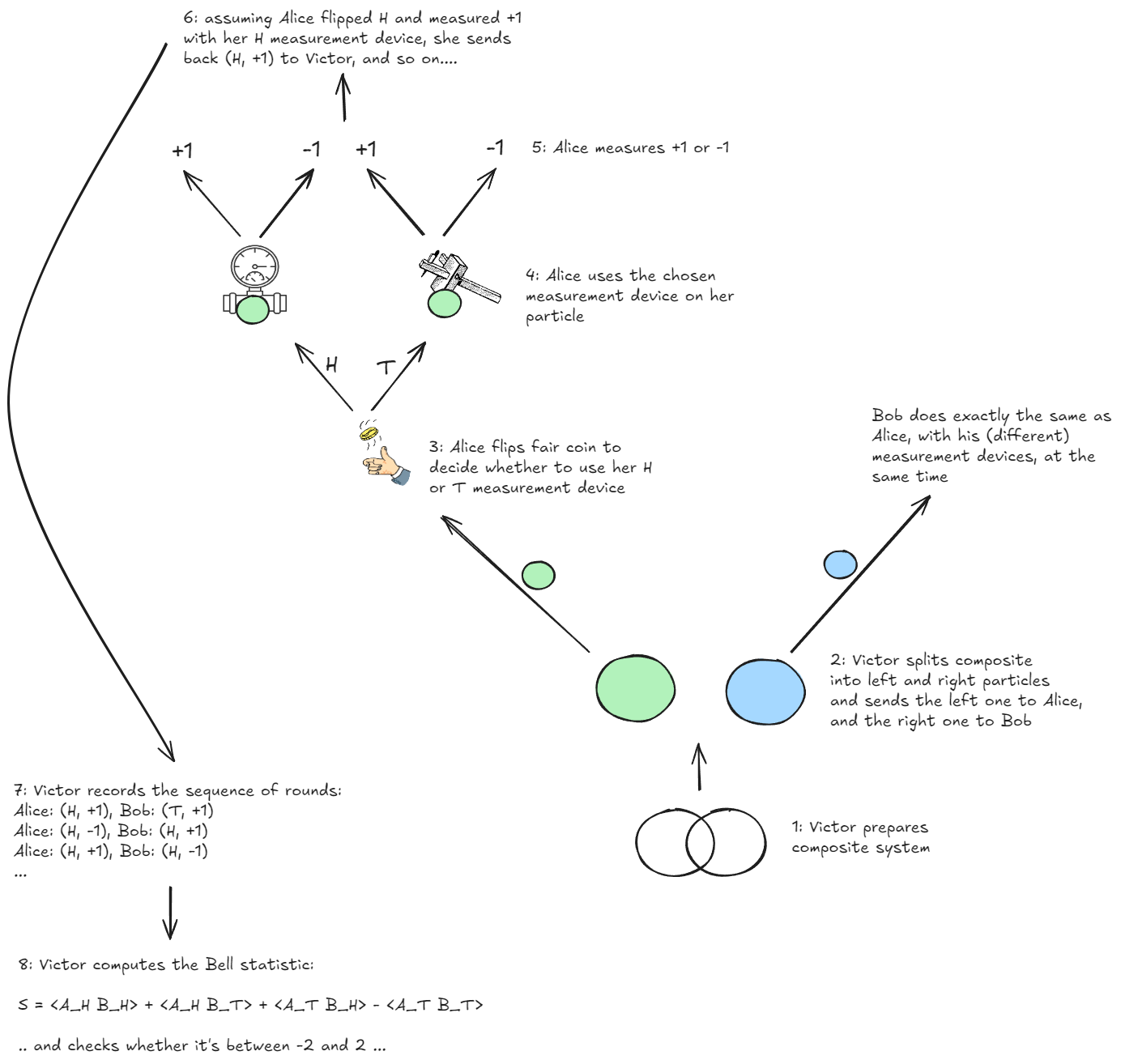
In the article, I first show how to "break" the Bell inequality without making a reference to any complicated math or Physics, this is the section "Breaking the Bell inequality with non-local information", which uses the dice roll example. This is on purpose, for pedagogical reasons, and this is why the Python approach imo is so useful to demonstrate this whole thing: the key idea is, to break the inequality, you need to "peek" at the other side.
Then, the next mental step is simply the statement that, in "real life", you can prepare a composite system (eg. 2 photons modeled as 2 qubits) that you can seperate (modeled as the split() function in Python), you can send the 2 parts to two different observers, they use a certain measurement setup, and the whole game is played, statistic computed, etc. and then you get this value 2.82 (which breaks the Bell inequality)! So somehow, the 2 qubits are doing that we can only model [in Python] as peeking!
The actual derivation of how to get that 2.82 is, in some sense, almost like a a detail. I think with this approach, even a non-physicist can understand what this whole argument is (=Bell's genius).
"a talented college physics student can do it" - I'm a Physicist, but I'm not working as a Physicist, and I was able to derive all the numbers in that table by hand with pen & paper directly. I figured if I can do it 15 years out of school, so can a talented college physics student!
The next article will be that derivation [of the raw probabilities], I just need to transcribe it from my notebook to Latex and clean it up. If you want to see the original notes:
It's related to the fact that the expected value of A_1 tensor B_1 is negative 1/sqrt(2), whilst the expected value of all other tensor products are positive 1/sqrt(2).
Greene's book is a fantastic read too!
It's very confusing. In particular it does not say that the box have 3 doors until the middle of the explanations. Also, I don't find the example very similar to the Bell's Inequality.
Moreover, I expect in a quantum system that when both open the same door they get the same result (or the oposite) so in a quantum system I expect that when both open the same door they get 100% (or 0%) agreement, so insted of 50% I expect 1/3 * 100% + 2/3 * 50 % = 66% (or 1/3 * 0% + 2/3 * 50 % = 33%).
Anyway, in some versions of the Bell's Inequality the doors of the boxes are "misalignment" so on box has white-gray-black doors and the other has another ser of colors. let's say creme-pink-brown doors. You never have a 100% or 0% of coincidences of the results.
[[EDIT - actually I take that back. The GHZ inequality refers to three systems whereas your link refers to three measurement choices]].
I don't think your link gives a derivation of the quantum correlations beyond "Quantum physics says that half the time they should get a match".
[0] https://en.wikipedia.org/wiki/Bell%27s_theorem#GHZ%E2%80%93M...
The advantage that GHZ has, similar to the Mermin-Peres magic square game, is that the quantum players should win 100% of the time while classical players win less than 90% of the time. This gives much faster Bayesian updates away from classical mechanics towards quantum mechanics as you collect samples (compared to CHSH). But you do still need multiple samples.
On the other hand, seeing the GHZ game fail would be instant total loss for quantum mechanics. If the win rate is supposed to be 100%, and you see a loss (that you can't attribute to noise or something), then in that case a single test would have caused you to totally discount quantum mechanics.
(Like another commenter, I was also hoping for a direct/standalone explanation for why the red matrix is transposed.)
What if there are no hidden properties per particle, but the combination of specific property values of particles allow for breaking Bell's Inequality?
I.e. what we call 'entanglement', it might not be 'action-at-a-distance', but the simple effect of the interaction of the properties of the two particles as they are generated.
For example, if we have two billiard balls, which are really close together, and we hit them with a third ball simultaneously, their spin will be correlated when we measure it for both balls (without taking into account other factors, i.e. friction, tilting of the table etc). Wouldn't that break Bell's inequality as well? the spins of the two balls will be correlated.
In general, classical correlation cannot break the Bell inequalities [assuming no peeking, ie. no action-at-a-distance in the measurement devices]. To be clear, I didn't prove this in the article, the approach the article takes is "here is some code, play around with it to get a feeling for why".
Hope this helps.
What if the particles have properties that mutate their state after they are sent to Alice and Bob?
Suppose, in the billiards example, that I put a small device into the balls that changes the spin of the ball to some predefined value.
Wouldn't that break the Bell inequalities without action at a distance?
The reason for the breaking would be that the state of the balls would be modified after they are sent to Alice and Bob. It would look like action at a distance without being 'action at a distance'.
You usually show a pupil the problem with classical probabilities, and show that you can't violate Bell's Inequalities, then you show that Quantum Mechanics managed to replicated the observed probabilities using a non-local way, and therefore you conclude that the world is non-local.
But this logic doesn't stand. You need to use inductive reasoning to see it through. Ask yourself the question, what change would it take to your theory to make it local and still replicate the observed probabilities (and still look reasonable).
Solve the riddle (it's quite beautiful once you see it :) ) and you will be rewarded with the awesome title of crackpot physicist, pitted against other dubious crackpot physicist each convinced their loopholes are the ones and only.
If you do this you're doing a bad job at being a teacher.
The way the argument should go is you start with a list of assumptions (of which locality is one), derive Bell's inequality from them, and determine that as Bell's inequality seems to be false in real experiments at least one of your assumptions was wrong. Then you can talk about quantum mechanics and explain which of these assumption are broken in quantum mechanics. If you have time you can have fun talking about different interpretations of quantum mechanics because (e.g.) Everettian Many Worlds is completely local, but still produces predictions matching quantum mechanics (and therefore breaks Bell's inequality).
If this wasn't sufficiently clear, I am not a teacher, I am a crackpot physicist.
Hint : Listing the assumptions doesn't work. This is what I call the three-card monte argument. The ball is not under one of the three goblets, the ball is in the sleeve of the magician.
Why not?
I could see that it might not if you are not clear about your assumptions
For me the most important thing about nonlocality is the lack of any "action at a distance", MWI satisfies this, but if you make more stringent demands it might not satisfy those.
No, Bell's inequality has a few sensible assumtions, like locality. The conclusion is that at least one of them is wrong and real world is a sensible one :(. By the way, there is this crazy thing call QM that nobody likes but gives accurate results.
>but gives accurate results.
Giving accurate results is missing the point.
Hint: The point is understanding how nature's does it.
Here is the Chesterton's fence implied by Bell's Inequality :
Lemma: There exist a local classical simulator that allows to simulate a universe that behaves according to the probabilities of QM.
Corollary : we can simulate "fast" a universe which behaves (in law) exactly like our universe.
Nota Bene : This doesn't mean we can compute QM probabilities fast, (we can't), although one way of computing them would be to use Montecarlo estimation on various instances of universe simulations.
The question is not whether to lift the fence, or how to lift the fence, the question is how are numerical biological instabilities handled.
No, that's the central point of modern (starting with Newton) physical science. In fact, I'd argue that's the main reason for the astonishing advances of the physics in mere 300 years: people stopped bothering too much about philosophical underpinning of reality and started to fucking measure the reality instead, as precisely and accurately as they could and then some. Fresnel's optics won over Newton's not because of its superior philosophical merits (it needs luminiferous aether to be a perfectly rigid incompressible solid, after all), but simply because it very accurately described light's interference, diffraction, all kinds of refraction and the accompanying polarization, and also dispersion, all in one nice, self-contained package. That's what mattered, not the ridiculousness or reasonableness of proposition that light corpuscles have poles and can experience fits of easy transmission/reflection.
> Hint: The point is understanding how nature's does it.
By being itself, how else? /s
Bell test: https://en.wikipedia.org/wiki/Bell_test :
> To do away with this assumption it is necessary to detect a sufficiently large fraction of the photons. This is usually characterized in terms of the detection efficiency η [\eta], defined as the probability that a photodetector detects a photon that arrives at it. Anupam Garg and N. David Mermin showed that when using a maximally entangled state and the CHSH inequality an efficiency of η > 2*sqrt(2)/2~= 0.83 is required for a loophole-free violation.[51] Later Philippe H. Eberhard showed that when using a partially entangled state a loophole-free violation is possible for η>2/3~=0.67 which is the optimal bound for the CHSH inequality.[53] Other Bell inequalities allow for even lower bounds. For example, there exists a four-setting inequality which is violated for η>(sqrt(5)-1)/2~=0.62 [54]
CHSH inequality: https://en.wikipedia.org/wiki/CHSH_inequality
/sbin/chsh
Isn't it possible to measure the wake of a photon instead of measuring the photon itself; to measure the wake without affecting the boat that has already passed? And shouldn't a simple beam splitter be enough to demonstrate entanglement if there is an instrument with sufficient sensitivity to infer the phase of a passed photon?
This says that intensity is sufficient to read phase: https://news.ycombinator.com/item?id=40492160 :
> "Bridging coherence optics and classical mechanics: A generic light polarization-entanglement complementary relation" (2023) https://journals.aps.org/prresearch/abstract/10.1103/PhysRev... :
>> This means that hard-to-measure optical properties such as amplitudes, phases and correlations—perhaps even these of quantum wave systems—can be deduced from something a lot easier to measure: light intensity
And all it takes to win the game is to transmit classical bits with digital error correction using hidden variables?
> IIRC I read on Wikipedia one day that Bell's actually says there's like a 60% error rate?(!)
That was probably the "Bell test" article, which - IIUC - does indeed indicate that if you can read 62% of the photons you are likely to find a loophole-free violation.
What is the photon detection rate in this and other simulators?
Obligatory reminder that there is an extra assumption here: the assumption that the result of the coin flip is not correlated to the hidden state of the particle. If when receiving a particle in stage a_H your coin flip always leads to, say, HH, then you will break Bell's inequality even if all the other assumptions hold. Theories that have this property are called "superdeterministic".