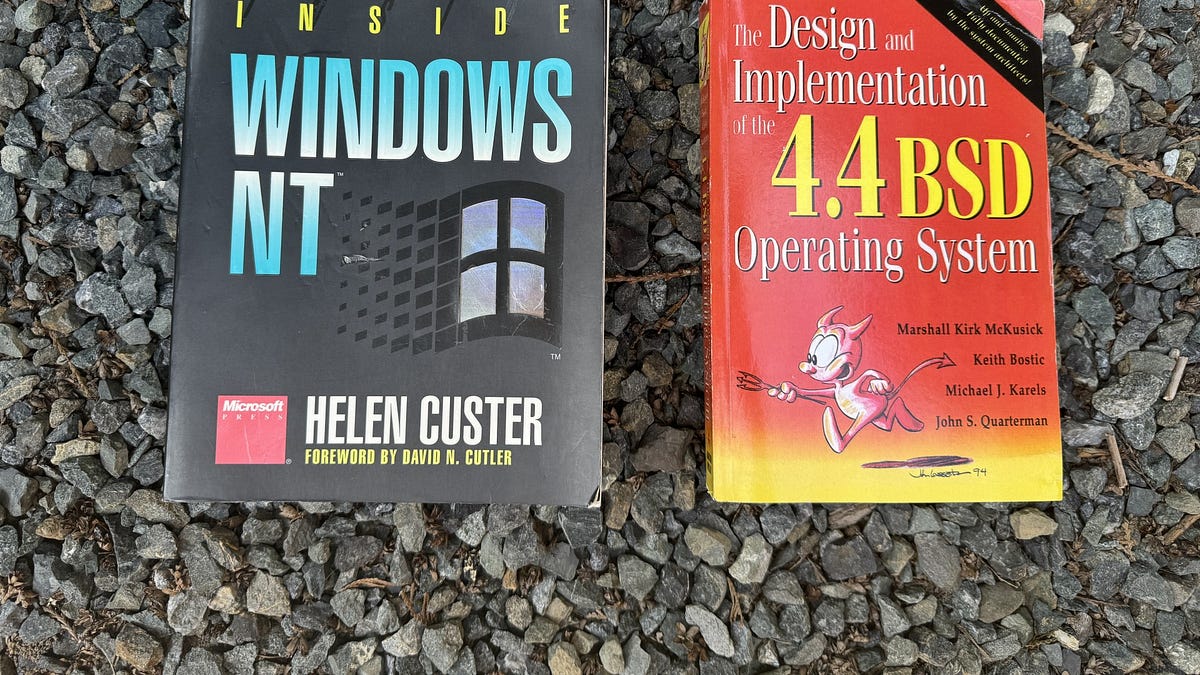
Windows NT vs. Unix: A design comparison
NT is often touted as a "very advanced" operating system. Why is that? What made NT better than Unix, if anything? And is that still the case?
blogsystem5.substack.com
648 points · by LorenDB · 2y ago · 609 comments
It seems like NT was designed to fix a lot of the problems with drivers in Windows 3.x/95/98. Drivers in those OSs came from 3rd party vendors and couldn't be trusted to not crash the system. So ample facilities were created to help the user out, such as "Safe Mode" , fallback drivers, and a graphics driver interface that disables itself if it crashes too many times (yes really).
Compare that to any Unix. Historic, AT&T Unix, Solaris, Linux, BSD 4.x, Net/Free/OpenBSD, any research Unix being taught at universities, or any of the new crop of Unix-likes such as Redox. Universally, the philosophy there is that drivers are high-reliability components vetted and likely written by the kernel devs.
(Windows also has a stable driver API and I have yet to see a Unix with that, but that's another tangent)
That feature is one of the great ones that came with Windows Vista.
I actually ran into this while upgrading an AMD driver and was very impressed! On Linux and macOS I was used to just getting kernel panics.
It’s too bad whatever system Crowdstrike hooked into was not similarly isolated.
Pretty sure most of this was already in place with Windows 95; I know Safe Mode definitely was along with a very basic VGA driver that could drive any video card in the world.
User space drivers that could restart without kernel panicking didn't exist until Windows Vista (well, on the home user side of Windows).
Fallback drivers were never a thing on Win9x, you would have to go into safe mode to uninstall broken drivers that wouldn't allow a boot (typically graphics drivers); or manually uninstall/replace them otherwise.
Also used when Windows doesn't have a specific driver yet, like immediately after a clean install.
Solaris has (or at least had) DDI (Device Driver Interface) and DLPI (Data Link Provider Interface)
NT was running in parallel with Windows 3.x/9x. The NT had better drivers because it was multiuser with some memory protection.
Just look at the recent Crowdstrike incident to see what they really fixed. /s
The processes section should be expanded upon. The NT kernel doesn't execute processes, it executes _threads_. Threads can be created in a few milliseconds where as noted, processes are heavy weight; essentially the opposite of Unicies. This is a big distinction.
io_uring would be the first true non-blocking async I/O implementation on Unicies.
It should also be noted that while NT as a product is much newer than Unicies, it's history is rooted in VMS fundamentals thanks to it's core team of ex-Digital devs lead by David Cutler. This pulls back that 'feature history' by a decade or more. Still not as old as UNIX, but "old enough", one could argue.
[0] https://stackoverflow.com/questions/8768083/difference-betwe...
It's sad that the article didn't mention VMS or MICA since NT didn't magically appear out of the void two years after Microsoft hired the NT team. MICA was being designed for years at DEC West as part of the PRISM project.
It started elegant, but all the backwards compatibility, technical debt, bad ideas, and dozens of versions later, with an endless list of perpetual features driven by whoever had a bigger wand at Microsoft at the time of their inception, takes a toll. Windows now is much more complicated than it could be.
It shocks me some apps get Windows NT4 style buttons even on Windows 11.
Most definitely. There was a lot of design cleanup from VMS (e.g. fork processes -> DPCs, removing global PTEs and balance slots, etc), optimizations (converging VMS's parallel array structure of the PFN database into one), and simplification (NT's Io subsystem with the "bring your own thread" model, removing P1 space, and much more). SMP was also designed into NT from the beginning. You can start seeing the start of these ideas in the MICA design documents but their implementation in C instead of Pillar (variant of Pascal designed for Mica) in NT was definitely the right thing at the time.
This is good, though. The alternative is that the app won't run at all, right? Windows NT is good because of that background compatibility, both for business apps and games.
MacOS & Linux are nothing like this. You can run most software, as most of the basis for modern software on those stacks is available in source form and can be maintained. Software which isn't breaks.
Apple/Google with their mobile OSes take that a step further, most older software is broken on those platforms.
The way they've kept compatibility within Windows is something I really love about the platform.. but it I keep wondering if there's a way to get the best of both worlds. Can you keep the compatibility layer as an adhoc thing, running under emulation, so that the core OS can be rationalised?
https://www.techmonitor.ai/technology/dec_forced_microsoft_i...
I was wondering for years why MS continued to support DEC Alpha CPUs with NT.
I am not sure what point you are attempting to make here. As written, it is more or less completely wrong.
NT and Unix kernels both execute threads. Threads can be created in a few microseconds. Processes are heavy weight on both NT and Unix kernels.
The only thing I can think of is the long-standing idea that Unix tends to encourage creating new processes and Windows-related OS kernels tend to encourage creating new threads. This is not false - process creation on Windows-related OS kernels is an extremely heavyweight process, certainly comparing it with any Unix. But it doesn't make the quote from you above correct.
On a separate note, the state of things at the point of creation of NT is really of very little interest other than than to computer historians. It has been more than 30 years, and every still-available Unix and presumably NT have continued to evolve since then. Linux has dozens to hundreds of design features in it that did not exist in any Unix when NT was released (and did not exist in NT either).
It’s not so much “heavyweight” vs “lightweight” but that NT has been by design more limited in how you can create new virtual memory spaces.
For better or worse NT tied the creation of VM spaces to this relatively expensive object to create which has made emulating Unix like behavior historically a pain in the ass.
Anyway, I see your point about the bleed between the different semantics of a task_t in the linux kernel.
I would agree with that statement in isolation, except by that standard (no need for a syscall per operation) the first “true” asynchronous I/O API on NT would be I/O ring (2021), a very close copy of io_uring. (Registered I/O, introduced in Windows 8, does not qualify because it only works on sockets.) The original NT API is absolutely in the same class as the FreeBSD and Solaris ones, it’s just that Linux didn’t have a satisfactory one for a long long time.
POSIX AIO has usability problems also outlined in the previously linked thread.
Remember, all I/O in NT is async at the kernel level. It's not a "bolt-on".
IoRing is limited to file reads, unlike io_uring.
Unfortunately that's only half-true. You can (and will) still get blockage sometimes with IOCP, it depends on a lot of factors, like how loaded the system is, I think. There is absolutely no guarantee that your I/O will actually occur asynchronously, only that you will be notified of its completion asynchronously.
Also, opening a file is also always synchronous, which is quite annoying if you're trying not to block e.g. a UI thread.
The implication of both of these is you still need dedicated I/O threads. I love IOCP as much as anyone, but it does have these flaws, and was very much designed to be used from multiple threads.
The only workaround I'm aware of was User-Mode Scheduling, which effectively notified you as soon as your thread got blocked, but it still required multiple logical threads, and Microsoft removed support for it in Windows 11.
All I/O in Linux is also async at the kernel level! The problem has always been expressing that asynchronicity to userspace in a sane way.
Nor do they have anything like IOCP, where the kernel is aware of the number of threads servicing a completion port, and can make sure you only have as many threads running as there are underlying cores, avoiding context switches. If you write your programs to leverage these facilities (which are very unique to NT), you can max perform your hardware very nicely.
I don't think it's a concept that meaningfully exists. Microkernels are primarily concerned with isolating non-executive functions (e.g. device drivers) for stability and/or security (POLA) reasons. NT achieves virtually none of that (see e.g. Crowdstrike). The fact that Windows ships a thin user-mode syscall shim which largely consists of thin-to-nonexistent wrappers of NtXXX functions is architecturally uninteresting at best. Arguably binfmt_misc would then also make Linux a hybrid kernel.
This is amongst the most important and visible differences between NT and Unix-likes, really. The key idea is that processes manage threads. Pavel Yosifovich in Windows 10 System Internals Part I puts it succinctly:
A process is a containment and management object that represents a running instance of a program. The term “process runs” which is used fairly often, is inaccurate. Processes don’t run - processes manage. Threads are the ones that execute code and technically run.
A process (really, a "task") is a containment and management object that represents a running instance of a program. A program ("task") does not run, its threads do.
The significant difference between Windows-related OS kernels and Unix-y ones is that process creation is much more heavyweight on the former. Nevertheless, on both types of systems, it is threads that execute code and technically run.
Linux is the only Unix-like kernel I actually know anything about. In Linux, processes essentially do not exist. You have threads, and thread groups. A thread group is what most of the user-space tooling calls a process. It doesn't do very much by itself. As the name implies, it mostly just groups threads together under one identifier.
Linux threads and "processes" are both created using the "clone" system call, which allows the caller to specify how much state the new thread shares with the old thread. Share almost everything, and you have a "thread". Share almost nothing, and you have a "process". But the kernel treats them the same.
By contrast, processes in NT are real data structures that hold all kinds of attributes, none of which is a running piece of code, since that's still handled by a thread in both designs.
However, from the application programmer's perspective, the convention on Unix-likes (which is what really matters) is to fork and pipe between processes as IPC, whereas on Windows this is not the case. Clearly the process start-up time on Unix-likes is considered fast enough that parallelism on Unix until fairly recently was based on spinning up tens to hundreds of processes and IPC-ing between them.
I believe the point stands.
A nice historical overview is…
https://developer.apple.com/library/archive/documentation/Da...
In contrast, Linux threads were implemented essentially as a hack - they were processes that shared memory and resources with their parent process, and were referred to internally as LWPs - lightweight processes.
I also remember a lot of Unix/Linux people not liking the idea of multithreading, preferring multiple processes to one, single-threaded process.
WNT = VMS + 1 (next letter in alphabet for all three)
Thread is a way to segregate computation. You spawn a thread and it will run some code scheduled by the OS. you kill/stop a thread and it will stop computation, but not the resources.
V->W
N->M
S->T
"New Technology", but yes, it's funny
(I no longer work with Windows very much, but this little bit of trivia has stuck with me over the years)
Some people point out if you shift characters by one "VMS" becomes "WNT", and give it as an explanation of the name choice of Windows NT, but it's a coincidence. For one thing, nobody ever explains how this gag was going to work back when the project was "NT OS/2"[3].
[1] Virtual Memory System, originally VAX/VMS, later OpenVMS.
[2] Later DEC Alpha, Intel Itanic and now AMD64 systems.
[3] AKA OS/2 3.0 or Portable OS/2.
On the philosophical side, one thing to consider is that NT is in effect a third system and therefore avoided some of the proverbial second system syndrome.. Cutler had been instrumental in building at least two prior operating systems (including the anti-UNIX.. VMS) and Microsoft was keen to divorce itself from OS/2.
With the benefit of hindsight and to clear some misconceptions, OS/2 was actually a nice system but was somewhat doomed both technically and organizationally. Technically, it solved the wrong problem.. it occupies a basically unwanted niche above DOS and below multiuser systems like UNIX and NT.. the same niche that BeOS and classic Mac OS occupied. Organizationally/politically, for a short period it /was/ a "better DOS than DOS and better Windows than Windows" with VM86 and Win API support, but as soon as Microsoft reclaimed their clown car of APIs and apps it would forever be playing second fiddle and IBM management never acknowledged this reality. And that compatibility problem was still a hard one for Microsoft to deal with, remember that NT was not ubiquitous until Windows XP despite being a massive improvement.
The current crop of operating systems may themselves be a temporary niche. The design of NT and unix are awash with single-host assumptions yet most use-cases are now networked. Consider the way that linux filesystem handles are specific to the host they are running on, rather than the grid of computers they run in. Yet we run word-processors in browsers, ssh to other host to dispatch jobs.
There is a gap for a system which has an API that feels like an operating system API, but which sits on top of a grid of computers, rather than a single host. The kernel/keeper acts as a resource-manager for CPUs and memory in the grid. Such systems exist in sophisticated companies but not in the mainstream. Apache Yarn is an example of a system headed in that direction.
Once such a system becomes mainstream, you don't need the kind of complex operating systems we have now. A viable OS would do far less - coordinate drivers, scheduler, TCP/IP stack.
There are obsolete systems that meet your criteria, Plan 9 and Apollo Domain/OS had plausible early answers for networked computing that haven't been adequately explored.
For your last point, I would say scheduling, security, namespacing are the core features and everything else can be layered (perhaps interchangeably) on top. As a practical example, even in monolithic FreeBSD it supports fully runtime swappable TCP/IP stacks and out of tree network stacks.. the core illusion for that system is retaining the same Socket interface for userspace. Presumably if you get the namespacing thing right the entire system and network of things would look a lot more like deliberately interchangeable parts.
You make a good case for base features in your last paragraph. I think monolith drivers as well. Raw speed seems to be important for survival in computing platforms. I am far from a domain expert but as far as I know, monolith drivers have efficiency/speed advantages over microkernel.
Let’s also not forget RISC OS, Atari TOS, AmigaOS, GEOS, SkyOS and numerous DOS frontends including, but not limited to, Microsoft Windows.
To further my thoughts a bit, the distinction I would place on OS/2 over DOS is double: 1) first class memory protection 2) full preemptive multitasking. The distinction I would place against all widely used modern desktop OSes is the lack of first class multi-user support.
Early Windows gains cooperative multi-tasking like Mac OS classic but neither fundamentally use memory protection the way later OSes normalize and that turns out to be a pretty clear dead end. I believe there are extensions for both that retrofit protection in. Both also have some add on approaches to multi-user but are not first class designs.
So, even the most robust single user system that implements full memory protection and preemptive multitasking still seems to be stuck in a valley. I.e. whatever the actual cost in terms of implementation and increase in cognitive workload for single user systems (i.e. "enter your administrative password" prompts on current macOS or Windows administrative accept dialogs) seems to be accepted by the masses.
And note that this isn't an implicit a negative judgement, for instance I find BeOS or those in your list can be absolutely fascinating. And OS/2 is lovely even today for certain niche or retrocomputing things. Just pointing out that NT made a better bet for the long term, and some of that undoubtedly related to the difference of a couple years.. keep in mind OS/2 ran on a 286, which NT completely bypassed.
That is how user switching in XP works, and how RDP works. You can have an arbitrary number of sessions of logged in users at once, only limited by the license for what version of Windows you have installed.
There have also been versions of Windows that allow multiple users to interact with each other at once, but I believe these have all been cancelled and I do not know to what extent these simultaneous users had their own accounts.
[0] https://en.wikipedia.org/wiki/Microsoft_Windows#Early_versio...
Microsoft get a lot of stick but Windows of the 90s do bring a lot to table. And by 9x DOS was basically a boot loader.
I think when it comes to this it is best to remember the home computing landscape of the time, and the most important part: DRAM prices.
They were absurdly high and NT4/2000 required more of it.
My assumption is Microsoft would have made the NT4/2000 jump much quicker if DRAM prices were driven in a downward direction.
PC gaming was, back then, still very DOS-centric. It wasn’t until the late 90s that games started to target Windows. And even then, people still had older games they wanted supported.
To add a third prong: hardware support was a big issue too as it is for any consumer OS, with legacy hardware being an issue just as it can be today if not more so. This hit both NT and OS/2 similarly.
I asked him why I should pick OS/2 over NT and his response was "honestly, if you can afford it, NT is better"
At the time, we were selling OS/2 for $99 and NT for $499 IIRC. (And I was able to use a store copy of both to take home and use, which was awesome)
OS/2s interface was better IMO.
What I really wanted to do was work on computers, not apply them to problems.
(https://www.youtube.com/watch?v=xi1Lq79mLeE&t=4314s - yes, it stands for New Technology)
But that's just another UNIX.
For example, the way that command line and globbing works are night and day, and in my mind the Windows approach is far superior. The fact that the shell is expected to do the globbing means that you can really only have one parameter that can expand. Whereas Win32 offers a FindFirstFile/FindNextFile interface that lets command line parameters be expanded at runtime. A missing parameter in unix can cause crazy behavior -- "cp *" but on windows this can just be an error.
On the other hand, the Win32 insistence on wchar_t is a disaster. UTF-16 is ... just awful. The Win32 approach only works if you assume 64k unicode characters; beyond that things go to shit very quickly.
FYI this started out as a vulnerability in yt-dlp [1]. Later it was found to impact many other languages [2]. Rust, along with other languages, also considered it a vulnerability to fix, while some other languages only updated the documentation or considered it as wontfix.
[1]: https://github.com/yt-dlp/yt-dlp/security/advisories/GHSA-42...
[2]: https://flatt.tech/research/posts/batbadbut-you-cant-securel...
Yes, Windows resolution and glob expansion can be inconsistent, but it usually isn't, but Unix makes you eat the cruft every time you use it. And you still get tools like ImageMagick that have strange ad hoc syntax for wildcard because they can't use the standard wildcarding, or even ancient tools like find that force you to do all sorts of stupid shit to be compatible with globbing.
The .BAT/.CMD to build the Windows kernel must have originally been quite the kludge.
Including pdksh in the original Windows NT might have been a better move.
https://gitlab.com/nbdkit/nbdkit/-/blob/0b4a47b5430f8b757f51...
PPS: Even less related, there's no exec() in Win32, so you can't write a starter program that does some setup and then runs another program (e.g. specified as a parameter). You need to keep the starter program open and act as a proxy to the started program! See the various dotenv CLI implementations. But I digress.
Another problem with UTF-16 on Windows is that it does not enforce that surrogate pairs are properly matched. You can have valid filenames or passwords that cannot be encoded in UTF-8. The solution was to create another encoding system called "WTF-8" that allows unmatched surrogate pairs to survive a round trip to and from UTF-16.
Imo that artificial restriction in UTF-8 is the problem.
Sometimes the restriction is appropriate, but sometimes a variant without this restriction is appropriate, and sometimes Unicode is not appropriate at all. The "artificial restriction" in UTF-8 is legitimate (since they are not valid Unicode characters) but should not apply for all kinds of uses; the problem is programs that apply them when they shouldn't be applied because of limitations in the design.
I think that using a sequence of bytes as the file name and passwords is better, and that file names and passwords being case sensitive is also better.
However, I think "WTF-8" specifically means that mismatched surrogates can be encoded, in case you want to convert to/from invalid UTF-16. Sometimes you might use a different variant of UTF-8, that can go beyond the Unicode range, or encode null characters without null bytes, etc. Sometimes it is better to use different Unicode encodings, or different non-Unicode encodings (which cannot necessarily be converted to Unicode; don't assume that you can or should convert them), or to care only that it is ASCII (or any extension of ASCII without caring about specific extension it is), or to not care about character encoding at all.
The command line handling as I note above is a really crufty old Unix thing that doesn't make sense now and is confusing and offputting when you get papercuts from it.
Another notable thing that they talk about to an extent is process creation -- the fork/exec model in Linux is basically completely broken in the presence of threads. The number of footguns involved in this process has now grown beyond the ability of a human to understand. The Windows model, while a bit more cumbersome seeming at first, is fully generalizable and very explicit about the handoff of handles between processes.
The file system model I think is mostly a wash -- on the one hand, Window's file locking model means that you can't always delete a file that's open, which can be handy. On the other hand, it means that you can't always delete a file that's open, which can be painful. On Linux, it's possible that trying to support POSIX file system semantics can result in unrecoverable sleeps that are nearly impossible to diagnose or fix.
It's a power tool, and one whose regularity and consistent presence is appreciated by many.
If it trips you up, then configure your interactive shell and/or scripts to not glob. Bash has 'set -f', other shells surely have similar switches, and undoubtedly there are shells that do no globbing at all.
If your counterargument to this workaround is that now you definitely can't use "*?[]" and friends, whereas you could maybe do that in some Windows software, my counterargument to that would be that leaving globbing & etc up to the application software not only makes it inconsistent and unreliable, it does nothing to systematically prevent the 'cp *' problem you mentioned above.
A paper by Microsoft on how viral fork is and why its presence prevents a better process model: https://www.cs.bu.edu/~jappavoo/Resources/Papers/fork-hotos1...
Windows just requires a set of functions from the driver to implement. Win32 drawing APIs are now completely userspace APIs and Windows actually did implement a couple of different ones.
Browsers switched to using a single graphics API canvas component long ago. Instead of relying on high level OS graphics API, they come with their own direct renderers that's opaque to the OS apart from the buffer requests. This approach can utilize GPUs better. Windows was among the first systems to implement the same as a UI component library. It is called WPF and it is still the backbone of many non-Win32 UI elements on Windows. On the Linux side, I think Qt was the first to implement such a concept with QML / QtQuick which is much later than WPF.
Moreover your argument that Unix evolves better or more freely falls apart when you consider that we had to replace X. On Unix world, the tendency to design "minimal" APIs that are close to hardware is the source of all evil. Almost any new technology requires big refactoring projects from application developers in the Unix world since the system programmers haven't bothered to design future-proof APIs (or they are researchers / hobbyists who don't have a clue about the current business and user needs nor upcoming tech).
Windows didn't need to replace Win32 since it was designed by engineers who understood the needs of businesses and designed an abstract-enough API that can survive things like introduction of HiDPI screens (which is just a "display changed please rerender" event). It is simply a better API.
On the Unix side X was tightly designed as around 96 or 72 DPI screens and everything had to be bolted on or hacked since the APIs were minimal or tightly coupled with the hardware capabilities at the time. Doing direct rendering on X was a pain in the ass and had an intertwined web of silly hacks which was why the DEs in 2010s kept discovering weird synchronization bugs and it was why Wayland needed to be invented.
Unfortunately, Windows the OS and the NT kernel are not completely independent - you can’t really run one without the other.
> we had to replace X
We did so because we wanted to continue to run apps made for it. The fact it was done without any change to the Linux kernel is precisely because the graphical environment is just another process running on top of the OS, and it’s perfectly fine to run Linux without X.
Cairo and such predate QML for long...
Actually, it can be wrong, and it is not necessarily a good idea to do this anyways (actually, is almost always is not a good idea to do this (just changing the documentation), I think, unless the problem was an error in the original documentation). Sometimes it is better to say that it is ASCII but allows 8-bit characters as well (without caring what they are), or something like that. For font rendering, it will be necessary to be more specific although it might depend on the font as well.
> it is obvious that UTF-16 is worse
UTF-16 is not always worse. It depends both on the program (and what requirements it has for processing the text) and on the language of the text. And then, there is also UTF-32. (And sometimes, Unicode is worse regardless of the encoding.)
If you run with the assumption that all UTF-16 characters are two bytes, you still get something that's usable for 99% of the Earth's population.
UTF-8 became a thing shortly thereafter and everyone started laughing at MS for having followed the best industry standard that was available to them when they had to make a choice.
Microsoft absolutely made the right decision at the time and really the only decision that could have been made. They didn't have the luxury to ignore internationalization until UTF-8 made it viable for Linux.
I have a different way in my idea of operating systems: One of the forks of a file specifies the type of the initial message that it expects, and the command shell will read this to figure out the types, so that effectively programs have types. This initial message also includes capabilities. This is better than needing to convert everything to/from text and then making a mess (e.g. needing quotation, unexpectedly interpreting file names as switches (even if they are quoted), needing an extra delimiter if the text starts with a minus sign which must then be parsed from the program too, the "crazy behavior" you mention with "cp *", etc).
(Also, my operating system design does not actually have file names nor directory structures.)
(I also think that Unicode is no good, but that is a different issue.)
Aside: a bit irksome how left out cp-437 is in a lot of internationalization/character tools. PC-DOS / US was a large base of a lot of software/compatibility.
There's just too much UTF-8 input I also need to take, and converting those to wstring hurts my heart.
Both Unix and NT are suboptimal here. I believe there was an OS lost to time (and my memory) that had globbing done by the program but using an OS-provided standard library. Probably the best way to do it consistently. That said, having to pick the runner up, I prefer the Unix way. As the unpredictable results happened to me more often on NT than... for example your cp example, which though possible I don't think I've ever done in my career.
The rest of command.com/cmd.exe is so poorly designed as to be laughable, only forgiven for being targeted to the PC 5150, and should have been retired a few years later. Makes sh/bash look like a masterpiece. ;-)
Some applications choose to handle things differently, though. For example, the RENAME builtin does rough pattern-matching; so "REN .jpg .jpg.old" will work pretty much the way that intuition demands that it work, but the latter parameter cannot be globbed as there no such files when this command begins to execute. Generally speaking this can get pretty messy if commands try to be clever about wildcard expansion against theoretical files.
But it is fairly easy to convert wchar_t to-and-from UTF8 depending on use.
UTF16 is not awful it is the same as an 8-bit character set but twice longer.
UTF-8 is well-designed and has a consistent mechanism for expanding to the underlying code point; it is easy to resynchronize and for ASCII systems (like most protocols) the parsing can be dead simple.
Dealing with Unicode text and glyph handling is always going to be painful because this problem is intrinsically difficult. But expansion of byte strings to unicode code points should not be as difficult as UTF-16 makes it.
Windows was converted to UCS-2 before higher code planes were designed and they never recovered.
This allows user-space processes to easily manipulate GPU resources, share them between processes if they want, and powers higher level technologies like Direct2D and Media Foundation.
Linux doesn’t have a good equivalent for these. Technically Linux has dma-buf subsystem which allows to share stuff between processes. Unfortunately, that thing is much harder to use than D3D, and very specific to particular drivers who export these buffers.
A 3D GPU is a shared hardware resource just like a disk. GPU resources are well-shaped slices of VRAM which can store different stuff, just like files are backed by the blocks of the underlying physical disks. User-space processes need to create and manipulate GPU resources and pass them across processes, just like they do with files on disks.
An OS kernel needs to manage 3D GPU resources for the same reason they include disk drivers and file system drivers, and expose consistent usermode APIs to manipulate files.
It seems Linux kernel designers mostly ignored 3D GPUs. The OS does not generally have a GPU API: some systems have OpenGL, some have OpenGL ES, some have Vulkan, some have none of them.
And Linux does run on such computers. But it also runs on mainframes, and on embedded systems with no graphics whatsoever. And it runs on a much wider variety of CPUs than Windows does.
So for Linux, it's much more of a stretch to assume that the device looks something like a PC. And if it's not going to be there in a wide variety of situations, then should Linux really have 3D graphics as part of the kernel? (At a minimum it should be removable, and have everything run fine without it.)
So again, why _must_ Linux have an equivalent?
Cutler knew about microkernels from his work at Digital, OS/2 was a hybrid kernel, and NT was really a rewrite after that failed partnership.
The directory support was targeting Netware etc...
Which is kinda interesting - Rashid went to Microsoft, Avie Tevanian went to NeXT/Apple.
Balancing benefits and costs of microkernel and monolithic kernels is common.
It looks like Google SEO gaming by removal of old content is making it hard to find good sources, but look at how OS/2 used ring 2 if you want to know.
Message passing and context switching between kernel and user mode is expensive, and if you ever used NT 3.51 that was clearly visible as were the BSoDs when MS shifted to more of a 'hybrid' model.
In comparison Windows NT is basically a monolithic kernel. Everything runs in the same address space, so there's 0 protection. Or at least, in any definition where you call NT a hybrid kernel then practically any modular kernel would be hybrid. In later versions of NT the separations between kernel-mode components this post is praising have almost completely disappeared and even the GUI is running in kernel mode...
Well, you're in luck, I have good news for you -- Windows also has its own version of this concept: it's called "The Registry". You might have heard of it?
Ironically in this respect it was a step backward... When settings lived in INI files, convention typically kept them in the same place as the program, so they were easy to find and were naturally extinguished when you deleted the software.
If you look at more modern OS's like Android and iOS they tend to enforce more explicit ties between apps and their data.
This is often touted as a downside for the registry, and indeed a whole ecosystem of apps have evolved around this concept to 'clean' the registry and 'speed it up'.
In my experience of 35 years of using windows, I have never noticed a bloated registry slowing down a computer. I have also never noticed a speed up of the system by removing some unused keys. The whole point of addresses and key pairs is that individual bits of data can be written or read without loading the whole hive.
I wonder where this idea of a bloated slow registry came from?
Using Windows Installer, this is easily accomplished. The Msi database _does_ track individual files and registry entries. If you're using another installer, or the developer allows their app to write something somewhere that isn't tracked by their installer, you're going to get files left behind.
macOS is especially bad in this respect. Bundles are great, until you have a ~/Library full of files that you never knew about after running an application.
I think this is a myth partly spread by commercial offerings that want to 'clean and optimize' a windows install.
Most of the cruft left in the registry is the equivalent of config files in /etc not removed after uninstalling an app. That stuff isn't affecting performance.
Can you manage registry folders with Git and keep track of the changes you make? Can you grep for content? On a Mac it’s indexed by the systemwide text search tooling.
Using the file system to store that data is extremely powerful.
Part of this might be mixing internal stuff that people never need to see with stuff that people will need to access.
Generally, 3rd party developers don't use a bunch of GUIDs for keys. Microsoft does for Windows components to map the internal object ID of whatever they're dealing with; my assumption is for ease of recognition/documentation on their side (and generally the assumption that the end user shouldn't be playing around in there).
However in the real world it is never as simple as you suggest. Linux apps often litter the filesystem with data. an app might have files in /etc and /opt with shortcut scripts in /root/bin and /usr/sbin. Config files in /home and /usr directories. Linux file systems are just as littered as windows registries in my experience, if not worse because they differ in different distros.
I feel like this is a point for unix. Unix being late to the unicode party means utf-8 was adopted where windows was saddled with utf-16
---
The NT kernel does seem to have some elegance. Its too bad it is not open source; windows with a different userspace and desktop environment would be interesting.
I can't really blame NT for this, it's unfortunate timing and it remains for backwards compatibility purposes. Java and JavaScript suffer similar issues for similar reasons.
UTF-8 is convenient on Unix systems since it fits into 8-bit character slots that were already in place; file systems have traditionally only forbidden the NULL byte and forward-slash, and all other characters are valid. From this fact, you can use UTF-8 in file names with ease on legacy systems, you don't need any operating system support for it.
UTF-8 is "space optimized" for ASCII text, while most extra-ASCII Latin, Cyrillic, Greek, Arabic characters need two bytes each (same as UTF-16); most of Chinese/Japanese/Korean script in the BMP requires three bytes in UTF-8, whereas you still only need two bytes in UTF-16. To go further beyond, all SMP characters (eg, most emoji) require four bytes each in both systems.
Essentially, UTF-8 is good space-wise for mostly-ASCII text. It remains on-par with UTF-16 for most western languages, and only becomes more inefficient than UTF-16 for east-Asian languages (in such regions, UTF-16 is already dominant).
Seriously, when was the last time where you both cared about saving a single kb, but compression was not an option. I'm pretty sure the answer is never. It was never in the 90s, it is extra never now that we have hard drives hundreds of gb big.
UTF-8 is better because bytes are a natural unit. You dont have to worry about surrogates. You dont have to worry about de-synchronization issues. You dont have to worry about byte order.
Backwards compatibility with ascii and basically every interface ever, also helps. (Well not 7bit smtp..). The fact is, ascii is everywhere. Being able to treat it as just a subset of utf-8 makes a lot of things easier.
> (eg, most emoji) require four bytes each in both systems.
This is misleading because most emoiji are not just a single astral character but a combination of many.
I wish it had branched to one platform as a workstation OS (NTNext).
and one that gets dumber and worse in order to make it work well for gaming. Windows 7/8/10/11 etc,
Technically one would hope that NTNext would be Windows Server, but sadly no.
I remember installing WindowsNT on my PC in awe how much better it was than Dos/Windows3 and later 95.
And compatibility back then was not great. There was a lot that didn't work, and I was more than fine with that.
It could run win32, os/2, and posix and it could be extended to run other systems in the same way.
Posix was added as a nessecity to bid for huge software contracts from the US government, and MS lost a huge contract and lost interest in the POSIX sub system, and in the os/2 sub system.
Did away with it, until they re-invented a worse system for WSL.
Note subsystem in WindowsNT means something very different than subsystem for Linux.
Linus and other early Linux people had a real good nose for performance.. not the gamesmanship kind just stacking often minuscule individual wins and avoiding too many layered architectural penalties. When it came time to worry about scalability Linux got lucky with the IBM investment who had also just purchased Sequent and knew a thing or two about SMP and NUMA.
Most commercial systems are antithetical to performance (there are some occasional exceptions). The infamous interaction of a Sun performance engineer trying to ridicule David Miller who was showing real world performance gains..
I think that keen performance really helped with adoption. Since the early days you might install Linux on hardware that was rescued from the garbage and do meaningful things with it whereas the contemporary commercial systems had forced it obsolete.
I would not call 1 order of magnitude performance penalty for accessing a local file system “little”: https://github.com/microsoft/WSL/issues/4197
However, what I was talking about performance-wise was the overhead of every system call. That overhead is gone under WSL2. Maybe it wasn't worth it for that reason alone, but original WSL could never keep up with Linux kernel and ecosystem development.
Being able to run nearly all Linux programs with only some operations being slow is probably still better than being able to run only some Linux programs with all operations being slow.
Welp, that's an unfortunate use of that capability given what we see today in language development when it comes to secondary control flows.
Funny, opening the manpage of aio on freebsd you get this on the second paragraph
> Asynchronous I/O operations on some file descriptor types may block an > AIO daemon indefinitely resulting in process and/or system hangs. > Operations on these file descriptor types are considered “unsafe” and > disabled by default. They can be enabled by setting the > vfs.aio.enable_unsafe sysctl node to a non-zero value.
So nothing is safe.
Up until this feature was added, processes in NT were quite heavyweight: new processes would get a bunch of the NT runtime libraries mapped in their address space at startup time. In a picoprocess, the process has minimal ties to the Windows architecture, and this is used to implement Linux-compatible processes in WSL 1.
They sound like an extremely useful construct.
Also, WSL 2 always felt like a "cheat" to me... is anyone else disappointed they went full-on VM and abandoned the original approach? Did small file performance ever get adequately addressed?
But WSL is so cool and since I mostly run windows in VMs without nested virtualization support I've pretty much only used that one and am super thankful for it.
Oh yes, some of us are.
This was a decent look:
https://jmmv.dev/2020/11/wsl-lost-potential.html
HN discussion:
Hahaha. Try polling stdin, a pipe, an ipv4 socket, and an ipv6 socket at the same time.
(2) Win NT’s approach to file systems makes many file system operations very slow which makes npm and other dev systems designed for the Unix system terribly slow in NT. Which is why Microsoft gave up on the otherwise excellent WSL1. If you were writing this kind of thing natively for Windows you would stuff blobs into SQLLite (e.g. a true “user space filesystem”) or ZIP files or some other container instead of stuffing 100,000 files in directories.
This is due to the file system filters. It shows when using DevDrive where there are significant performance improvements.
https://devblogs.microsoft.com/visualstudio/devdrive/
https://learn.microsoft.com/en-us/windows/dev-drive/#set-up-...
But as someone who's used all versions of Windows since 95, this paragraph strikes me the most:
> What I find disappointing is that, even though NT has all these solid design principles in place… bloat in the UI doesn’t let the design shine through. The sluggishness of the OS even on super-powerful machines is painful to witness and might even lead to the demise of this OS.
I couldn't agree more. Windows 11 is irritatingly macOS-like and for some reason has animations that make it appear slow as molasses. What I really want is a Windows 2000-esque UI with dense, desktop-focused UIs (for an example, look at Visual Studio 2022 which is the last bastion of the late 1990s-early 2000s-style fan-out toolbar design that still persists in Microsoft's products).
I want modern technologies from Windows 10 and 11 like UTF-8, SSD management, ClearType and high-quality typefaces, proper HiDPI scaling (something that took desktop Linux until this year to properly handle, and something that macOS doesn't actually do correctly despite appearing to do so), Windows 11's window management, and a deeper integration of .NET with Windows.
I'd like Microsoft to backport all that to the combined UI of Windows 2000 and Windows 7 (so probably Windows 7 with the 'Classic' theme). I couldn't care less about transparent menu bars. I don't want iOS-style 'switches'. I want clear tabs, radio buttons, checkboxes, and a slate-grey design that is so straightforward that it could be software-rasterised at 4K resolution, 144 frames per second without hiccups. I want the Windows 7-style control panel back.
I bet dollars to donuts that all the designers who come up new Windows designs are using Macs.
The old Windows UI was designed out of painstaking end user testing which was famously responsible for the Start button.
Engineers like you and I want that. The common end user wants flashy, sleek, stylish (and apparently CandyCrush).
But don't forget that that 2000 UI was flashy, sleek, and stylish with it's fancy pants GDI+ and a mouse pointer with a drop shadow!
Do they, though? I get the impression that nobody is actually testing with users. It seems more like UI developers want "flashy, sleek, stylish" and that's what's getting jammed down all our throats.
BTW: Windows 7 is another story: at that time PC magazines wrote deep analyses how some performance issues in the user interface code of Windows Vista that made Vista feel "sluggish" were fixed in Windows 7.
https://en.wikipedia.org/wiki/Windows_XP_visual_styles#Windo...
On what planet is this a good thing? What does this realistically and practically mean outside of some high level layer that provides syntax sugar for B2B dev's. Lord knows you better not be talking about COM.
I honestly only see these types of comments from people who do NOT do systems programming.
That being said if you run something like Win10 LTSC (basically super stripped down win10 with no tracking and crapware) and turn off all window animations / shadows / etc you might be very surprised - it is snappy as hell. With a modern SSD stuff launches instantly and it is a totally different experience.
NT has been sluggish since _forever_. It is hardly a bloated GUI problem. On machines were 9x would literally fly NT would fail to boot due to low memory.
NT4 had a higher base RAM requirement than 9x. Significantly so.
This sounds like you are talking from a design perspective and the rest of your post seems to be from a usability perspective. Is this correct?
> Windows 11 is irritatingly macOS-like
MacOS is such an objectively inferior design paradigm, very frustration to use. It's Apple thinking 'different' for the sake of being different, not because it's good UI.
I only keep a W10 image around because it's still supported and W11 seems like a lot more work to beat into shape. OpenShell at least makes things much better.
Not sure about Windows but on macOS you can disable most of these animations - look for "Reduce motion" in Accessibility, the same setting is available on iOS/iPadOS. The result seems snappier.
This is not possible (measure software blitting performance and you'll see), and for power reasons you wouldn't want to even if it were.
It calls itself "bash" but it is really the Almquist shell with a bit of added bash syntactic sugar. It does not support arrays.
All the talk here about how Windows had a better architecture into he beginning conveniently avoids the fact that windows was well known for being over-designed while delivering much less than its counterparts in the networking arena for a long time.
Its not wrong to admire what windows got right, but Unix got so much right by putting attention where it was needed.
[0] https://www.microsoft.com/en-us/research/publication/the-mic...
Now, that being said, I think the Windows kernel sounded better on paper, but in reality Windows was never as stable as Linux (even in it's early days) doing everyday tasks (file sharing, web/mail/dns server etc.).
Even to this day, the Unix philosophy of doing one thing and doing it well stands: maybe the Linux kernel wasn't as fancy as the Windows one, but it did what it was supposed to do very well.
What if there are just a billion objects and you can't tell which ones need which permission, as an administrator. I couldn't tell if this example actually exists from the article as it only talks abstractly about the subject. But Windows security stuff just sounds like a typical convoluted system that never worked. This is probably one of the one places where UN*X is better off, not that it's any good since it doesn't support any use case other than separating the web server process from the DNS server process, but that it's very simple.
What if the objects do not describe the items I need to protect in sufficient detail? How many privilege escalation / lateral movement vulns were there in Windows vs any UN*X?
Windows currently has a significant scaling issue because of its Processor Groups design, it is actually more of an ugly hack that was added to Windows 7 to support more than 64 threads. Everyone makes bad decisions when developing a kernel, the difference between the Windows NT kernel and the Linux kernel is that fundamental design flaws tend to get eventually fixed in the Linux kernel while they rarely get fixed in the Windows NT kernel.
I think things like Credential Guard, various virtualization (security-related, not VM-related) are relatively new kernel-integrated features, etc.
Kernel bugs that need to exist because of backwards compat are going to continue to exist since backwards compat is a design goal of Windows.
Windows is more and more based on virtualization
And the other hand, more and more microsoft stuff is Linux native
It would not surprise me if Linux runs every windows, somewhere far deep, in the next decades
More hybridations are probably coming, but where will it stop ? And why ?
It's not clear to me how processor groups inhibit scaling. It's even sensible to constrict the movement of threads willy-nilly between cores in a lot of cases (because of NUMA locality, caches, etc.) And it looks like there's an option to not confine your program to a single processor group, too.
Not really. There was no Ring -1 (hypervisor), no hardware-assisted virtualization as we use the term today. On Windows/386, it ran in Ring 0.
Virtual 8086 mode was leveraged via the NTVDM, shipping with the first release of NT.
[0] https://web.archive.org/web/20111110161740/http://blogs.msdn...
[Extra] https://devblogs.microsoft.com/oldnewthing/20130208-00/?p=53...
I pretty much ran NT/Win2K at home for all internet stuff from then on, without flash at all. I do miss the shell replacement I used back in those days, I don't remember the name, but also remember Windowblinds.
...and as the sibling comment alludes to, MS eventually adopted that architecture somewhat with Hyper-V and the VBS feature, but now running NT inside of the hypervisor instead of protected-mode DOS.
I worked on kernel drivers starting in with NT 3.5. However, over the years, the kernel has become bloated. The bloat is both in code and in architecture.
I guess this is inevitable as the original team has long gone, and it is now too large for anyone to understand the whole thing.
> Lastly, as much as we like to bash Windows for security problems, NT started with an advanced security design for early Internet standards given that the system works, basically, as a capability-based system.
I’m curious as to why the NT kernel’s security guarantees don’t seem to result in Windows itself being more secure. I’ve heard lots of opinions but none from a comparative perspective looking at the NT vs. UNIX kernels.
Fun fact: NT is a spiritual (and in some cases, literal) successor of VMS, which itself is a direct descendant of the RSX family of operating systems, which are themselves a descendant of a process control family of task runners from 1960. Unix goes back to 1964 - Multics.
Although yeah, Unix definitely has a much longer unbroken chain.
See http://mcvoy.com/lm/papers/SunOS.vm_arch.pdf and http://mcvoy.com/lm/papers/SunOS.vfs_arch.pdf
Predicting the imminent demise of Windows is as common, and accurate, of a take as saying this is the year of Linux on the desktop or that Linux takes over PC gaming.
Maybe if you can run that explorer under NT systems you could explore them under the original NT OSes too.
Edit: https://winclassic.net/thread/1852/reactos-registry-ntobject...
  input_string = "VMS"
  output_string = ''.join([chr(ord(char) + 1) for char in input_string])
print(output_string)but i don't agree with is that it was ever more advanced or "better" (in some hypothetical single-dimensional metric). the problem is that all that high minded architectural art gets in the way of practical things:
    - performance, project: (m$ shipping product, maintenance, adding features, designs, agility, fixing bugs)

    - performance, execution (anyone's code running fast)

    - performance, market (users adopting it, building new unpredictable things)
in the mid 2000-2010s my workplace had a source license for the entire Windows codebase (view only). when the API docs and the KB articles don't explain it, we could dive deeper. i have to say i was blown away and very surprised by "NT" - given it's abysmal reliability i was expecting MS-DOS/Win 3.x level hackery everywhere. instead i got a good idea of Dave Cutler and VMS - it was positively uniformly solid, pedestrian, uniform and explicit. to a highly disgusting degree: 20-30 lines of code to call a function to create something that would be 1-2 lines of code in a UNIX (sure we cheat and overload the return with error codes and status and successful object id being returned - i mean they shouldn't overlap, right? probably? yolo!).
in NT you create a structure containing the options, maybe call a helper function to default that option structure, call the actual function, if it fails because of limits, it reports how much you need then you go back and re-allocate what you need and call it again. if you need the new API, you call someReallyLongFunctionEx, making sure to remember to set the version flag in the options struct to the correct size of the new updated option version. nobody is sure what happens if getSomeMinorObjectEx() takes a getSomeMinorObjectParamEx option strucure that is the same size as the original getSomeMinorObjectParam struct but it would probably involve calling setSomeMinorObjectParamExParamVersion() or getObjectParamStructVersionManager()->SelectVersionEx(versionSelectParameterEx). every one is slightly different, but they are all the same vibe.
if NT was actual architecture, it would definitely be "brutalist" [1]
the core of NT is the antithesis of the New Jersey (Berkeley/BSD) [2] style.
the problem is that all companies, both micro$oft and commercial companies trying to use it, have finite resources. the high-architect brutalist style works for VMS and NT, but only at extreme cost. the fact that it's tricky to get signals right doesn't slow most UNIX developers down, most of the time, except for when it does. and when it does, a buggy, but 80%, solution is but a wrong stackoverlflow answer away. the fact that creating a single object takes a page of code and doing anything real takes an architecture committee and a half-dozen objects that each take a page of (very boring) code, does slow everyone down, all the time.
it's clear to me, just reading the code, that the MBA's running micro$oft eventually figured that out and decided, outside the really core kernel, not to adopt either the MIT/Stanford or the New Jersey/Berkeley style - instead they would go with "offshore low bidder" style for the rest of whatever else was bolted on since 1995. dave cutler probably now spends the rest of his life really irritated whenever his laptop keeps crashing because of this crap. it's not even good crap code. it's absolutely terrible; the contrast is striking.
then another lesson (pay attention systemd people), is that buggy, over-complicated, user mode stuff and ancillary services like control-panel, gui, update system, etc. can sink even the best most reliable kernel.
then you get to sockets, and realize that the internet was a "BIG DEAL" in the 1990s.
ooof, microsoft. winsock.
then you have the other, other, really giant failure. openness. open to share the actual code with the users is #1. #2 is letting them show the way and contribute. the micro$oft way was violent hatred to both ideas. oh, well. you could still be a commercial company that owns the copyright and not hide the, good or bad, code from your developers. MBAAs (MBA Assholes) strike again.
[1] https://en.wikipedia.org/wiki/Brutalist_architecture [2] https://en.wikipedia.org/wiki/Worse_is_better
VMS POSIX ports:
https://en.m.wikipedia.org/wiki/OpenVMS#POSIX_compatibility
VMS influence on Windows:
https://en.m.wikipedia.org/wiki/Windows_NT#Development
"Microsoft hired a group of developers from Digital Equipment Corporation led by Dave Cutler to build Windows NT, and many elements of the design reflect earlier DEC experience with Cutler's VMS, VAXELN and RSX-11, but also an unreleased object-based operating system developed by Cutler at Digital codenamed MICA."
Windows POSIX layer:
https://en.m.wikipedia.org/wiki/Microsoft_POSIX_subsystem
Xenix:
https://en.m.wikipedia.org/wiki/Xenix
"Tandy more than doubled the Xenix installed base when it made TRS-Xenix the default operating system for its TRS-80 Model 16 68000-based computer in early 1983, and was the largest Unix vendor in 1984."
EDIT: AT&T first had an SMP-capable UNIX in 1977.
"Any configuration supplied by Sperry, including multiprocessor ones, can run the UNIX system."
https://www.bell-labs.com/usr/dmr/www/otherports/newp.pdf
UNIX did not originally use an MMU:
"Back around 1970-71, Unix on the PDP-11/20 ran on hardware that not only did not support virtual memory, but didn't support any kind of hardware memory mapping or protection, for example against writing over the kernel. This was a pain, because we were using the machine for multiple users. When anyone was working on a program, it was considered a courtesy to yell "A.OUT?" before trying it, to warn others to save whatever they were editing."
https://www.bell-labs.com/usr/dmr/www/odd.html
Shared memory was "bolted on" with Columbus UNIX:
https://en.m.wikipedia.org/wiki/CB_UNIX
...POSIX implements setfacl.
My issue with Windows as an OS, is that there's so much cruft, often adopted from Microsoft's older OSes, stacked on top of the NT kernel effectively circumventing it's design.
You frequently see examples of this in vulnerability write-ups: "NT has mechanisms in place to secure $thing, but unfortunately, this upper level component effectively bypasses those protections".
I know Microsoft would like to, if they considered it "possible", but they really need to move away from the Win32 and MS-DOS paradigms and rethink a more native OS design based solely on NT and evolving principles.
IMO this is because they are better written, by people who had deeper understanding of the entire OS picture and cared more about writing performant and maintainable code.
I can't think of any worse API in the entire world?
https://en.wikipedia.org/wiki/Virtual_DOS_machine
(Math on the 40 years: windows 1.0 was released in 1985, the last consumer version of Windows 10 (which is the last Windows NT version to support 32-bit install and thus NTVDM) goes out of support in 2025. DOS was first released in 1981, more than 40 years ago. I don’t know when it was released, but I’ve used a pretty old 16-bit DOS app on Windows 10: a C compiler for the Intel 80186)
> The backwards compatibility though is one of the major features of windows as an OS.
But at what point does that become a liability?
I'm arguing that point was about 15-20 years ago.
The top discussion thread on that post is about “my old iPhone $version is good enough, why would I upgrade”.
It’s funny, if you ask tech people, a lot fall into the “I have to have the latest and greatest” but also a lot fall into the “I’ll upgrade when they pry the rusting hardware from my cold dead hands”.
For Microsoft, the driver for backwards compatibility is economic: Microsoft wants people to buy new Windows, but in order to do that, they have to (1) convince customers that all their existing stuff is going to continue to work, and (2) convince developers that they don’t have to rewrite (or even recompile) all their stuff whenever there’s a new version of Windows.
Objectively, it seems like Microsoft made the right decision, based on revenue over the decades.
Full disclosure: I worked for Microsoft for 17 years, mostly in and around Windows, but left over a decade ago.
The little weird things that exist due to backwards compatibility really don't matter. They're not harming anything.
I’d argue that software is never finished, only abandoned, and I absolutely did not generate that quote.
Stop. Just stop.
Of course even that isn't trivial, as one wants to share filesystem access (while I can imagine some overlay limiting access), might need COM and access to devices ... but I would assume they could push that a lot more actively. If they decided which GUI framework to focus on.
A huge amount of the compatibility stuff is already moved out into separate code that isn't loaded unless needed.
The problem too, though, is users don't want independent subsystems -- they want their OS to operate as a singular environment. Raymond Chen has mentioned this a few times on his blog when this sort of thing comes up.
Backwards compatibility also really isn't the issue that people seem to think it is.
https://arstechnica.com/information-technology/2010/01/windo...
And while wine doesn't run everything, at least it doesn't circumvent security measures put in place by the OS...
My understanding is that the main thing keeping Windows relevant is the support for legacy software, so they'd be hesitant to jeopardize that with any bold changes to the kernel or system APIs.
That said. Given my imagined cost of maintaining a kernel plus my small, idiolistic, naive world view; I'd love if it Microsoft simply abandoned NT and threw their weight behind the Linux kernel (or if GNU is too restrictive, BSD or alternatively write their own POSIX compliant kernel like MacOS).
Linux would be ideal given its features; containers, support for Android apps without emulation, abundance of supported devices, helpful system capabilities like UNIX sockets (I know they started to made progress there but they abandoned further development), and support for things like ROCm (which only works on Linux right now).
Microsoft could build Windows on top of that POSIX kernel and provide a compatibility layer for NT calls and Win32 APIs. I don't even care if it's open source.
The biggest value for me is development capabilities (my day job is writing a performance sensitive application that needs to run cross-platform and Windows is a constant thorn in my side).
Cygwin, msys2/git-bash are all fantastic but they are no replacement for the kind of development experience you get on Linux & MacOS.
WSL1 was a great start and gave me hope, but is now abandonware.
WSL2 is a joke, if I wanted to run Linux in a VM, I'd run Linux in a VM.
I guess a less extreme option would be for Microsoft to extend NT to be POSIX compliant - If I could target unix syscalls during development and produce binaries that worked on Windows, I supposed I'd be happy with that.
I don't understand why people keep repeating this wish, rather than the arguably better, more competitive option: open-source the NT and Windows codebase, prepare an 'OpenWindows' (nice pun there, really) release, and simultaneously support enterprise customers with paid support licences, like places like Red Hat currently do.
> Cygwin, msys2/git-bash are all fantastic but they are no replacement for the kind of development experience you get on Linux & MacOS.
I couldn't disagree more. As someone who comes from a mostly-Windows pedigree, UNIX is... pretty backwards, and I look upon any attempt to shoehorn UNIX-on-Windows with a fair bit of disapproval, even if I concede that their individual developers and maintainers have done a decent job. Visual Studio (not Code) is a massively superior development and debugging tool to anything that the Unix crowd have cooked up (gdb? perf? Tell me when you can get flame graphs in one click).
- The relatively low revenue of Windows for Microsoft means that they have the potential opportunity of increasing Windows profitability by dropping the engineering costs associated with NT (though on the flipside, they'd acquire the engineering cost of developing Linux).
- Open sourcing NT would likely see a majority of it ported into Linux compatibility layers which would enable competitors (not that this is bad for us as consumers, it's just not good for business)
- Adopting the Linux kernel and writing a closed source NT compatibility layer, init system, and closed source desktop environment means that the "desktop" and Microsoft aspects of the OS could be retained as private IP - which is the part that they could charge for. I know I'd certainly pay for a Linux distribution that has a well made DE.
> UNIX is... pretty backwards,
I honestly agree. Many of the APIs show their age and, in the age of high level languages, it's frustrating to read C docs to understand function signatures/semantics. It's certainly not ergonomic - though that's not to say there isn't room to innovate here.
Ultimately, I value sameness. Aside from ergonomics, NT doesn't offer _more_ than POSIX and language bindings take care of the ergonomics issues with unix, so in many ways I'd argue that NT offers less.
> Visual Studio (not Code) is a massively superior development and debugging too [...] Tell me when you can get flame graphs in one click
Just because the tooling isn't as nice to use now doesn't mean that Microsoft couldn't make it better (and charge for that) if they adopted Linux. This isn't something entirely contingent on the kernel.
May be very difficult or impossible if the Windows codebase has third-party IP (e.g. for hardware compatibility) with restrictive licensing
Having to go through every source file to ensure there is nothing to cause offense in there; there may be licensed things they'd have to remove; optionally make it buildable outside of their own environment...
Or there may be just plain embarrassing code in there they don't feel the need to let outsiders see, and they don't want to spend the time to check. But you can be sure a very small group of nerds will be waiting to go through it and shout about some crappy thing they found.
Hard disagree on the development aspect of VS, which (last time I used it, in 2015) couldn't even keep up with my fairly slow typing speed.
The debugging tools are excellent, but they are certainly not any more excellent than those in Instruments on macOS (which is largely backed by DTrace).
VS is dogshit full of bloat and a UI that takes a PhD to navigate. CLion and QTCreator embed gdb/lldb and do the debugging just fine. perf also gets you more system metrics than Visual Studio does; the click vs CLI workflow is mostly just workflow preference. But if you're going to do a UI, at least don't do it the way VS does.
Oh hell no!
Diversity in operating systems is important, and the NT architecture has several advantages over the Linux approach. I definitely don't want just one kernel reigning supreme, not yet at least - although that is probably inevitable.
Microsoft had this and abandoned it. I was building GNU software on NT in 2000 under Interix. It became Services for Unix and then was finally abandoned.
Was finally _replaced_ by WSL.
> WSL1 was a great start and gave me hope, but is now abandonware.
Exactly my thoughts. I really admired the design and how far WSL1 got. It is just sad to see it abandoned.
> WSL2 is a joke, if I wanted to run Linux in a VM, I'd run Linux in a VM.
I couldn't have said it better. If I wanted to run Linux in a VM, I'd run Linux in a VM, why are we pretending something special is going on.
I think it was mainly the docker crowd that kept asking for compatibility there :(
But why was it better, other than aesthetic preference?
Without Windows, there would be no platform to sell office (macOS aside). That as a side note.
The important piece you are missing is this: The entirety of Azure runs on an optimized Variant of Hyper-V, hence all of Azure runs on Windows. That is SUBSTANTIAL!
Their was a time MS sales posted NT to be more POSIX compatible than UNIXes.
This entire article is an elegant argument why this would be a terrible idea. Didn't you RTFA?
> I guess a less extreme option would be for Microsoft to extend NT to be POSIX compliant
Way to expose and highlight your ignorance. :-( NT 3.1, the first release, was POSIX compliant in 1993, and every release since has been.
The GPL isn't too restrictive. Google has no issue with it on Android (which uses a modified Linux kernel). GPL doesn't mean you have to open-source everything, just the GPL components, which in the case of the Linux kernel, is just the kernel itself. MS already contributes a bunch of drivers (for their hypervisor) to the Linux kernel. They could easily make a Linux-based OS with their own proprietary crap on top if they wanted to.
>support for Android apps without emulation
They wouldn't need CPU-level emulation, but the API would need some kind of compatibility layer, similar to how WINE serves this purpose for Windows applications on Linux.
>Microsoft could build Windows on top of that POSIX kernel and provide a compatibility layer for NT calls and Win32 APIs.
They don't need to: they can just use WINE. They could improve that, or maybe fork it and add some proprietary parts like CodeWeavers does, or they could even just buy out CodeWeavers.
What does that mean, exactly? Linux is also an "aging design", unless I missed a big announcement where they redesigned it at any point since 1994.
"I’ve repeatedly heard that Windows NT is a very advanced operating system"
It's very advanced for decades ago. It's not meant as an insult.
About 20 years ago, despite being a Linux/UNIX/BSD diehard, I went through the entire Inside Windows NT book word by word and took up low-level NT programming and gained a deep respect for it and Dave Cutler. Also a h/t to Russinovich who despite having better things to do running Winternals Software[1], would always patiently answer all my questions.
It also entirely overlooks how the system that allows a user with know specialized knowledge to authorize random code to run in a privileged environment which led to vulnerabilities that had their own vulnerabilities.
Call that the mainframe--though it too has been evolving all along and is a much more moving target than the caricatures suggest. Clustering, partitions, cryptographic offload, new Web and Linux and data analytics execution environments, most recently data streaming and AI--many new use modes have been added since the 60s and 70s inception.
In linux/unix there is too much focus on the "multiuser" and "timesharing" aspect of the system, when in the modern day you generally have one user with a ton of daemons so you forced to run daemons as their own users and then have some sort of init system to wrangle them all. A lot of the unixisms are not as elegant as they should be (see plan9, gobolinux, etc).
TempleOS is more like a commodore 64 environment than an OS: there's not really any sort of timesharing going on and the threading is managed manually by userspace programs. One thing I like is that the shell language is the same as the general programming language (HolyC).
Unix is an Apollo-era technology! Also an aging design.
The quality of an idea is independent of the time of its conception.
The utility of an idea is dependent on the time and place where it may be used however.
Didn't help that trying to cater to those developers, management kept rebooting the whole development approach, making adoption even worse.
`type CON > file.txt`, then type some stuff and press CTRL+Z.
https://learn.microsoft.com/en-us/windows/win32/fileio/namin...
mkdir \\.\C:\COM1https://stackoverflow.com/questions/40794287/cannot-write-to...
Unix is around the same age.
Ditto with GNU/Linux and old SVGAlib games. It already should have been some a wrapper against SDL2.
Apps talk to the subsystem, and the subsystem talks to the Executive (kernel).
Traditionally, Windows apps talk to the Win32 subsystem[1]. This subsystem, as currently designed, is an issue as described in my previous comment.
1. https://en.wikipedia.org/wiki/Architecture_of_Windows_NT#Win...
Caveat: Details of this may have changed in the last couple major Windows versions. I've been out of the NT game for a bit. Someone correct me, if so.
Yet this fantasy exists.
And as soon as you make something new, it'll be old, and people will call for its replacement.
Users and business want to stop being hacked. Windows will never achieve this without starting over.
To reinforce how much people hate "100% new" how long has Microsoft been working on ReFS? 20 years? The safest most boring job in the world must be NTFS developer.
Fun facts, to accelerate networking and Internet capability of Windows NT due to the complexity of coding a compatible TCP/IP implementation, the developers just took the entire TCP/IP stacks from BSD, and call it a day since BSD license does allows for that.
They cannot do that with Linux since it's GPL licensed codes, and this probably when the FUD attack started for Linux by Microsoft and the culmination of that is "Linux is cancer" statement by the ex-CEO Ballmer.
The irony is that Linux now is the most used OS in Azure cloud platform (where Butler was the chief designer) not BSDs [2].
[1] History of the Berkeley Software Distribution:
https://en.wikipedia.org/wiki/History_of_the_Berkeley_Softwa...
[2] Microsoft: Linux Is the Top Operating System on Azure Today:
NT 3.1 used a TCP stack from Spider Systems[0]. It was completely rewritten by Microsoft in 3.5[1].
The userland utilities, ping, tracert, etc were brought over from BSD.
[0] https://en.wikipedia.org/wiki/Spider_Systems
[1] https://web.archive.org/web/20151229084950/http://www.kuro5h...
"While Microsoft did technically 'buy' their TCP/IP stack from Spider Systems, they did not "own" it. Spider used the code available and written for BSD, so it doesn't appear that Microsoft directly copied BSD code (which, again, it is perfectly legal and legitimate to copy), they got it from a third party. Also ftp, rcp and rsh seems to have come with the bundle. I have heard that ftp was, but have never used rcp and rsh on Windows, so don't know what version(s) those were or were not included in any particular Windows version. Anyone can look through the .exes for those files and look for "The Regents of the University of California" copyright notice, if they want to see for themselves (rather than take the word of some anonymous geeks on a forum) ;)"
[1] Windows TCPIP Stack Based on Unix ?
https://www.neowin.net/forum/topic/381190-windows-tcpip-stac...
The TCP & IP stacks were written by Microsoft in NT 3.5.
What Spider Software used (again, used by Microsoft in NT 3.1 due to time pressures) may have originated from BSD, but we don't know.
You can browse the NT4 source code TCP/IP stack. Just search GitHub.
They didn't, but I don't know why you're putting a sinister spin on this either way. Of course the licence allows for that. It was the express intention of the authors of the BSD networking stack that it be used far and wide.
They went to considerable effort to extract the networking code into an independent distribution (BSD Net/1) which could be released under the BSD licence independently of the rest of the code (parts of which were encumbered at the time). They wanted it to be used.
Didn't they?
I am not questioning the fact that BSD is a commercial and Microsoft 'friendly' license, and Microsoft and Unix vendors hired many of BSD developers, it's a win-win situation for them.
What is so sinister by saying Microsoft at the time didn't particularly like Linux GPL license and their ex-CEO called it a cancer (their words not mine) since it's not compatible with their commercial endeavours at that particular time. Perhaps you have forgotten or too young to remember the hostility of Microsoft towards Linux with their well documented FUD initiatives [1].
[1] Halloween documents:
For example.
- Portability. Who cares, even in the 1990s, NetBSD is a thing. We've known learned that portability across conventional-ish hardware doesn't actually affect OS design in vary
Overall, the author is taking jargon / marketing terms too much at face value. In many cases, Windows and Unix will use different terms to describe the same things, or we have terms like "object-oriented kernel" that, by default, I assume don't actually mean anything: "object oriented" was too popular and adjective in the 1990s to be trusted.
- "NT doesn’t have signals in the traditional Unix sense. What it does have, however, are alerts, and these can be kernel mode and user mode."
Topic sentence should not start with the names of things. It is extraneous.
The author did explain what it specifically means in the context of the NT kernel: centralized access control, common identity, and unified event handling.