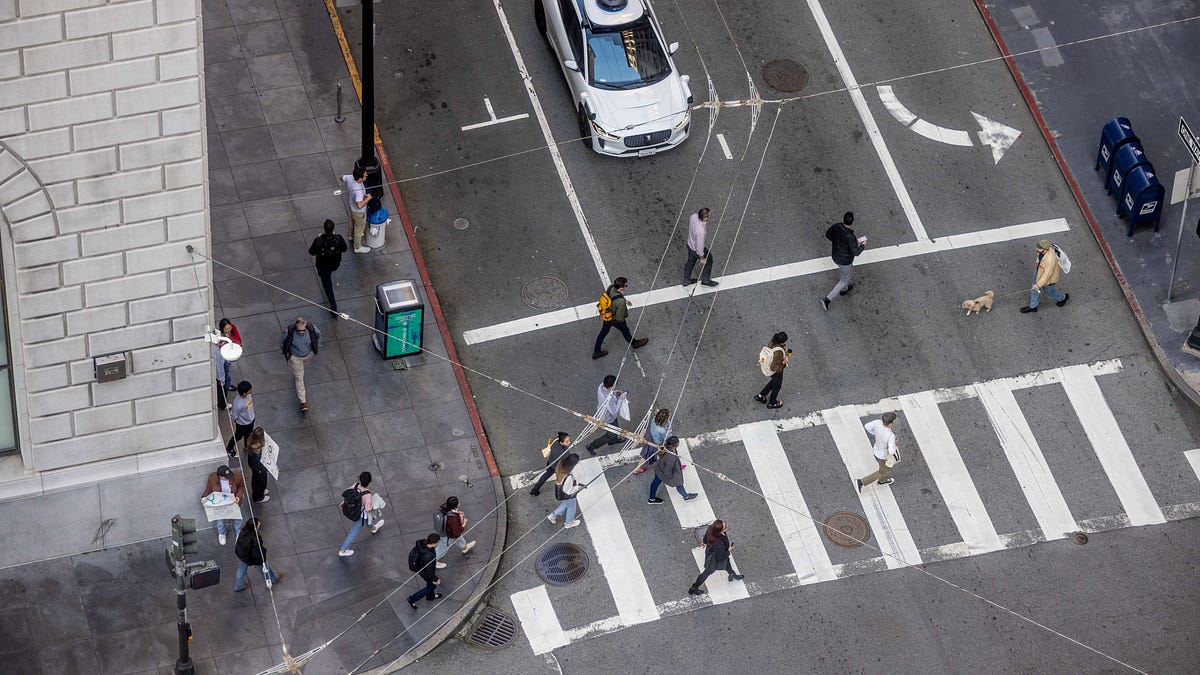
Human drivers are to blame for most serious Waymo collisions
I took a careful look at Waymo’s latest crash data.
understandingai.org
8 points · by ra7 · 2y ago · 26 comments
That seems insanely high to me. Maybe this is just a SF thing?
These articles seem to be pushing the safety aspect and saying they can do just as good as a human driver. This is progress and could be better than relying on a taxi or Uber human. But if you want to convince me to use it, it needs to be better than me, not the average. The average is human driver terrible. I would love to hear (and see!) more about how good these systems are at defensive driving. Ok, so you got rear-ended or another car ran the light - not your fault, but what steps did the car take to try to avoid it?
https://www.reddit.com/r/Damnthatsinteresting/comments/1dllw...
The cases they highlight, such as a multi-collision hit and run, are obvious bad human situations. But, this article feels like it's being a bit generous in its interpretation.
After all, I've seen Waymo cars cause wild traffic jams, and that sort of unexpected behavior could absolutely cause collisions.
There's nothing you can do when that happens. Some idiot coming in way too fast not paying attention for whatever reason. Stuff like this is quite common. I don't see how you could mitigate that easily.
Waymo has an advantage here carefully planning tests in optimal conditions and locations to bias the results from the outset.
If safety was the key concern for travelling by car, highways would have a 30mph limit, cars would require yearly inspection (common in Europe), and city centres would be car-free.
Making the "look how safe we are" argument in order to garner support seems like a fools errand.
Many states have yearly inspections too. The research seems mixed and does not show strong support that inspections reduce mechanical failure related crashes.
If it's just an annual emissions test (as I assume many are, but I'm not well informed), then there's unlikely to be any significant prevention of mechanical failure on the road.
California (where I live) has every-other-year emissions tests, and that's it.
EDIT: There's a pretty comprehensive list on Wikipedia: https://en.wikipedia.org/wiki/Vehicle_inspection_in_the_Unit...
EDIT 2: A summary:
Passenger vehicle inspection timeframe:
Annually: Delaware, Hawaii, Louisiana, Maine, Massachusetts, New Hampshire, New York, North Carolina, Pennsylvania, Texas, Vermont, Virginia
Biennially: Missouri, Rhode Island, West Virginia
On transfer (sale or import from other jurisdiction): Kentucky, Maryland, Nebraska
https://www.theamericanconsumer.org/2019/06/do-mandatory-veh...
> Inside companies like Zoox, this kind of human assistance is taken for granted. Outside such companies, few realize that autonomous vehicles are not completely autonomous.
> For years, companies avoided mentioning the remote assistance provided to their self-driving cars. The illusion of complete autonomy helped to draw attention to their technology and encourage venture capitalists to invest the billions of dollars needed to build increasingly effective autonomous vehicles.
> “There is a ‘Wizard of Oz’ flavor to this,” said Gary Marcus, an entrepreneur and a professor emeritus of psychology and neural science at New York University who specializes in A.I. and autonomous machines.
> ...
> When regulators last year ordered Cruise to shut down its fleet of 400 robot taxis in San Francisco after a woman was dragged under one of its driverless vehicles, the cars were supported by about 1.5 workers per vehicle, including remote assistance staff, according to two people familiar with the company’s operations. Those workers intervened to assist the vehicles every two and a half to five miles, the people said.
[0] Remote operators don't control the car in real time, so they certainly would not have any kind of impact on the safety record either way.
The article I linked is about Waymo cars too:
> As companies like Waymo, owned by Google’s parent company, Alphabet...have begun to remove drivers from their cars, scrutiny of their operations has increased. After a series of high-profile accidents, they have started to acknowledge that the cars require human assistance.
Zoox let the NYT peek to see the man behind the curtain. That "Waymo and Cruise declined to comment for this story" doesn't mean there's no man behind their curtain, and probably just means they're still following the playbook of exaggerating the technology to drive interest in it.
Waymo has used this kind of limited remote operation for years and talked about it publicly [0]. The article provides literally no evidence for its assertion that something changed (let alone making a falsifiable claim about what changed). So it's pretty clear that this paragraph claiming that something changed isn't actually about Waymo either. It's pretty sad that the journalist feels the need to just blatantly lie like that, but I guess it made the article look a little bit more relevant.
I can't help notice that you didn't explain why you think this is in any way related to the crash data from the submitted article. The remote operation is not used in realtime, and would neither help avoid crashes nor cause them. I guess it's my fault for phrasing that as a statement rather than a question. Any chance you could answer that?
[0] Random example from a few years back, found with 5 seconds of searching, just to show that this isn't new: https://www.reuters.com/business/autos-transportation/secret...