210 points · by stalfosknight · 2y ago · 145 comments
That kind of ruins the whole idea of "officially letting people repair their stuff" as if I replace my own battery, I can no longer trust other parts won't be switched by someone else at a later point, as I'll see the same warning regardless...
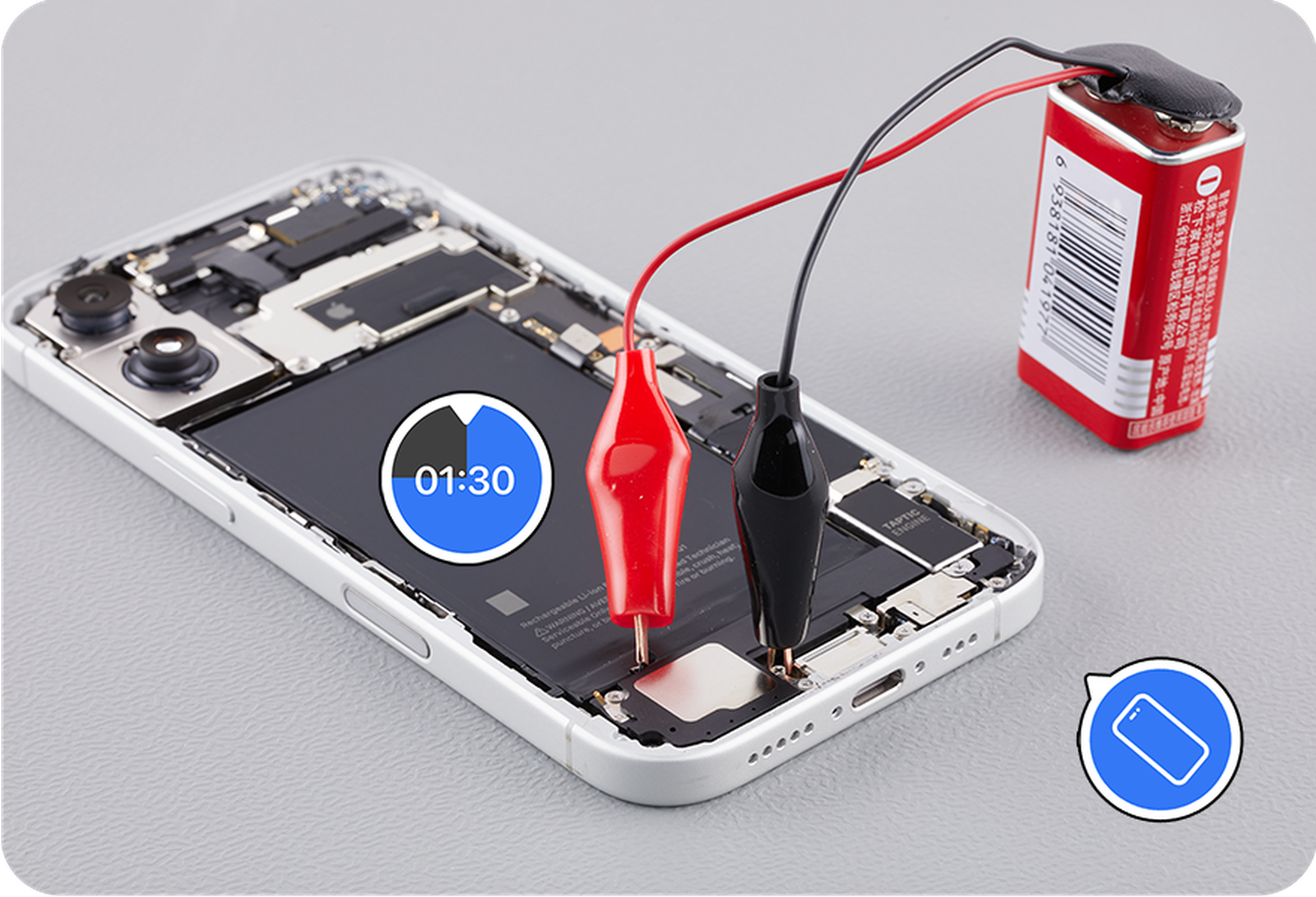
"Easier" is relative I guess:
Here’s every tool you’ll need to replace the iPhone 16’s battery https://9to5mac.com/2024/09/20/heres-every-tool-youll-need-t...
* 9-volt battery
* 9-volt battery clips (923-10726)
* Battery press (923-02657)
* Ethanol wipes or isopropyl alcohol (IPA) wipes
* Nylon probe (black stick) (922-5065) or suction cup
* Safety glasses with side shields
* Sand
* Sand container
By contrast, the Treo 650 battery replacement took a few seconds and zero tools.
So, to me, this is a huge progress. Plus, don’t you normally have 9v battery and some connectors for it already?
These new iPhone batteries seem to be not far off being compliant, if they're not already:
> A portable battery should be considered to be removable by the end-user when it can be removed with the use of commercially available tools and without requiring the use of specialised tools, unless they are provided free of charge, or proprietary tools, thermal energy or solvents to disassemble it.
> Commercially available tools are considered to be tools available on the market to all end-users without the need for them to provide evidence of any proprietary rights and that can be used with no restriction, except health and safety-related restrictions.
https://www.europarl.europa.eu/doceo/document/TC1-COD-2020-0...
https://www.europarl.europa.eu/doceo/document/TA-9-2023-0237...
Batteries don't need to be glued on in the first place.
Torque driver (blue, 0.65 kgf cm) (923-0448)
Torque driver (green, 0.45 kgf cm) (923-00105)
Security bit (923-0247)
Micro stix bit (923-01290)
Nylon probe (black stick) (922-5065)
ESD-safe tweezers
Adhesive removal tool (923-09176)
Adhesive cutter (923-01092)
Ethanol wipes or isopropyl alcohol (IPA) wipes
6.1-inch repair tray (923-10712)
Camera cap (923-10716)
Display press (661-08916)
Cut-resistant gloves. Gloves may vary by region.
Heat-resistant gloves. Gloves may vary by region.
Safety glasses with side shields
And the rest is just for safety.
But I guess Apple caters to the people who think getting grease in their hands is beyond them.
I have a pixel 5a with a dead screen that runs but can't be used because the dead part is part of the motherboard not the screen. It's a known problem with this model. So it still runs, but I can't recover any pics or texts from dead people from it because I can't respond to the screen prompts to allow the USB connection.
I don't see how I'm any better off.
CDMA Network Update https://www.verizon.com/prepaid/cdma-network-update/
> Starting Dec 31,2022 we no longer support 3G/4G Non-VoLTE. To keep your service active, upgrade your phone.
Sorry, which of a 9-volt battery, alcohol wipes, safety glasses or sand (and a container for it) screams inaccessible? (And everything there is technically optional. I doubt most Treo 650 users drained the battery before touching it, or bothered with a suction cup.)
Removing the back glass takes special tools, but I'll take that over having to replace my phone every time it gets wet.
On my Librem 5, I can replace the battery without any tools.
Removing the back glass takes special tools, but I'll take that over having to replace my phone every time it gets wet.
Gaskets have been around for over a century.
Is should be totally possible to make a good 2024 flagship with replaceable batteries, but we'd have to forgo the fancy glass back panels.
The problem with this logic is that phones are complicated and have a lot of constraints. Phone design inherently involves numerous tradeoffs.
So... of course it's possible for manufacturers like Apple and Samsung to create a thin, waterproof phone with no-tool battery replacement.
But at a cost to other features.
The market has shown repeatedly that few consumers value no-tool battery replacements, relative to various other features they'd have to give up to get it. People are voting with their wallets and it doesn't make sense for Apple, Samsung, etc., to build phones people don't really want.
Plastic is just meh.. I'd rather have an unrepairable device than one made of plastic.
(We can't have metal because of the wireless charging)
When they remove the battery cover -- "oh, waterproofing"
When they glue the battery amd remove all screws -- "oh, waterproofing"
When they eventually require an approved persons blood sample to perform repair, will I also hear the "oh, waterproofing" thing?
(Kidding. I did love mine and I did not protect it, and I'm sure it got rained on many times, but I don't know if I ever literally hosed water through it. :)
Older devices could generally handle splashes, e.g being used in light rain. Water damage seemed far less likely than drop damage.
You can still do all the same shit with iFixit tools. These are just the genuine tools aimed at repair shops.
This is a state of the art micro computer. Of course it will require tools to handle correctly.
And removable batteries require far more internal space which is why they fell out of favour.
No they don't. Less than 1% extra volume.
Especially given that you would want to preserve some form of water resistance.
Meaning you either (a) have the entire back be removable or (b) a battery injection mechanism similar to a Leica SL3. Both of which would seem to need far more than 1% extra volume.
Nobody is going and buying the Apple 9v battery or "Apple sand"
https://cdsassets.apple.com/live/SZLF0YNV/images/tp/bucket_3...
There are alternative devices one could use, or you know, just use the tools you have, as long as you keep the pressure smooth. Possibly a Juicero kind of device
https://xdaforums.com/t/official-google-repair-guides-for-va...
So, I can now change the battery on my iPhone 12 Pro _and_ reset its status in the Settings->Battery field, which is great. I already have all of the tools apart from the Apple specific ones, which to be fair are very useful for someone that does this everyday, I don't - so I can replace them with manual alternatives.
Apple did the good thing and y'all still act like children.
If HN had its way, iPhones would be made from through-hole components and 7400 logic. The battery would last all of approximately 13 minutes… so it would be not just possible, but actually necessary to swap the battery in seconds.
Ideally, the phone would be slightly unreliable (MTBF of no more than 200 hours) so that every user could experience the joy of troubleshooting the bad component and soldering in a replacement themselves.
Maybe Apple could even include a sacrificial capacitor in the power supply that is just slightly under-spec’d. That would also give users the opportunity to “soup up” their iPhones by installing a better capacitor in that one location.
It would be illegal to sell them without including (in the box with the phone) a 3000 page printed service manual containing not just schematics, but a detailed theory of operations and full source listing. Nobody would actually look that these, of course, but it’s the principle of costing the manufacturer money that matters.
Such a device would be not small. After all, you need to have room to work inside the engine bay^H^H iPhone and you don’t want the components packed in too tight to support easy maintenance. That space would also promote airflow from the three fans necessary to cool all those 7400 ICs.
But that turned out to be irrelevant because of the replacement schedule. It seems clear that the frequency with which people replace their phones is what drove the decisions to make maintaining them difficult. If nobody ever needs to maintain the phone, why would you put any effort into helping them hypothetically do so?
The analog of Moore's Law for smartphones is already dying and there was a lot of news coverage a while ago of how people seem to be keeping their phones. That may drive the development of phones that can last longer than two years.
Malicious compliance accomplished.
Apple's instructions for all of the battery repairs include expensive equipment like an iPhone battery press to put a replacement battery back in place.
It's like they just copy-pasted their production line processes, but clearly that's not necessary.
Apple is known for their... interesting attitude towards repair, even in the previous manuals that have leaked. It somewhat reminds me of German automotive engineering --- lots of special tools and fixtures when a simpler and more conventional process would work just as well.
For example, I bought the iFixit repair kit nearly a decade ago and I have used it for any minor work for all that time. $80 spent once and I’ve never once needed to fish for some strange bit or tool no matter what device I’ve opened. In fact, the iFixit kit will still be sufficient for this entire repair plus the 9 volt battery of course.
Unless you’re saying all these are one time use tools but I didn’t see that from the parts lists.
What I think the parent is referring to is this: https://support.apple.com/en-us/120983
Obviously it is bullshit to suggest that a consumer would buy these tools. But it is also bullshit to suggest that you actually "need" a 'battery press' just because it is on the parts list.
The average phone repair shop will know how to loosen some battery adhesive very well with various techniques. So I don't think they will be discouraged by the Apple documentation.
Malicious compliance? Seems like it, a little bit. Still useful though.
I’m rich enough to buy the Apple tools but I’m too much of a grinch to buy them. I actually think iFixit protects me from myself as well because it’s too complicated (for me) to buy the tools I’d need.
If you want to repair phones to the equivalent quality of Apple stores, Apple makes it possible via their "overengineered" machines. There's nothing in Apple's ToS that forces you to make repairs this way, you're welcome to buy the Apple genuine part and use your own heat mats and press and whatever and knowingly make that tradeoff.
(Watch the Asian repair videos on YouTube. Not necessarily just phones but other things too.)
When MacOS was still called OSX and developers were the Macbooks greatest contributors and cheerleaders, things looked a lot different. A lot of the current framework components were copied from community components back then.
I'll miss the closed loop payment card support from iOS, but for everything else, I'll just say good riddance ...
I was definitely hurting for a while for lack of this (and iMessage) on Windows. While I haven’t gotten over iMessage (and use a KVM with my iPad to resolve that), the additional friction for payments has actually been a boon for my bank account.
The more friction we feel with payments, the fewer payments we make. Cash is higher friction than cards. Manual card input is higher friction than password manager autocomplete. Autocomplete is higher friction than apple pay. I haven’t found anything lower friction than apple pay.
By switching back to password manager autocomplete (which is unreliable at best), I’ve found my spending has gone down, because the cost of friction in payment is higher than the value of the item.
(I clearly also have too much disposable income, but that’s a whole other tangent)
Likewise for almost every home or car repair.
The whole point is that the tools are largely a once off purchase and repairing your phone is something you might do throughout your life. Therefore the initial costs should be spread over a longer period.
If Apple was also promising to keep the same process for the next 7 years I'd see a point to this, but this of course not the case.
Considering that it's been the same battery press going back at least as far as the iPhone 12, it's probably going to continue to be the same battery press for a long time. Especially now that they've definitely been using the same battery press across at least two methods of gluing in the battery (the adhesive with pull tabs, and the new adhesive that's released electrically).
Lots of my bike tools I have will take over a decade to get my money back on my stuff alone. But I get to do something I mostly enjoy. I can also help out friends/acquaintances when they need it. The same goes for this.
Let's assume a "no" for the sake of the discussion.
> How many times do you see yourself replacing the iPhone 16's battery ?
100s of times (for 100s of different phones, obviously), because otherwise you _would not be buying repair tools_!
The whole notion that you buy a set of high-tech tools and then use them only once or twice is the insanity that causes this whole discussion to even take place. These are tools intended for professional repair shops, not for consumers to repair their own phone.
You are both wrong and contradicting yourself. If it isn't necessary, then complaining about the tools is moot since as you wrote yourself, it's not necessary.
But, if you design a portable consumer device and you know to what tolerance you need a battery to be adhered to the case to make it not come loose, you know what pressure, movement, adhesive etc. are needed to make that happen for the form factor the battery is going to fit in. You know who doesn't know that? Pretty much everyone who isn't an engineer, and for most people who are an engineer, they might know that these are parameters that exist, but they aren't going to know every variation for every device ever produced. So now that nonsense about it being "clearly" is not so clear anymore.
Engineering things to be safe and reliable is pretty difficult. Add in batteries and it's suddenly one or more orders of magnitudes more difficult. That much is definitely clear, because when you cut corners, just guess or think to yourself "it is just a battery and some adhesive, how hard can this be" you get phones self-igniting on airplanes.
If we take your full line as a quote:
> It's like they just copy-pasted their production line processes, but clearly that's not necessary.
Do you really think there are a bunch of people using manual hand tools mass producing every aspect of a phone? Sure, there might be a bunch of steps where manual labour was effective and efficient, but it's not like you show up at the factory with your suitcase of tools and go to work at your desk.
What they reproduced is the parameters. And that is exactly what you want. A repaired product should be as close to a freshly manufactured product as possible if you're going to be liable for it.
This has some sense to it, mostly from the liability point of view, but this
> if you design a portable consumer device and you know to what tolerance you need a battery to be adhered to the case to make it not come loose, you know what pressure, movement, adhesive etc. are needed to make that happen for the form factor the battery is going to fit in.
as someone who works in this field, this is overstating the matter quite a bit. The tolerances for something like pressure in this instance are going to be wide enough that "press firmly" would suffice in a rework document. It's made to be very simple on purpose for manufacturing, and a lot of slop is built in so that we're not in this situation where microns or milli-newtons matter and cause a battery fire somewhere down the line. The fixtures are primarily for efficiency gains, and in that sense I would agree with the gp that press fixtures are not practically necessary in an at-home version of this process.
I agree, however, the battery example was a prime candidate for "it is not always as simple as it seems". LiPo batteries don't like getting squished.
I also repair my white goods, black goods, car, HVAC, etc. Most of those don't require special tools either.
If they copy-pasted their production line processes the parts would cost less than $40 total.