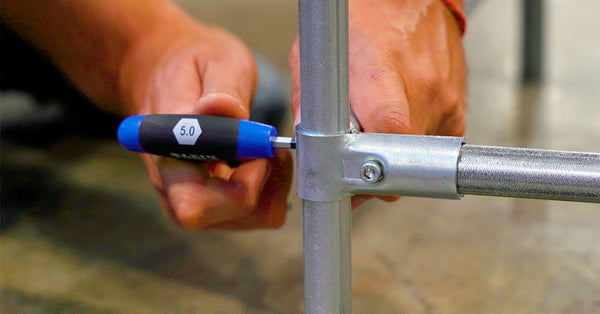
Maker Pipe | Structural Pipe Fittings for DIY Builders
We empower you to make something you love. Whether you're a beginner or DIY pro, our products are a great fit for your project. Learn why.
Maker Pipe
276 points · by elsewhen · 2y ago · 119 comments
https://makerpipe.com/collections/modular-pipe-fittings/prod...
edit: I did not even see when I posted this that they had made this open source with the downloadable STL to print your own connectors. Great move on them!
I can see that being a pretty fun cheapo building toy for the kids. Might have to grab a pack of stirrers and run off a couple handfuls of connectors. Very cool.
I love how much work they've done on connectors. In my experience with PVC, one of the biggest hurdles to making interesting projects is finding prebuilt connectors for anything besides simple 90-degree angles. It makes sense given that most PVC projects are for construction rather than hobby projects, but it's still annoying.
Having pre-drilled screw holes is also a nice bonus.
For everyone else, there’s McMaster Carr.
Said wizard stores sometimes have a handwritten sign taped up on the wall behind the counter dating back to the Carter administration that reads "Those in the trade will be served first"[0].
Your reward for being a wizard is having competent help at the store, and the fittings haven't been randomly distributed among the bins by a million prior muggles.
Electrician wizards similarly work with electrical supply stores, not Home Depot if they can avoid it. Carpenter wizards cross over a little more, but they generally prefer to work with lumber yards that deliver[1] and have halfway decent lumber[2].
[0] Yes, literally.
[1] I believe the box stores do to, but they charge handsomely because they don't really want to.
[2] 2x3's are crap everywhere, but the quality on anything bigger goes up immensely at a real lumberyard.
While sometimes I would make the argument that the lack of inventory is why people go online instead, in this case I think that is wrong. Their target market is home owners doing plumbing, and plumbing rarely needs those odd connectors. Frankly if you have small PVC/cPVC water pipes (as opposed to larger drain pipes) I would replace them with PEX where practical, and cut them off where not and install a PEX adapter. (I'd also do that for copper or iron pipes - copper because it might have lead solder but if it doesn't you are good for a while; iron because it hasn't been common in so long that anything you see is probably past expected lifespan)
https://www.ncbi.nlm.nih.gov/pmc/articles/PMC10779931/#:~:te....
Agreed though -- PVC pipe (the white stuff) does very poorly with exposure to UV light. The beige CPVC stuff is worse. The black PVC (ABS?) is supposed to be better, but less available in small gauges. And the grey plastic stuff used for electrical conduit is also supposedly UV-safe, but is far less structurally rigid than any of the others, or of course galvanized EMT. Sometimes that flexibility is a virtue, but usually not.
My ali efforts often get flooded with nonsense.
Modular pipe connector
Those do okay without you getting hundreds of irrelevant air hose fittings
You can easily bend 1/2 emt by hand.
I wouldn't use it for scaffolding(!) or anything supporting dynamic loads in the human-scale, but I've sistered three 3/4" EMT pipes together for an extremely strong, rigid, and inexpensive support pole.
Here's some real values for you:
2ft 3/4 EMT has an expected failure force of about 3300lbs (some studies found actual is around 3900-4200lbs).
4ft 3/4 EMT ha an expected failure force of about 2000lbs.
8ft 3/4 EMT has an expected failure force of about 450lbs.
So it is non-linear.
This is the point at which it fails catastrophically, not the point at which it starts sagging.
They are also not permanent load ratings, include no safety factors, etc.
Cost wise, 3/4 EMT costs 11 bucks for a 10ft piece at my home depot.
I can go to my local metal supply and get 3/4 square structural steel tube for < $1.00 a ft.
This is relatively in line with online suppliers so i believe it's not an exception: https://www.onlinemetals.com/en/buy/square-tube
This is structurally rated steel tube - it will hold much more than the EMT, it is meant for holding things, and being square, it's often easier to work with.
So i just don't know why i'd use the EMT.
This is why you see wood or outdoor plastics for raised garden beds
Priced individually:
  | Fitting | Price (ea) | Qty | Total |
  |---------|------------|-----|-------|
  | T       |       3.34 |  12 | 40.08 |
  | 90      |       5.79 |   4 | 23.16 |
  | 45      |       4.95 |   4 | 19.80 |
  | 180     |       4.95 |   2 |  9.90 |
  |=========|============|=====|=======|
                         |  22 | 92.94 |
If you've got the cash to burn on benchstock at this price point, more power to you, but the point is you're really paying a premium to throw away choice for the illusion of value with this bundle.
(At a past startup, we used 80/20 for the structure of our factory stations. We were very happy with how 80/20 was easily adapted during prototyping and testing, and then our final station design could be replicated quickly stateside to several stations, then disassembled into a few assemblies for flight, reassembled at the factory in Asia, and hold up well in production, and it also looked professional for demos. A lot of that success was due to the know-how and effort of our mechE, but, IMHO, 80/20 is appealing to people who grew up with Lego-like toys, and even I, primarily a software person, felt I could do useful things with it and some basic tools.)
For a machine like a 3d printer, I would choose 80/20. For some lightweight shelves, EMT conduit or wood. So I see this product almost as a wood replacement rather than a 80/20 replacement.
For example: https://keesystems.com/product-category/fittings/kee-klamp/?...
https://makerpipe.com/collections/modular-pipe-fittings/prod...
Doubly bad, the friction seems to be created by screws that can get loose with time/ not be tightened with the proper torque.
Also, an Europe specific thing (I think), is that we don't use metallic pipes for electric wiring, we use PVC.
PVC conduit is used for some underground applications, it isn’t (typically) used outdoors above ground since UV light destroys it.
You can use EMT w/ raintight compression fittings or galvanized RMC outdoors (or PVC-coated RMC if you have lots of money and/or want it to last 50 years).
Steel conduit (or metal-clad cable) is typical for indoor commercial installations, aside from some specific places where aluminum or PVC is used, like an MRI room.
In college I hung blackout curtains in my dorm room with conduit - IIRC it was maybe $5 for a pipe that was longer, sturdier, cheaper, and less annoying than the typical telescoping curtain rods (where the curtain always gets caught up on the telescoping edges as you open it).
I also love that you can add structural bends with readily available (and relatively compact) conduit bending tools. Gotta love economies of scale.
For others, Patriot is a dark comedy TV show available on Amazon. I highly recommend it.
There’s absolutely no way I’d trust a desk made of EMT, if someone leans on it too hard it will crumple immediately.
(the kind people do make desks and shelves out of)
While there is a 1 inch measure in common use that is as you described, the subject here is EMT. There is no dimension in EMT that is 1 inch by the system you describe. The diameter is close to 1 inch, but it is noticeably different to the naked eye, and for all useful purposes different enough that anything actually 1 inch in diameter is not compatible.
1' is one foot
So yeah, a weird measurement unit. Technically the symbol to be used is a prime symbol (https://en.m.wikipedia.org/wiki/Prime_(symbol)), but what’s used in practice is anything that looks close enough.
Black pipe is still pretty cheap and way stronger than EMT.
https://www.tnutz.com/product-category/10-series-extrusions/
One of the most important lessons I've learned in all my time building things, is that it's very often the mechanical and physical construction that makes or breaks a project.
Electronics and software are pretty forgiving, but bad mechanical design directly translated to a bad product and a bad experience building it. I love to see progress in that aspect of DIY!
But seems like there are plenty of options.
But have to say, not enough people know that products like this exist that can allow building something a lot cheaper than buying something pre-made.
Any ideas who might have them?
In most of these cases they are tradeoffs, not direct advantages but it should be kinda obvious which would be best for any given situation