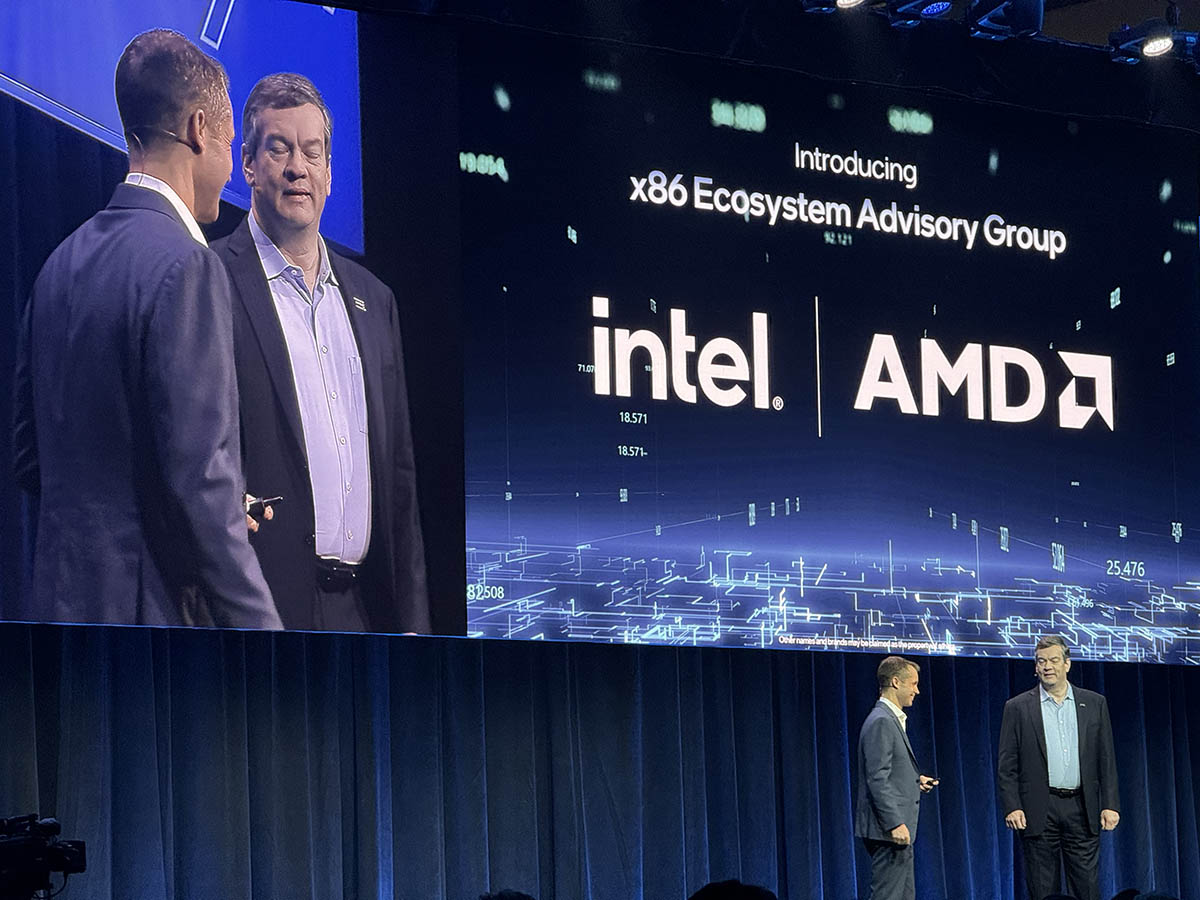
Hell Freezes Over as AMD and Intel Come Together for x86
Hell freezes over as AMD and Intel come together at OCP Summit 2024 to jointly drive the future x86 ISA through an industry advisory board
ServeTheHome
81 points · by rbanffy · 2y ago · 121 comments
ARM took embedded first, then mobile, then gaming (on mobile and handhelds), then Macs, and now it is making real inroads into Windows laptops (e.g. Snapdragon X Elite) and servers (e.g. Graviton.)
The next shoe to drop would be a high-end gaming PC that can take an NVIDIA or AMD graphics card powered by a Snapdragon X Elite-like ARM chip.
Another shoe to drop would be a super-computer powered by ARM chips instead of x86. I don't think that has happened yet?
After that, the last refuge of x86 is in legacy software that hasn't been natively ported to ARM. But there will be fewer and fewer cases of this as the years go by. For now I think it will be mostly games.
x86 is under serious threat.
It's not like ARM has taken over those markets yet. Snapdragon X is fine but nothing special compared AMD/Intel chips. I think we just might have a pretty distorted view of ARM vs x86 because of Apple. They are just much better at designing ARM chips than anyone else (including both Qualcomm and especially ARM itself). Servers is kind of a mixed story as well.
There is nothing wrong with other companies trying to disrupt AMD/Intel duopoly and hopefully we'll get lower prices and more innovation because of that but calling x86 dead is a bit premature at this point..
The issue is that ARM is now fine for Windows. Until Snapdragon, ARM was actually pretty crap outside of Apple. This is a huge step. Qualcomm acquired a lot of the original Apple team for the M1 via Nuvia and I expect them to be able to execute at least decently going forward.
Apparently they are selling because they have better battery life than Intel/AMD laptops according to this: https://www.techpowerup.com/324301/battery-life-is-driving-s...
> Servers is kind of a mixed story as well.
Graviton is 30% cheap for the performance (e.g. performance adjusted price.) It is a no brainer for a lot of workflows, especially given so many developers are actually building on ARM machines in the first place. I want my servers to be 30% cheaper.
> There is nothing wrong with other companies trying to disrupt AMD/Intel duopoly and hopefully we'll get lower prices and more innovation because of that but calling x86 dead is a bit premature at this point..
Qualcomm is exploring acquiring Intel. A company who got its value from ARM is looking to take over the historic leader in x86 - doesn't that tell you something? https://www.reuters.com/markets/deals/qualcomm-approached-in...
The writing is on the wall. x86 isn't dead and it won't be dead anytime soon, but it definitely in its twilight period.
Sure, I mean I agree that ARM can outcompete x86 there but mainly Amazon can just cut out Intel/AMD and make their chips themselves which can significantly reduce costs. Not because Neoverse is somehow inherently better or faster than its x86 equivalents. Of course from the perspective of most users that's effectively the same thing, why overpay for 1 fast core when you can just get 2 slightly slower ones.
> Qualcomm is exploring acquiring Intel.
That's far fetched and hard to believe. IIRC there were talks about Qualcomm maybe buying some secondary subsidiaries/departments form Intel and somehow it got extrapolated to Qualcomm acquiring Intel (unless there is any credible information to back that up?)
Huh, I didn't even realize they are sufficiently big for this to be potentially possible.
and those chips become relatively unimpressive once everyone gets access to the same TSMC nodes a year and some down the road with AMD's x86 beating Apple's wonder ARM once again…
Astra at Sandia Labs was the first Arm peta-scale supercomputer, and the first on the Top500. It debuted in 2018.
Fugaku is the fastest Arm supercomputer, taking the #1 spot on the Top500 in 2020. It is currently #4.
All NVIDIA Grace-Hopper systems will be Arm. There is one in the top 10 already, Alps at the Swiss CSCS, at #6. There are four more in the top 100.
Apparently I am super wrong here. ARM has made serious inroads here as well.
I think that ARM's willingness to allow their IP to be customized for their clients needs has really given them a lot of competitive advantages.
Sometimes useful to see how cpu architectures grow and then get crowded out by the next processor family -- at least among supercomputers.
ARM devices are embedded in the SoC. That's basically the definition of a SoC. Intel & co. at that time didn't produce SoCs. A CPU was just a CPU. It didn't have UARTs, GPU, SDHCI, I2c, SPI and other stuff in it.
The only thing x86 (basically Intel, not Microsoft) did good was to standardize I/O addresses like framebuffer, IDE ports, serial I/O and later to make the rest discoverable via ACPI standard (which is a bad standard, btw, and UEFI is far worse).
You may view ACPI as the x86 devicetree. The only difference is that x86 comes with ACPI written in a chip, while ARM firmware is a separate file you add into your bootable image next to the kernel, without the need for a separate EEPROM chip.
You shouldn't be complaining about the ARM device descovery (devicetree), but about the absolute jungle of devices that ARM includes. Just think how many different USB controllers are out there. Each manufacturer designed it's own controller and every ARM chip needs a different driver. On x86 there are/were only 2: Intel (UHCI) and AMD (OHCI), and then they cooperated and made universal EHCI and xHCI.
This was in a different era where most PCs weren't networked.
x86_64 has moved to UEFI and SecureBoot since, but is still mostly expected to boot any live distro you'd like. Replacing x86 could drastically reduce the chances of replacing non-free vendor software with free software.
Fugaku?
I guess a secondary factor is that it was made of custom/low volume CPUs, which would increase the unit price as compared to the higher volume providers.
I've thought about this quite a bit since I responded to a commenter who was somewhat was amazed at an ARM supercomputer quite a while ago about this subject. I decided to comment about this a lot more since it is my option to do so. cheers They had posited that ARM would take over, mostly recognizing the very low-power and fairly inexpensive ARM SoC in phone handsets and routers.
This thought didn't sit quite right with me. I considered the power requirements and architectural needs of a larger computer system. With many, many PCIe lanes or some other interconnect, rapid storage commitments and the very responsive performance required by a "serious" architecture will cause all of these subsystems to continually draw current and dissipate heat. This is in stark contrast to power efficient computing devices like iPhone or ARM macbooks, and in my mind seems likely to eat the "gains" that people generally associate with these devices.
The piece missing in my understanding is about the semiconductor industry and the electronics field in general, and is particularly interesting to me, because many of the highest-tier operators outsource %100~ of their production to TSMC or the other. There isn't anything magic or even very good about x86 architecture. I'm fairly certain the instruction set no longer maps to hardware in most cases, rather more analogous to function calls in typical software applications.
Every now and then I like to reflect that iPhone came out in 2007. My car is older than that, and we were well on our way during the election of Barack Obama. And while legends hold that Power still exists, I had long forgotten about ALPHA or SPARC by then.
Imagine for yourself this earth-shattering shift: What happens when the basic lithography processes, assembly practices, and validation procedures become such that for similar trade offs, any advanced hobbyist could order a wafer from future fab houses similar to JLPCB, Scaleway, OSH Park, TSMCWAY, or whatever on-demand? Like, what if you could just pay $$$$ to buy a wafer that you designed and then sell 14nm UltraSPARC on tindie?
Yes, I believe this is called micro operations and have been around for a while now:
https://en.wikipedia.org/wiki/Intel_microcode#P6_and_later_m...
- The first game console with an ARM CPU was the 3D0 (1991 - not sure if it was an ARM1 or later version).
- The first game console with an Intel CPU was the Magnavox Odyssey 2 with an Intel 8048 (it also had an Intel graphics chip) (1978).
- The first game console with an x86 Intel CPU I believe was the FM Towns Marty (I think this is 1992 or 1993 - it had a 386).
- The first successful game console with an x86 Intel CPU was the original Xbox (2001 or 2002) - and actually it was an AMD CPU (edit: nope it was an Intel).
There were mobile phones with Intel CPUs in them for a short time - I think it was 2010-2011. I always wanted to see one (was like super curious how the boot firmware looked if it was user accessible). I wonder what happened.
I think it was actually a Pentium III with less cache, i.e. basically a Celeron. Only third-gen Microsoft consoles onward use AMD parts.
Correct according to Wikipedia: https://en.wikipedia.org/wiki/List_of_Intel_Pentium_III_proc...
ARM is clearly here to stay and took some of the 68k, PPC, MIPS, and low end/embedded x86 use cases.
Since the industry loves the idea of displaced incumbents we’ll see a lot of RISC-V articles for years to come.
All of these came before Linux dominated the server space. Back then, being able to run Windows was needed to escape the narrow Unix niche.
Plus, 20 years ago people said x86 could never hit power and performance targets that today are the norm. Everyone talks about x86 like the actual hardware is the same year after year. It's not. The underlying CPUs are amazing and both Intel and AMD have done amazing work keeping the ISA competitive. I don't see that changing any time soon.
When did it switch to ARM from x86.
I don't really see any reasons why can't x86 and ARM just coexist long-term. Porting software is relatively easy or not even necessary these days and ARM main advantage (that companies other than Intel/AMD can use it) is entirely non-technical (development + licensing costs) so as long as Intel/AMD can keep up they have no incentives at all to switch.
Amazon's and Ampere's ARM server chips are significantly slower and less power efficient than the equivalent AMD chips (for Ampere at least, note sure if Amazon is sharing their power usage data but I doubt it's massively lower..) they are also 30-40% cheaper because you don't have to pay for AMD/Intel's oligopoly margins.
x86 still powers most of how we actually get stuff done.
ARM is not going anywhere for a while. It dominates the mobile and embedded markets and is making in-roads in others. If it eventually gets displanted, it will be by RIsC-V or its successor.
X86 is vulnerable, more vulnerable than the other two. Taking it down is going to take a lot though. I would not bet against it. The biggest problem is that it is master of an ever shrinking empire. Even if they never lose it, they may matter less over time.
What you probably want is less variability in SoC devices. Now each chip has a different SDHCI, different USB, different UART and different I2c, each needing a different driver. x86 only has 2: the Intel variant or the AMD variant.
If you know what board are you booting on, then you can load correct hardware drivers for everything else. But that's not going to work without UEFI and ACPI.
Two individuals along with multi-billion dollar corporations. Curious why the organizations that these individuals represent were not included instead?
An Intel-AMD merger would make sense, but it’s only extension of extinction if they don’t migrate from x86