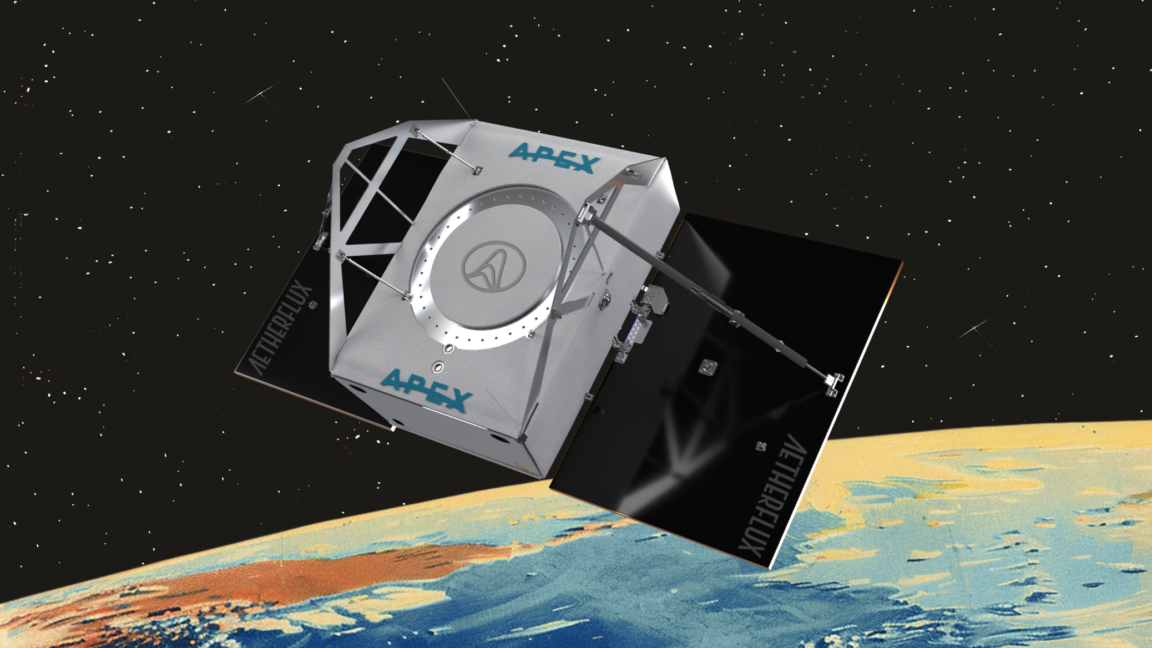
Solar power from space? Actually, it might happen in a couple of years.
From Robinhood to slinging photons.
Ars Technica
16 points · by thunderbong · 2y ago · 58 comments
I listened to a podcast[1] a few months ago which proposed the (IMHO) more innovative idea of using giant, ultra-light foil mirrors in space to sell sunlight to existing solar farms at night. Aetherflux seems to be using the more traditional solar panels + IR laser approach, which seems harder to justify the cost of compared to batteries.
[1]: https://firstprinciples.fm/episodes/8-ben-nowack-selling-sun...
At 47:42 he says:
> So serving energy customers is kind of like the end state, you know, that, that makes sense when you're launching like, you know, full Falcon Heavies full of full of vehicles.
Implying he knows you're not getting 200W/m^2 with only a single 10m x 10m 16u cubesat. He says for single satellites their short term goal is to be an alternative for street lights in undeveloped areas, which requires much less power per unit area.
And at 1:11:57:
> And you can also optimize like different curves of customer saturation, you know, so like initially, you're not going to have as many customers excited to buy, you know, a couple minutes of sunlight that's not very bright. But later down the line you're going to have a lot of people who are very interested in buying a lot of sunlight. Um, you know, at the kind of point where we're, you know, a couple hundred Watts per square meter for, for quite a while.
So it sounds like 200W/m^2 is a long term goal, not something they're planning to have right away with the 100m^2 satellites.
Would be interesting to run the numbers and find out exactly what would be needed for 200W/m^2 in the maximally bright part of the illuminated area, in terms of the size and number of satellites required.
What would that look like from Earth? I can't imagine star-gazing with a giant mirror shining down on me.
The cost of solar power has plummetted in the last 2 decades and nobody is quite sure where this will bottom out.
Now obviously sometimes it's night time and sometimes it's just cloudy. You have a number of options for this, in increasing level of engineering and technological difficulty:
1. Do nothing. Just take power when it is available. This works surprisingly well for a lot of our power usage. Power usage peaks in daylight hours so solar reduces your baseload requirements. Sometimes you can simply do things when the weather doesn't permit (eg data centers).
2. Store excess power in another form. This could be batteries but it could also be things like sequestering carbon from the air into a hydrocarbon form you can later burn for power. This is carbon neutral by definition. This method currently isn't economic. In some cases that doesn't matter (eg in cold climates where current batteries aren't particularly effective).
3. Power satellites that bean down power. A solar collector in space would produce ~7 times as much power as a terrestrial collector because there's no day/night or weather interruptions nor atmospheric loss. It is technically feasible to beam down power.
4. Build an orbital ring. Attach solar collectors to it. Run cables to the ground. Obviously this is more far future.
More [1].
Narrator: It will not happen.
The only place space based solar makes sense is on things that are in space.
I suspect we could get collectors pretty small and efficient if they were optimized.
The problem always lies in how you get that energy down to Earth. There's no way to do this that can't also be used in a way that can be destructive. Even this proposal at 1kW you can do some damage. They're doing IR because this is fairly transmissible through the atmosphere but it can still be damaging. These range from a directed energy weapon (likely aimed at electronics) to a more denial of service attack (you'd need higher energy than 1kW). There's another proposal about just redirecting light[0] and I think it is easier to imagine how this is a weapon. Could you imagine someone just making you, in your house (or worse, it follows you around), always live in daylight? It would drive you crazy. I know the Nords, Alaskans, Canadians, and others will tell you there's challenges to living in perpetual daylight. But you can destabilize crops, which need night, insects and wildlife, and I'll let your imagination run wild. But this is also true for IR light, you just won't see it with your eyes. That still affects many insects, snakes, fish, and other animals, not to mention plants. IR is heat, and it doesn't take much heat to disrupt things.
On a different point:
  > told me he wants to reinvent the idea of space-based solar power beginning with a relatively small investment—likely a bit north of $10 million
  > That physicist is Baiju Bhatt, who co-founded the electronic trading platform Robinhood in 2013
It seems you aren't aware that space is not controlled by a single country. It's ruled by international agreements. Do you really think everyone sitting at that table is going to be using that power to make laws based purely on the merit of the technology and it's safety? Or do you think they're going to be bullshit arguments that are reaching at best? We both know the answer to that. Predicting what they will argue is not the same thing as saying their points will be valid. But you also can't just pretend that bullshit won't exist.
Anybody willing to ignore international agreements to develop weapons can reach for the very effective nuclear, chemical or biological weapons rather than for imaginary impossible ones.
Using a directed energy weapon to shoot down drones is millions of times more feasible than space lasers -- thousands of times more concentrated power, thousands of times less air dispersion, on the softest possible target. Yet using lasers to shoot down drones is so ineffective that we're not doing it. You're proposing something a billion times more difficult.
You need the size of the area you want to shine it up which is HUGE.
Why do we entertain this? How do people get funding for doing this? Are people so ignorant?
5 years ago, catching a rocket booster with a tower was not realistic.
The past 150 years has been wild, I'm not too sure I think anything is unrealistic anymore.
Space-based is becoming more attractive every year. Lift costs, panel weight and cost, computing power are all going in the right direction to improve the space-solar economic equation. As for space, a few square miles is trivial to find a place for.
Further, the usual bugaboos about "How do you get it down here?!" (microwaves to high-capacity receivers) can be circumvented entirely if you use the power in space e.g. in AI-training compute centers also in orbit.
Its cheap (its just silicium plates), we will have organic based systems in the future. You will be able to print it in the future.
Efficency is huge. We have so much unused roof space, its ridicoulous. parking spots, house roofs, commercial building roofs.
Why would you think its smart to send computers, which need cooling, up to use the energy over there? Do you know how hard it is to radiate heat away in space?
Rooftop solar is pointless. Roofs don't scale; roofs are not optimally placed; roofs are hard to reach; roofs are not engineered to support the load or hardware. Open cheap unobstructed ground near a grid with clear access are optimal. Roofs are exactly zero of those.
Efficincy is 50% at best - the daily occurrence of the terrestrial eclipse known as 'night'? Remember?
Any panel argument is the same in space. Don't know what that point was about.
Using energy near the generation point is optimal. The heat argument is good; it goes double for a planet that's already heating up and causing problems. Get that shit away from our ecosystems.
Any advantage of ground-based solar is eroding daily with advances in lift cost, land price rises, congestion in cities. It's only a matter of time and money.
And southern walls.
Putting AI training in space is daft. Heat dissipation is the problem (on top of gravity)
In addition to power requirements and data transfer, I always thought that the main logistical issue with in-orbit computers was heat dissipation. If you have a need for compute in orbit (let’s assume this is true), you’d still need a way to dissipate heat. But this isn’t something that can happen easily in space.
(But it makes me wonder if you could have a Peltier generator attached to a hot chip to remove heat and “recycle” some of that energy back into electricity… not that it would help too much with the other issue with compute in orbit - data transfer)
Not really. The atmosphere does reduce solar energy at the surface, but the fact we're 1 AU from the sun is the major reason we receive so little power.
The costs of putting things into orbit and maintaining things in orbit are unlikely to ever overcome the atmospheric difference.
Plus, on the surface of the Earth, you get convective cooling in atmosphere "for free." Good luck keeping your panels cool on orbit.