165 points · by jakey_bakey · 2y ago · 87 comments
https://technology.riotgames.com/news/demolishing-wallhacks-...
Not many first person games have that "fog of war", it turns out to be quite hard to implement well.
This video compares Valves own fog-of-war implementation to the implementation used by FACEIT, a third party competitive matchmaking service, which shows there's a pretty wide range of trade-offs to be made. Valve went for conservative and fast, while FACEIT went for aggressive and (presumably) slow:
https://www.youtube.com/watch?v=8w1ICIBO3D4
Valves implementation is better than nothing, it at least stops cheaters from knowing which direction the other team is going at the start of a round, but beyond that it doesn't stop them from knowing exactly where most enemies are standing around corners because the serverside visibility checks are so coarse.
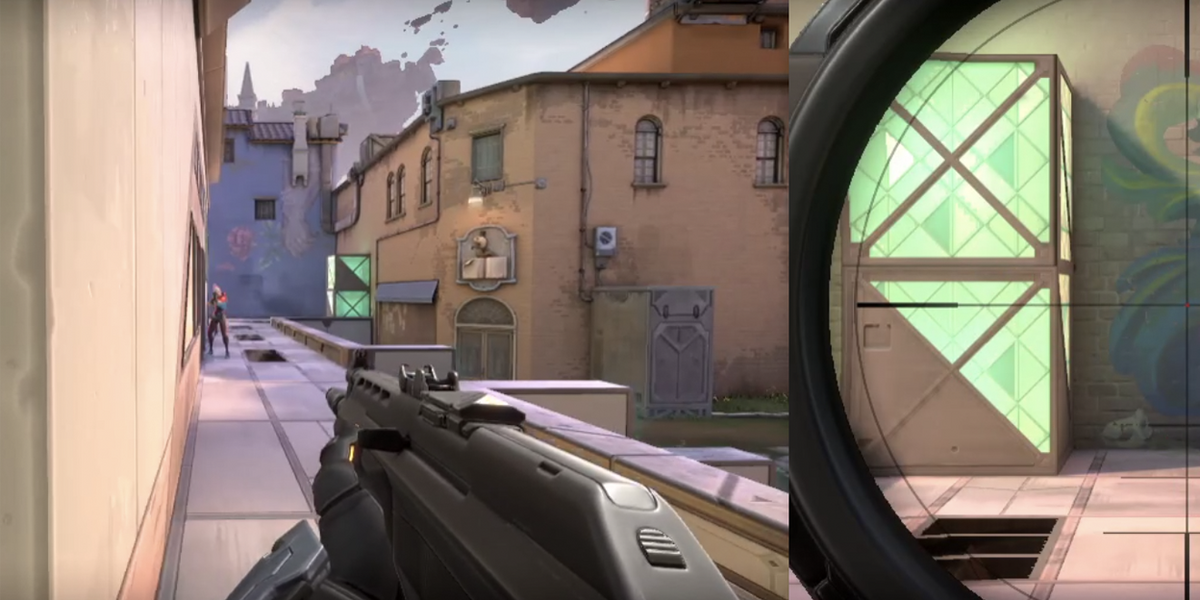
Many custom servers in games like CS enable a more aggressive version, in cases where you geographically will be close, so you can rule out high latency connections and have more aggressive fog of war.
https://old.reddit.com/r/GlobalOffensive/comments/37ebes/maj...
> Added trace-based visibility checks to prevent networking invisible enemy players.
If you're remembering playing with the r_drawothermodels console command to get a faux-wallhack effect, that was still subject to the engines clientside occlusion culling so it didn't show everything the client (and real cheats) were actually aware of.
The thing I remember was that my friend's graphics card had a global transparency setting built in (AKA a wall-hack mode lol). You could see other players come into view as soon as the came into an area that was rendered. Then a CS patch came out and the players weren't visible until very shortly before they would become visible had we not had the uhh... transparency mode on haha.
Maybe the grass is always greener, but it just sounds like an incredible opportunity for anyone working on the Valorant team. You get to solve challenging, interesting problems that hundreds of millions of users will benefit from, that's just so cool to me.
But on the flip side, that one cool thing might be the ONLY thing they do, all day, every day, which might not be as cool after 6-10 years.
But I do think your point about benefitting large numbers of people is a strong motivator..that's partly what academia relies on to keep employees as below-market rates -- the mission oriented drive to make the future better. I don't mean to poke at that issue specifically, but it's a great example of how teachers, etc. will continue to work for pennies as long as they can afford it (it's almost abusive).. but that drive is a critical part of their personal happiness
Yeah, sometimes I think I'd like to be a systems engineer and work on databases or similar but then I think about that being 100% of my work and realize I don't desire that kind of job.
This stuff seems fun until you realize it means you're choosing to specialize in something pretty niche. I prefer being a product engineer working on web stuff for now until I find something worthwhile specializing in.
Probably different at Riot? Not sure.
But companies like Blizzard/Activision and some smaller companies were described as very toxic environments.
[0]: https://www.riotgames.com/en/news/2024-rioter-update - 11% of staff let go
You're ever chasing the mouse. If it's not some hacker, it's some bug. If it's not a bug than its a feature and then all three.
Directors want results, 24 hour of stressful debugging to discover why some new person can now shoot through walls, creating a patch, replicating and ensuring it doesn't exploit or nuke any other feature and pushing the patch out without effecting gameplay is stressful. Partly why Overwatch had real-time patching abilities on each game.
You don't get downtime, no sitting on tickets. Hacking costs revenue and you got to ensure your work is correct.
Wake up the next day and start all over.
While playing FPS', I wondered why corners were a point of contention for me, both in dying or killing, and now I have additional insight.
I can sit at a corner and die from an oncoming enemy, or I can take the corner and take the enemy. I assumed it was all due to my own biological perceptual system, and now I see the synchronization would be giving each player an advantage depending upon who's overtaking the corner.
So in that sense, corners are pretty much a point of contention for everyone at every level since most of the game is based around taking and holding corners/angles.
The peeker vs holder relationship is pretty interesting to analyze as there is more to it then just server sync. But how both players try minimize/isolate the amount of angles they attack/are exposed at any given point in time.
As well as use their general game knowledge to make predictions about where the enemy is most likely to be in a certain situation. Prioritizing their attention/crosshair on those angles while ignoring the others.
I think this what makes it fun. Theirs a lot of thinking + buildup/anticipation for the moment of contact between players which is then usually resolved in <1s. And since the dead player has to then sit out the round it feels meaningful.
And in fact, both people can be making one at the same time, but the trick is that they are a slightly different lines because each client has a slightly different idea of where both players are.
But any process your user runs can read memory of other processes of the same user, Windows provides an API for it. So its not just kernel stuff that is scary.
Vanguard might be nice if you want to dedicate a PC to locked-down gaming, not so much if you just want to do legitimate $anything_else with it.
And yet Valorant and every other game with kernel-level anticheat seems to have been hacked anyways
Overwatch has a long time-to-kill, interesting to compare tradeoffs.
Some of Valorant's game servers are hosted in a data center very close to my house. When I played, my ping was in the single digit milliseconds. Some people accused me of being a Riot employee.
Of course, that low ping didn't prevent me from being utter trash. My K/D ratio was usually around 0.3.
Come to think of it, seeing the network buffering they perform, I wonder if having such low ping actually gave me a disadvantage when peeking towards someone with a 30 ms ping?
Yes. Counterintuitively, the players with the worst connections often get away with the most ridiculous nonsense.
Those timestamps are compared to a window against the server's and other players'.
Did you feel it potentially made the game MORE fun for you, having that high ping? I presume yes?
One of these days I’ll find a way to run Valorant in a windows vm
Had no idea it went this deep on your device.
Also their parent company is Chinese Tencent, which is a major alarm coupled with this type of invasive software.
Did the author do no research into the competition/precursors before going down this path?
Did they lie to make it seem more impressive?
Whatever the case, it’s odd.
I have to assume that what you mean by this is "for millions of people, Valorant will have been their first and only FPS."
That may well be true! The knee-jerk response you're getting from others is because your statement sounds like you're saying "no other FPS game has ever had a million+ players."
DOOM rears its head up from 32 years ago and says "People still make mods for me."
I wonder if pay to win elements reduce the number of cheaters? Some of these CS clones have equipments you can buy in the lobby that offer smaller hitboxes, higher health, better gun etc. Would that offer enough convenience/highs for these people to not stoop to hacking?