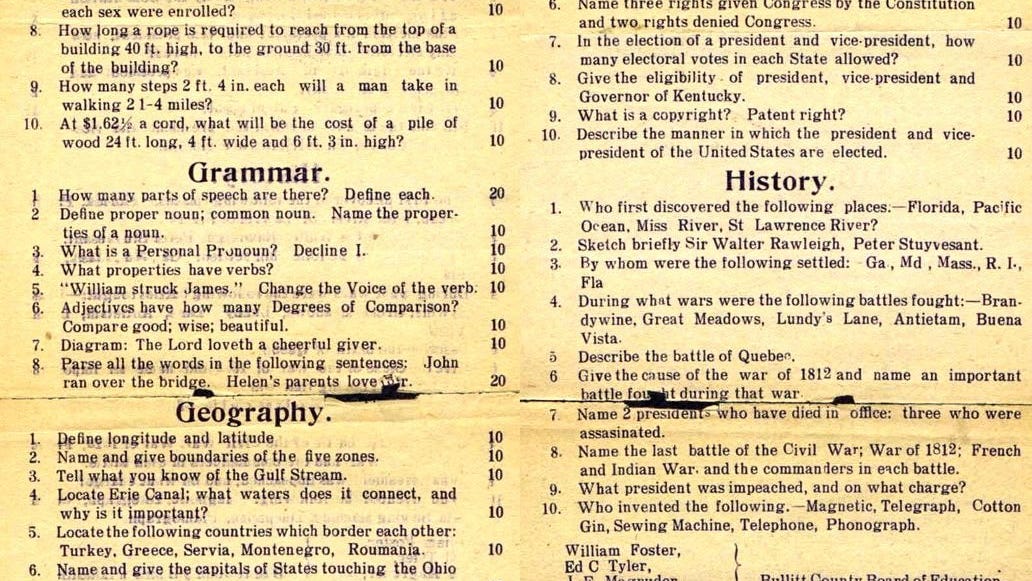
Could you pass this 8th grade test from 1912?
Are we comparing apples with pears?
onepercentrule.substack.com
69 points · by Gaishan · 2y ago · 142 comments
10% of high school aged people attended a high school?
90% of students enrolled in high school never bothered to attend or "worked from home"?
It would be interesting to know what was the “right” answer to this in 1912.
An indian-australian's semi-recent take on modern "educayshun":
Strongly disagree. A 12 year old has zero chance of applying critical thinking or data analysis to complex subjects like climate change or human migration. It's still memorization, he's still expected to regurgitate a few lines he learned in school.
The teacher repeated every time that he wanted us to understand broader concepts and do everything but rote learning.
Almost everyone then failed the exam (based on analysing various situations). The expected answers were word-for-word copies of the teaching material, that sometimes felt unrelated to the question. It was so absurd that we all took it as some involuntary but elaborate joke/life lesson.
School is about teaching your brain how to retain information in general, so you can retain what you need to use.
They would lack any info about world wars, decolonization, computers, space race, internet, climate change, just to pick some topics taught today.
School mainly serves as day care and social programming: obey authority, believe what we tell you, remember what will appear on the test. Some people get more out of it than others.
If you've got a system that can reliably take a citizen earning $40,000/year and turn them into a citizen earning $140,000/year, governments from all over the world will beat down a path to your door. Over a 40 year career that's an extra $4 million in taxable income.
Wikipedia for images:
- https://en.wikipedia.org/wiki/Peter_Stuyvesant
- https://en.wikipedia.org/wiki/Walter_Raleigh
Sketch one balding clean shaven face and sketch another one with pointy triangular beard?
Some of the questions are look line bonus questions. I wouldn't have been able to place Serbia on a map in 8th grade (Montenegro didn't exist anymore/yet), but I remember a friend failing a 9th grade test where he was expected to name 30 African countries and either place them on a map or name their capital cities. The test was stupid but not that much outside expectations.
It was mostly B-grade learning: learn the rules, apply the rules or research, reformulate, present etc. Critical thinking would begin in or just before highschool.
Deep knowledge wasn't required.
My response to that would be "for real critical thinking, you need memorization as a starting point. You can't think critically about the politics of the Middle East until you can point to Israel and Gaza on a map!"
Who's right? Are memorization and critical thinking complements, or substitutes?
This might have different answers in different fields. Like in maths, can you learn more advanced maths without a deep intuitive familiarity with numbers, the kind you get from being able to do arithmetic in your head? What about history? Can you get by without dates?
Not true IMHO. You can map it to a some sort of neighbouring countries graph and a few other facts.
Dates are only important as they relate to each other, their specifics are almost always meaningless.
There's a difference between rote memorization and committing to memory through practice.
I mean, there is still some rote memorization needed at times, but you want to minimize it as much as possible.
The mathematics is simple. The rest of it is stuff that is simple to Google. There’s a little bit of interpretation, but none of this is about problem solving or any kind of serious analysis.
I'd much prefer my children to have concrete knowledge and prepared for the world. Frankly, they'll be plenty prepared for the job market. Many of the folks I work are barely able to function outside of their role at work -- order all their food, can't change a tire, outsource all knowledge, etc. They're probably like the aristocrats in the 17th - 19th centuries, where they know only what they need, servants take care of the rest.
It's not representative of the average American during that era - who would not have made it to 8th grade.
Heck, in 1910, Kentucky had a 17% illiteracy rate [0]
The fact that illiteracy using the IMF definition is non-existent in the US automatically means your average 8th grader today is better off than one a century ago.
And if I'm honest, the exam itself doesn't seem that different from content I dealt with in 4th-6th grade and I was attending an urban lower middle class school back then.
[0] - https://usa.ipums.org/usa/resources/voliii/pubdocs/1910/Vol1...
That said, Germany's functional illiteracy rate is estimated to be comparable to the US [0]
It's a similar story with PISA as well - most other countries use it as a dick measuring contest by testing at gifted schools, but the NCES tries to randomize PISA testing in order to actually benchmark subnational performance and identify laggards.
Well that question didn’t age well…
In college anything below a C put you on academic probation. In graduate school anything lower than a B put you on academic probation.
Passing grade, 2, in most schools would be from around 30% to 50%. It's teacher choice.
Using Pythagoras, it's the square root of 30*2 + 40*2. It effectively a 3, 4, 5 right angle triangle.
A2 + b2 = c2
And this is pre-calculator so the number is one of the squares that the kids would have memorized. 4^2 + 3^2 = 25 = 50 feet.
Yeah, but the vast majority wouldn't, so isn't this contradictory? Is he trying to say 8th graders could pass if they studied or had the identical question in advance? That, too, I am skeptical of. Maybe some could, but most would not.
The reason is because the corpus of knowledge is so large. It's not like those are the only questions, but rather drawn from much larger reading. This is why even well-educated adults do poorly on general knowledge tests--what is considered 'general knowledge' is quite vast.
The difference now vs. 1912:
Emphasis on specialization for gifted kids, but also considerable intra-classroom variability of skill, so you have some kids learning multi-variable calc at 9th grade (not at school, but rather at local college, private tutoring , or self-study such as online with apps), and on the other extreme, others still struggling with fractions.
In 1912, the strugglers would have been weeded out by either dropping out of school or learning a trade. Mandatory k-12 school was not yet a thing. So there are selection biases here. Same for demographic change.
It is hard to apply an agenda on an educated and internet-connected populace. Internet connectivity is still useful as a control/propaganda mechanism, as the available content can be centrally influenced (think RT News ban, "community guidelines" moderation, etc.). So it is chosen to gradually erode education over time using a variety of pretexts, so that the population will gradually regress from self-thinking citizens to obedient subjects.
If you are referring to the exit exam in the link, you also have to remember that grade 8 in 1912 was available to a privileged few. This filtered out people with learning difficulties whose families didn’t feel like spending money on school was a worthwhile investment.
Those that had the means to attend school in the 1900s also had time to dedicate to study.
What's 21st century capitalism's plan for people who aren't any good at Latin and Greek?
Also, you are comparing expectations on top students in one case and expectations on overall population including the lowest ranking students. Likewise, reading at "grade level" is fairly high standard that massive amount of Kentucky 1912 kids would not clear ... because no one taught them to our current grade level standard.
Americans colleges teach biology, physics, chemistry to a pretty high level. Entrance to the top universities is also massively more competitive then it used to be.
The answer depends on who you ask. It you ask this to what you probably would call 'capitalists' the answer would be "school choice, school vouchers, home schooling and more vocational schooling instead of useless college 'degrees' in lesbian dance theory and the like". Ask those who consider themselves to be the "defenders of the oppressed" and the answer would be "more money for teachers (unions), get rid of standardised tests because they are 'racist', get rid of those 'books written by dead white men' and replace them with books by 'diverse' authors, get rid of school choice, close top education schools because they attract mostly asian and white pupils, lower admission demands for 'diverse' people, cancel student debt, etc.".
I think the former approach is more likely to lead to a return to sanity while the latter will just lead to more dismal [1] results, what do you think?
[1] interestingly enough my phone autocorrected that word to 'Disney' which somehow seems fitting
And the latter one are to large extend strawman.
Let them become homeless and addicted to fentanyl and slowly wither away and die or have to resort to crime to survive then lock them up and tax the people who are good at Latin and Greek to pay for their upkeep or UBI so they don't get robbed or murdered on the street by the people who aren't good at Latin or Greek and have nothing left to loose.
I can't even read it on my small phone screen and I'll be d*mned if I have to zoom in
But maybe it's too much to ask of modern Americans to understand that spellings of proper nouns can and do change over time.
Is this AI-generated? It certainly has all the signs of being so.
I've read real books from the late 19th and early 20th century, and while occasional typos do appear, their density here is suspicious.
Thus my conclusion is that I don't think this is a real 8th grade test.
https://www.bullittcountyhistory.com/bchistory/schoolexam191... - on the answers page they also acknowledge the typo on "eneeavor".
https://headsup.scoutlife.org/would-you-pass-this-test/ - 2013
I believe the misspellings in the spelling section are intentional so that the student will identify them—I am guessing that’s the point.
"Decline I" is a request to decline the pronoun "I".
Edit: there's also "secrate" and "Pres dent"
edit: The test seems to come from this page from the county's museum: https://www.bullittcountyhistory.com/bchistory/schoolexam191.... The WayBack machine records the first snapshot in 2012, so AI seems unlikely.
They note the spelling errors
> Note that there are several typesetting mistakes on the test including a mistake in the spelling list. The word "eneeavor" should be "endeavor." This version of the exam was probably a master version given out to the schools (note that the spelling words wouldn’t be written on a test.) The museum has been told that the exam was handed out in a scroll form (that is why the paper is long.) The typos would have been corrected simply by contacting the teachers and telling them to mark their copies accordingly, much like would be done today. And there might not be quite as many typos as you think; "Serbia" for example was indeed spelled "Servia" back then.
Current generation LLMs does not make smelling mistakes, only humans do.
Even the best of existing image generation models often spell words hilariously wrong when asked to generate an image containing text.
But sometimes their messassage gets mangled in intersting ways
(To be clear, I don't believe this is actually generated by AI, but in this case, but since we're looking at an image, I can see why some people might be concerned that it might be AI given the misspellings.)
But yes in general it's a reasonable concern to have.
https://cdn.arstechnica.net/wp-content/uploads/2024/02/fcell...