How Albertsons Kills Rural Grocers with Land Use Restrictions
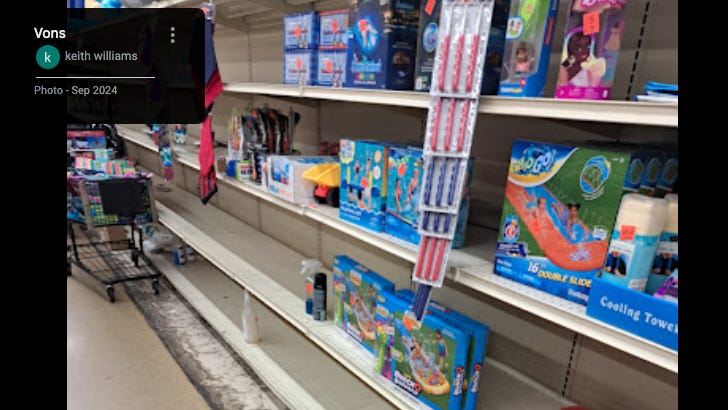
Albertsons uses land use restrictions in Mammoth, CA to stop competition so it can be the only store in town.
thebignewsletter.com
288 points · by unpredict · 2y ago · 308 comments
One could argue that HOAs are kind of a similar issue, acting like a pseudogovernment, with restrictions on housing passing on down indefinitely, even to new owners who may not have wanted to agree to them (but with housing being as constrained as it is, you may not always have a realistic choice).
As a general rule, prior owners probably shouldn't be getting a say in what future owners do with land. Why? Because land is inherently limited in a way in which most other property is not, which reduces the ability of new entrants to 'disrupt' the market by offering people more choice.
If my town only has one car dealership with shitty business practices, no biggie, it's not too hard to go to another town and buy a car, then bring it back. But I can't buy land and bring it back to use it, I'm stuck with whatever's already there.
> "In June, for instance, Washington state Attorney General Bob Ferguson, who is also litigating against the merger, fined Albertsons $25,000 for imposing a land use restriction on a store it sold in 2018 in a low-income section of Bellingham, Washington. As part of the sale, the supermarket giant put a requirement on the deed that no grocery store could open there until 2038. Ferguson found this provision was a violation of the state antitrust law."
The fine imposed doesn't seem all that significant though.
Perhaps they could also be prosecuted under federal antitrust law?
Now anyone can file the same suit and they'll need to settle.
An easier solution is mandatory sunsets after a period of time. Because the flip side of making them illegal is you'll have a lot more land with conservation easements being exploited for resources.
That said, I think I'm much more practical solution is to focus on the buyer's rights and non-competitive behavior then limiting sellers rights. It makes intuitive sense that people would be able to option or sell indefinite use rights if they own the thing itself. It is less intuitive that individuals have a right to aggregate such options for Monopoly.
Now that I think about it, it seems there could be some comparison to the corner crossing cases that are being litigated too
I.e. easements that come from law rather than seller stipulation? Seems an easy distinction to make.
A lot of convservation land in America is put under non-governmental easement [1]. The owner puts a restriction on the deed prohibiting development. They typically require emininet domain powers to be removed.
"Sure NGO XYZ, I'll sell this land to iff you accept a long-term restriction on it's use"
Only saw that idea just now and it seems interesting enough to investigate further. I'm not a tax guy though so don't know if I'm missing something obvious.
That's a system that fails more catasrophically than private easements.
People do it here, constantly. Look at the FTC - they're charged with maintaining and enforcing a competitive free market. But when they make rules or prevent monopolistic mergers or anti-competitive contracts, conservatives and libertarians lose their minds.
It seems nobody knows what capitalism is!
I could be wrong, but I think property use restrictions are actually more of a socialist concept. When done right, they're meant to protect others (aka society, in general - not some businesses that don't like having competitors across the street) from various harms, such as emissions, noise, overcrowding or things like that. In other words, not about what goes on at some property, but what happens to the outside because of it. But as the uncontrolled abuse grew unchecked, it became something else entirely.
This stuff, together with non-competes and exclusivity agreements is something different. I don't know what it is, but it's neither capitalism nor socialism "as they were well-meant", but rather a weird amalgamation of perverted concepts from both, leading to both erosion of healthy markets (so, harming capitalism) and degradation of life quality (so, harming socialism).
Single family home zoning is the factor in bloated infrastructure and housing prices going up. This protects capital investment of a necessity which ensures exploitation of the working class.
> where businesses grow too big (too close to monopolies) and go unchecked
By this reasoning, the Gilded Age was already "late stage capitalism", and yet somehow regulations were implemented and capitalism continued on, in a less shitty form.
We've done it before, we can do it again.
In a truly capitalistic economy, there would be no regulations preventing competitors from coming in and creating competition. The propaganda doesn't have to be good when nobody understands what is and isn't capitalism anyways.
It's the same as a farmer secretly buying up neighboring already irrigated fields from bankrupt farmers, and not planting on them in order to be able to raise the price on their own crops, assuming that the cost of importing the same crops from elsewhere is prohibitive and there is no other readily arable land nearby (thus they have a monopoly on the local market). So it's cheaper for them to leave the purchased fields fallow, and raise prices, than grow more crops.
This is the type of predatory capitalist practices for which we need regulation in the first place.
HOAs also tend to be too small - it is hard to find someone qualified who wants to be in charge and so they are often forced to accept some busybody nobody really likes because at least that person wants the job. As you get larger you get a choice of qualified people for the job (but of course also large enough for corruption to take effect).
Can you give some examples that are applicable today?
>HOAs also tend to be too small - it is hard to find someone qualified who wants to be in charge and so they are often forced to accept some busybody nobody really likes because at least that person wants the job. As you get larger you get a choice of qualified people for the job (but of course also large enough for corruption to take effect).
This might vary on a state by state basis, but there are some pretty "cities" in some states. In Florida, there are plenty with population in the hundreds. In some cases it's due to it being rural, but there's plenty of cases where the city is simply small. For instance: https://en.wikipedia.org/wiki/Briny_Breezes,_Florida
more: https://en.wikipedia.org/wiki/List_of_municipalities_in_Flor...
They live on a lake that attracts very aggressive Canadian geese. The geese do geese things like eat and poop lots of poop.
The HOA fined them before they moved into the house for having goose poop in their back yard.
For me, it's hilarious. I take handfuls of corn and stuff to throw around their backyard when I go visit.
She has started a genuine campaign to have the HOA removed. She's so salty all the time now. It is top 10 things that has happened in my life.
HOAs cannot enforce rules that conflict with State or Federal law or the Constitution.
If you were to draw a comparison, HOAs are far more consensual.
https://x.com/matthewstoller/status/1824155610201432264
If apartment buildings are banned in 96% of residential land in California, with most of the 4% already built up with apartments, isn't that pretty similar to the commercial land use situation in Mammoth, CA?
Here in SF, a good example is the leading progressive mayoral candidate, Peskin. He's basically a housing subversive. He'll pay lip service to it, then sabotage YIMBY efforts. Earlier this year he sponsored an ordinance blocking higher density in parts of his district. The current mayor vetoed it [1] but he got the board to override the veto [2].
The barons originally sold suburban supply restrictions as anti-sprawl measures, co-opting the greener factions of the left. Then they sold density restrictions as anti-traffic measures.
No suburbs + no density = no new housing.
Luckily this unholy coalition has started to crumble a few years ago. A large majority of Democrats is now in favor of more housing.
[1] https://sfstandard.com/2024/03/14/san-francisco-breed-peskin...
[2] https://sfist.com/2024/03/26/supervisors-override-breeds-vet...
To reach utopia - the fantasy goes - we must first travel through a dystopia in which the poor are enserfed by the housing barons, paying upwards of 70% of their income in rent. Unfortunately the dystopia never ends in practice.
Then there's the perplexing question of how real estate taxation got to this point. As the saying goes, a real estate family that pays any income tax at all needs to fire their tax advisor.
Companies on the other hand don’t get a vote. So if all grocery companies banded together and voted for a law to allow monopolies then it wouldn’t be the same thing as if all the humans voted for it. Companies do love to lobby though, but lobbying and voting are still two different things.
So if all the people in California banded together and voted to allow grocery chains to collaborate and split up areas to avoid competition, then I guess that would be mostly fine too.
It's a good deal for the people who live there, but a bad one for the population as a whole as all of the prime real estate is taken and they're pushed out to places that nobody previously wanted to live.
If I had a good or easy solution I would offer it, but this is just a fundamental problem with democracy. Maybe if there was a fairly hostile state zoning board that vetoed most of the laws that prevent new construction, but there is almost no way to prevent that sort of position from being captured by the local interests and it would be very hard to staff since the person would be under both intense pressure and hate from nearly all communities in the state. Can you imagine being the guy who, through veto of the anti-construction law, let some skyscraper be built that blocks the ocean view of a few millionaire mansions? You'd be lucky to get out of town alive.
That's a feature, not a bug. People who don't live in a community shouldn't be able to dictate how that community runs its affairs.
The local decisions on zoning are not made democratically, there's layers of representatives, and the representatives that get elected are some of the least reported-on and discussed elections in our society.
Land use decisions are made by small numbers of highly motivated people, that already have housing, and benefit financially from a shortage of housing. Just like the grocery stores here.
At the state level, regulation of land use is far more similar to poll results, and that regulation is reining in the abuses of local land use policy, forcing local decision makers to allow for more housing.
Some of these zoning restrictions (don't know specifically about CA but true elsewhere) were put into place 60 years ago, when a majority wanted it that way (often for very racists and class warfare reasons), and they made it a requirement to have a supermajority to change it, not simple majority.
Thus, a majority could want to change, but are unable to reach the 2/3rds or whatever supermajority threshold is required.
Don't all political questions in the US boil down to democracy issues?
Bullshit. Their money holds more value than any vote.
https://en.wikipedia.org/wiki/Soft_story_building
Rebuilding these as new modern apartments would make everyone a lot safer in case of an earthquake.
Also, we don't outlaw ways of life based on safety. For example, larger cities are far safer when it comes to fire deaths, than small towns, but we're not about to outlaw communities < 2,500 (see Figure 5):
https://www.nfpa.org/education-and-research/research/nfpa-re...
If I'm ever inconsistent, I hope people point it out to me! This isn't "whataboutism" this is me changing the subject to a different area where I wish he'd be correct and use his considerable wonk-weight to correcting. Its not changing the subject to counter his point about grocery stores in Mammoth, California, it's more of a yes, and.
I'm also for improving the market forces in construction, and do devote some political effort to correcting exactly that problem.
That's not whataboutism, it's inconsistency, and it's worth pointing out.
>It's okay to be right one one thing and wrong on another.
but wouldn't you rather be right on both? "but I'm at least right on one" seems like a pretty low bar to aim for.
>It doesn't invalidate anything.
Did OP imply otherwise?
Beyond enforcement, the government has no real part in the former. Except perhaps not disallowing it. But we have rights to specific parts of usage excluded from land sales all the time - water rights being a particularly gnarly one.
I understand whataboutism as bringing up something that is somewhat related in order to shift the focus away from the original topic.
Your parent didn't say "those two cases are different," but rather "it's OK to be right about one thing and wrong on another." That someone has a blind spot for matters that affect him directly doesn't mean he's wrong about the matter that doesn't affect him directly (though of course it also doesn't mean he's right).
if the residents of one town were deciding that no housing could be built in another town, that would be closer to the commercial land use case made here
I can't build a fourplex on my lot, despite having the room for it, because people living elsewhere deemed it so. Instead it's a SFH with most of the lot wasted as setbacks, and is worth more than it should because of it.
(Not saying that NIMBY-ism is good or right, just that the situation is different.)
Then, if Bob sells it to Charlie, Alice still has an ownership stake (logically speaking) from the restrictions (whether it is land use, or mineral rights, or whatever). That is what keeps Charlie bound by those same restrictions. And again, the land isn't worth as much to Charlie as unrestricted land would be.
Now since Alice still has what could be considered ownership in the land (via the restrictions), then Alice should be paying some property tax based on that value she is retaining. And since taxes can be assessed based on the nature of how the property is used (such as granting a homestead exemption/discount for example), then if the current situation isn't benefiting the county or city, they can redefine their tax code to raise the portion that Alice would have to pay based on the ownership type.
I understand that the above is an ideal situation, and if Alice isn't getting a tax bill then that should probably be addressed by the local government.
You would end up with people paying property tax for their gym memberships and apartment rentals. Those too are contractual encumbrances that would impact a buyer
Economic theory on tax incidence says otherwise. Land, being inelastic, takes the tax burden. Land tax cannot be passed on to tenants or businesses.
Correct, and the parent post is proposing taxes on things other than the land itself.
If I sell rights to hike across my private property, or make a contract with nature conservancy not to chop down my trees, I still have the land (and pay taxes).
To make the nature conservancy pay property taxes as well for contract rights they own is just like having a tenant pay for private use of my house, or a consumer for a shared access right to my gym.
She owns specific rights separate from the ownership of the land.
If Alice still has some say over what can be done with a property, even if it is through a contract with Bob, then how is Alice able to tell Charlie what he can do with the property once Bob sells it to Charlie? When Charlie never signed any paperwork with Alice? That sounds like something that comes with still having some level of ownership, even if the law that enables the restrictions to be enforced don't word it that way. And that is where I'm saying that the county can write into the tax law that this type of control is taxable with property tax (because even if it isn't technically ownership of the land, the right of enforcing the restrictions is still something that Alice owns).
I'd also like to see taxes on property that is underutilized (for the zoning that it is in). For example, some landlords would prefer to not rent out units rather than lower the rent to market rates (either housing or storefront properties), contributing to a constrained supply. If property taxes are raised on a unit that is unoccupied for a specific length of time, that would encourage the owner to rent it out at what the market is willing to pay instead of artificially keeping the rent higher and therefore the building empty.
The vacant store has a 100 miles of literal desert in each direction and nobody can build a competing store because the environmental review process is weaponized.
That happened with US vs. Eastern Mushroom Marketing (2005). [1] Eastern Mushroom Marketing was leasing, or buying options to lease, competing mushroom farms, and shutting them down. They lost.
[1] https://www.federalregister.gov/documents/2005/02/10/05-2495...
1. Courts do not consider hypotheticals. In order to get the issue before a court, you have to actually buy the land and actually get sued over it.
2. Most people in a position to start up new grocery stores barely have enough capital to start one store, and cannot afford to tie it up in litigation for the next five to ten years.
3. Those in a position to attack the deed restriction are other large chains, who all have class solidarity and would never dare of attacking their own business practices.
Sometimes the logic behind #3 breaks - usually when a business in one industry tries to expand horizontally into other industries. This used to be a lot more common back when we had functioning caps on business consolidation, but now pretty much everyone owns everyone else. And sometimes someone decides to commit financial suicide, breaking the logic behind #2. But that brings us to the next reason:
4. Courts really, really do not like getting people out of contracts, even - and especially - really, really unfair ones.
Because...
0. Courts do not want to be arbiters of fairness, because fairness is arbitrary. Laws and contracts carry the illusion of impartiality, which is often good enough to trick otherwise bright minds into getting lost in the weeds of caselaw and clauses instead of asking "Hey, aren't we playing into someone else's hands"?
- The vacant K-Mart being referred to is not in Mammoth at all, it is in the nearest larger town of Bishop, a 45 minute drive away. There has never been a K-Mart in Mammoth.
- There is also a Grocery Outlet in Mammoth just down the street from Von's, so there's already more than one grocery store? It's a different store format but it's still a very legit full grocery. There is also a Grocery Outlet in Bishop.
It's an important topic but the Mammoth part is not sourced well.
This sounds like Bishop, not Mammoth. Bishop is 30 minutes outside of Mammoth and is a little bit bigger. Mammoth does have two grocery stores now, for years it was just a Vons and now there is a Grocery Outlet as well.
Bishop has a Vons, Grocery Outlet, and a Smart and Final. Both cities have some hispanic grocers that I'm not familiar with. As far as I know though there has never been a K-Mart in Mammoth, and I've snowboarded there since ~2002.
Bishop did used to have a K-Mart and it is just sitting empty now.
> Vons started leasing one plot in 2019 when K-Mart went under, “holding the space hostage.” It now leases the other as well.
Edit: Oops I mean Bishop. I'm too sleepy. The article is weird and mixing up the towns and their separate but related issues. I lived in the Bishop/Mammoth corridor for 2 winters.
One thing I have noticed after moving to the US is that white Americans are terrified of going to ethnic grocers, it's pretty fascinating
Also, the mayor expressed his frustration but there is a lot that local government can do to combat this kind of thing. Even something as simple as getting a weekly farmers market started or actively looking for small time grocers would help. I think the mayor doesn't want to push too hard for whatever reason.
or to put it different, how does society benefit from a system where kroger can sell me land, but with the stipulation about what i'm allowed to put on it? it seems to me that if kroger wants a say in how that land is used, they need to lease it rather than sell it, which is exactly what happens in the article. the article doesn't seem to expand much on the "the supermarket giant put a requirement on the deed that no grocery store could open there until 2038" aspect
It also isn’t just grocers. Canadian Tire is a big offender too.
The article leaves this out. Mammoth isn't just "rural," it's a wealthy vacation town hemmed in by federal land with severely limited land. But then it confuses it with Bishop which is 40 minutes away and has its own issues (Bishop is kind of walkable, Mammoth isn't really).
- Adam Smith, The Wealth of Nations
This is interesting, I mean A.S. was talking about the merchant class but I suppose infosec professionals as well as commercial parties attend defcon. Are there market-directed shennanigans going alongside the tech workshops and talks? I wonder what Crowdstrike and AWS executives talk about at those kind of industry gatherings. I guess the NSA isn't a commercial interest exactly...
I think A.S. was not proposing a theorem as much as casting a jaundiced eye over such proceedings. But he never did a hackathon.
https://www.oregonlive.com/window-shop/2015/06/peterkort_alb...
What did I miss? Does someone have a cached version??
There's probably something else going on. My first suspicion is that the story is simply wrong: generally, when you read something that's so comic-book-villain evil, something about the story is being misrepresented or is just wrong. It would not surprise me to hear if this Vons actually did have competition that the author conveniently missed, forgot about, etc.
Corporations will do anything and everything they deem that will make them money with the only constraint being the least possible adherence to law they can get away with.
"Land use restrictions are common in the supermarket industry, because it costs about $10 million and requires a good plot of land to open a new store. It’s much easier to open a store in a building already suitable for a grocery store than to build something from scratch."
> when you read something that's so comic-book-villain evil, something about the story is being misrepresented or is just wrong
seriously? companies pull stuff like that all the time to try to shut out the competition. It's not much different than Microsoft bundling IE with Windows to kill Netscape -- forgoing revenue on something it could charge for, to kill the competition and then have a pretty lousy browser for a long time
What I will absolutely cast doubt on is that its the whole story. And, in fact, my suspicion was correct: as this other comment states, the story has a variety of inaccuracies [1].
Its honestly hard being so right all the time. My intuition is just too good, its a curse tbh.
Depends, should you be "free" to offer terms on land you own, and to "free" to accept those terms when purchasing?
Whenever people talk about "free markets", it often embeds a sneaky internal contradiction between (A) the freedom to operate without worrying about secrets and strange restrictions, versus (B) the freedom to create secrets and strange restrictions on others.
That pattern is a pet-peeve of mine: People will celebrate a "free market" as being theoretically optimal when everyone has perfect information about prices and deals... Then the next day others will pooh-pooh concerns over cartels, because a "free market" enables defectors to make secret deals with hidden prices. I wouldn't be surprised if in some cases they ended up being the same people.
The state meddling in the market would be if two parties agree to a contract, and then one party gets the state to pass a law that changes the terms of the contract to the benefit of one party. Like 'right to work laws,' for example.
For a more obvious example: if all the companies that sell smartphones agreed to form a cartel to raise prices, the state preventing them from making that agreement would make the market for smartphones more free, not less.
Imposing a restriction on this means that the government is saying that these two individuals cannot conduct private business in a certain way.
Now do I agree with this? Hell no, land use restrictions should be legislated into oblivion and companies should not be able to make flagrant abuse of monopolistic behavior to destroy essential businesses for towns. But this is as pure of a free market interaction as you can get, with all the downsides.
This is an obvious grey area on the abrogation of property rights.
> an economic system in which prices are determined by unrestricted competition between privately owned businesses.
And the word unrestricted is underlined. It seems to me that land use restrictions (I mean, it's literally in the name) are directly working against this philosophy.
The free market sorta means that anyone is going to use any means possible to fuck over their competition, I don't see how this situation is incompatible with that.
An average free market supporter would say this isn’t the free market working.
Not at all established. Monopolies require strong states to exist.
Unregulated markets are not the "natural" state of a market, and not the meaning of a "free" market. A free market is one in which there is competition and new agents are able to enter the market, not ones where there is no law.
Edit - we’re talking about two markets - groceries and land. Rules in one market (land) are being used to create a monopoly in the other (groceries). While the land market may still be “free”, the grocery market is not. And now we devolve into debate about what’s better - textbook free markets or markets that require government intervention to ensure the most social good.
Betting on government inaction for breaking the law is still using the government. If it is illegal, then a competing grocery store should be able to open its doors and any lawsuits thrown out. Considering Albertsons’ and other grocery store’s lawyers are not willing to bet on this, it must be clearly illegal, which is again, a problem the government has to solve.
with liberty and justice for all?
This could be solved today by not imposing arbitrary restrictions on what other people can do with their land without their consent.
That said, government policy could be more proactive in disallowing those sorts of restrictions and punishing companies when they try to impose them.