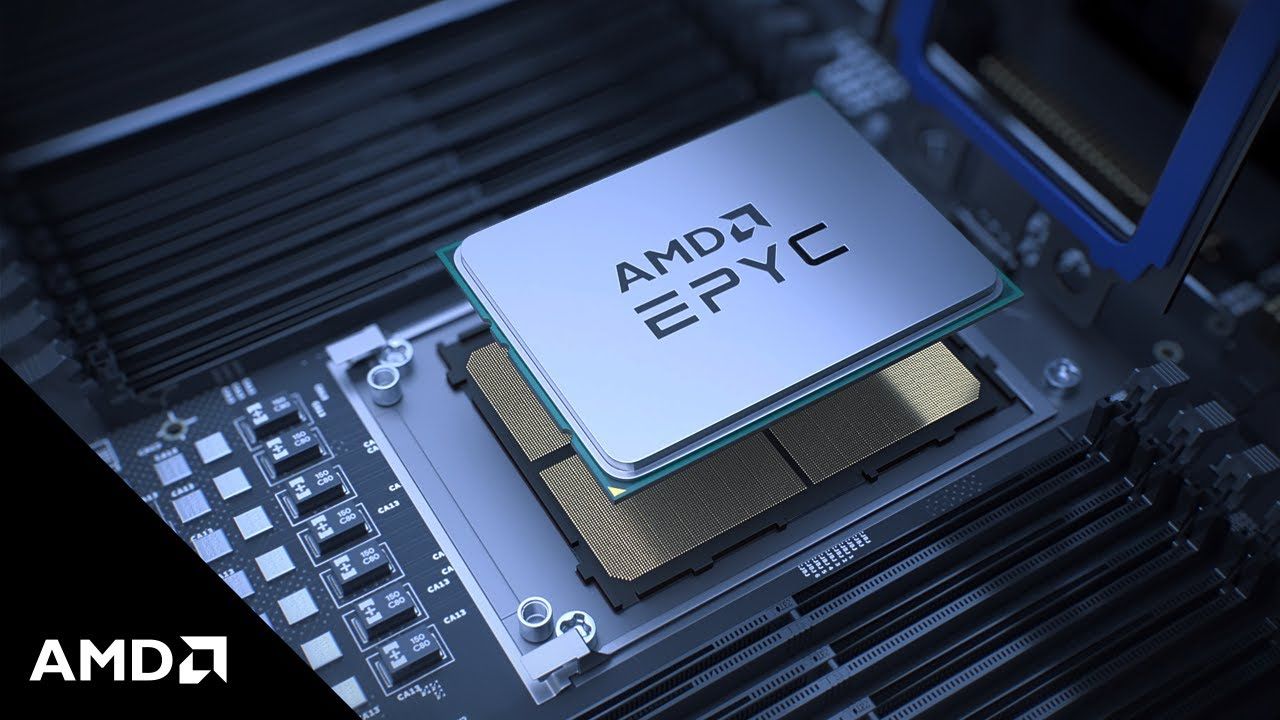
For the first time ever, AMD outsells Intel in the datacenter space
But both fall far behind sales of Nvidia
Tom
499 points · by baal80spam · 2y ago · 161 comments
When the Intel 80386-33 came out we thought it was the pinnacle of CPUs, running our Novell servers! We now had a justification to switch from arcnet to token ring. Our servers could push things way faster!
Then, in the middle 1991, the AMD 80386-40 CPU came out. Mind completely blown! We ordered some (I think) Twinhead motherboards. They were so fast we could only use Hercules mono cards in them; all other video cards were fried. 16Mb token ring was out, so some of my clients moved to it with the fantastic CPU.
I have seen some closet-servers running Novell NetWare 3.14 (?) with that AMD CPU in the late '90s. There was a QUIC tape & tape drive in the machine that was never changed for maybe a decade? The machine never went down (or properly backed up).
> While the AM386 CPU was essentially ready to be released prior to 1991, Intel kept it tied up in court.[2] Intel learned of the Am386 when both companies hired employees with the same name who coincidentally stayed at the same hotel, which accidentally forwarded a package for AMD to Intel's employee.[3]
After all, it sounds like they directly caused a "billion dollar" type of problem for AMD through their mistake.
That's amazing!
I once had a bloke writing a patch for eDirectory in real time in his basement whilst running our data on his home lab gear, on a weekend. I'm in the UK and he was in Utah. He'd upload an effort and I'd ftp it down, put it in place, reboot the cluster and test. Two iterations and job done. That was quite impressive support for a customer with roughly 5,000 users.
For me the CPU wasn't that important, per se. NWFS ate RAM: when the volumes were mounted, the system generated all sorts of funky caches which meant that you could apply and use trustee assignments (ACLs) really fast. The RAID controller and the discs were the important thing for file serving and ideally you had wires, switches and NICs to dole the data out at a reasonable rate.
Don't look too closely at the collision avoidance mechanism in 10base-T1S, standardized in 2020. Sure looks like a virtual token ring passing mechanism if you squint...
Good luck doing that on a load balanced rack of 96 core AMD servers today.
SIP hasn't gotten much heavier, nor CGI scripts, and tiny distros like OpenWRT can do a lot with little iron.
Heard lots of rough ADSL era VoIP stories, hopefully you weren't struggling with that back then.
Intel should be focused on an x86+RISC-V hybrid chip design where they can control an upcoming ecosystem while also offering a migration path for businesses that will pay the bills for decades to come.
But having worked with Intel on some of those SoCs, it's everything else that fell down. They were late, they were the "disfavored" teams by execs, they were the engineer's last priority, they had stupid hw bugs they refused to fix and respin, they were everything you could do to set up a project to fail.
First I've heard of this. Is this actually a possibility?
Even if it was hard to foresee the success of the iPhone, he surely had the Core Duo in his hands when this happened even if it didn't launch yet so the company just found its footing again and they should've attempted this moonshot: if the volume is low, the losses are low. If the volume is high then economies of scale will make it a win. This is not hindsight 20/20, this is true even if no one could've foreseen just how high the volume would've been.
Apple doesn't matter beyond its 10% market share, they don't target servers any more.
Ampere is a step away to be fully owned by Oracle, I bet most HN ARM cheering crowd is blessifuly unaware of it.
Graviton is only relevant for AWS customers.
Maybe Pat has lit the much needed fire under them.
> Future Intel generations of chips, including Panther Lake and Nova Lake, won’t have baked-on memory. “It’s not a good way to run the business, so it really is for us a one-off with Lunar Lake,” said Gelsinger on Intel’s Q3 2024 earnings call, as spotted by VideoCardz.[0]
[0]: https://www.theverge.com/2024/11/1/24285513/intel-ceo-lunar-...
When you prioritize yourself (way to run the business) over delivering what customers want you're finished. Some companies can get that wrong for a long time, but Intel has a competitor giving the customers much more of what they want. I want a great chip and honestly don't know, care, or give a fuck what's best for Intel.
A dying platform and as relevant as VAX/VMS going forward.
Unfortunately for Intel, X Elite was a bad CPU that has been fixed with Snapdragon 8 Elite's update. The core uses a tiny fraction of the power of X Elite (way less than the N3 node shrink would offer). The core also got a bigger frontend and a few other changes which seem to have updated IPC.
Qualcomm said they are leading in performance per area and I believe it is true. Lunar Lake's P-core is over 2x as large (2.2mm2 vs 4.5mm2) and Zen5 is nearly 2x as large too at 4.2mm2 (Even Zen5c is massively bigger at 3.1mm2).
X Elite 2 will either be launching with 8 Elite's core or an even better variant and it'll be launching quite a while before Panther Lake.
And also, they compete in the same price bracket as Zen 5, which are more performant with not that much worse battery life.
LNL is too little too late.
[0] https://www.bestbuy.com/site/asus-vivobook-s-14-14-oled-lapt...
We will see whatever they come out with for 17th gen onwards, but for now Intel needs to fucking pay back their CHIPS money.
AMD is IME more finicky with RAM, chipset / UEFI / builtin peripheral controller quality and so on. Not prohibitively so, but it's more work to get an AMD build to run great.
No trouble with any AMD or Intel Thinkpad T models, Lenovo has taken care of that.
Is it? I presume that a large chunk of the AMD's $3.5B is MI3XX chips, and very little of Intel's $3.5B is AI, so doesn't that mean that Xeon likely still substantially outsells EPYC?
This may be in the cards.
The good news is that AMD has, finally, mostly achieved that, and in some ways they are now superior. But that has taken time: far longer than it took AMD to beat Intel at benchmarks.
The public clouds help a lot here by trivializing testing and locking in enough volume to get all of the basic stuff supported, and I think that’s why AMD was more successful now than they were in the Opteron era.
On the other hand AMD has been very conservative with their EPYC sales and forecast.
Maybe recent EPYC had caught up? I haven't been following too closely since it hasn't mattered to me. But both companies were suggesting an AMD pass by.
Not surprising at all though, anyone who's been following roadmaps knew it was only a matter of time. AMD is /hungry/.
No, not its not even close. AMD is miles ahead.
This is a Phoronix review for Turin (current generation): https://www.phoronix.com/review/amd-epyc-9965-9755-benchmark...
You can similarly search for phoronix reviews for the Genoa, Bergamo, and Milan generations (the last two generations).
AMD is still going to win a lot of the time, but Intel is better than it seems.
Intel has just been removed from the Dow index. They are under performing on multiple levels
https://apnews.com/article/dow-intel-nvidia-sherwinwilliams-...
this is one of those things where there's a lot of money on the line, and people are willing to do the math.
the fact that it took this long should tell you everything you need to know about the reality of the situation
https://www.ebay.com/itm/235469964291
Best start believin' in the crazy cyberpunk stories. You're in one!
edit: legally that is, assuming there's even enough demand for these tools for anyone to bother cracking them
Where are they pulling those PCB chunks from that have cheap Ultrascale+ chips?
That's not how it works. You need to pump money into fabs to get them working, and Intel doesn't have money. If AMD had fabs to light up their money, they would also have a much lower valuation.
The market is completely irrational on AMD. Their 52-week high is ~225$ and 52-week low is ~90$. 225$ was hit when AMD was guiding ~3.5B in datacenter GPU revenue. Now, they're guiding to end the year at 5B+ datacenter GPU revenue, but the stock is ~140$?
I think it's because of how early Nvidia announced Blackwell (it isn't any meaningful volume yet), and the market thinks AMD needs to compete with GB200 while they're actually competing with H200 this quarter. And for whatever reason the market thinks that AMD will get zero AI growth next year? I don't know how to explain the stock price.
Anyway, they hit record quarterly revenue this Q3 and are guiding to beat this record by ~1B next quarter. Price might move a lot based on how AMD guides for Q1 2025.
Being fabless does have an impact because it caps AMD's margins and makes x86 their only moat. They can only extract value if they remain competitive on price. Sure that does not impact Nvidia, but they get to have fat margins because they have virtually no competition.
> The market is completely irrational on AMD. Their 52-week high is ~225$ and 52-week low is ~90$.
That's volatility not irrationality. As I wrote AMD's valuation is built on the basis that they will keep executing in the DC space, Intel will keep shitting the bed and their MI series will eventually be competitive with Nvidia. These facts make investor skittish and any news about AMD causes the stock to move.
> the market thinks AMD needs to compete with GB200 while they're actually competing with H200 this quarter. And for whatever reason the market thinks that AMD will get zero AI growth next year?
The only hyperscaler that picked up MI300X is Azure and they GA'ed it 2 weeks ago, both GCP and Azure are holding off. The uncertainty on when (if) it will catch on is a factor but the growing competition from those same hyperscaler building their own chip means that the opportunity window could be closing.
It's ok to be bullish on AMD the same way that I am bearish on it, but I would maintain that the swings have nothing to do with irrationality.
Many "influencers" have been convinced that: it is all about software - especially in AI. (I happen to agree, but my opinion doesn't matter).
It doesn't matter how well a company is doing if they are targeting the wrong point - their future will be grim. And stock is all about the future.
If I were AMD CEO I would make the top priority to have a software stack on par with CUDA so that AMD GPUs have a chance in the data centers.
Everyone I think knew AMD is catching up but thought this was still a year or two out